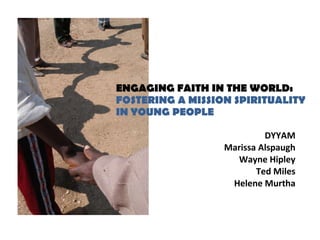
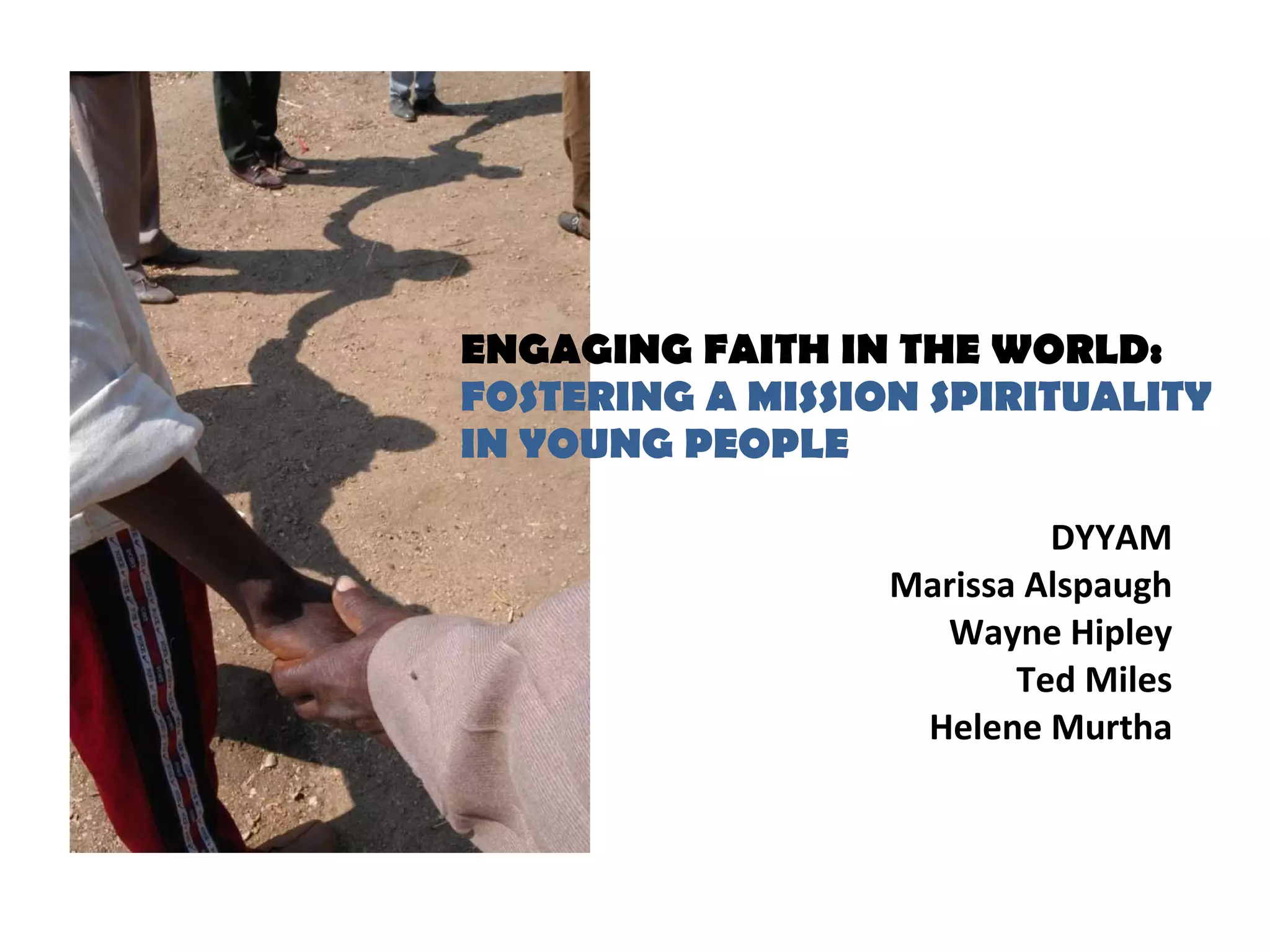
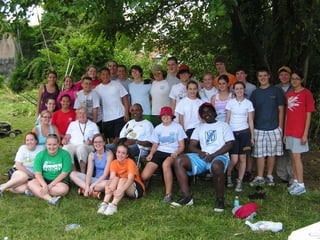
ENGAGING FAITH IN THE WORLD:  FOSTERING A MISSION SPIRITUALITY  IN YOUNG PEOPLE  DYYAM Marissa Alspaugh Wayne Hipley Ted Miles Helene Murtha
 
INTRODUCTIONS
Goals for our Gathering: To think together about what it means to sent in mission  … hold a faith life that is both personal and social (MISSION). To explore a model that can help lead young people to a sense of mission as rooted in our Catholic Social Tradition. To share resources and ideas that enhance service learning models appropriate for Catholic education and youth ministry
 
 
Find someone in the room with the same item on his/her nametag.  Introduce yourself by the significant relationships in your life. Because we are so much more than what we  DO .
 
 
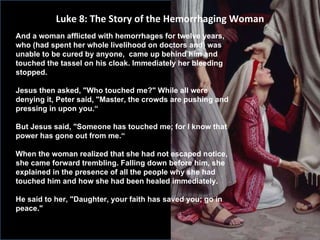
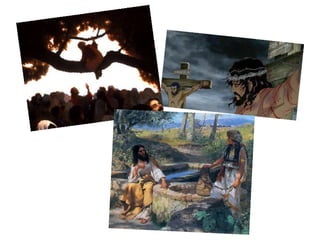
Luke 8: The Story of the Hemorrhaging Woman And a woman afflicted with hemorrhages for twelve years, who (had spent her whole livelihood on doctors and) was unable to be cured by anyone,  came up behind him and touched the tassel on his cloak. Immediately her bleeding stopped.  Jesus then asked, "Who touched me?" While all were denying it, Peter said, "Master, the crowds are pushing and pressing in upon you.“  But Jesus said, "Someone has touched me; for I know that power has gone out from me.“  When the woman realized that she had not escaped notice, she came forward trembling. Falling down before him, she explained in the presence of all the people why she had touched him and how she had been healed immediately.  He said to her, "Daughter, your faith has saved you; go in peace."
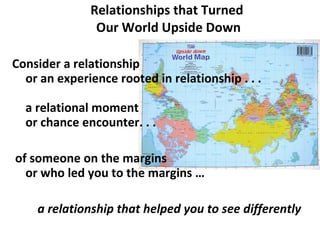
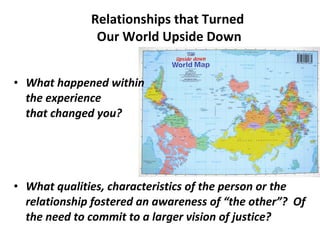
Relationships that Turned  Our World Upside Down Consider a relationship  or an experience rooted in relationship . . . a relational moment  or chance encounter. . . of someone on the margins  or who led you to the margins … a relationship that helped you to see differently
Relationships that Turned  Our World Upside Down What happened within  the experience  that changed you? What qualities, characteristics of the person or the relationship fostered an awareness of “the other”?  Of the need to commit to a larger vision of justice?
Has its origin in our understanding … experience of God Communitarian Involved & Inviting LOVE Engenders a deepening experience of God through our response/commitment to love Fosters a new way of  seeing  and  living  that empowers us to  cross “boundaries”  …  a lifelong response & commitment  … discipleship
Discipleship … Jesus Christ Jesus: Reign of God  (letting no one be anonymous) Giving away of self,  compassion, & opening of arms  - vulnerability Abundant Life
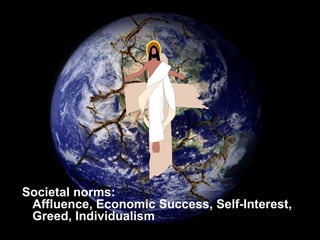
Societal norms:    Affluence, Economic Success, Self-Interest,   Greed, Individualism
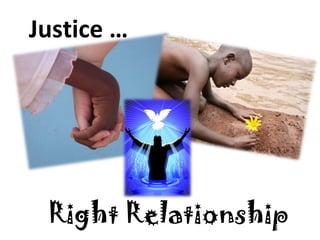
Justice … Right Relationship
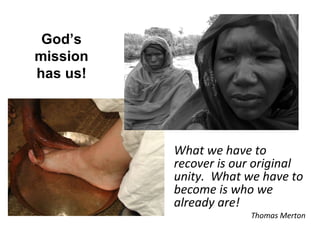
What we have to recover is our original unity.  What we have to become is who we already are!  Thomas Merton God’s mission has us!
How do you connect young people with the sense of mission  that our Church upholds  through service opportunities? What might I need to re-consider that would foster a deeper sense of mission?
Look Closely Look Critically
Look Closely Read the scenario provided to your group. Scenarios have been distributed randomly, and may or may not be similar to an experience with which someone in your group  has been connected Try to refrain from assessing the scenario or “filling in blanks”
Look Critically Our next session will allow us to break open the Pastoral Circle. As the components of each stage of the Pastoral Circle are presented, critique the service scenario in light of the particular stage of the Pastoral Circle.  Each group should identify one member to record the group’s critique for the four stages of the Pastoral Circle.
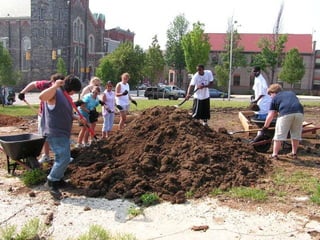
Why? The value of Experiential Learning is the experience, the doing. Working together allows us to be companions to one another on this particular journey. Working together allows us to share Best Practices. Working together reminds us that none of us is as smart as all of us.


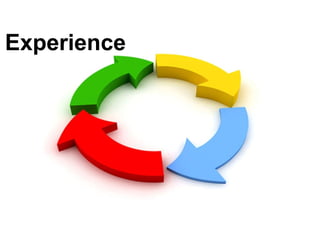
Experience
 
Do not conform to the pattern of the world, but be transformed by the renewing of your mind. (Romans 12:2)


How does our service opportunity integrate relational experience? What is “missing” from our  service projects that  could have taken them to the next level? What can I do - or should have done –  to make our service opportunity  more relational?
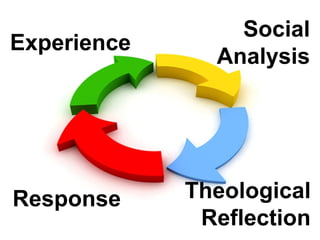
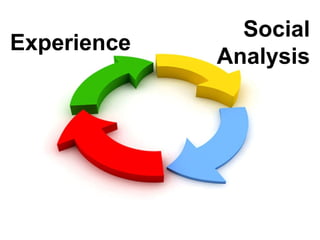
Experience Social Analysis
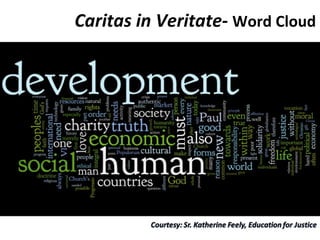
Caritas in Veritate-   Word Cloud
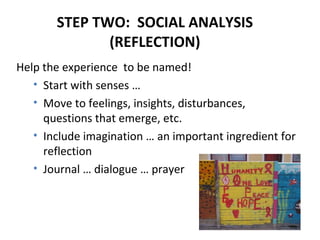
STEP TWO:  SOCIAL ANALYSIS (REFLECTION) Help the experience  to be named! Start with senses … Move to feelings, insights, disturbances, questions that emerge, etc. Include imagination … an important ingredient for reflection Journal … dialogue … prayer
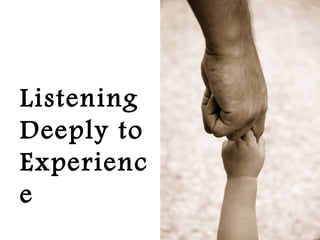
Listening Deeply to Experience
Analyze Perspectives
Identify Power … and Its Uses “ In every community there is work to be done.  In every nation there are wounds to heal.  In every heart there is the power to do it.” - Marianne Williamson
Step Two:  Social Analysis Establish the Context  & Content The set of circumstances or facts that surround a particular event, situation  The who, what, where, when, why and how? Substantive information Develop Critical Thinking Skills Understanding personal assumptions and biases What are the root causes? Where do you see connections? What if…?
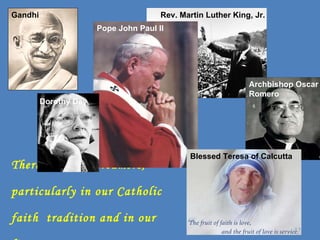
There still   are dreamers, particularly in our Catholic faith  tradition and in our lives. Gandhi Rev. Martin Luther King, Jr. Pope John Paul II Dorothy Day Archbishop Oscar  Romero Blessed Teresa of Calcutta
How does our service opportunity integrate social analysis? How can social analysis / reflection be better integrated into our service opportunities?
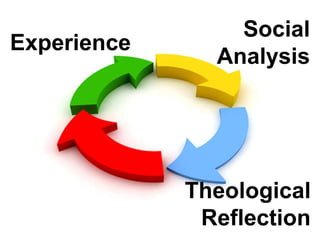
Experience Social Analysis Theological Reflection
Theological Reflection “ And the Grinch with his Grinch feet ice cold in the snow,  stood puzzling and puzzling:  ‘How could it be so? ’…And he puzzled three hours till his puzzler was sore.   Then  the Grinch thought of something he hadn’t before.
Reflection Good life skill Significant when an experience cannot be  explained using previous “frameworks” Experience  Cognitive Dissonance   Know  Cognitive Dissonance  creates a need, and an opportunity for assistance and encouragement with the reflection process  Often too easy to avoid the dissonance, for all
Critical Reflection “ Critical Reflection is a process specifically structured to help examine the frameworks that we use to interpret experience; critical reflection pushes us to step outside of the old and familiar and to reframe our questions and our conclusions in innovative and more effective ways.” A Practioner’s Guide to Reflection in Service Learning  Student Voices and Reflections  Janet Eyler, Dwight E. Giles Jr. , Angela Schmiede
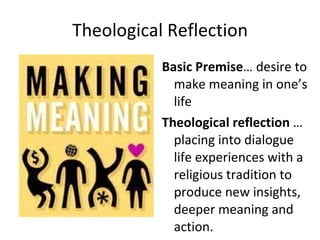
Theological Reflection Basic Premise … desire to make meaning in one’s life Theological reflection  … placing into dialogue life experiences with a religious tradition to produce new insights, deeper meaning and action.
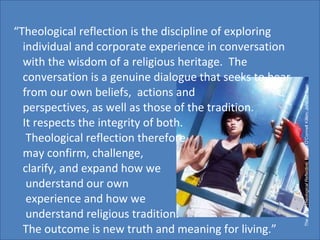
“ Theological reflection is the discipline of exploring  individual and corporate experience  in conversation with the wisdom of a  religious heritage .  The conversation is a genuine  dialogue  that seeks to hear from  our own beliefs,  actions and  perspectives, as well as those of the tradition .  It respects the integrity of both.   Theological reflection therefore  may confirm, challenge,  clarify, and  expand how we  understand our own  experience and how we  understand religious tradition .  The outcome is  new truth and meaning for living .” The Art of Theological Reflection;  Patricia O’Connell Killen; John de Beer
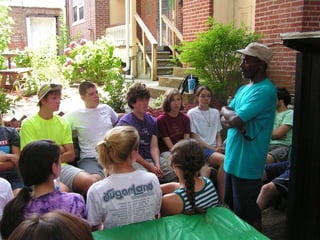
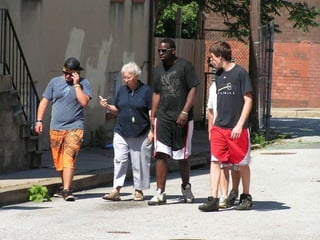
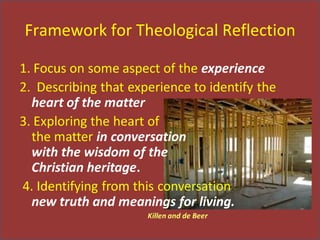
Framework for Theological Reflection
Suggested Steps for  Theological Reflection Identify root elements of experience Pray Develop specific questions connecting experience with a Christian Community response Explore scripture, church documents relevant to the theme of reflection After prayerful reading of scripture, church documents, ask questions about situation (this can be done in many ways, as a group, through journaling) What reinforces gospel values, social teachings What undercuts, destroys, these values and/or teachings Where is Jesus present here What is grace in this situation as an opening up to God
Suggested Steps for Theological Reflection Include questions about scripture, church teachings ,or other relevant documents In the real world is it possible to put Christian teaching into practice? What more do I need to know about scripture and church teachings? Include questions about church structure and practice What is the role of the church here; the role of the laity? What is the place of sacraments? What “spirituality” is appropriate here?
Suggested Steps for Theological Reflection Prayerfully discern or identify some of the significant sharings and or learnings Pray for strength to move into the decisions and actions which are called for by the social analysis and theological reflection of the experience  Joe Holland Peter Henriot, S.J. Social Analysis Linking Faith and Justice
Four C’s of Critical Reflection Continuous …ongoing part of student’s learning and service involvement Connected …to the intellectual, academic( and  spiritual) pursuits of students Challenging …engage students in a critical manner, ask the hard, unfamiliar, uncomfortable questions Contextualized …appropriate for the setting and context of experience.    Eyler, Giles, Schmiede
How does our service opportunity integrate theological reflection? How can theological reflection be better integrated into our service opportunities?


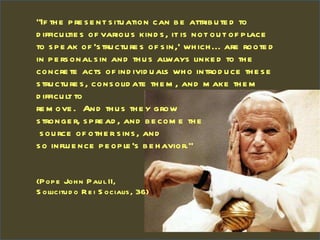
"If the present situation can be attributed to difficulties of various kinds, it is not out of place to speak of ‘structures of sin,’ which... are rooted in personal sin and thus always linked to the concrete acts of individuals who introduce these structures, consolidate them, and make them difficult to  remove.  And thus they grow  stronger, spread, and become the  source of other sins, and  so influence people's behavior." (Pope John Paul II,  Sollicitudo Rei Socialis, 36)
 
 
Experience Social Analysis Theological Reflection Response
 
“ Charity calls forth a generous response from individuals; justice requires concerted communal action to transform institutional policies, societal laws, or unjust social situations... Transformative action gets at the root causes; it does not stop at alleviating the symptoms.” (In the Footsteps of Jesus: Catholic Social Teaching at Work Today, United States Conference of Catholic Bishops)
“ To this you were called, because Christ suffered for you, leaving you an example, that you should follow in his steps.” (1 Peter 2:21)
In the context of the service project we already do,  how can we make our response  one that is meaningful  and addresses the root cause of problems in our society? What makes our responses uniquely Catholic?
“ Transformers, more than meets the eye!”
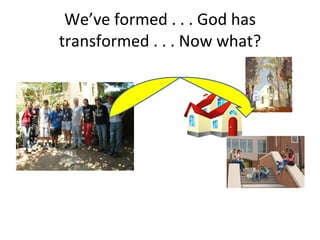
We’ve formed . . . God has transformed . . . Now what?
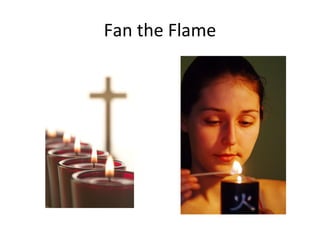
Fan the Flame
“ The role of education is much more profound than merely the process of imparting facts, broadening knowledge, or developing skills needed for functioning in the world.  At the  heart  of education, what we really do is  awaken  in [others] an awareness of God’s presence within them and around them so that through the  exercise of their God-given gifts and talents , they may become the  persons they are intended to be for the benefit of the wider world .  There is no higher calling.”  Katherine Feely SND  “ Engaging Faith in the World: Exploring Catholic Social Teaching and Global Solidarity”
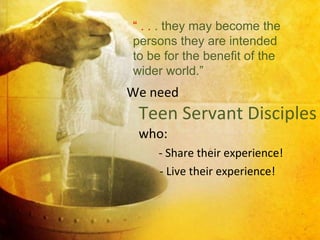
We need  Teen Servant Disciples  who: - Share their experience! - Live their experience! - Intentionally Serve! “  . .  . they may become the persons they are intended to be for the benefit of the wider world.”
Language At Home At the Parish Taking the message where we can’t go . . . What can we do to help our young people SHARE their experience?

Youth contact Scottedits

  • 1.
    ENGAGING FAITH INTHE WORLD: FOSTERING A MISSION SPIRITUALITY IN YOUNG PEOPLE DYYAM Marissa Alspaugh Wayne Hipley Ted Miles Helene Murtha
  • 2.
  • 3.
  • 4.
    Goals for ourGathering: To think together about what it means to sent in mission … hold a faith life that is both personal and social (MISSION). To explore a model that can help lead young people to a sense of mission as rooted in our Catholic Social Tradition. To share resources and ideas that enhance service learning models appropriate for Catholic education and youth ministry
  • 5.
  • 6.
  • 7.
    Find someone inthe room with the same item on his/her nametag. Introduce yourself by the significant relationships in your life. Because we are so much more than what we DO .
  • 8.
  • 9.
  • 10.
    Luke 8: TheStory of the Hemorrhaging Woman And a woman afflicted with hemorrhages for twelve years, who (had spent her whole livelihood on doctors and) was unable to be cured by anyone, came up behind him and touched the tassel on his cloak. Immediately her bleeding stopped. Jesus then asked, "Who touched me?" While all were denying it, Peter said, "Master, the crowds are pushing and pressing in upon you.“ But Jesus said, "Someone has touched me; for I know that power has gone out from me.“ When the woman realized that she had not escaped notice, she came forward trembling. Falling down before him, she explained in the presence of all the people why she had touched him and how she had been healed immediately. He said to her, "Daughter, your faith has saved you; go in peace."
  • 11.
    Relationships that Turned Our World Upside Down Consider a relationship or an experience rooted in relationship . . . a relational moment or chance encounter. . . of someone on the margins or who led you to the margins … a relationship that helped you to see differently
  • 12.
    Relationships that Turned Our World Upside Down What happened within the experience that changed you? What qualities, characteristics of the person or the relationship fostered an awareness of “the other”? Of the need to commit to a larger vision of justice?
  • 13.
    Has its originin our understanding … experience of God Communitarian Involved & Inviting LOVE Engenders a deepening experience of God through our response/commitment to love Fosters a new way of seeing and living that empowers us to cross “boundaries” … a lifelong response & commitment … discipleship
  • 14.
    Discipleship … JesusChrist Jesus: Reign of God (letting no one be anonymous) Giving away of self, compassion, & opening of arms - vulnerability Abundant Life
  • 15.
    Societal norms: Affluence, Economic Success, Self-Interest, Greed, Individualism
  • 16.
    Justice … RightRelationship
  • 17.
    What we haveto recover is our original unity. What we have to become is who we already are! Thomas Merton God’s mission has us!
  • 18.
    How do youconnect young people with the sense of mission that our Church upholds through service opportunities? What might I need to re-consider that would foster a deeper sense of mission?
  • 19.
  • 20.
    Look Closely Readthe scenario provided to your group. Scenarios have been distributed randomly, and may or may not be similar to an experience with which someone in your group has been connected Try to refrain from assessing the scenario or “filling in blanks”
  • 21.
    Look Critically Ournext session will allow us to break open the Pastoral Circle. As the components of each stage of the Pastoral Circle are presented, critique the service scenario in light of the particular stage of the Pastoral Circle. Each group should identify one member to record the group’s critique for the four stages of the Pastoral Circle.
  • 22.
    Why? The valueof Experiential Learning is the experience, the doing. Working together allows us to be companions to one another on this particular journey. Working together allows us to share Best Practices. Working together reminds us that none of us is as smart as all of us.
  • 23.
  • 24.
  • 25.
  • 26.
  • 27.
  • 28.
  • 29.
  • 30.
  • 31.
  • 32.
  • 33.
    Do not conformto the pattern of the world, but be transformed by the renewing of your mind. (Romans 12:2)
  • 34.
  • 35.
  • 36.
  • 37.
  • 38.
  • 39.
    How does ourservice opportunity integrate relational experience? What is “missing” from our service projects that could have taken them to the next level? What can I do - or should have done – to make our service opportunity more relational?
  • 40.
  • 41.
  • 42.
    STEP TWO: SOCIAL ANALYSIS (REFLECTION) Help the experience to be named! Start with senses … Move to feelings, insights, disturbances, questions that emerge, etc. Include imagination … an important ingredient for reflection Journal … dialogue … prayer
  • 43.
  • 44.
  • 45.
    Identify Power …and Its Uses “ In every community there is work to be done. In every nation there are wounds to heal. In every heart there is the power to do it.” - Marianne Williamson
  • 46.
    Step Two: Social Analysis Establish the Context & Content The set of circumstances or facts that surround a particular event, situation The who, what, where, when, why and how? Substantive information Develop Critical Thinking Skills Understanding personal assumptions and biases What are the root causes? Where do you see connections? What if…?
  • 47.
    There still are dreamers, particularly in our Catholic faith tradition and in our lives. Gandhi Rev. Martin Luther King, Jr. Pope John Paul II Dorothy Day Archbishop Oscar Romero Blessed Teresa of Calcutta
  • 48.
    How does ourservice opportunity integrate social analysis? How can social analysis / reflection be better integrated into our service opportunities?
  • 49.
    Experience Social AnalysisTheological Reflection
  • 50.
    Theological Reflection “And the Grinch with his Grinch feet ice cold in the snow, stood puzzling and puzzling: ‘How could it be so? ’…And he puzzled three hours till his puzzler was sore. Then the Grinch thought of something he hadn’t before.
  • 51.
    Reflection Good lifeskill Significant when an experience cannot be explained using previous “frameworks” Experience Cognitive Dissonance Know Cognitive Dissonance creates a need, and an opportunity for assistance and encouragement with the reflection process Often too easy to avoid the dissonance, for all
  • 52.
    Critical Reflection “Critical Reflection is a process specifically structured to help examine the frameworks that we use to interpret experience; critical reflection pushes us to step outside of the old and familiar and to reframe our questions and our conclusions in innovative and more effective ways.” A Practioner’s Guide to Reflection in Service Learning Student Voices and Reflections Janet Eyler, Dwight E. Giles Jr. , Angela Schmiede
  • 53.
    Theological Reflection BasicPremise … desire to make meaning in one’s life Theological reflection … placing into dialogue life experiences with a religious tradition to produce new insights, deeper meaning and action.
  • 54.
    “ Theological reflectionis the discipline of exploring individual and corporate experience in conversation with the wisdom of a religious heritage . The conversation is a genuine dialogue that seeks to hear from our own beliefs, actions and perspectives, as well as those of the tradition . It respects the integrity of both. Theological reflection therefore may confirm, challenge, clarify, and expand how we understand our own experience and how we understand religious tradition . The outcome is new truth and meaning for living .” The Art of Theological Reflection; Patricia O’Connell Killen; John de Beer
  • 55.
  • 56.
    Suggested Steps for Theological Reflection Identify root elements of experience Pray Develop specific questions connecting experience with a Christian Community response Explore scripture, church documents relevant to the theme of reflection After prayerful reading of scripture, church documents, ask questions about situation (this can be done in many ways, as a group, through journaling) What reinforces gospel values, social teachings What undercuts, destroys, these values and/or teachings Where is Jesus present here What is grace in this situation as an opening up to God
  • 57.
    Suggested Steps forTheological Reflection Include questions about scripture, church teachings ,or other relevant documents In the real world is it possible to put Christian teaching into practice? What more do I need to know about scripture and church teachings? Include questions about church structure and practice What is the role of the church here; the role of the laity? What is the place of sacraments? What “spirituality” is appropriate here?
  • 58.
    Suggested Steps forTheological Reflection Prayerfully discern or identify some of the significant sharings and or learnings Pray for strength to move into the decisions and actions which are called for by the social analysis and theological reflection of the experience Joe Holland Peter Henriot, S.J. Social Analysis Linking Faith and Justice
  • 59.
    Four C’s ofCritical Reflection Continuous …ongoing part of student’s learning and service involvement Connected …to the intellectual, academic( and spiritual) pursuits of students Challenging …engage students in a critical manner, ask the hard, unfamiliar, uncomfortable questions Contextualized …appropriate for the setting and context of experience. Eyler, Giles, Schmiede
  • 60.
    How does ourservice opportunity integrate theological reflection? How can theological reflection be better integrated into our service opportunities?
  • 61.
  • 62.
  • 63.
  • 64.
    "If the presentsituation can be attributed to difficulties of various kinds, it is not out of place to speak of ‘structures of sin,’ which... are rooted in personal sin and thus always linked to the concrete acts of individuals who introduce these structures, consolidate them, and make them difficult to remove. And thus they grow stronger, spread, and become the source of other sins, and so influence people's behavior." (Pope John Paul II, Sollicitudo Rei Socialis, 36)
  • 65.
  • 66.
  • 67.
    Experience Social AnalysisTheological Reflection Response
  • 68.
  • 69.
    “ Charity callsforth a generous response from individuals; justice requires concerted communal action to transform institutional policies, societal laws, or unjust social situations... Transformative action gets at the root causes; it does not stop at alleviating the symptoms.” (In the Footsteps of Jesus: Catholic Social Teaching at Work Today, United States Conference of Catholic Bishops)
  • 70.
    “ To thisyou were called, because Christ suffered for you, leaving you an example, that you should follow in his steps.” (1 Peter 2:21)
  • 71.
    In the contextof the service project we already do, how can we make our response one that is meaningful and addresses the root cause of problems in our society? What makes our responses uniquely Catholic?
  • 72.
    “ Transformers, morethan meets the eye!”
  • 73.
    We’ve formed .. . God has transformed . . . Now what?
  • 74.
  • 75.
    “ The roleof education is much more profound than merely the process of imparting facts, broadening knowledge, or developing skills needed for functioning in the world. At the heart of education, what we really do is awaken in [others] an awareness of God’s presence within them and around them so that through the exercise of their God-given gifts and talents , they may become the persons they are intended to be for the benefit of the wider world . There is no higher calling.” Katherine Feely SND “ Engaging Faith in the World: Exploring Catholic Social Teaching and Global Solidarity”
  • 76.
    We need Teen Servant Disciples who: - Share their experience! - Live their experience! - Intentionally Serve! “ . . . they may become the persons they are intended to be for the benefit of the wider world.”
  • 77.
    Language At HomeAt the Parish Taking the message where we can’t go . . . What can we do to help our young people SHARE their experience?

Editor's Notes

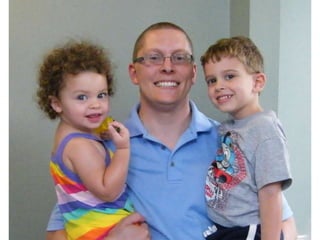
  • #7 Good morning everyone. It is good to be with you. As Scott said earlier, my name is Marissa Alspaugh. For those of you who know me you are aware that I can rarely get through any gathering without bragging about my beautiful family. I am the mother of 2 beautiful children, Michael and Celia. They are a great gift to me from God, and I suppose my husband, Brian had something to do with it as well . . . Most namely my daughter’s blue eyes. I have a small group of girlfriends that I have collected over the years, Christina from elementary school, Ruthann in college, Rachel in graduate school, Jenni as a new mom, and several in my youth ministry world. Each week my family and I are sure to score a free meal or two at our parents’ homes.
  • #8 Now that I’ve introduced myself to all of you. I’d like you to do the same.
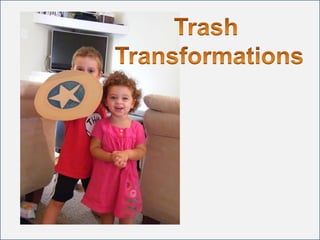
  • #9 Please gather your things and move to sit at the table with the same object as what’s on your nametag. Icebreaker Now back to the item on your table. Each group has a common household item along with a couple ordinary tools to help you with this project (scissors, markers, tape). Using the tools you have before you I’d like you to transform that item into something completely different that serves a different purpose. Items: Egg carton Broom Cardboard box towel/sheet Milk Jug paper towel roll Coffee can Pillow case - By a show of hands how many of you were stumped/challenged at first? - How many of you thought this was fun/challenging? Children are masters at this. Taking an everyday item and transforming it into something else. I have the pleasure of watching my two children do this daily. Just a couple weeks ago my son and I transformed a Nike shoe box into a Captain America shield. I didn’t see a super hero shield when I looked at this box but my son did. It seems that as we get older we train our minds to compute the proper usage for each item. Everything has its place. Certain things are done a certain way. I bring this up because what we’re striving to do today is take something very common place to all of us – service and look at it in a different light. So I hope that you will carry these two themes with you throughout the rest of the day: Relational & Transformational service.
  • #11 ted
  • #12 ted
  • #13 ted
  • #14 ted
  • #15 ted
  • #16 ted
  • #17 ted
  • #18 ted
  • #19 ted
  • #20 Helene … scenarios distributed
  • #21 Helene
  • #22 Helene
  • #23 Helene
  • #24 Wayne … transformation
  • #25 Wayne
  • #26 Wayne
  • #27 Wayne
  • #28 Wayne
  • #29 Wayne
  • #30 Wayne
  • #31 Wayne
  • #32 Wayne
  • #33 Wayne
  • #34 Wayne
  • #35 Wayne
  • #36 Wayne
  • #37 Wayne
  • #38 Wayne
  • #39 Wayne
  • #40 Wayne
  • #41 Ted
  • #42 Ted
  • #43 Ted
  • #44 Ted
  • #47 Explore context and content: Do not skip this step – help them make the connections to their world and that beyond them. Based on your experience, what does it feel like to be homeless? Where are the homeless in your community? Who might feel like an outcast in your community? Begin to make connections to broader issues, other stories, realities of life around those issues – for instance, poverty that leads to immigration, lack of affordable health care that leaves one on the streets, a system that does not support disabled or those with addictions   Social Analysis Critical thinking skills set in –and invite them to make connection Ask the questions why and how to help young people understand the root causes Challenge YP to analyze their assumptions, perceptions, and perspectives – to remove the blinders from their own eyes that creates barriers rather then relationships Identifying power relationships and its uses, and its abuses   Many reflection tools and resources can be consulted to assist with the “how” of analysis. Three key areas to examine include: a) naming the assumptions that are operating, b) analyzing the various perspectives involved in the situation, and c) identifying the various sources of power behind a situation. Carrie at St. Michaels …   Bring God into the picture   We’ve examined the experience on a personal level, through emotion … through reason and social analysis … connecting heart to head   Unless we talk about this in the context of faith, how does the conversion happen – As people of faith, we must examine it through the lens of faith … To see solutions where there appears to be none, requires faith. To commit to seeking those solutions requires hope To build relationships in doing so requires the capacity to love   The stories of faith – as we bring them into the picture – become our stories and they shed light on the very situations that exist today   When we practice the presence of God within our ministries, young people are changed. Pray, Joy, Hope, Unconditional Love – How did they experience Christ in this experience?   How – scripture, church doctrine, teachings, witnesses of faith, prayer Think Global! Act Local! 7/20/2009
  • #48 Ted
  • #49 Ted
  • #50 Helene
  • #51 Helene
  • #52 Helene
  • #53 Helene
  • #54 Helene
  • #55 Helene
  • #56 Helene
  • #60 Helene
  • #61 Helene
  • #63 Wayne
  • #64 Wayne
  • #65 Wayne
  • #66 Wayne
  • #67 Wayne
  • #68 Wayne
  • #69 Wayne
  • #70 Wayne
  • #71 Wayne
  • #72 Wayne
  • #73 It is good to be with you again. Hopefully at this point in the day you are not only feeling physically nourished and satisfied, but are also feeling empowered to bring some new elements into the service you are involved in with your parishes and places of work. Earlier today I spoke about my son Michael. Not only does he love to transform things he is currently obsessed with Transformers. When he introduces himself he says, “Hi I’m Michael. I like Transformers.” Since transformation has been so much a part of our discussion today I thought I’d go back to my 80’s roots and look up some info about Transformers. I discovered that the theme song of the original transformers was, “Transformers more than meets the eye.” At this point in our pastoral circle we hope that both our teens and youth ministers have come to know and experience that service is more than meets the eye. It is more than – a bagged lunch for the homeless, pennies collected for a well in Africa, a freshly painted fence. If we have allowed for those transformational moments – if we have left room for Christ to be present then we are going to be sending teens home to our parishes, families, and communities different – transformed.
  • #74 But . . . do our parents know more than – “Our teens built a house with Habitat.” Does our parish know more than, “We send 6 teens to the soup kitchen every other month.” Do our teenagers know how to tell them that service is “more than meets the eye?” How do we help our teens take the response that Wayne discussed before lunch and bring it back to the “real world.” At this point our teens will feel a dissonance – a tension between the Gospel ideal they just experienced and the real world.
  • #75 Often this is where we sometimes drop the ball. I know that on the way home from a service encounter I’m already making the laundry list of things that need to get done both at home and at work while I have on fire teens sitting in the back seats of my car eager to know the next step– If we stop at this point in our pastoral circle we have transformed – on fire teens with nowhere to go . . . It’s like taking ballroom dancing lessons and then never going out to dance. It doesn’t make sense. Our teens are like these flames on the left. We all know about fire – it needs to be tended, fed. If we let it go it will exstinguish. We all also know that our teens can be like this young lady on the right – they are able to pass on the fire within them to others if they are given the opportunity. Maria This analogy makes me think of one young lady who started in our ministry in her 8 th grade year in the hopes of being able to be confirmed in her 9 th grade year. She was the only teen from the Thurmont area. She didn’t know anyone. All throughout her 8 th grade year she pretty much mangaged to stay invisible. It wasn’t until her parents encouraged her to attend our summer work camp before her 9 th grade year that she became a part of our ministry. Her parents volunteered to come and serve dinner to the work campers one night. They were so impressed by the joy and stories the teens shared and by the transformation that they saw in their daughter that they decided to come to Maria’s worksite the next day and help her paint the walls of a Crisis Pregnancy Center. Since this time Maria has become active in every ministry I can give her. Her mother has returned to Church. She gave a beautifully powerful witness at one of our Edge Nights that included parents about how her daughter, Maria’s witness brought her back to Church. We all know the power and impact our teens can have on the rest of the world if they are given the tools and opporutnity to do so.
  • #76   So what’s next . . . I draw a lot of inspiration from this quote from Katherine Feely who works on Social Justice education. “ The role of education is much more profound than merely the process of imparting facts, broadening knowledge, or developing skills needed for functioning in the world. At the heart of education, what we really do is awaken in [others] an awareness of God’s presence within them and around them so that through the exercise of their God-given gifts and talents, they may become the persons they are intended to be for the benefit of the wider world. There is no higher calling.” Katherine Feely SND “Engaging Faith in the World: Exploring Catholic Social Teaching and Global Solidarity” This quote gets me jazzed because I think it encapsulates the work I want to be a part of. For me there is no higher calling than helping a young person discover Christ, discover their God-given talents and then learn how to exercise all of that in the world to bring about the Kingdom of God.
  • #77 So how do we help our young people become “the persons they are intended to be for the benefit of the wider world.” We need teen servant disciples . . . who are equipped to share and live their experience in the world. So let’s help them do just that.
  • #78 First things first . . . Do our young people have the language to share with their family and friends about their service experience? If they can’t talk about it they’ll struggle to share it. Hopefully we have given them opportunities to practice sharing their experience with each other and that they have also picked up language through the social analysis and theological reflection portions of the pastoral circle so they can accurately express the experience. Once they can talk about it they can take it anywhere. Let’s give them opportunities to share at home and at Church.. . . We’ll come back to what some of the opportunities might look like in a moment. Remember if they feel ready to share their experience they can take it places we can’t go . . . The locker room, FB, and school.
  • #79 Our teens need to put faith into action at the service of others. Let’s make sure they know that service can happen everyday, anywhere by offering them the following: Putting our teens in touch with agencies where they can continue to serve on their own and develop relationships and skills. Identify people in our parish and community who can mentor young people who are ready to make service a part of their life. Teachers, social workers, nurses, doctors, missionaries . . . Connect serving others with their vocational or career path.
  • #81 Helene
  • #83 Ted
  • #85 Add closing slide here for prayer
  • #86 Add closing slide here for prayer
  • #89 Add closing slide here for prayer
  • #90 Add closing slide here for prayer
  • #91 Add closing slide here for prayer
  • #92 Add closing slide here for prayer
  • #93 Add closing slide here for prayer
  • #94 Add closing slide here for prayer
  • #95 Add closing slide here for prayer
  • #96 Add closing slide here for prayer