GCSE Computing: A451Computer Systems & Programming
www.computerscienceuk.com
The CPU
Central Processing Unit
2.
GCSE Computing: A451Computer Systems & Programming
www.computerscienceuk.com
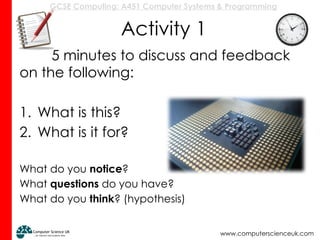
Activity 1
5 minutes to discuss and feedback
on the following:
1. What is this?
2. What is it for?
What do you notice?
What questions do you have?
What do you think? (hypothesis)
3.
GCSE Computing: A451Computer Systems & Programming
www.computerscienceuk.com
The CPU – Central Processing Unit
What is the Purpose of the CPU?
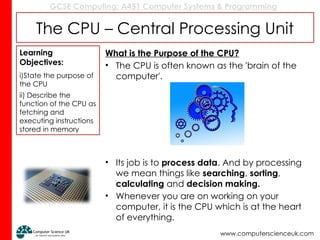
• The CPU is often known as the 'brain of the
computer'.
• Its job is to process data. And by processing
we mean things like searching, sorting,
calculating and decision making.
• Whenever you are on working on your
computer, it is the CPU which is at the heart
of everything.
Learning
Objectives:
i)State the purpose of
the CPU
ii) Describe the
function of the CPU as
fetching and
executing instructions
stored in memory
4.
GCSE Computing: A451Computer Systems & Programming
www.computerscienceuk.com
The CPU – Central Processing Unit
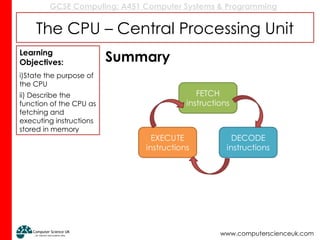
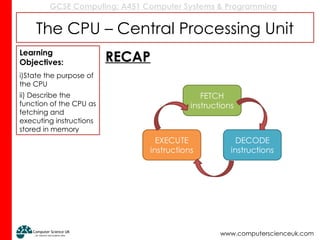
The Fetch-Decode-Execute Cycle
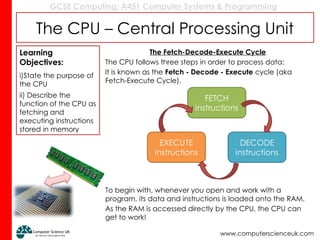
The CPU follows three steps in order to process data:
It is known as the Fetch - Decode - Execute cycle (aka
Fetch-Execute Cycle).
To begin with, whenever you open and work with a
program, its data and instructions is loaded onto the RAM.
As the RAM is accessed directly by the CPU, the CPU can
get to work!
Learning
Objectives:
i)State the purpose of
the CPU
ii) Describe the
function of the CPU as
fetching and
executing instructions
stored in memory
5.
GCSE Computing: A451Computer Systems & Programming
www.computerscienceuk.com
The CPU – Central Processing Unit
The Fetch Stage
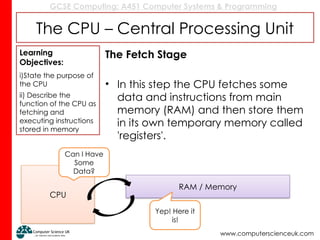
• In this step the CPU fetches some
data and instructions from main
memory (RAM) and then store them
in its own temporary memory called
'registers'.
Learning
Objectives:
i)State the purpose of
the CPU
ii) Describe the
function of the CPU as
fetching and
executing instructions
stored in memory
RAM / Memory
CPU
Can I Have
Some
Data?
Yep! Here it
is!
6.
GCSE Computing: A451Computer Systems & Programming
www.computerscienceuk.com
The CPU – Central Processing Unit
The Fetch Stage - Continued
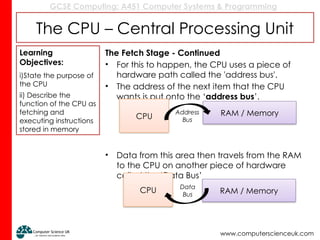
• For this to happen, the CPU uses a piece of
hardware path called the 'address bus'.
• The address of the next item that the CPU
wants is put onto the ‘address bus’.
• Data from this area then travels from the RAM
to the CPU on another piece of hardware
called the ‘Data Bus’
Learning
Objectives:
i)State the purpose of
the CPU
ii) Describe the
function of the CPU as
fetching and
executing instructions
stored in memory
RAM / Memory
CPU
RAM / Memory
CPU
Address
Bus
Data
Bus
7.
GCSE Computing: A451Computer Systems & Programming
www.computerscienceuk.com
The CPU – Central Processing Unit
The Decode Stage
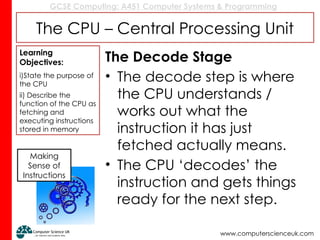
• The decode step is where
the CPU understands /
works out what the
instruction it has just
fetched actually means.
• The CPU ‘decodes’ the
instruction and gets things
ready for the next step.
Learning
Objectives:
i)State the purpose of
the CPU
ii) Describe the
function of the CPU as
fetching and
executing instructions
stored in memory
Making
Sense of
Instructions
8.
GCSE Computing: A451Computer Systems & Programming
www.computerscienceuk.com
The CPU – Central Processing Unit
The Execute Stage
• The Execute stage is where
data processing happens.
• Instructions are carried out
on the data.
• Once a cycle has
completed, another
begins.
Learning
Objectives:
i)State the purpose of
the CPU
ii) Describe the
function of the CPU as
fetching and
executing instructions
stored in memory
9.
GCSE Computing: A451Computer Systems & Programming
www.computerscienceuk.com
The CPU – Central Processing Unit
Summary
Learning
Objectives:
i)State the purpose of
the CPU
ii) Describe the
function of the CPU as
fetching and
executing instructions
stored in memory
10.
GCSE Computing: A451Computer Systems & Programming
www.computerscienceuk.com
Activity 2
10 minutes:
Compete the first activity sheet:
“The stages of the Fetch – Decode –
Execute Cycle”
11.
GCSE Computing: A451Computer Systems & Programming
www.computerscienceuk.com
The CPU – Central Processing Unit
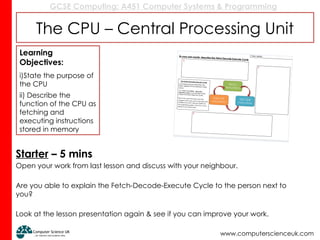
Starter – 5 mins
Open your work from last lesson and discuss with your neighbour.
Are you able to explain the Fetch-Decode-Execute Cycle to the person next to
you?
Look at the lesson presentation again & see if you can improve your work.
Learning
Objectives:
i)State the purpose of
the CPU
ii) Describe the
function of the CPU as
fetching and
executing instructions
stored in memory
12.
GCSE Computing: A451Computer Systems & Programming
www.computerscienceuk.com
The CPU – Central Processing Unit
RECAP
Learning
Objectives:
i)State the purpose of
the CPU
ii) Describe the
function of the CPU as
fetching and
executing instructions
stored in memory
13.
GCSE Computing: A451Computer Systems & Programming
www.computerscienceuk.com
The CPU – Central Processing Unit
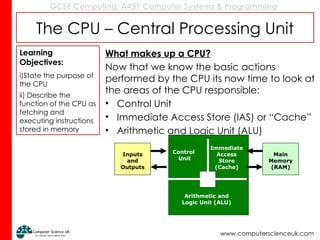
What makes up a CPU?
Now that we know the basic actions
performed by the CPU its now time to look at
the areas of the CPU responsible:
• Control Unit
• Immediate Access Store (IAS) or “Cache”
• Arithmetic and Logic Unit (ALU)
Learning
Objectives:
i)State the purpose of
the CPU
ii) Describe the
function of the CPU as
fetching and
executing instructions
stored in memory
Arithmetic and
Logic Unit (ALU)
Control
Unit
Immediate
Access
Store
(Cache)
Inputs
and
Outputs
Main
Memory
(RAM)
14.
GCSE Computing: A451Computer Systems & Programming
www.computerscienceuk.com
The CPU – Central Processing Unit
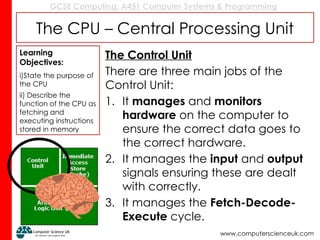
The Control Unit
There are three main jobs of the
Control Unit:
1. It manages and monitors
hardware on the computer to
ensure the correct data goes to
the correct hardware.
2. It manages the input and output
signals ensuring these are dealt
with correctly.
3. It manages the Fetch-Decode-
Execute cycle.
Learning
Objectives:
i)State the purpose of
the CPU
ii) Describe the
function of the CPU as
fetching and
executing instructions
stored in memory
15.
GCSE Computing: A451Computer Systems & Programming
www.computerscienceuk.com
The CPU – Central Processing Unit
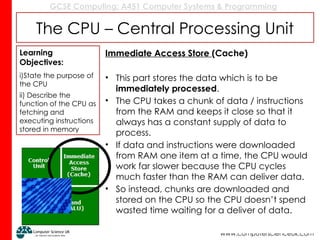
Immediate Access Store (Cache)
• This part stores the data which is to be
immediately processed.
• The CPU takes a chunk of data / instructions
from the RAM and keeps it close so that it
always has a constant supply of data to
process.
• If data and instructions were downloaded
from RAM one item at a time, the CPU would
work far slower because the CPU cycles
much faster than the RAM can deliver data.
• So instead, chunks are downloaded and
stored on the CPU so the CPU doesn’t spend
wasted time waiting for a deliver of data.
Learning
Objectives:
i)State the purpose of
the CPU
ii) Describe the
function of the CPU as
fetching and
executing instructions
stored in memory
16.
GCSE Computing: A451Computer Systems & Programming
www.computerscienceuk.com
The CPU – Central Processing Unit
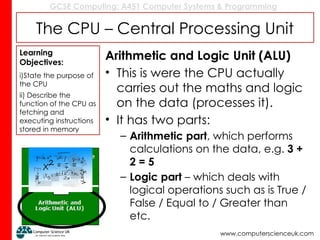
Arithmetic and Logic Unit (ALU)
• This is were the CPU actually
carries out the maths and logic
on the data (processes it).
• It has two parts:
– Arithmetic part, which performs
calculations on the data, e.g. 3 +
2 = 5
– Logic part – which deals with
logical operations such as is True /
False / Equal to / Greater than
etc.
Learning
Objectives:
i)State the purpose of
the CPU
ii) Describe the
function of the CPU as
fetching and
executing instructions
stored in memory
17.
GCSE Computing: A451Computer Systems & Programming
www.computerscienceuk.com
Summary of the CPU
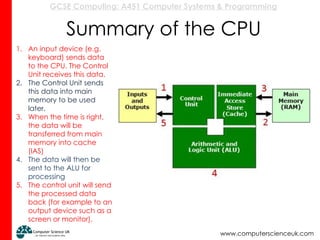
1. An input device (e.g.
keyboard) sends data
to the CPU. The Control
Unit receives this data.
2. The Control Unit sends
this data into main
memory to be used
later.
3. When the time is right,
the data will be
transferred from main
memory into cache
(IAS)
4. The data will then be
sent to the ALU for
processing
5. The control unit will send
the processed data
back (for example to an
output device such as a
screen or monitor).
18.
GCSE Computing: A451Computer Systems & Programming
www.computerscienceuk.com
Activity 3
15 minutes:
Compete the second activity sheet:
“The Journey of Data through the CPU”
19.
GCSE Computing: A451Computer Systems & Programming
www.computerscienceuk.com
The CPU – Central Processing Unit
RECAP
What is the Purpose of the CPU?
• The CPU is known as the 'brain of the computer'.
• Its job is to process data. And by processing we
mean things like searching, sorting, calculating
and decision making.
Can YOU describe the function of the CPU?
• What is the cycle that takes place?
Learning
Objectives:
i)State the purpose of
the CPU
ii) Describe the
function of the CPU as
fetching and
executing instructions
stored in memory