Uncovering modes of evolution: divergent selection vs. genetic drift in species diversificationAnna Kostikova and Nicolas Salamin, DEE, UNIL
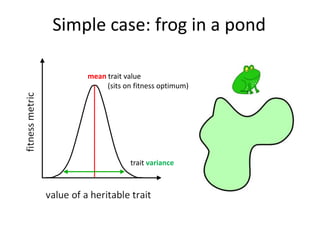
Simple case: frog in a pondmean trait value           (sits on fitness optimum)trait variance
How frogs can speciate with time?We will look at mechanisms(and not at geographic mode or initial events)
Genetic drift and natural selection
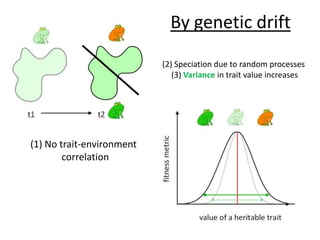
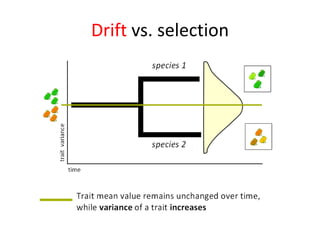
By genetic drift(2) Speciation due to random processes (3) Variance in trait value increases(1) No trait-environment correlation
By natural selection, which is far more complex
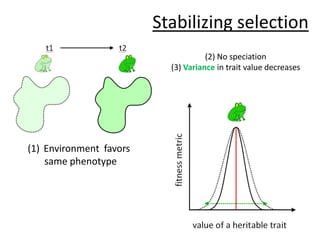
Stabilizing selection(2) No speciation(3) Variance in trait value decreasesEnvironment  favors same phenotype
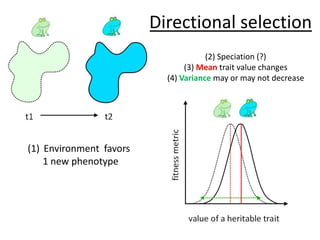
Directional selection(2) Speciation (?)(3) Mean trait value changes(4) Variance may or may not decreaseEnvironment  favors 1 new phenotype
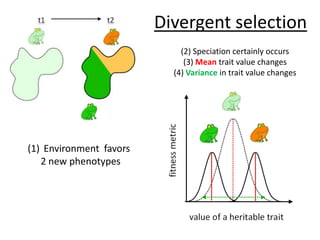
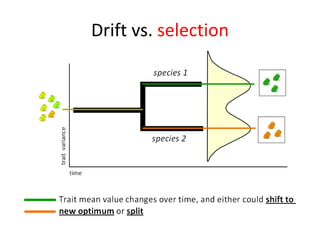
Divergent selection(2) Speciation certainly occurs(3) Mean trait value changes(4) Variance in trait value changesEnvironment  favors 2 new phenotypes
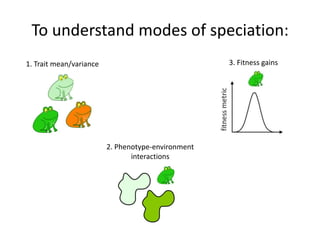
To understand modes of speciation:3. Fitness gains1. Trait mean/variance2. Phenotype-environmentinteractions
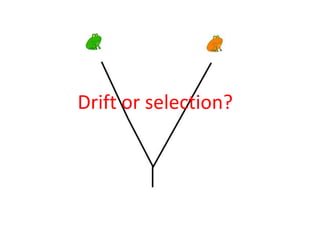
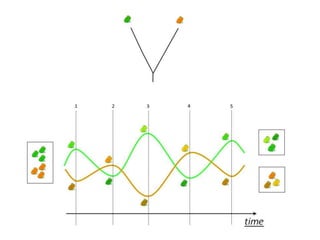
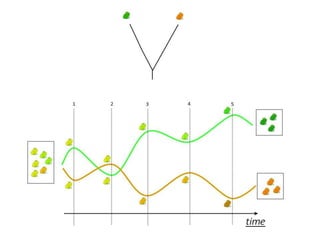
Drift or selection?
Drift vs. selection
Drift vs. selection
Mathematical models
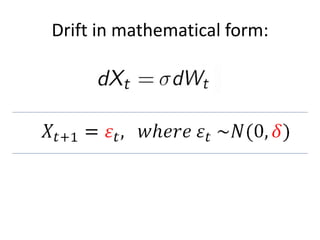
Drift in mathematical form:
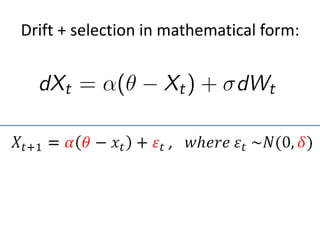
Drift + selection in mathematical form:
In this project:Code (in R) a model of drift+selection (based on Ornstein–Uhlenbeck process) with fixed parameters (              )Develop it further to include parameter optimization with OPTIM package (R)Test on (1) artificial dataset and (2) real dataset of Amolops frogs species
Thanks for attention and I am open to any questions

Uncovering modes of evolution

Editor's Notes

  • #12 Trait mean and variancePhenotype-environment interactionFitness measures