VIVEKANANDA COLLEGE OF NURSING
MICRO-TEACHING
PRESENTED BY- APURVA DWIVEDI [M.Sc. Nsg. 1ST Yr.]
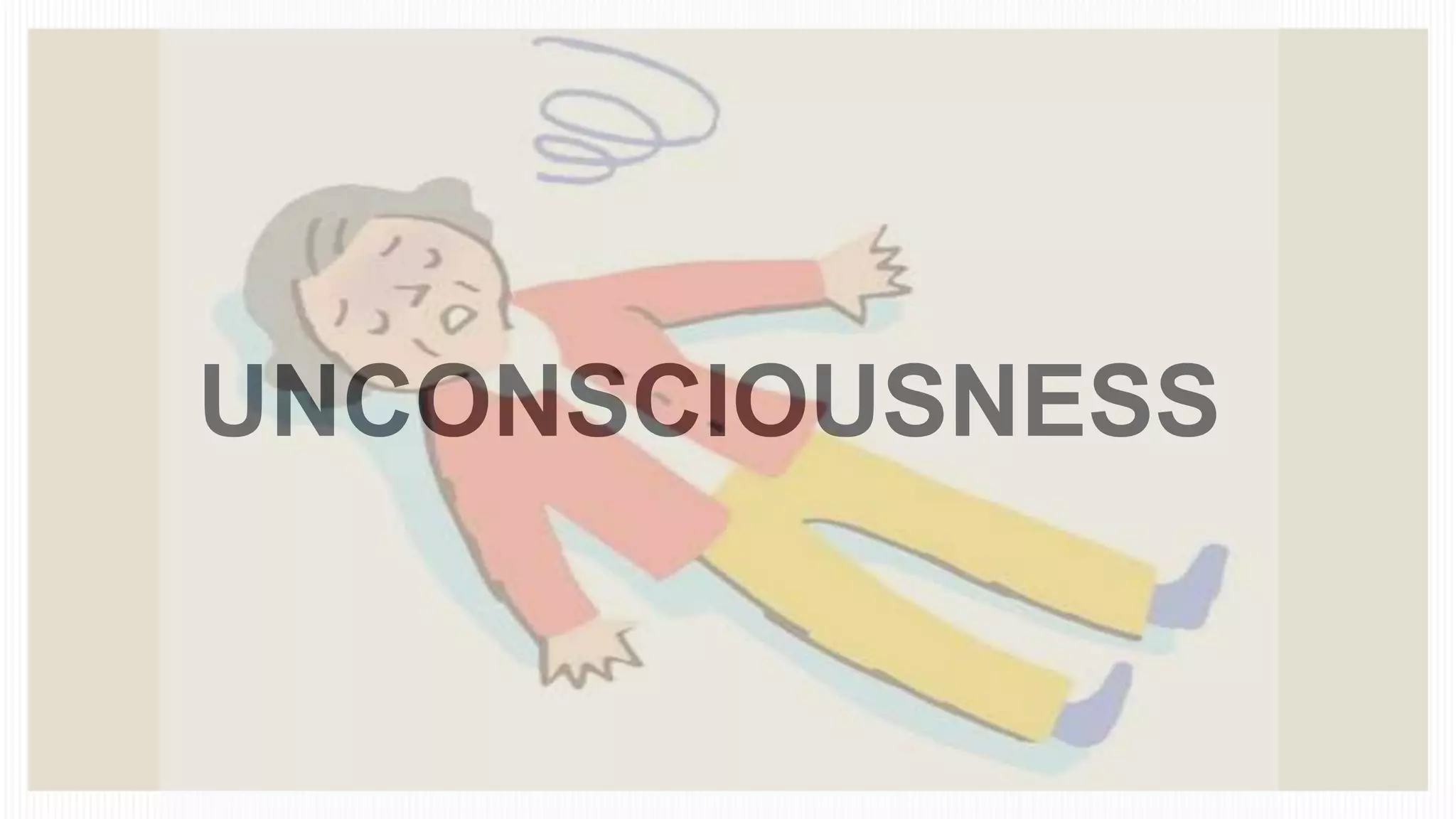
UNCONSCIOUSNESS
WHAT IS CONSCIOUSNESS?
It is a state of being that has 2 important aspects:
Wakefulness
Awareness of self,
others, and time.
Unconsciousness Definition
Is an abnormal state resulting from disturbance of
sensory perception to the extent that the patient is
not aware of what is happening around him or her.
Periods of unconsciousness may be momentary
(the common faint or syncope) or may last for
month (for example, following a serious motor
vehicle accident in which extensive brain damage
has been sustained.
Degrees or Levels of Unconsciousness
Excitatory unconsciousness
◦ The patient does not respond coherently but is easily disturbed by
sensory stimuli such as bright lights, noise, or sudden movement.
◦ He may become excited and agitated at the slightest disturbance.
◦ This stage of unconsciousness is commonly seen in patients who are
going under anaesthesia or who are partially reacted from anesthesia.
◦ In caring for such a patient the room should be kept dimly lighted, the
environment should be quiet, talking should be avoided, and any
necessary moving of the patient or activity about him should be slow
and gentle.
Somnolent
Patient is extremely drowsy and will respond
only of spoken to directly and perhaps
touch. This response is rarely more than a
mumble or a jerky body movement in
response to a stimulus.
Stupor us
Patient responds only to painful stimuli such
as pricking or pinching of the skin. In deep
stupor he may respond only to supraorbital
or substernal pressure. This response may
be reflex withdrawal from the painful
stimulus. The patient in deep coma does not
respond to any stimuli
Etiology
◦ Structural lesions in brain (eg, Brain tumor, cerebral
haemorrage, brain absess, hematoma, infraction)
◦ Metabolic disorders and diffusin lesions (eg, infections,
hypoglycemia, nutritional deficiency, metabolic
encephalopathy, poisons, alcohol and drugs.)
◦ Psychogenic causes (eg, hysteria, catatonia)
Structural lesions in brain
◦ Supratentotorial lesions (causing upper brain stem dysfunction)
◦ Brain Tumour.
◦ Brain abscess (rare)
◦ Cerebral haemorrhage
◦ Cerebral infarction (large)
◦ Epidural hematoma/Subdural hematoma
◦ Subtentorial lesions (compressing or destroying the reticular
formation)
◦ Pontine or cerebellar haemorrhage / Tumour.
Metabolic disorders and diffuse in lesions
◦ Diseases of neurons
◦ Metabolic encephalopathy
◦ Disease of other organs e.g. liver,
kidney
◦ Poisons, Alcohol and drugs
◦ Fluid and electrolyte imbalance.
o Concussion and postictal states
o Nutritional deficiency
o Hypoglycemia
o Anoxia or ischemia
o Common fainting
o Temperature regulating disorders.
Psychogenic
◦ Hysteria
◦ Catatonia
Pathophysiology
Hypoxia
Ischemia
Chemicals needed to
carryout function not formed
COMA
Toxic waste from
liver/ kidney/
bacterial invasion
from meningitis/
metaboilates from
drug over dose
effects of
substances
Direct compression
(e.g.tumour)
Destruction of
structures (e.g.
hemorrhage) in
brainstem or
swelling in cerebral
hemisphere
Clinical manifestations
Sudden
inability to
respond
Slurred
speech
A rapid
heart beat
Confusion
Dizziness or
light
headness
Diagnostic assessment
Glasgow Coma Scale
A Computed
topographic (CT)
scan
Magnetic resonance
imaging (MRI)
Lumbar puncture
EEG
(Electroencephalogram)
Management
First aid
management
Medical
management
Nursing
management
First aid management
◦ Check the person's airway, breathing, and pulse frequently. If
necessary, begin rescue breathing and cardiopulmonary
resuscitation.
◦ If the person is breathing and lying on the back, and you do
not think there is a spinal injury, carefully roll the person
toward you onto the side. Bend the top leg so both hip and
knee are at right angles. Gently tilt the head back to keep the
airway open. If breathing or pulse stops at any time, roll the
person on to his back and begin CPR.
Conti.
◦ If you think there is a spinal injury, leave the person found (as
long breathing continues). If the person vomits, roll the entire
body at one time to the side. Support the neck and back to
keep head and body in the same position while you roll.
◦ Keep the person warm until medical help arrives.
◦ If you see a person fainting, try to prevent a fall. Lay the
person flat on the floor and raise the feet about 12 inches.
◦ If fainting is likely due to low blood sugar, give the person
something sweet to eat or drink when consciousness returns.
Medical management
◦ Ventilator support
◦ Oxygen therapy
◦ Management of blood pressure
◦ Management of fluid balance
◦ Management of seizures: anti
epileptic, sedative, paralytic agent.
◦ Management of nutrition: TPN and
RT feeds.
o Treating ICP: mannitol,
corticosteroid
o Management of temperature
regulation: ice packs, tepid
sponging, antipyretics, NSAIDS.
o Management of elimination:
laxatives and high fibre diet.
o DVT prophylaxis.
Surgical management
◦ Craniotomy
◦ Cranioplasty
◦ Burr-hole
Nursing management
◦ Assess patient general condition.
◦ Moniter the vital signs.
◦ Maintain the airway.
◦ Provide the mouth care.
◦ Provide the eye care.
◦ Maintain the fluid and electrolyte balance.
◦ Prevent the patient from accidents.
Summary
Conclusion
◦ Patients who are comatose are vulnerable to
many complications, including injury, skin
breakdown etc. Nurses provide a lifeline for
these clients, giving protection and promoting
normal body functions. The families of these
clients require therapeutic management
because they face many difficult decisions.
THANK YOU..

UNCONSCIOUSNESS.pptx

  • 1.
    VIVEKANANDA COLLEGE OFNURSING MICRO-TEACHING PRESENTED BY- APURVA DWIVEDI [M.Sc. Nsg. 1ST Yr.]
  • 2.
  • 3.
    WHAT IS CONSCIOUSNESS? Itis a state of being that has 2 important aspects: Wakefulness Awareness of self, others, and time.
  • 4.
    Unconsciousness Definition Is anabnormal state resulting from disturbance of sensory perception to the extent that the patient is not aware of what is happening around him or her. Periods of unconsciousness may be momentary (the common faint or syncope) or may last for month (for example, following a serious motor vehicle accident in which extensive brain damage has been sustained.
  • 5.
    Degrees or Levelsof Unconsciousness
  • 6.
    Excitatory unconsciousness ◦ Thepatient does not respond coherently but is easily disturbed by sensory stimuli such as bright lights, noise, or sudden movement. ◦ He may become excited and agitated at the slightest disturbance. ◦ This stage of unconsciousness is commonly seen in patients who are going under anaesthesia or who are partially reacted from anesthesia. ◦ In caring for such a patient the room should be kept dimly lighted, the environment should be quiet, talking should be avoided, and any necessary moving of the patient or activity about him should be slow and gentle.
  • 7.
    Somnolent Patient is extremelydrowsy and will respond only of spoken to directly and perhaps touch. This response is rarely more than a mumble or a jerky body movement in response to a stimulus.
  • 8.
    Stupor us Patient respondsonly to painful stimuli such as pricking or pinching of the skin. In deep stupor he may respond only to supraorbital or substernal pressure. This response may be reflex withdrawal from the painful stimulus. The patient in deep coma does not respond to any stimuli
  • 9.
    Etiology ◦ Structural lesionsin brain (eg, Brain tumor, cerebral haemorrage, brain absess, hematoma, infraction) ◦ Metabolic disorders and diffusin lesions (eg, infections, hypoglycemia, nutritional deficiency, metabolic encephalopathy, poisons, alcohol and drugs.) ◦ Psychogenic causes (eg, hysteria, catatonia)
  • 10.
    Structural lesions inbrain ◦ Supratentotorial lesions (causing upper brain stem dysfunction) ◦ Brain Tumour. ◦ Brain abscess (rare) ◦ Cerebral haemorrhage ◦ Cerebral infarction (large) ◦ Epidural hematoma/Subdural hematoma ◦ Subtentorial lesions (compressing or destroying the reticular formation) ◦ Pontine or cerebellar haemorrhage / Tumour.
  • 11.
    Metabolic disorders anddiffuse in lesions ◦ Diseases of neurons ◦ Metabolic encephalopathy ◦ Disease of other organs e.g. liver, kidney ◦ Poisons, Alcohol and drugs ◦ Fluid and electrolyte imbalance. o Concussion and postictal states o Nutritional deficiency o Hypoglycemia o Anoxia or ischemia o Common fainting o Temperature regulating disorders.
  • 12.
  • 13.
    Pathophysiology Hypoxia Ischemia Chemicals needed to carryoutfunction not formed COMA Toxic waste from liver/ kidney/ bacterial invasion from meningitis/ metaboilates from drug over dose effects of substances Direct compression (e.g.tumour) Destruction of structures (e.g. hemorrhage) in brainstem or swelling in cerebral hemisphere
  • 14.
    Clinical manifestations Sudden inability to respond Slurred speech Arapid heart beat Confusion Dizziness or light headness
  • 15.
    Diagnostic assessment Glasgow ComaScale A Computed topographic (CT) scan Magnetic resonance imaging (MRI) Lumbar puncture EEG (Electroencephalogram)
  • 16.
  • 17.
    First aid management ◦Check the person's airway, breathing, and pulse frequently. If necessary, begin rescue breathing and cardiopulmonary resuscitation. ◦ If the person is breathing and lying on the back, and you do not think there is a spinal injury, carefully roll the person toward you onto the side. Bend the top leg so both hip and knee are at right angles. Gently tilt the head back to keep the airway open. If breathing or pulse stops at any time, roll the person on to his back and begin CPR.
  • 18.
    Conti. ◦ If youthink there is a spinal injury, leave the person found (as long breathing continues). If the person vomits, roll the entire body at one time to the side. Support the neck and back to keep head and body in the same position while you roll. ◦ Keep the person warm until medical help arrives. ◦ If you see a person fainting, try to prevent a fall. Lay the person flat on the floor and raise the feet about 12 inches. ◦ If fainting is likely due to low blood sugar, give the person something sweet to eat or drink when consciousness returns.
  • 19.
    Medical management ◦ Ventilatorsupport ◦ Oxygen therapy ◦ Management of blood pressure ◦ Management of fluid balance ◦ Management of seizures: anti epileptic, sedative, paralytic agent. ◦ Management of nutrition: TPN and RT feeds. o Treating ICP: mannitol, corticosteroid o Management of temperature regulation: ice packs, tepid sponging, antipyretics, NSAIDS. o Management of elimination: laxatives and high fibre diet. o DVT prophylaxis.
  • 20.
    Surgical management ◦ Craniotomy ◦Cranioplasty ◦ Burr-hole
  • 21.
    Nursing management ◦ Assesspatient general condition. ◦ Moniter the vital signs. ◦ Maintain the airway. ◦ Provide the mouth care. ◦ Provide the eye care. ◦ Maintain the fluid and electrolyte balance. ◦ Prevent the patient from accidents.
  • 22.
  • 23.
    Conclusion ◦ Patients whoare comatose are vulnerable to many complications, including injury, skin breakdown etc. Nurses provide a lifeline for these clients, giving protection and promoting normal body functions. The families of these clients require therapeutic management because they face many difficult decisions.
  • 24.