INTRODUCTION TO UML
Prepared By
Ms. R. Gomathijayam
Assistant Professor of CA
Bon Secours College
Thanjavur
UML – Unified Modeling Language
• Union of all Modeling Languages
– Use case diagrams
– Class diagrams
– Object diagrams
– Sequence diagrams
– Collaboration diagrams
– Statechart diagrams
– Activity diagrams
– Component diagrams
– Deployment diagrams
– ….
• Very big, but a nice standard that has been
embraced by the industry.
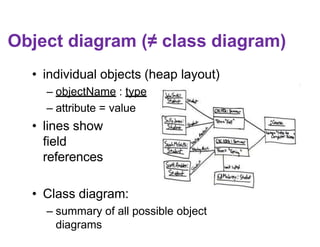
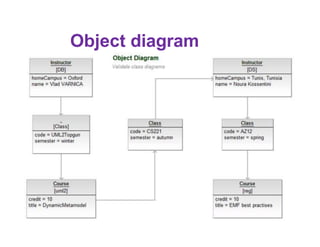
Object diagram (≠ class diagram)
• individual objects (heap layout)
– objectName : type
– attribute = value
• lines show
field
references
• Class diagram:
– summary of all possible object
diagrams
Object diagram
example
UML class diagrams
• UML class diagram: a picture of
– the classes in an OO system
– their fields and methods
– connections between the classes
• that interact or inherit from each other
• Not represented in a UML class diagram:
– details of how the classes interact with each
other
– algorithmic details; how a particular
behavior is implemented
Diagram of one class
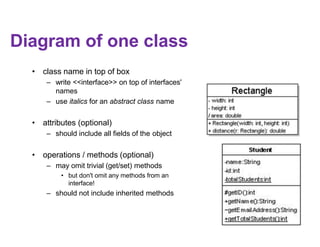
• class name in top of box
– write <<interface>> on top of interfaces'
names
– use italics for an abstract class name
• attributes (optional)
– should include all fields of the object
• operations / methods (optional)
– may omit trivial (get/set) methods
• but don't omit any methods from an
interface!
– should not include inherited methods
Class attributes / fields
• attributes (fields, instance variables)
– visibility name : type [count] =
default_value
– visibility: + public
# protected
- private
~ package
(default)
/ derived
– underline static attributes
– derived attribute: not stored, but can
be computed from other attribute
values
• “specification fields “ from CSE 331
– attribute example:
- balance : double = 0.00
Class operations / methods
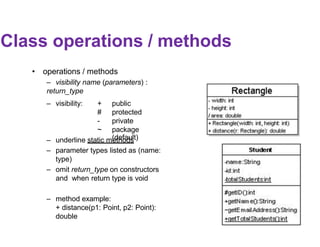
• operations / methods
– visibility name (parameters) :
return_type
– visibility: + public
# protected
- private
~ package
(default)– underline static methods
– parameter types listed as (name:
type)
– omit return_type on constructors
and when return type is void
– method example:
+ distance(p1: Point, p2: Point):
double
Relationships between classes
• generalization: an inheritance
relationship
– inheritance between classes
– interface implementation
• association: a usage relationship
– dependency
– aggregation
– composition
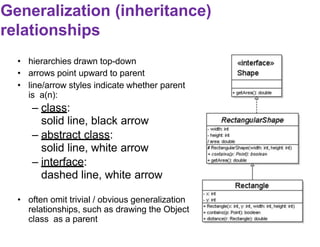
Generalization (inheritance)
relationships
• hierarchies drawn top-down
• arrows point upward to parent
• line/arrow styles indicate whether parent
is a(n):
– class:
solid line, black arrow
– abstract class:
solid line, white arrow
– interface:
dashed line, white arrow
• often omit trivial / obvious generalization
relationships, such as drawing the Object
class as a parent
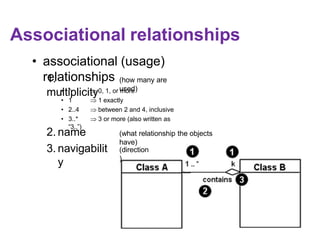
Associational relationships
• associational (usage)
relationships1.
multiplicity
(how many are
used)• *  0, 1, or more
• 1  1 exactly
• 2..4  between 2 and 4, inclusive
• 3..*  3 or more (also written as
“3..”)
2. name
3. navigabilit
y
(what relationship the objects
have)
(direction
)
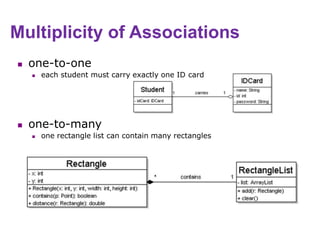
 one-to-one
 each student must carry exactly one ID card
 one-to-many
 one rectangle list can contain many rectangles
Multiplicity of Associations
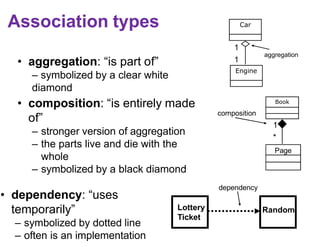
Association types
• aggregation: “is part of”
– symbolized by a clear white
diamond
• composition: “is entirely made
of”
– stronger version of aggregation
– the parts live and die with the
whole
– symbolized by a black diamond
• dependency: “uses
temporarily”
– symbolized by dotted line
– often is an implementation
1
1
Car
aggregation
Engine
Lottery
Ticket
Random
dependency
Page
Book
composition
*
1
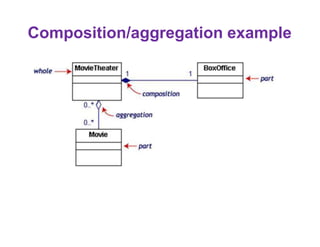
Composition/aggregation example
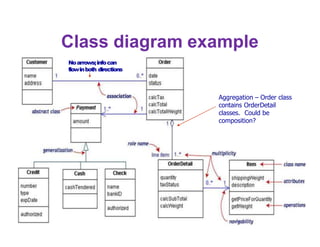
Class diagram example
Aggregation – Order class
contains OrderDetail
classes. Could be
composition?
Noarrows;infocan
flowinboth directions
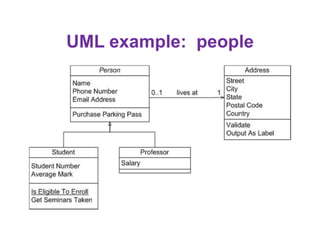
UML example: people
26
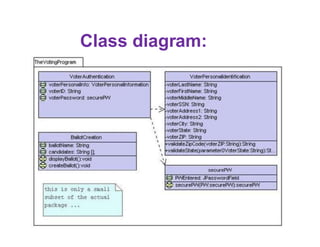
Class diagram:
voter
s
Class diagram example:
student
StudentBody
+ main (args : String[])
1 100
Student
- firstName : String
- lastName : String
- homeAddress : Address
- schoolAddress : Address
+ toString() : String
Address
- streetAddress : String
- city : String
- state : String
- zipCode : long
+ toString() : String
Tools for creating UML diagrams
• Violet (free)
– http://horstmann.com/violet/
• Rational Rose
– http://www.rational.com/
• Visual Paradigm UML Suite
(trial)
– http://www.visual-paradigm.com/
– (nearly) direct download link:
http://www.visual-
paradigm.com/vp/download.jsp?product=vpuml&edition=ce
(there are many others, but most are commercial)
THANK YOU

Uml ppt

  • 1.
    INTRODUCTION TO UML PreparedBy Ms. R. Gomathijayam Assistant Professor of CA Bon Secours College Thanjavur
  • 2.
    UML – UnifiedModeling Language • Union of all Modeling Languages – Use case diagrams – Class diagrams – Object diagrams – Sequence diagrams – Collaboration diagrams – Statechart diagrams – Activity diagrams – Component diagrams – Deployment diagrams – …. • Very big, but a nice standard that has been embraced by the industry.
  • 3.
    Object diagram (≠class diagram) • individual objects (heap layout) – objectName : type – attribute = value • lines show field references • Class diagram: – summary of all possible object diagrams
  • 4.
  • 5.
    UML class diagrams •UML class diagram: a picture of – the classes in an OO system – their fields and methods – connections between the classes • that interact or inherit from each other • Not represented in a UML class diagram: – details of how the classes interact with each other – algorithmic details; how a particular behavior is implemented
  • 6.
    Diagram of oneclass • class name in top of box – write <<interface>> on top of interfaces' names – use italics for an abstract class name • attributes (optional) – should include all fields of the object • operations / methods (optional) – may omit trivial (get/set) methods • but don't omit any methods from an interface! – should not include inherited methods
  • 7.
    Class attributes /fields • attributes (fields, instance variables) – visibility name : type [count] = default_value – visibility: + public # protected - private ~ package (default) / derived – underline static attributes – derived attribute: not stored, but can be computed from other attribute values • “specification fields “ from CSE 331 – attribute example: - balance : double = 0.00
  • 8.
    Class operations /methods • operations / methods – visibility name (parameters) : return_type – visibility: + public # protected - private ~ package (default)– underline static methods – parameter types listed as (name: type) – omit return_type on constructors and when return type is void – method example: + distance(p1: Point, p2: Point): double
  • 9.
    Relationships between classes •generalization: an inheritance relationship – inheritance between classes – interface implementation • association: a usage relationship – dependency – aggregation – composition
  • 10.
    Generalization (inheritance) relationships • hierarchiesdrawn top-down • arrows point upward to parent • line/arrow styles indicate whether parent is a(n): – class: solid line, black arrow – abstract class: solid line, white arrow – interface: dashed line, white arrow • often omit trivial / obvious generalization relationships, such as drawing the Object class as a parent
  • 11.
    Associational relationships • associational(usage) relationships1. multiplicity (how many are used)• *  0, 1, or more • 1  1 exactly • 2..4  between 2 and 4, inclusive • 3..*  3 or more (also written as “3..”) 2. name 3. navigabilit y (what relationship the objects have) (direction )
  • 12.
     one-to-one  eachstudent must carry exactly one ID card  one-to-many  one rectangle list can contain many rectangles Multiplicity of Associations
  • 13.
    Association types • aggregation:“is part of” – symbolized by a clear white diamond • composition: “is entirely made of” – stronger version of aggregation – the parts live and die with the whole – symbolized by a black diamond • dependency: “uses temporarily” – symbolized by dotted line – often is an implementation 1 1 Car aggregation Engine Lottery Ticket Random dependency Page Book composition * 1
  • 14.
  • 15.
    Class diagram example Aggregation– Order class contains OrderDetail classes. Could be composition? Noarrows;infocan flowinboth directions
  • 16.
  • 17.
  • 18.
    Class diagram example: student StudentBody +main (args : String[]) 1 100 Student - firstName : String - lastName : String - homeAddress : Address - schoolAddress : Address + toString() : String Address - streetAddress : String - city : String - state : String - zipCode : long + toString() : String
  • 19.
    Tools for creatingUML diagrams • Violet (free) – http://horstmann.com/violet/ • Rational Rose – http://www.rational.com/ • Visual Paradigm UML Suite (trial) – http://www.visual-paradigm.com/ – (nearly) direct download link: http://www.visual- paradigm.com/vp/download.jsp?product=vpuml&edition=ce (there are many others, but most are commercial)
  • 20.