This Presentation Courtesy of the
                               International SOA Symposium
                               October 7-8, 2008 Amsterdam Arena
                               www.soasymposium.com
                               info@soasymposium.com


                                                        Founding Sponsors


Platinum Sponsors


Gold Sponsors            Silver Sponsors


Enterprise
Mashups
with SOA
SYSTEMATIC THOUGHT LEADERSHIP FOR INNOVATIVE BUSINESS


Ümit Yalçinalp
Shel Finkelstein
SAP Research, Palo Alto
umit.yalcinalp@sap.com
shel.finkelstein@sap.com
Outline


 Mission
 The Changing Computing Landscape
 Composition Characteristics
 Enterprise Mashup Application Platform
 Recent SAP Research Work
 Conclusions


                   October, 2008      SOA Symposium                            3


Mission:


 Simplify creation, delivery and execution of enterprise apps
   Emerging technologies for the Web, dynamic languages and
   programming environments

 Advanced Web Technologies group at SAP Research, OCTO
   Ümit Yalçinalp, Shel Finkelstein, Tilman Giese, Rama Gurram,
   Brian Mo, Matthias Kunze, Jennifer Baldwin, Anne Hardy …

 This talk is about trends & experiments, not product directions
 This document contains only intended strategies, developments, and functionalities of the
 SAP® product and is not intended to be binding upon SAP to any particular course of
 business, product strategy, and/or development. SAP assumes no responsibility for errors
 or omissions in this document. SAP does not warrant the accuracy or completeness of the
 information, text, graphics, links, or other items contained within this material.


                   October, 2008      SOA Symposium                            4
Typical Application Architecture


  Presentation Layer

  Application/Business Logic Layer

  Data Access Layer


               October, 2008       SOA Symposium   5


Traditional Web Applications

                               ?
  Client
   Displaying UI

  Web Server
   Generation of presentation

  Midtier
   Data integration
   Composition
   Business Logic
   Validation

  Database

               October, 2008       SOA Symposium   6
Today

    Not (Client.isDumb()) and Not (Client.isThin())


New Clients


 Memory++ and processing power++
  128MB RAM and 620MHz CPU for smartphones

 Browser as an app platform Plug-in as a Platform (PaaP)

 Empowered by Dynamic language runtimes and proprietary APIs
 (e.g., Microsoft Silverlight, JavaScript libraries)
    –   Client generates dynamic presentation layer
    –   Client may include preliminary logic (e.g. validation)

 Deployment of same controls in both standalone runtimes and
 browsers (e.g., ADOBE AIR)

 Rich client controls (video, sounds, etc.) in applications

 Local data cache management by client apps (e.g., Google Gears)

                  October, 2008      SOA Symposium               8
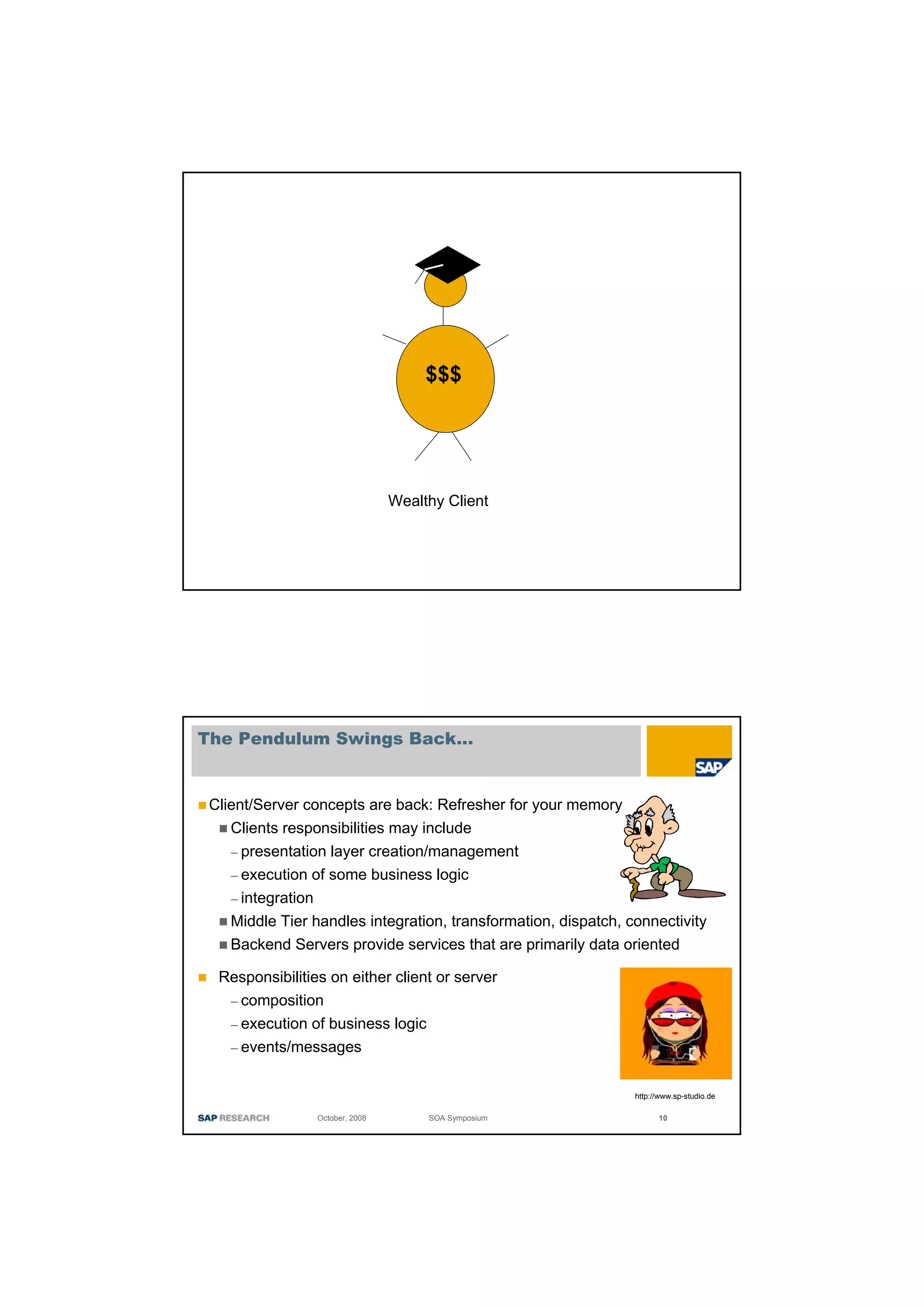
$$$


                                 Wealthy Client


The Pendulum Swings Back…


 Client/Server concepts are back: Refresher for your memory
    Clients responsibilities may include
    – presentation layer creation/management
    – execution of some business logic
    – integration
    Middle Tier handles integration, transformation, dispatch, connectivity
    Backend Servers provide services that are primarily data oriented

  Responsibilities on either client or server
   – composition
   – execution of business logic
   – events/messages


                                                                http://www.sp-studio.de

                 October, 2008        SOA Symposium                   10
What are the Implications for Enterprise
Applications?

  Use client as a real SOA tier
   Offloads server
   Crucial for user experience
   Composition

  Design services to exploit wealthy clients
   Utilize their characteristics and full potential
   Make integration possible
   Distribute application responsibilities

  Enterprise applications require new distribution of responsibilities across
   Development
   Assembly and composition
   Deployment
   Execution

                  October, 2008       SOA Symposium                 11


                   Where are these capabilities?
                They may be in the client, server or both
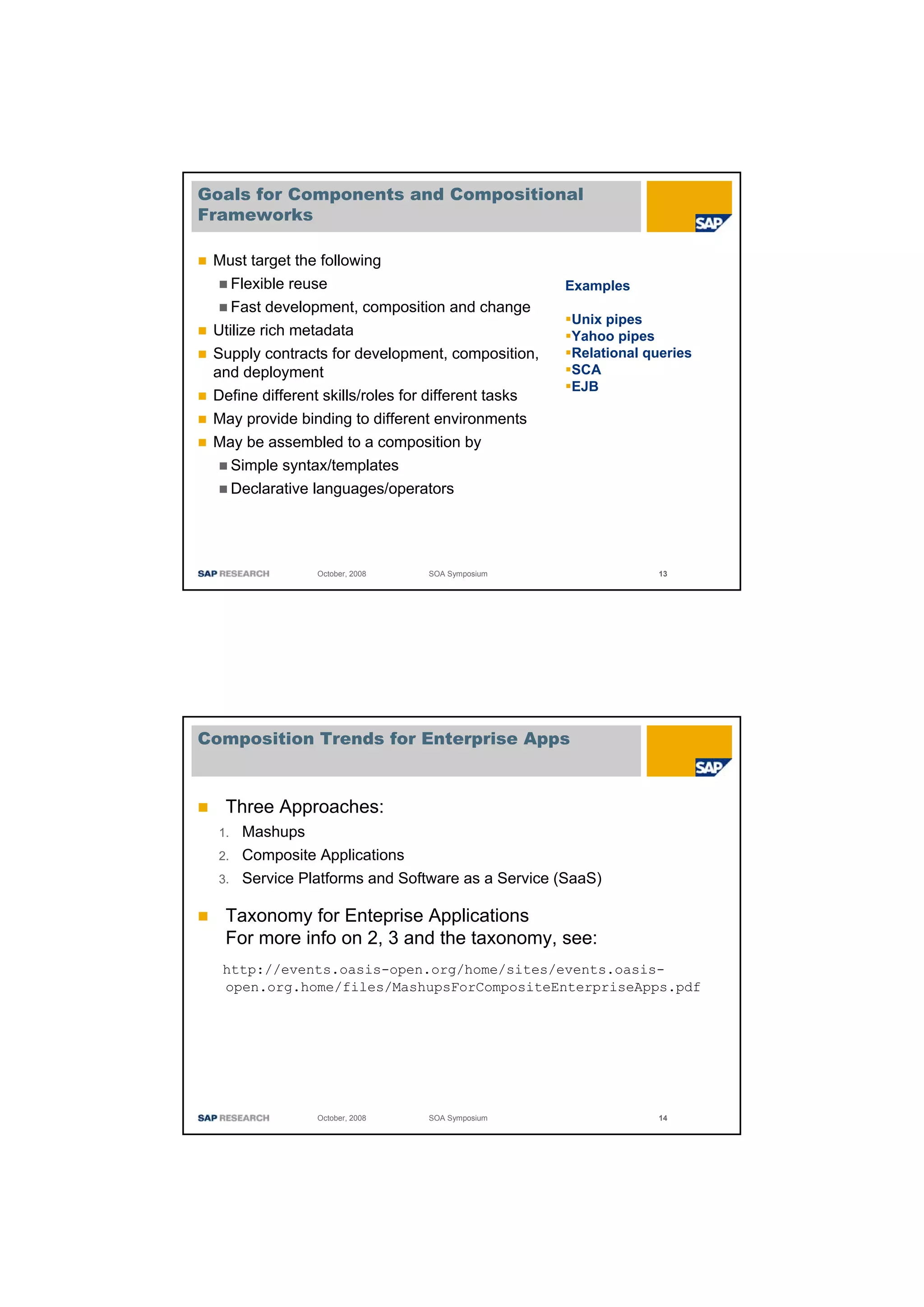
Goals for Components and Compositional
Frameworks

 Must target the following
    Flexible reuse                                   Examples
    Fast development, composition and change
                                                     Unix pipes
 Utilize rich metadata                               Yahoo pipes
 Supply contracts for development, composition,      Relational queries
 and deployment                                      SCA
                                                     EJB
 Define different skills/roles for different tasks
 May provide binding to different environments
 May be assembled to a composition by
    Simple syntax/templates
    Declarative languages/operators


                 October, 2008   SOA Symposium                    13


Composition Trends for Enterprise Apps


   Three Approaches:
  1.   Mashups
  2.   Composite Applications
  3.   Service Platforms and Software as a Service (SaaS)

   Taxonomy for Enteprise Applications
   For more info on 2, 3 and the taxonomy, see:
  http://events.oasis-open.org/home/sites/events.oasis-
  open.org.home/files/MashupsForCompositeEnterpriseApps.pdf


                 October, 2008   SOA Symposium                    14
Mashups Today


 Driven by Client side development
 Composition is handled on the client
 Lightweight and rapid development style
   Scripting and dynamic languages (JavaScript, Ruby)
   Component metadata
 Browser as a container enables rich client
   Plug-in as a Platform enables wealthier client


                 October, 2008            SOA Symposium                       15


Two Styles of Client-side Composition


 Composition with APIs
  Development Model: Use APIs to supply client-side components with server-
  side data
  Execution Model:               Run components on client; fetch (async pre-fetch) data
  from server
 (Google Maps)

 Composition with events
  Development Model: Compose using events and metadata
  Execution Model:   Run components connected by pub/sub events
 (OpenAjax Hub, SAP Research Enterprise Web Widget Framework, IBM
   QEDWiki)

                                  Not mutually exclusive


                 October, 2008            SOA Symposium                       16
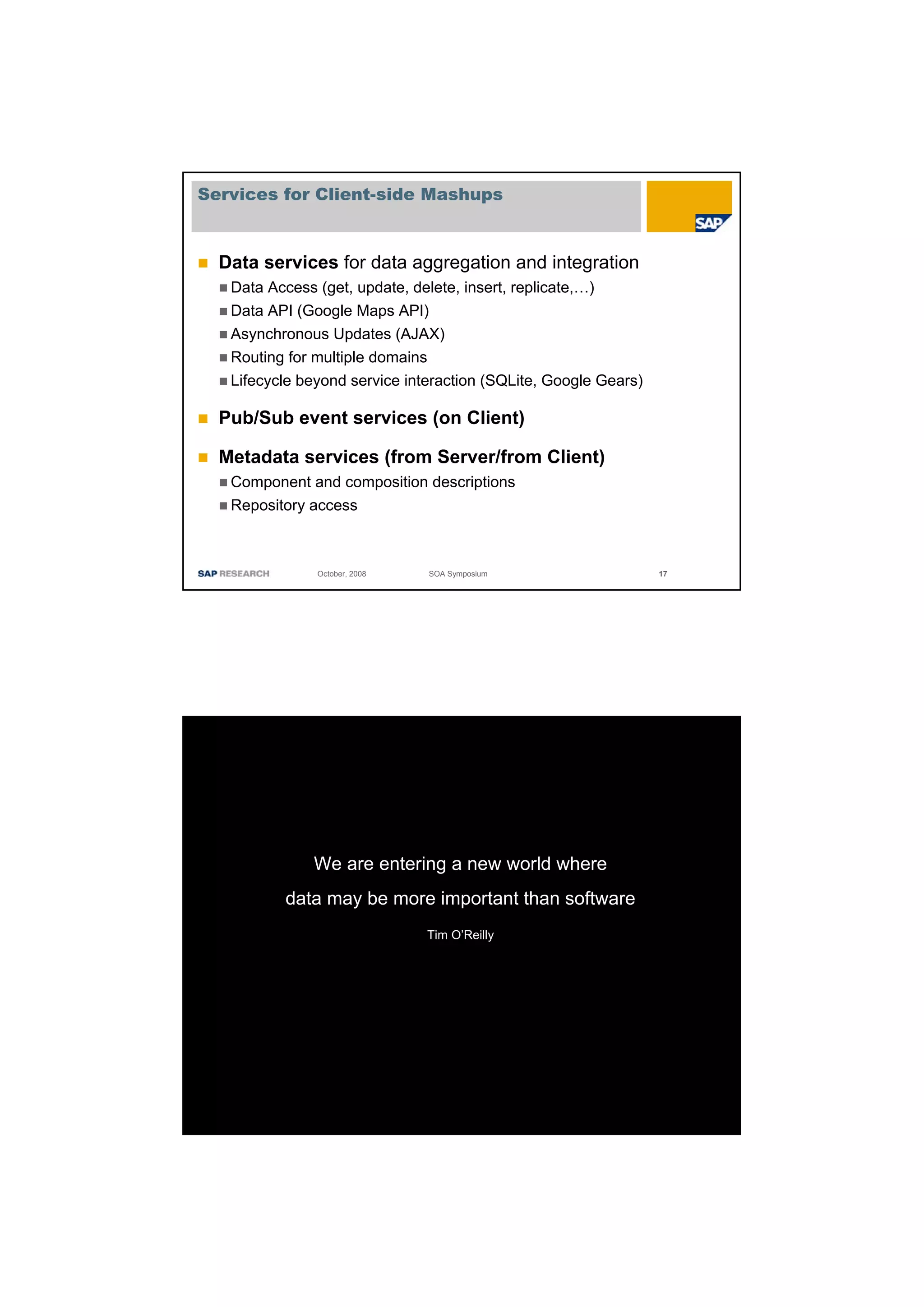
Services for Client-side Mashups


  Data services for data aggregation and integration
   Data Access (get, update, delete, insert, replicate,…)
   Data API (Google Maps API)
   Asynchronous Updates (AJAX)
   Routing for multiple domains
   Lifecycle beyond service interaction (SQLite, Google Gears)

  Pub/Sub event services (on Client)

  Metadata services (from Server/from Client)
   Component and composition descriptions
   Repository access


               October, 2008   SOA Symposium                     17


              We are entering a new world where
          data may be more important than software
                               Tim O’Reilly
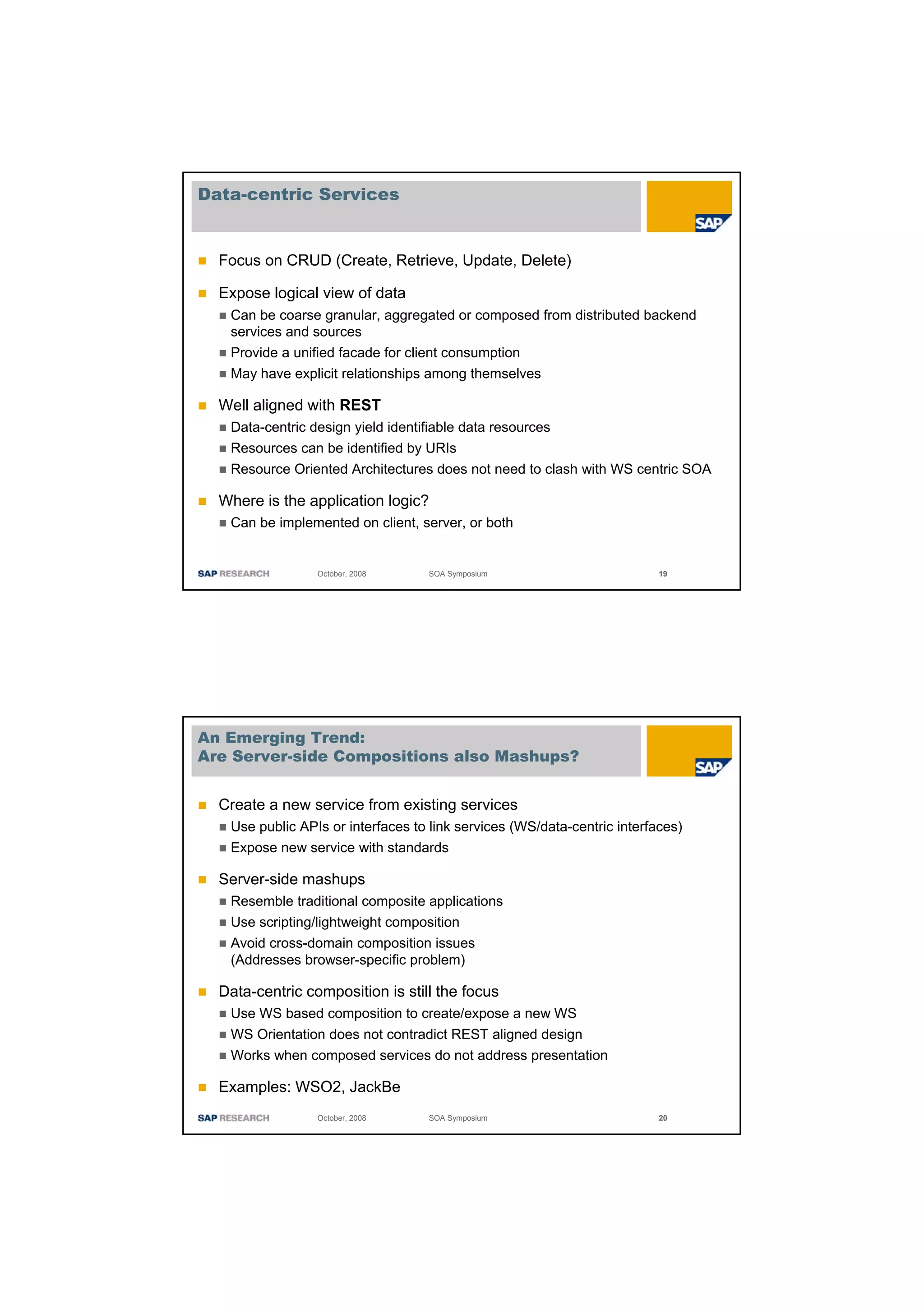
Data-centric Services


  Focus on CRUD (Create, Retrieve, Update, Delete)

  Expose logical view of data
   Can be coarse granular, aggregated or composed from distributed backend
   services and sources
   Provide a unified facade for client consumption
   May have explicit relationships among themselves

  Well aligned with REST
   Data-centric design yield identifiable data resources
   Resources can be identified by URIs
   Resource Oriented Architectures does not need to clash with WS centric SOA

  Where is the application logic?
   Can be implemented on client, server, or both


                 October, 2008     SOA Symposium                          19


An Emerging Trend:
Are Server-side Compositions also Mashups?


  Create a new service from existing services
   Use public APIs or interfaces to link services (WS/data-centric interfaces)
   Expose new service with standards

  Server-side mashups
   Resemble traditional composite applications
   Use scripting/lightweight composition
   Avoid cross-domain composition issues
   (Addresses browser-specific problem)

  Data-centric composition is still the focus
   Use WS based composition to create/expose a new WS
   WS Orientation does not contradict REST aligned design
   Works when composed services do not address presentation

  Examples: WSO2, JackBe
                 October, 2008     SOA Symposium                          20
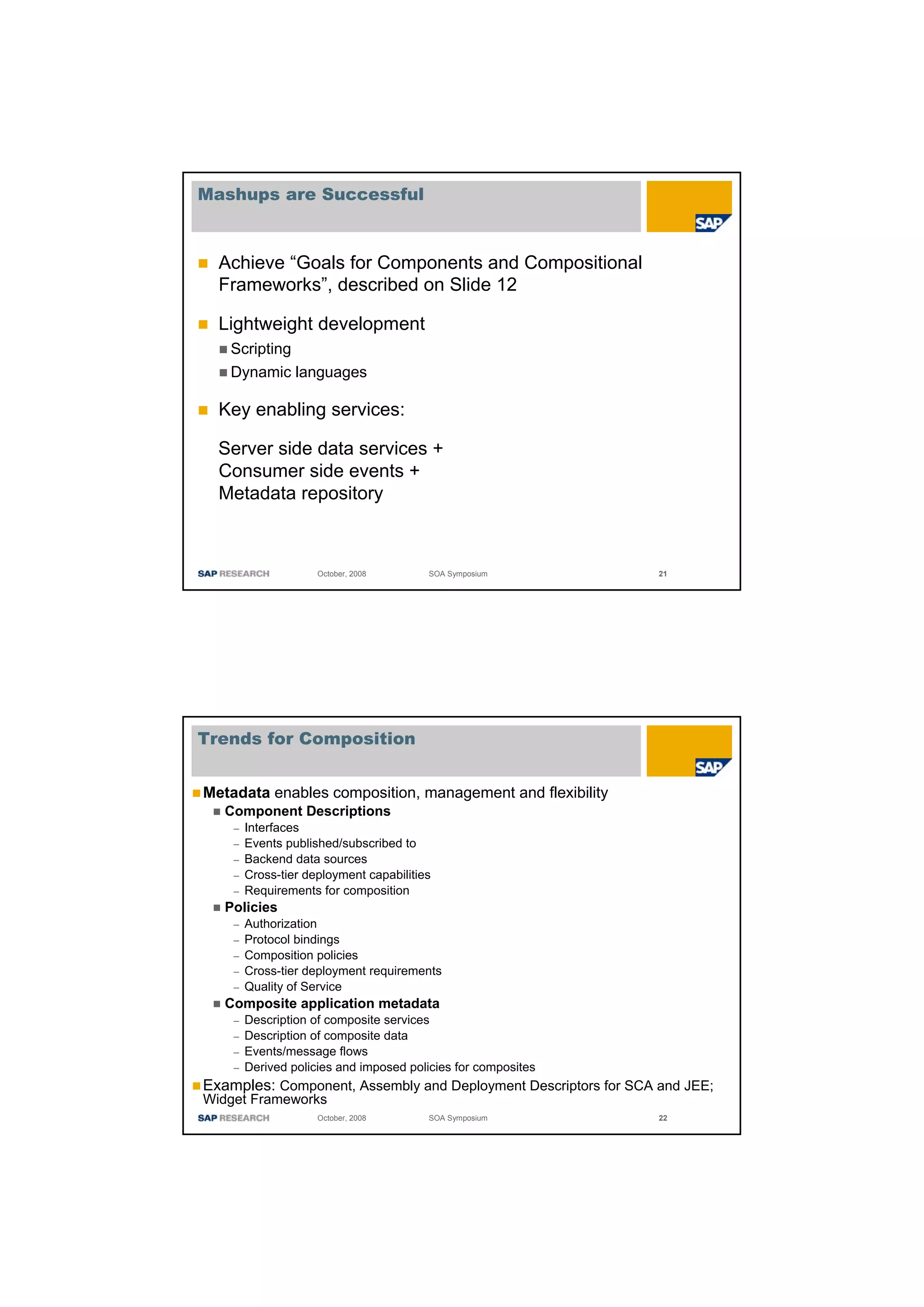
Mashups are Successful


  Achieve “Goals for Components and Compositional
  Frameworks”, described on Slide 12

  Lightweight development
   Scripting
   Dynamic languages

  Key enabling services:

  Server side data services +
  Consumer side events +
  Metadata repository


                   October, 2008       SOA Symposium             21


Trends for Composition


Metadata enables composition, management and flexibility
   Component Descriptions
    – Interfaces
    – Events published/subscribed to
    – Backend data sources
    – Cross-tier deployment capabilities
    – Requirements for composition
   Policies
    – Authorization
    – Protocol bindings
    – Composition policies
    – Cross-tier deployment requirements
    – Quality of Service
   Composite application metadata
    – Description of composite services
    – Description of composite data
    – Events/message flows
    – Derived policies and imposed policies for composites
Examples: Component, Assembly and Deployment Descriptors for SCA and JEE;
Widget Frameworks
                   October, 2008       SOA Symposium             22
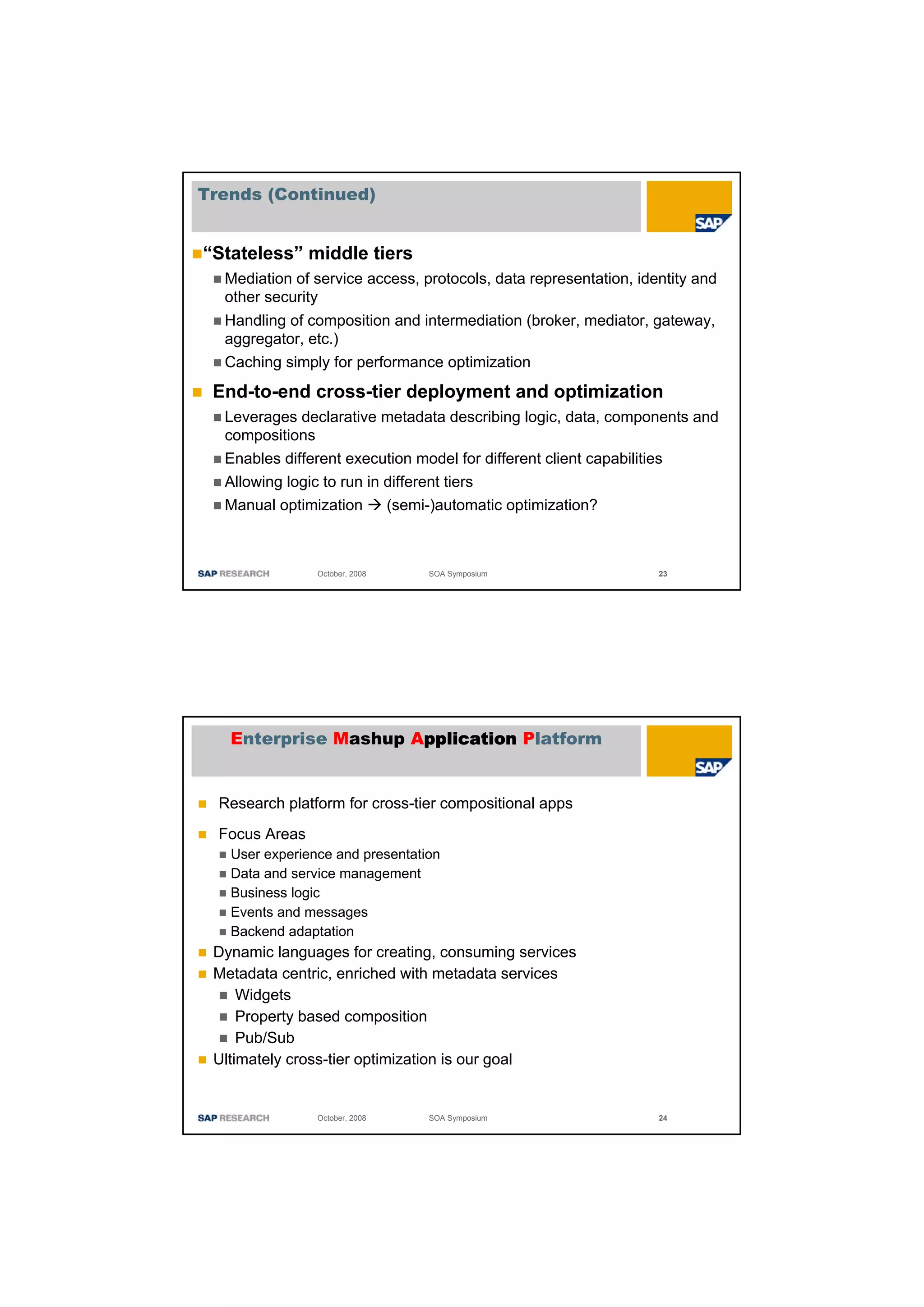
Trends (Continued)


“Stateless” middle tiers
  Mediation of service access, protocols, data representation, identity and
  other security
  Handling of composition and intermediation (broker, mediator, gateway,
  aggregator, etc.)
  Caching simply for performance optimization
 End-to-end cross-tier deployment and optimization
  Leverages declarative metadata describing logic, data, components and
  compositions
  Enables different execution model for different client capabilities
  Allowing logic to run in different tiers
  Manual optimization      (semi-)automatic optimization?


                October, 2008    SOA Symposium                    23


   Enterprise Mashup Application Platform


  Research platform for cross-tier compositional apps
  Focus Areas
   User experience and presentation
   Data and service management
   Business logic
   Events and messages
   Backend adaptation
 Dynamic languages for creating, consuming services
 Metadata centric, enriched with metadata services
     Widgets
     Property based composition
     Pub/Sub
 Ultimately cross-tier optimization is our goal


                October, 2008    SOA Symposium                    24
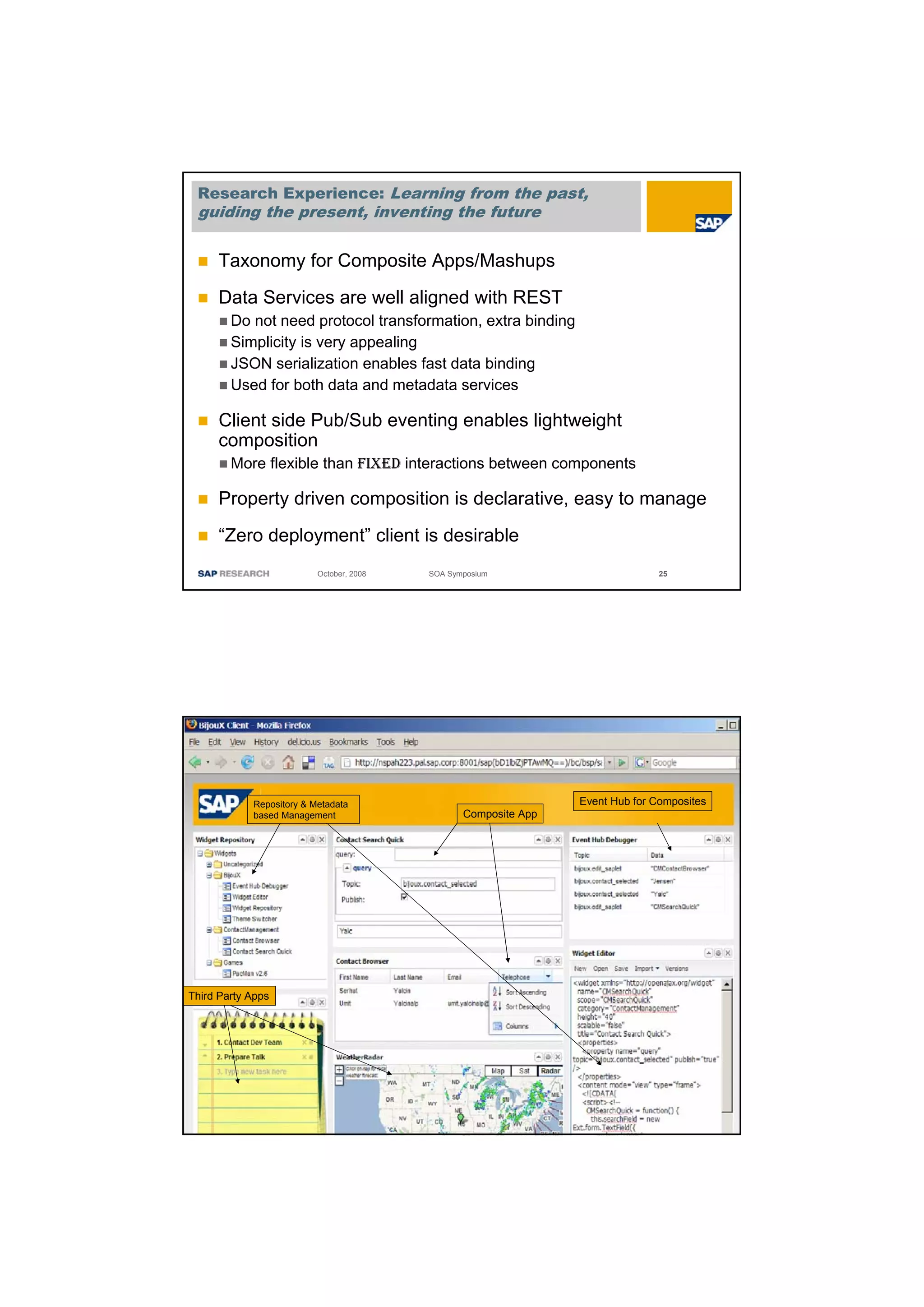
Research Experience: Learning from the past,
 guiding the present, inventing the future


     Taxonomy for Composite Apps/Mashups
     Data Services are well aligned with REST
        Do not need protocol transformation, extra binding
        Simplicity is very appealing
        JSON serialization enables fast data binding
        Used for both data and metadata services

     Client side Pub/Sub eventing enables lightweight
     composition
        More flexible than FIXED interactions between components

     Property driven composition is declarative, easy to manage
     “Zero deployment” client is desirable
                          October, 2008   SOA Symposium                         25


            Repository & Metadata                                Event Hub for Composites
            based Management                     Composite App


Third Party Apps


                          October, 2008   SOA Symposium                         26
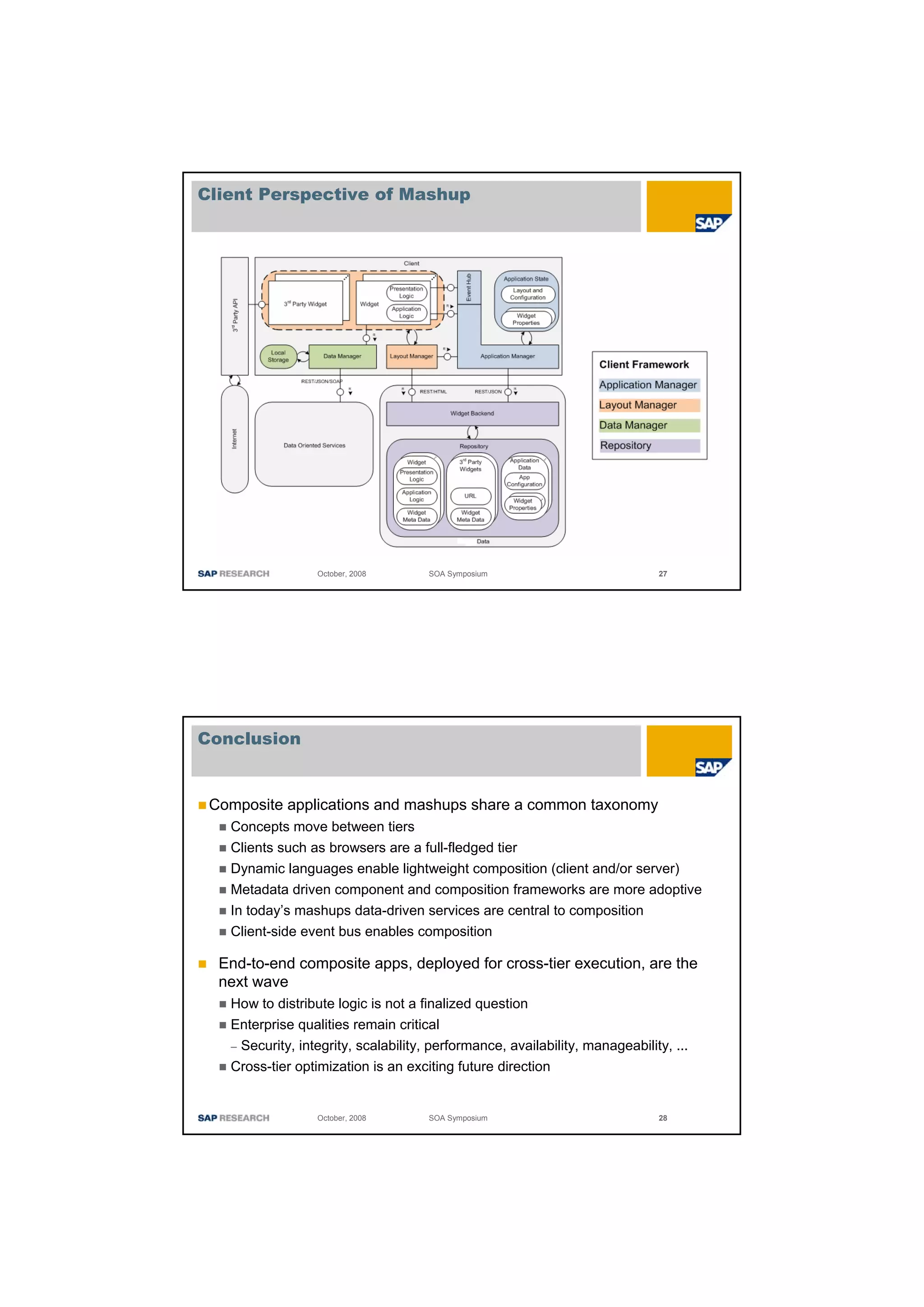
Client Perspective of Mashup


                  October, 2008       SOA Symposium                           27


Conclusion


 Composite applications and mashups share a common taxonomy
   Concepts move between tiers
   Clients such as browsers are a full-fledged tier
   Dynamic languages enable lightweight composition (client and/or server)
   Metadata driven component and composition frameworks are more adoptive
   In today’s mashups data-driven services are central to composition
   Client-side event bus enables composition

  End-to-end composite apps, deployed for cross-tier execution, are the
  next wave
   How to distribute logic is not a finalized question
   Enterprise qualities remain critical
   – Security, integrity, scalability, performance, availability, manageability, ...
   Cross-tier optimization is an exciting future direction


                  October, 2008       SOA Symposium                           28
References

 Rama Gurram et. al. : A Web Based Mashup Platform for Enterprise 2.0
 http://www.springerlink.com/content/0442382328227386/
 Jonathan Marsh: Mashup: Noun or Verb?
 http://wso2.org/repos/wso2/people/jonathan/Mashup%20No
  un%20or%20Verb.pdf
 Charlton Barreto : Web 20-20 Architecture for the New Internet
 http://charltonb.typepad.com/talks/120407-cbb-
 web2020/Web2020TheNewInternet.pdf

 Pat Helland: The Irresistible Forces Meet the Moveable Objects
 http://blogs.msdn.com/pathelland/attachment/7082107.as
  hx
 Alistair Barros: The Rise of Web Service Ecosystems
 http://csdl2.computer.org/persagen/DLAbsToc.jsp?resour
  cePath=/dl/mags/it/&toc=comp/mags/it/2006/05/f5toc.xm
  l&DOI=10.1109/MITP.2006.123


                  October, 2008       SOA Symposium                     29


Enterprise Mashups with SOA


                                  Ümit Yalcinalp
                                  Shel Finkelstein


                        SAP Research, Palo Alto
                         umit.yalcinalp@sap.com
                       shel.finkelstein@sap.com


                  October, 2008       SOA Symposium                     30

Umit Yalcinalp Enterprise Mashupsfor S O A

  • 1.
    This Presentation Courtesyof the International SOA Symposium October 7-8, 2008 Amsterdam Arena www.soasymposium.com info@soasymposium.com Founding Sponsors Platinum Sponsors Gold Sponsors Silver Sponsors Enterprise Mashups with SOA SYSTEMATIC THOUGHT LEADERSHIP FOR INNOVATIVE BUSINESS Ümit Yalçinalp Shel Finkelstein SAP Research, Palo Alto umit.yalcinalp@sap.com shel.finkelstein@sap.com
  • 2.
    Outline Mission TheChanging Computing Landscape Composition Characteristics Enterprise Mashup Application Platform Recent SAP Research Work Conclusions October, 2008 SOA Symposium 3 Mission: Simplify creation, delivery and execution of enterprise apps Emerging technologies for the Web, dynamic languages and programming environments Advanced Web Technologies group at SAP Research, OCTO Ümit Yalçinalp, Shel Finkelstein, Tilman Giese, Rama Gurram, Brian Mo, Matthias Kunze, Jennifer Baldwin, Anne Hardy … This talk is about trends & experiments, not product directions This document contains only intended strategies, developments, and functionalities of the SAP® product and is not intended to be binding upon SAP to any particular course of business, product strategy, and/or development. SAP assumes no responsibility for errors or omissions in this document. SAP does not warrant the accuracy or completeness of the information, text, graphics, links, or other items contained within this material. October, 2008 SOA Symposium 4
  • 3.
    Typical Application Architecture Presentation Layer Application/Business Logic Layer Data Access Layer October, 2008 SOA Symposium 5 Traditional Web Applications ? Client Displaying UI Web Server Generation of presentation Midtier Data integration Composition Business Logic Validation Database October, 2008 SOA Symposium 6
  • 4.
    Today Not (Client.isDumb()) and Not (Client.isThin()) New Clients Memory++ and processing power++ 128MB RAM and 620MHz CPU for smartphones Browser as an app platform Plug-in as a Platform (PaaP) Empowered by Dynamic language runtimes and proprietary APIs (e.g., Microsoft Silverlight, JavaScript libraries) – Client generates dynamic presentation layer – Client may include preliminary logic (e.g. validation) Deployment of same controls in both standalone runtimes and browsers (e.g., ADOBE AIR) Rich client controls (video, sounds, etc.) in applications Local data cache management by client apps (e.g., Google Gears) October, 2008 SOA Symposium 8
  • 5.
    $$$ Wealthy Client The Pendulum Swings Back… Client/Server concepts are back: Refresher for your memory Clients responsibilities may include – presentation layer creation/management – execution of some business logic – integration Middle Tier handles integration, transformation, dispatch, connectivity Backend Servers provide services that are primarily data oriented Responsibilities on either client or server – composition – execution of business logic – events/messages http://www.sp-studio.de October, 2008 SOA Symposium 10
  • 6.
    What are theImplications for Enterprise Applications? Use client as a real SOA tier Offloads server Crucial for user experience Composition Design services to exploit wealthy clients Utilize their characteristics and full potential Make integration possible Distribute application responsibilities Enterprise applications require new distribution of responsibilities across Development Assembly and composition Deployment Execution October, 2008 SOA Symposium 11 Where are these capabilities? They may be in the client, server or both
  • 7.
    Goals for Componentsand Compositional Frameworks Must target the following Flexible reuse Examples Fast development, composition and change Unix pipes Utilize rich metadata Yahoo pipes Supply contracts for development, composition, Relational queries and deployment SCA EJB Define different skills/roles for different tasks May provide binding to different environments May be assembled to a composition by Simple syntax/templates Declarative languages/operators October, 2008 SOA Symposium 13 Composition Trends for Enterprise Apps Three Approaches: 1. Mashups 2. Composite Applications 3. Service Platforms and Software as a Service (SaaS) Taxonomy for Enteprise Applications For more info on 2, 3 and the taxonomy, see: http://events.oasis-open.org/home/sites/events.oasis- open.org.home/files/MashupsForCompositeEnterpriseApps.pdf October, 2008 SOA Symposium 14
  • 8.
    Mashups Today Drivenby Client side development Composition is handled on the client Lightweight and rapid development style Scripting and dynamic languages (JavaScript, Ruby) Component metadata Browser as a container enables rich client Plug-in as a Platform enables wealthier client October, 2008 SOA Symposium 15 Two Styles of Client-side Composition Composition with APIs Development Model: Use APIs to supply client-side components with server- side data Execution Model: Run components on client; fetch (async pre-fetch) data from server (Google Maps) Composition with events Development Model: Compose using events and metadata Execution Model: Run components connected by pub/sub events (OpenAjax Hub, SAP Research Enterprise Web Widget Framework, IBM QEDWiki) Not mutually exclusive October, 2008 SOA Symposium 16
  • 9.
    Services for Client-sideMashups Data services for data aggregation and integration Data Access (get, update, delete, insert, replicate,…) Data API (Google Maps API) Asynchronous Updates (AJAX) Routing for multiple domains Lifecycle beyond service interaction (SQLite, Google Gears) Pub/Sub event services (on Client) Metadata services (from Server/from Client) Component and composition descriptions Repository access October, 2008 SOA Symposium 17 We are entering a new world where data may be more important than software Tim O’Reilly
  • 10.
    Data-centric Services Focus on CRUD (Create, Retrieve, Update, Delete) Expose logical view of data Can be coarse granular, aggregated or composed from distributed backend services and sources Provide a unified facade for client consumption May have explicit relationships among themselves Well aligned with REST Data-centric design yield identifiable data resources Resources can be identified by URIs Resource Oriented Architectures does not need to clash with WS centric SOA Where is the application logic? Can be implemented on client, server, or both October, 2008 SOA Symposium 19 An Emerging Trend: Are Server-side Compositions also Mashups? Create a new service from existing services Use public APIs or interfaces to link services (WS/data-centric interfaces) Expose new service with standards Server-side mashups Resemble traditional composite applications Use scripting/lightweight composition Avoid cross-domain composition issues (Addresses browser-specific problem) Data-centric composition is still the focus Use WS based composition to create/expose a new WS WS Orientation does not contradict REST aligned design Works when composed services do not address presentation Examples: WSO2, JackBe October, 2008 SOA Symposium 20
  • 11.
    Mashups are Successful Achieve “Goals for Components and Compositional Frameworks”, described on Slide 12 Lightweight development Scripting Dynamic languages Key enabling services: Server side data services + Consumer side events + Metadata repository October, 2008 SOA Symposium 21 Trends for Composition Metadata enables composition, management and flexibility Component Descriptions – Interfaces – Events published/subscribed to – Backend data sources – Cross-tier deployment capabilities – Requirements for composition Policies – Authorization – Protocol bindings – Composition policies – Cross-tier deployment requirements – Quality of Service Composite application metadata – Description of composite services – Description of composite data – Events/message flows – Derived policies and imposed policies for composites Examples: Component, Assembly and Deployment Descriptors for SCA and JEE; Widget Frameworks October, 2008 SOA Symposium 22
  • 12.
    Trends (Continued) “Stateless” middletiers Mediation of service access, protocols, data representation, identity and other security Handling of composition and intermediation (broker, mediator, gateway, aggregator, etc.) Caching simply for performance optimization End-to-end cross-tier deployment and optimization Leverages declarative metadata describing logic, data, components and compositions Enables different execution model for different client capabilities Allowing logic to run in different tiers Manual optimization (semi-)automatic optimization? October, 2008 SOA Symposium 23 Enterprise Mashup Application Platform Research platform for cross-tier compositional apps Focus Areas User experience and presentation Data and service management Business logic Events and messages Backend adaptation Dynamic languages for creating, consuming services Metadata centric, enriched with metadata services Widgets Property based composition Pub/Sub Ultimately cross-tier optimization is our goal October, 2008 SOA Symposium 24
  • 13.
    Research Experience: Learningfrom the past, guiding the present, inventing the future Taxonomy for Composite Apps/Mashups Data Services are well aligned with REST Do not need protocol transformation, extra binding Simplicity is very appealing JSON serialization enables fast data binding Used for both data and metadata services Client side Pub/Sub eventing enables lightweight composition More flexible than FIXED interactions between components Property driven composition is declarative, easy to manage “Zero deployment” client is desirable October, 2008 SOA Symposium 25 Repository & Metadata Event Hub for Composites based Management Composite App Third Party Apps October, 2008 SOA Symposium 26
  • 14.
    Client Perspective ofMashup October, 2008 SOA Symposium 27 Conclusion Composite applications and mashups share a common taxonomy Concepts move between tiers Clients such as browsers are a full-fledged tier Dynamic languages enable lightweight composition (client and/or server) Metadata driven component and composition frameworks are more adoptive In today’s mashups data-driven services are central to composition Client-side event bus enables composition End-to-end composite apps, deployed for cross-tier execution, are the next wave How to distribute logic is not a finalized question Enterprise qualities remain critical – Security, integrity, scalability, performance, availability, manageability, ... Cross-tier optimization is an exciting future direction October, 2008 SOA Symposium 28
  • 15.
    References Rama Gurramet. al. : A Web Based Mashup Platform for Enterprise 2.0 http://www.springerlink.com/content/0442382328227386/ Jonathan Marsh: Mashup: Noun or Verb? http://wso2.org/repos/wso2/people/jonathan/Mashup%20No un%20or%20Verb.pdf Charlton Barreto : Web 20-20 Architecture for the New Internet http://charltonb.typepad.com/talks/120407-cbb- web2020/Web2020TheNewInternet.pdf Pat Helland: The Irresistible Forces Meet the Moveable Objects http://blogs.msdn.com/pathelland/attachment/7082107.as hx Alistair Barros: The Rise of Web Service Ecosystems http://csdl2.computer.org/persagen/DLAbsToc.jsp?resour cePath=/dl/mags/it/&toc=comp/mags/it/2006/05/f5toc.xm l&DOI=10.1109/MITP.2006.123 October, 2008 SOA Symposium 29 Enterprise Mashups with SOA Ümit Yalcinalp Shel Finkelstein SAP Research, Palo Alto umit.yalcinalp@sap.com shel.finkelstein@sap.com October, 2008 SOA Symposium 30