This Presentation Courtesy of the
                          International SOA Symposium
                          October 7-8, 2008 Amsterdam Arena
                          www.soasymposium.com
                          info@soasymposium.com


                                       Founding Sponsors


Platinum Sponsors


Gold Sponsors       Silver Sponsors
Web Services and Transactions


                    Dr Mark Little
       Technical Development Manager, Red Hat
Overview

• Fault tolerance
• Transaction fundamentals
  – What is a transaction?
  – ACID properties
• The Web Service effect on transactions
• What characteristics do we really need?
• Is this specific to Web Services?


   2                                   Red Hat
Fault tolerance

• Machines and software fail
      – Fundamental universal law (entropy increases)
      – Things get better with each generation, but still
        statistically significant
• Failures of centralized systems difficult to
  handle
• Failures of distributed systems are much
  more difficult


  3                                                   Red Hat
Fault tolerance techniques

• Replication of resources
        – Increase availability
            • Probability is that a critical number of resources remain
              operational
            • “Guarantee” forward progress
        – Tolerate programmer errors by heterogeneous
          implementations
• Spheres of control
     – “Guarantee” no partial completion of work in the presence of
       failures
•   Often a duality
        – “Understanding the Role of Atomic Transactions and Group
          Communications in Implementing Persistent Replicated”,
          Proceedings of the 8th International Workshop on
          Persistent Object Systems, California, USA,1998

    4                                                                 Red Hat
What is a transaction?

• Mechanistic aid to achieving correctness
• Provides an “all-or-nothing” property to
  work that is conducted within its scope
     – Even in the presence of failures
• Ensures that shared resources are
  protected from multiple users
• “Guarantees” the notion of shared global
  consensus
     – Different parties in different locales have the same view of
       the transaction outcome


 5                                                           Red Hat
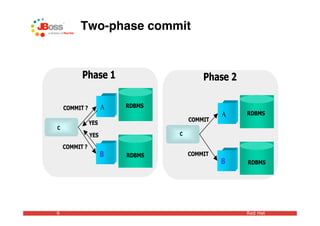
Two-phase commit


          Phase 1                        Phase 2

    COMMIT ?         A   RDBMS
                                              A    RDBMS
                                     COMMIT
               YES
C
               YES               C

    COMMIT ?
                     B   RDBMS       COMMIT
                                              B    RDBMS


6                                                  Red Hat
Transactions for Web Services

• Business-to-business interactions may be
  complex
      – involving many parties
      – spanning many different organisations
      – potentially lasting for hours or days
• Cannot afford to lock resources on behalf of an
  individual indefinitely
• May need to undo only a subset of work
• So the search has been on, because …


  7                                             Red Hat
ACID-ic Web Services?

• ACID transactions implicitly assume
      – Closely coupled environment
         • All entities involved in a transaction span a LAN, for
           example.
      – Short-duration activities
         • Must be able to cope with resources being locked for
           periods
• Therefore, do not work well in
   – Loosely coupled environments!
   – Long duration activities!


  8                                                           Red Hat
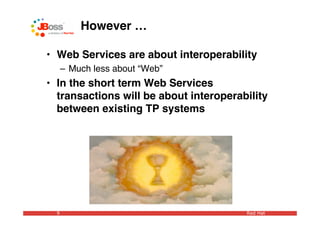
However …

• Web Services are about interoperability
      – Much less about “Web”
• In the short term Web Services
  transactions will be about interoperability
  between existing TP systems


  9                                     Red Hat
What characteristics are right?

 • Need to be able to relax the strict ACID properties
 • Need to put control of some into hands of service
   developer
     – Is consistency (or consensus) important?
 • May need a notion of a central coordinator
     – But may not!
     – Or something with a fuzzy idea of whatʼs going on
 • “A comparison of Web services transaction
   protocols”, IBM Developer Works, 2003.


10                                                         Red Hat
Relaxing isolation

 • Internal isolation of resources should be a
   decision for the service provider
     – E.g., commit early and define compensation activities
     – However, it does impact applications
        • Some users may want to know a priori what isolation policies
          are used
 • Undo can be whatever is required
     – Before and after image
     – Entirely new business processes
     – Not guaranteed to really undo


11                                                                  Red Hat
Relaxing atomicity

 • Sometimes it may be desirable to cancel some
   work without affecting the remainder
     – E.g., prefer to get airline seat now even without travel
       insurance
 • Similar to nested transactions
     – Work performed within scope of a nested transaction is
       provisional
     – Failure does not affect enclosing transaction


12                                                                Red Hat
Structuring transactions

 • Could structure transactional applications from
   short-duration transactions
     – Release locks early
     – Resulting application may still be required to appear to have
       “ACID” properties
         • May require application specific means to restore consistency
 • A transactional workflow system could be used
   to script the composition of these transactions
     – But you still need a reliable “coordinator”
         • Something that knows the state of the flow
         • Participants also need to know/remember their state
 • Recovery!
     – Workflows without (automatic) recovery can be a PITA


13                                                                   Red Hat
Relaxation of consistency

 • ACID transactions (with two-phase commit) are
   all about strong global consistency
     – All participants remain in lock-step
     – Same view of transaction outcome
 • But that does not scale
     – Replication developers have known about this for years
         • Weak consistency replication protocols developed for large
           scale (number of replicas and physical deployment)
         • Merging of caching and replication protocols
             – Local domains of consistency
         • Cannot “stop the world” and enforce global consistency
     – Some transaction research into this, but industry pushing
       global consistency
         • Starting to see a change


14                                                                      Red Hat
Heisenbergʼs Uncertainty
           Principle
 • Cannot accurately measure both position and
   momentum of sub-atomic particles
     – Can know one with certainty, but not the other
     – Non-deterministic measurements
 • Large-scale/loosely-coupled transactional
   applications suffer the same effect
     – Can know that all services will eventually see same state,
       just not when
     – Or at known time can determine state within
       model/application specific degree of uncertainty
 • Or another way of thinking about it …
     – No such thing as simultaneity in data space as there isn't in
       space-time
         • “Data on the Outside vs. Data on the Inside”, by Pat Helland

15                                                                    Red Hat
No global consensus

 • Split transactions into domains of consistency
     – Strong consistency within domains
     – Some level of (known) consistency between domains
         • See “A method for combining replication and caching”,
           Proceedings of International Workshop on Reliable Middleware
           Systems, October 1999.
         • OASIS WS-BusinessProcess specification, part of OASIS WS-
           CAF, 2003.
     – Resolve inconsistencies at the business level
         • Don’t try and run consensus protocols between domains
 • Consistency related to isolation
     – Put into the control of the service and application developers


16                                                                 Red Hat
Web Services or scale?

 • Problems with transactions pre-date Web
   Services
     – “Restructure your application to remove transactions”
 • Current issues with database technologies are
   not Web Services specific either
 • Problems are two-fold
     – Scalability (size and geographic distributed nature)
     – Control over the infrastructure/services
         • Trust comes into this too
 • Much research in the 1990ʼs
 • SOA (and Web Services) bring this to the
   foreground
     – REST would be just as appropriate
         • Yes, people really do want atomic updates across Web servers


17                                                                 Red Hat
OASIS WS-TX Goals

 • 4th attempt at standardising
 • Support range of use cases
 • “One-size does not fit all”
     – “Make each program do one thing well; to do a new job,
       build afresh rather than complicate old programs by adding
       new features”, Doug McIlroy, inventory Unix pipes
     – Therefore a single protocol cannot cope with all
       requirements
 • Interoperability with existing transaction
   infrastructures


18                                                             Red Hat
WS-AT/WS-BA

 • Specifications released by Arjuna, BEA, IBM,
   IONA and Microsoft
     – Now OASIS standard
 • Separate coordination from transactions
     – WS-Coordination
 • Define two transaction models
     – AtomicTransaction
         • Closely coupled, interoperability
     – Business Activities
         • Compensation based, for long duration activities


19                                                            Red Hat
Web Services Coordination

 • Coordination is more fundamental than
   transactions
     – Transactions, security, workflow, replication, …
     – But each use may require different protocol
        • Two-phase, three-phase, QoS specific, …
 • Define separate coordination service
     – Allow customisation for different protocols


20                                                       Red Hat
WS-Coordination

 • Defines typical roles of coordinator and
   participant
     – Coordinator split into two roles
        • Activation service
           – Context
        • Registration service
     – Participant interface is implied by specific protocol


21                                                      Red Hat
WS-AtomicTransaction

 •   Assume ACID transactions
     –   High degree of trust
     –   Isolation for duration of transaction
     –   Backward compensation techniques
     –   Does not allow heuristic outcomes
 •   Integration with existing transaction systems
     – Important to leverage investments
 •   Interoperability between transaction systems
     – Something of a holy grail to date


22                                                   Red Hat
WS-BusinessActivity

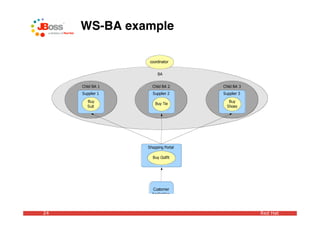
 •   Workflow-like coordination and management
 •   Business activity can be partitioned into tasks
     – Parent and child relationships
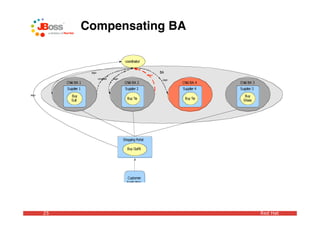
         • Select subset of children to complete
         • Parent can deal with child failures without compromising forward
           progress
 •   Tasks can dynamically exit a business activity
 •   Tasks can indicate outcome earlier than termination
     – Up-calls rather than just down-calls


23                                                                            Red Hat
WS-BA example

                   coordinator


                       BA


     Child BA 1     Child BA 2      Child BA 3
     Supplier 1     Supplier 2      Supplier 3

        Buy                            Buy
                      Buy Tie
        Suit                          Shoes


                  Shopping Portal

                    Buy Outfit


                     Customer
                    Application


24                                               Red Hat
Compensating BA

                                                       coordinator

                          begin                                                   BA
                                                                        faulted
                                  completed   begin
                                                                                   begin
             Child BA 1                                Child BA 2                          Child BA 4   Child BA 3
             Supplier 1                                Supplier 2                          Supplier 4   Supplier 3
begin           Buy                                                                                        Buy
                                                         Buy Tie                            Buy Tie
                Suit                                                                                      Shoes


                                                      Shopping Portal

                                                         Buy Outfit


                                                         Customer
                                                        Application


        25                                                                                                           Red Hat
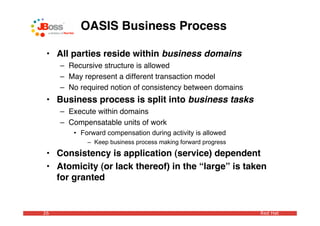
OASIS Business Process

 • All parties reside within business domains
     – Recursive structure is allowed
     – May represent a different transaction model
     – No required notion of consistency between domains
 • Business process is split into business tasks
     – Execute within domains
     – Compensatable units of work
        • Forward compensation during activity is allowed
            – Keep business process making forward progress
 • Consistency is application (service) dependent
 • Atomicity (or lack thereof) in the “large” is taken
   for granted


26                                                            Red Hat
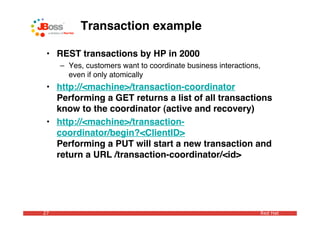
Transaction example

 • REST transactions by HP in 2000
     – Yes, customers want to coordinate business interactions,
       even if only atomically
 • http://<machine>/transaction-coordinator
   Performing a GET returns a list of all transactions
   know to the coordinator (active and recovery)
 • http://<machine>/transaction-
   coordinator/begin?<ClientID>
   Performing a PUT will start a new transaction and
   return a URL /transaction-coordinator/<id>


27                                                            Red Hat
Conclusions

 • Transactions are important in mission critical
   environments
     – Definition of “transaction” needs to be re-thought for Web
       Services
     – But ACID transactions still important
 • OASIS WS-TX defines the standard for Web
   Services Transactions
     – Multiple protocols for different use cases
     – Demonstrated interoperability between
         •   Red Hat/Jboss
         •   IBM
         •   Microsoft
         •   IONA Technologies


28                                                             Red Hat

Mark Little Web Services And Transactions

  • 1.
    This Presentation Courtesyof the International SOA Symposium October 7-8, 2008 Amsterdam Arena www.soasymposium.com info@soasymposium.com Founding Sponsors Platinum Sponsors Gold Sponsors Silver Sponsors
  • 2.
    Web Services andTransactions Dr Mark Little Technical Development Manager, Red Hat
  • 3.
    Overview • Fault tolerance •Transaction fundamentals – What is a transaction? – ACID properties • The Web Service effect on transactions • What characteristics do we really need? • Is this specific to Web Services? 2 Red Hat
  • 4.
    Fault tolerance • Machinesand software fail – Fundamental universal law (entropy increases) – Things get better with each generation, but still statistically significant • Failures of centralized systems difficult to handle • Failures of distributed systems are much more difficult 3 Red Hat
  • 5.
    Fault tolerance techniques •Replication of resources – Increase availability • Probability is that a critical number of resources remain operational • “Guarantee” forward progress – Tolerate programmer errors by heterogeneous implementations • Spheres of control – “Guarantee” no partial completion of work in the presence of failures • Often a duality – “Understanding the Role of Atomic Transactions and Group Communications in Implementing Persistent Replicated”, Proceedings of the 8th International Workshop on Persistent Object Systems, California, USA,1998 4 Red Hat
  • 6.
    What is atransaction? • Mechanistic aid to achieving correctness • Provides an “all-or-nothing” property to work that is conducted within its scope – Even in the presence of failures • Ensures that shared resources are protected from multiple users • “Guarantees” the notion of shared global consensus – Different parties in different locales have the same view of the transaction outcome 5 Red Hat
  • 7.
    Two-phase commit Phase 1 Phase 2 COMMIT ? A RDBMS A RDBMS COMMIT YES C YES C COMMIT ? B RDBMS COMMIT B RDBMS 6 Red Hat
  • 8.
    Transactions for WebServices • Business-to-business interactions may be complex – involving many parties – spanning many different organisations – potentially lasting for hours or days • Cannot afford to lock resources on behalf of an individual indefinitely • May need to undo only a subset of work • So the search has been on, because … 7 Red Hat
  • 9.
    ACID-ic Web Services? •ACID transactions implicitly assume – Closely coupled environment • All entities involved in a transaction span a LAN, for example. – Short-duration activities • Must be able to cope with resources being locked for periods • Therefore, do not work well in – Loosely coupled environments! – Long duration activities! 8 Red Hat
  • 10.
    However … • WebServices are about interoperability – Much less about “Web” • In the short term Web Services transactions will be about interoperability between existing TP systems 9 Red Hat
  • 11.
    What characteristics areright? • Need to be able to relax the strict ACID properties • Need to put control of some into hands of service developer – Is consistency (or consensus) important? • May need a notion of a central coordinator – But may not! – Or something with a fuzzy idea of whatʼs going on • “A comparison of Web services transaction protocols”, IBM Developer Works, 2003. 10 Red Hat
  • 12.
    Relaxing isolation •Internal isolation of resources should be a decision for the service provider – E.g., commit early and define compensation activities – However, it does impact applications • Some users may want to know a priori what isolation policies are used • Undo can be whatever is required – Before and after image – Entirely new business processes – Not guaranteed to really undo 11 Red Hat
  • 13.
    Relaxing atomicity •Sometimes it may be desirable to cancel some work without affecting the remainder – E.g., prefer to get airline seat now even without travel insurance • Similar to nested transactions – Work performed within scope of a nested transaction is provisional – Failure does not affect enclosing transaction 12 Red Hat
  • 14.
    Structuring transactions •Could structure transactional applications from short-duration transactions – Release locks early – Resulting application may still be required to appear to have “ACID” properties • May require application specific means to restore consistency • A transactional workflow system could be used to script the composition of these transactions – But you still need a reliable “coordinator” • Something that knows the state of the flow • Participants also need to know/remember their state • Recovery! – Workflows without (automatic) recovery can be a PITA 13 Red Hat
  • 15.
    Relaxation of consistency • ACID transactions (with two-phase commit) are all about strong global consistency – All participants remain in lock-step – Same view of transaction outcome • But that does not scale – Replication developers have known about this for years • Weak consistency replication protocols developed for large scale (number of replicas and physical deployment) • Merging of caching and replication protocols – Local domains of consistency • Cannot “stop the world” and enforce global consistency – Some transaction research into this, but industry pushing global consistency • Starting to see a change 14 Red Hat
  • 16.
    Heisenbergʼs Uncertainty Principle • Cannot accurately measure both position and momentum of sub-atomic particles – Can know one with certainty, but not the other – Non-deterministic measurements • Large-scale/loosely-coupled transactional applications suffer the same effect – Can know that all services will eventually see same state, just not when – Or at known time can determine state within model/application specific degree of uncertainty • Or another way of thinking about it … – No such thing as simultaneity in data space as there isn't in space-time • “Data on the Outside vs. Data on the Inside”, by Pat Helland 15 Red Hat
  • 17.
    No global consensus • Split transactions into domains of consistency – Strong consistency within domains – Some level of (known) consistency between domains • See “A method for combining replication and caching”, Proceedings of International Workshop on Reliable Middleware Systems, October 1999. • OASIS WS-BusinessProcess specification, part of OASIS WS- CAF, 2003. – Resolve inconsistencies at the business level • Don’t try and run consensus protocols between domains • Consistency related to isolation – Put into the control of the service and application developers 16 Red Hat
  • 18.
    Web Services orscale? • Problems with transactions pre-date Web Services – “Restructure your application to remove transactions” • Current issues with database technologies are not Web Services specific either • Problems are two-fold – Scalability (size and geographic distributed nature) – Control over the infrastructure/services • Trust comes into this too • Much research in the 1990ʼs • SOA (and Web Services) bring this to the foreground – REST would be just as appropriate • Yes, people really do want atomic updates across Web servers 17 Red Hat
  • 19.
    OASIS WS-TX Goals • 4th attempt at standardising • Support range of use cases • “One-size does not fit all” – “Make each program do one thing well; to do a new job, build afresh rather than complicate old programs by adding new features”, Doug McIlroy, inventory Unix pipes – Therefore a single protocol cannot cope with all requirements • Interoperability with existing transaction infrastructures 18 Red Hat
  • 20.
    WS-AT/WS-BA • Specificationsreleased by Arjuna, BEA, IBM, IONA and Microsoft – Now OASIS standard • Separate coordination from transactions – WS-Coordination • Define two transaction models – AtomicTransaction • Closely coupled, interoperability – Business Activities • Compensation based, for long duration activities 19 Red Hat
  • 21.
    Web Services Coordination • Coordination is more fundamental than transactions – Transactions, security, workflow, replication, … – But each use may require different protocol • Two-phase, three-phase, QoS specific, … • Define separate coordination service – Allow customisation for different protocols 20 Red Hat
  • 22.
    WS-Coordination • Definestypical roles of coordinator and participant – Coordinator split into two roles • Activation service – Context • Registration service – Participant interface is implied by specific protocol 21 Red Hat
  • 23.
    WS-AtomicTransaction • Assume ACID transactions – High degree of trust – Isolation for duration of transaction – Backward compensation techniques – Does not allow heuristic outcomes • Integration with existing transaction systems – Important to leverage investments • Interoperability between transaction systems – Something of a holy grail to date 22 Red Hat
  • 24.
    WS-BusinessActivity • Workflow-like coordination and management • Business activity can be partitioned into tasks – Parent and child relationships • Select subset of children to complete • Parent can deal with child failures without compromising forward progress • Tasks can dynamically exit a business activity • Tasks can indicate outcome earlier than termination – Up-calls rather than just down-calls 23 Red Hat
  • 25.
    WS-BA example coordinator BA Child BA 1 Child BA 2 Child BA 3 Supplier 1 Supplier 2 Supplier 3 Buy Buy Buy Tie Suit Shoes Shopping Portal Buy Outfit Customer Application 24 Red Hat
  • 26.
    Compensating BA coordinator begin BA faulted completed begin begin Child BA 1 Child BA 2 Child BA 4 Child BA 3 Supplier 1 Supplier 2 Supplier 4 Supplier 3 begin Buy Buy Buy Tie Buy Tie Suit Shoes Shopping Portal Buy Outfit Customer Application 25 Red Hat
  • 27.
    OASIS Business Process • All parties reside within business domains – Recursive structure is allowed – May represent a different transaction model – No required notion of consistency between domains • Business process is split into business tasks – Execute within domains – Compensatable units of work • Forward compensation during activity is allowed – Keep business process making forward progress • Consistency is application (service) dependent • Atomicity (or lack thereof) in the “large” is taken for granted 26 Red Hat
  • 28.
    Transaction example •REST transactions by HP in 2000 – Yes, customers want to coordinate business interactions, even if only atomically • http://<machine>/transaction-coordinator Performing a GET returns a list of all transactions know to the coordinator (active and recovery) • http://<machine>/transaction- coordinator/begin?<ClientID> Performing a PUT will start a new transaction and return a URL /transaction-coordinator/<id> 27 Red Hat
  • 29.
    Conclusions • Transactionsare important in mission critical environments – Definition of “transaction” needs to be re-thought for Web Services – But ACID transactions still important • OASIS WS-TX defines the standard for Web Services Transactions – Multiple protocols for different use cases – Demonstrated interoperability between • Red Hat/Jboss • IBM • Microsoft • IONA Technologies 28 Red Hat