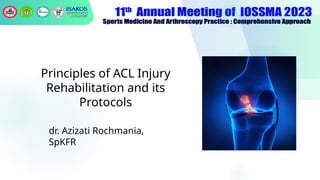
Principles of ACL Injury
Rehabilitation and its
Protocols
dr. Azizati Rochmania,
SpKFR
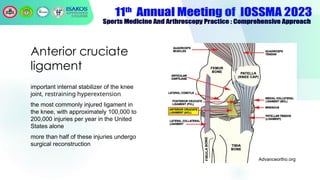
Anterior cruciate
ligament
important internal stabilizer of the knee
joint, restraining hyperextension.
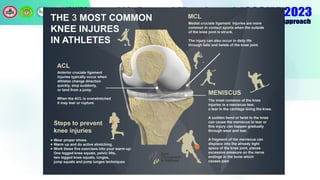
the most commonly injured ligament in
the knee, with approximately 100,000 to
200,000 injuries per year in the United
States alone
more than half of these injuries undergo
surgical reconstruction
Advanceortho.org
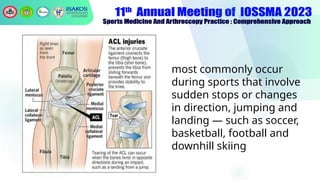
most commonly occur
during sports that involve
sudden stops or changes
in direction, jumping and
landing — such as soccer,
basketball, football and
downhill skiing
Symptoms
•A pop sound in the knee
•A popping sensation in the knee
•Swelling and pain within few hours of injury
•Hemarthrosis- bleeding into the knee joint
•Loss of range of motion
•Severe pain causing hindrance in continuing the activity
•Tenderness and discomfort around the joint while
walking
After ACL reconstruction, the speed and safety with
which an athlete returns to sports or regains the pre-injury
level of function depends largely on the rehabilitation
protocol
Evidence-based rehabilitation following anterior cruciate
ligament reconstruction, Grinsven, Cingel, Holla, van Loon: Knee Surg Sports Traumatol
Arthrosc (2010)
Rehabilitation protocols
Time based
from surgery
Criteria
based
Progression from one phase to the next is based on readiness by
achieving functional criteria rather than the time elapsed since surgery.
Anterior Cruciate Ligament Reconstruction Rehabilitation: MOON Guidelines
Wright, Haas, Anderson et all; SPORTS HEALTH, vol7 no 3, 2014
Pro
 bracing is used to reduce pain,
immobilize the joint, and/or limit
range of motion (ROM)
 protect the graft site by limiting
varus and valgus stresses and
restricting ROM
 recommended bracing for 1 to 3
weeks after surgery, 4 or 6 weeks,
depends on surgery type
Contra
 no study demonstrated a clinically
significant or relevant
improvement in safety, range of
motion including extension, or
other outcome measures
Bracing
Rehabilitation Principles to Consider for Anterior Cruciate Ligament
Repair; Wu, Kator, Zarro et all, SPORTH HEALTH, vol 14 no 3,
2022
Evidence-based rehabilitation following anterior cruciate
ligament reconstruction, Grinsven, Cingel, Holla, van Loon: Knee
Surg Sports Traumatol Arthrosc (2010)
Wright, Haas, Anderson et all; SPORTS HEALTH, vol7 no 3,
2014
Pre operative
.
a preoperative extension deficit (lack of full
extension) is a major risk factor for an
extension deficit after ACLR
a preoperative deficit in quadriceps strength of
>20% has a significant negative consequence for
the self reported outcome 2 years after ACLR
prehabilitation ensures better self-reported knee
function up to 2 years after ACLR.
Evidence-based clinical practice update: practice guidelines for anterior cruciate ligament
rehabilitation based on a systematic review and multidisciplinary consensus
van Melick N, van Cingel REH, Brooijmans F, et al. Br J Sports Med 2016;50:1506–1515
Goals
Minimal pain, swelling and
inflammation response
Restore normal ROM
Develop quadricep and hamstring
strength
Post operative
Weight
bearing
Immediate full weightbearing is initiated following ACL reconstruction
•Moonguidelines,2015
Immediate weight bearing does not affect knee laxity and results in decreased incidence
of anterior knee pain
immediate weight bearing should only be tolerated if there is a correct gait pattern (if
necessary with crutches) and no pain, effusion or increase intemperature when walking or
shortly after walking
•Evidence-based clinical practice update: practice guidelines for anterior cruciate ligament rehabilitation based on a
systematic review and multidisciplinary consensusvan Melick N, van Cingel REH, Brooijmans F, et al. Br J Sports Med
2016;50:1506–1515
Full weight-bearing without crutches within 10 days (with a normal gait pattern) improves
quadriceps function, prevents patellofemoral pain and does not affect knee stability.
•Evidence-based rehabilitation following anterior cruciate ligament reconstruction, Grinsven, Cingel, Holla, van Loon: Knee
Surg Sports Traumatol Arthrosc (2010)
After repair techniques, WB recommendations vary to account for the
initial strength of repair.
•Rehabilitation Principles to Consider for Anterior Cruciate Ligament Repair; Wu, Kator, Zarro et all, SPORTH HEALTH, vol 14 no 3,
2022
ROM
guidelines
Immediate recovery of passive and active
ROM (with an emphasis on full extension)
Multidirectional mobilizations of the patella
should be included
• Evidence-based rehabilitation following anterior cruciate ligament reconstruction, Grinsven, Cingel,
Holla, van Loon: Knee Surg Sports Traumatol Arthrosc (2010)
early full extension is advocated along with
progressively increasing flexion
• Rehabilitation Principles to Consider for Anterior Cruciate Ligament Repair; Wu, Kator, Zarro et all,
SPORTH HEALTH, vol 14 no 3, 2022
Neuromuscular and Proprioceptive Training
Neuromuscular and proprioceptive training is extremely important to
protect the graft from stress and enhance dynamic stability of the knee
generally begins 2 to 4 weeks post-ACLR
Neuromuscular training has been suggested in most phases
Neuromuscular training should start as soon as walking without crutches is
possible
CKC
vs OKC
after ACLR, OKC exercises can be performed from week 4
postoperative in a restricted ROM of 90–45
CKC and OKC training can be used for regaining quadriceps
strength
CKC exercises can be performed from week 2 postoperative
•Evidence-based clinical practice update: practice guidelines for anterior cruciate ligament rehabilitation based on a
systematic review and multidisciplinary consensusvan Melick N, van Cingel REH, Brooijmans F, et al. Br J Sports Med
2016;50:1506–1515
open chain activities after 6 weeks may improve strength
without adversely affecting the graft and/or increasing graft
laxity
•Moonguidelines,2015
Electrical stimulation
electrostimulation can be useful as an addition to isometric
strength training for re-educating voluntary contraction of
the quadriceps muscles during the first postoperative weeks
•Evidence-based clinical practice update: practice guidelines for anterior cruciate ligament rehabilitation based on a systematic review and
multidisciplinary consensusvan Melick N, van Cingel REH, Brooijmans F, et al. Br J Sports Med 2016;50:1506–1515
Some patients who are lagging in muscle recruitment and
redevelopment following surgery will benefit from this
adjunctive treatment
The electrical parameters that best stimulate the muscle for
improved outcome are uncertain and require further
analysis.
•MOON guidelines, 2015
Return to play
An extensive test battery should be used to determine the return-to-play moment
perform an extensive test battery for quantity and quality of movement.
should include at least a strength test battery and a hop test battery and
measurement of quality of movement.
LSI of > 90% could be used as a cut-off point, For pivoting/contact sports, an LSI of
>100% is recommended
The athlete is comfortable, confident, and eager to return to sport, as measured
by the ACL-RSI and IKDC
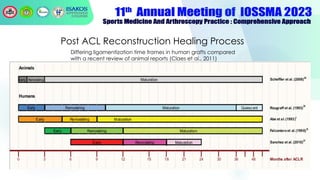
Post ACL Reconstruction Healing Process
Differing ligamentization time frames in human grafts compared
with a recent review of animal reports (Claes et al., 2011)
Phase 1
Recovery from surgery
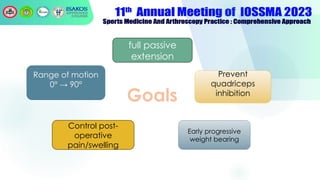
Goals
full passive
extension
Control post-
operative
pain/swelling
Range of motion
0° → 90°
Prevent
quadriceps
inhibition
Early progressive
weight bearing
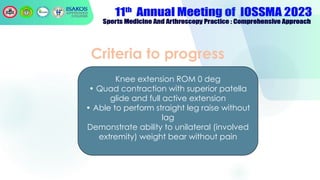
Criteria to progress
Knee extension ROM 0 deg
• Quad contraction with superior patella
glide and full active extension
• Able to perform straight leg raise without
lag
Demonstrate ability to unilateral (involved
extremity) weight bear without pain
Phase 2
Strength and neuromuscular control
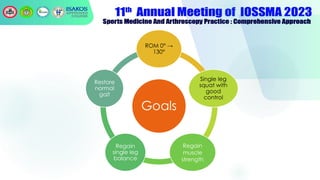
Goals
ROM 0° →
130°
Single leg
squat with
good
control
Regain
muscle
strength
Regain
single leg
balance
Restore
normal
gait
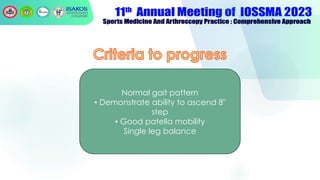
Normal gait pattern
▪ Demonstrate ability to ascend 8″
step
▪ Good patella mobility
Single leg balance
Phase 3
Running, agility, landing
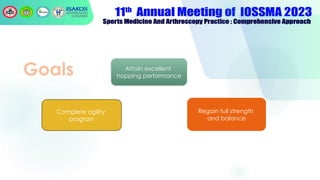
Goals Attain excellent
hopping performance
Complete agility
program
Regain full strength
and balance
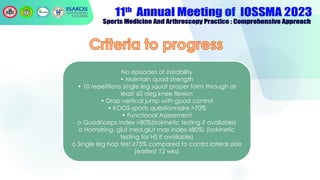
No episodes of instability
• Maintain quad strength
• 10 repetitions single leg squat proper form through at
least 60 deg knee flexion
• Drop vertical jump with good control
• KOOS-sports questionnaire >70%
• Functional Assessment
o Quadriceps index >80%(isokinetic testing if available)
o Hamstring, glut med,glut max index ≥80%; (isokinetic
testing for HS if available)
o Single leg hop test ≥75% compared to contra lateral side
(earliest 12 wks)
Phase 4
Return to sport
Safely progress strengthening
• Safely initiate sport specific training
program
• Promote proper movement patterns
• Avoid post exercise pain/swelling
• Avoid activities that produce pain at
graft donor site
Return to sport criteria
Lack of apprehension with sport specific movements
▪ Maximize strength and flexibility as to meet demands of
individual’s sport activity
▪ Isokinetic test ≥90% limb symmetry
▪ Hop test ≥90% limb symmetry
▪ Acceptable quality movement assessment
Athlete is comfortable, confident, and eager to return to Sport
measured by the ACL-RSI and IKDC
An ACL injury prevention program is discussed, implemented, and
continued whilst the athlete is participating in sport
95 + on Melbourne Return to Sport Score
ACL Rehabilitation Progression: Where Are We Now?: Cavanaugh, Powers Curr
Rev Musculoskelet Med (2017) 10:289–296,
Melbourne ACL Rehabilitation Guide 2.0
Phase 5
Prevention of re-injury
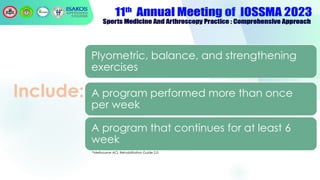
Include:
Plyometric, balance, and strengthening
exercises
A program performed more than once
per week
A program that continues for at least 6
week
•Melbourne ACL Rehabilitation Guide 2.0
Acl rehabilitation.......................

Acl rehabilitation.......................

  • 1.
    Principles of ACLInjury Rehabilitation and its Protocols dr. Azizati Rochmania, SpKFR
  • 3.
    Anterior cruciate ligament important internalstabilizer of the knee joint, restraining hyperextension. the most commonly injured ligament in the knee, with approximately 100,000 to 200,000 injuries per year in the United States alone more than half of these injuries undergo surgical reconstruction Advanceortho.org
  • 4.
    most commonly occur duringsports that involve sudden stops or changes in direction, jumping and landing — such as soccer, basketball, football and downhill skiing
  • 5.
    Symptoms •A pop soundin the knee •A popping sensation in the knee •Swelling and pain within few hours of injury •Hemarthrosis- bleeding into the knee joint •Loss of range of motion •Severe pain causing hindrance in continuing the activity •Tenderness and discomfort around the joint while walking
  • 6.
    After ACL reconstruction,the speed and safety with which an athlete returns to sports or regains the pre-injury level of function depends largely on the rehabilitation protocol Evidence-based rehabilitation following anterior cruciate ligament reconstruction, Grinsven, Cingel, Holla, van Loon: Knee Surg Sports Traumatol Arthrosc (2010)
  • 7.
    Rehabilitation protocols Time based fromsurgery Criteria based Progression from one phase to the next is based on readiness by achieving functional criteria rather than the time elapsed since surgery. Anterior Cruciate Ligament Reconstruction Rehabilitation: MOON Guidelines Wright, Haas, Anderson et all; SPORTS HEALTH, vol7 no 3, 2014
  • 8.
    Pro  bracing isused to reduce pain, immobilize the joint, and/or limit range of motion (ROM)  protect the graft site by limiting varus and valgus stresses and restricting ROM  recommended bracing for 1 to 3 weeks after surgery, 4 or 6 weeks, depends on surgery type Contra  no study demonstrated a clinically significant or relevant improvement in safety, range of motion including extension, or other outcome measures Bracing Rehabilitation Principles to Consider for Anterior Cruciate Ligament Repair; Wu, Kator, Zarro et all, SPORTH HEALTH, vol 14 no 3, 2022 Evidence-based rehabilitation following anterior cruciate ligament reconstruction, Grinsven, Cingel, Holla, van Loon: Knee Surg Sports Traumatol Arthrosc (2010) Wright, Haas, Anderson et all; SPORTS HEALTH, vol7 no 3, 2014
  • 9.
  • 10.
    . a preoperative extensiondeficit (lack of full extension) is a major risk factor for an extension deficit after ACLR a preoperative deficit in quadriceps strength of >20% has a significant negative consequence for the self reported outcome 2 years after ACLR prehabilitation ensures better self-reported knee function up to 2 years after ACLR. Evidence-based clinical practice update: practice guidelines for anterior cruciate ligament rehabilitation based on a systematic review and multidisciplinary consensus van Melick N, van Cingel REH, Brooijmans F, et al. Br J Sports Med 2016;50:1506–1515
  • 11.
    Goals Minimal pain, swellingand inflammation response Restore normal ROM Develop quadricep and hamstring strength
  • 12.
  • 13.
    Weight bearing Immediate full weightbearingis initiated following ACL reconstruction •Moonguidelines,2015 Immediate weight bearing does not affect knee laxity and results in decreased incidence of anterior knee pain immediate weight bearing should only be tolerated if there is a correct gait pattern (if necessary with crutches) and no pain, effusion or increase intemperature when walking or shortly after walking •Evidence-based clinical practice update: practice guidelines for anterior cruciate ligament rehabilitation based on a systematic review and multidisciplinary consensusvan Melick N, van Cingel REH, Brooijmans F, et al. Br J Sports Med 2016;50:1506–1515 Full weight-bearing without crutches within 10 days (with a normal gait pattern) improves quadriceps function, prevents patellofemoral pain and does not affect knee stability. •Evidence-based rehabilitation following anterior cruciate ligament reconstruction, Grinsven, Cingel, Holla, van Loon: Knee Surg Sports Traumatol Arthrosc (2010) After repair techniques, WB recommendations vary to account for the initial strength of repair. •Rehabilitation Principles to Consider for Anterior Cruciate Ligament Repair; Wu, Kator, Zarro et all, SPORTH HEALTH, vol 14 no 3, 2022
  • 14.
    ROM guidelines Immediate recovery ofpassive and active ROM (with an emphasis on full extension) Multidirectional mobilizations of the patella should be included • Evidence-based rehabilitation following anterior cruciate ligament reconstruction, Grinsven, Cingel, Holla, van Loon: Knee Surg Sports Traumatol Arthrosc (2010) early full extension is advocated along with progressively increasing flexion • Rehabilitation Principles to Consider for Anterior Cruciate Ligament Repair; Wu, Kator, Zarro et all, SPORTH HEALTH, vol 14 no 3, 2022
  • 15.
    Neuromuscular and ProprioceptiveTraining Neuromuscular and proprioceptive training is extremely important to protect the graft from stress and enhance dynamic stability of the knee generally begins 2 to 4 weeks post-ACLR Neuromuscular training has been suggested in most phases Neuromuscular training should start as soon as walking without crutches is possible
  • 16.
    CKC vs OKC after ACLR,OKC exercises can be performed from week 4 postoperative in a restricted ROM of 90–45 CKC and OKC training can be used for regaining quadriceps strength CKC exercises can be performed from week 2 postoperative •Evidence-based clinical practice update: practice guidelines for anterior cruciate ligament rehabilitation based on a systematic review and multidisciplinary consensusvan Melick N, van Cingel REH, Brooijmans F, et al. Br J Sports Med 2016;50:1506–1515 open chain activities after 6 weeks may improve strength without adversely affecting the graft and/or increasing graft laxity •Moonguidelines,2015
  • 17.
    Electrical stimulation electrostimulation canbe useful as an addition to isometric strength training for re-educating voluntary contraction of the quadriceps muscles during the first postoperative weeks •Evidence-based clinical practice update: practice guidelines for anterior cruciate ligament rehabilitation based on a systematic review and multidisciplinary consensusvan Melick N, van Cingel REH, Brooijmans F, et al. Br J Sports Med 2016;50:1506–1515 Some patients who are lagging in muscle recruitment and redevelopment following surgery will benefit from this adjunctive treatment The electrical parameters that best stimulate the muscle for improved outcome are uncertain and require further analysis. •MOON guidelines, 2015
  • 18.
    Return to play Anextensive test battery should be used to determine the return-to-play moment perform an extensive test battery for quantity and quality of movement. should include at least a strength test battery and a hop test battery and measurement of quality of movement. LSI of > 90% could be used as a cut-off point, For pivoting/contact sports, an LSI of >100% is recommended The athlete is comfortable, confident, and eager to return to sport, as measured by the ACL-RSI and IKDC
  • 19.
    Post ACL ReconstructionHealing Process Differing ligamentization time frames in human grafts compared with a recent review of animal reports (Claes et al., 2011)
  • 20.
  • 21.
    Goals full passive extension Control post- operative pain/swelling Rangeof motion 0° → 90° Prevent quadriceps inhibition Early progressive weight bearing
  • 22.
    Criteria to progress Kneeextension ROM 0 deg • Quad contraction with superior patella glide and full active extension • Able to perform straight leg raise without lag Demonstrate ability to unilateral (involved extremity) weight bear without pain
  • 23.
    Phase 2 Strength andneuromuscular control
  • 24.
    Goals ROM 0° → 130° Singleleg squat with good control Regain muscle strength Regain single leg balance Restore normal gait
  • 25.
    Normal gait pattern ▪Demonstrate ability to ascend 8″ step ▪ Good patella mobility Single leg balance
  • 26.
  • 27.
    Goals Attain excellent hoppingperformance Complete agility program Regain full strength and balance
  • 28.
    No episodes ofinstability • Maintain quad strength • 10 repetitions single leg squat proper form through at least 60 deg knee flexion • Drop vertical jump with good control • KOOS-sports questionnaire >70% • Functional Assessment o Quadriceps index >80%(isokinetic testing if available) o Hamstring, glut med,glut max index ≥80%; (isokinetic testing for HS if available) o Single leg hop test ≥75% compared to contra lateral side (earliest 12 wks)
  • 29.
  • 30.
    Safely progress strengthening •Safely initiate sport specific training program • Promote proper movement patterns • Avoid post exercise pain/swelling • Avoid activities that produce pain at graft donor site
  • 31.
    Return to sportcriteria Lack of apprehension with sport specific movements ▪ Maximize strength and flexibility as to meet demands of individual’s sport activity ▪ Isokinetic test ≥90% limb symmetry ▪ Hop test ≥90% limb symmetry ▪ Acceptable quality movement assessment Athlete is comfortable, confident, and eager to return to Sport measured by the ACL-RSI and IKDC An ACL injury prevention program is discussed, implemented, and continued whilst the athlete is participating in sport 95 + on Melbourne Return to Sport Score ACL Rehabilitation Progression: Where Are We Now?: Cavanaugh, Powers Curr Rev Musculoskelet Med (2017) 10:289–296, Melbourne ACL Rehabilitation Guide 2.0
  • 33.
  • 34.
    Include: Plyometric, balance, andstrengthening exercises A program performed more than once per week A program that continues for at least 6 week •Melbourne ACL Rehabilitation Guide 2.0

Editor's Notes

  • #7 Programs are individualized, where some patients will be ready to advance sooner than others. Biological factors such as graft revascularization and maturation as well as fixation techniques are also considered to ensure a safe progression through the ACLR rehabilitation program
  • #15 Neuromuscular training is defined as training enhancing unconscious motor responses by stimulating afferent signals and central mechanisms responsible for dynamic joint control