UK BIM Alliance
Update
Su Butcher
UK BIM Alliance Executive Team
View these Slides: bit.ly/UKBIMABIM4HOUSING
What is BIM?
BIM is…
Having
the right information
available in the right place
at the right time”
“
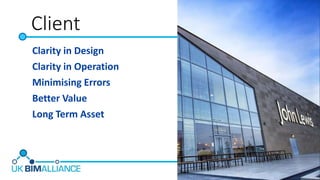
Client
Clarity in Design
Clarity in Operation
Minimising Errors
Better Value
Long Term Asset
Architect
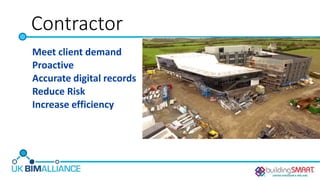
Contractor
Meet client demand
Proactive
Accurate digital records
Reduce Risk
Increase efficiency
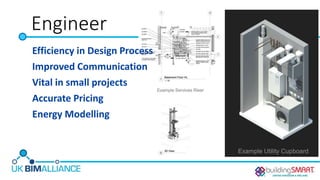
Engineer
Efficiency in Design Process
Improved Communication
Vital in small projects
Accurate Pricing
Energy Modelling
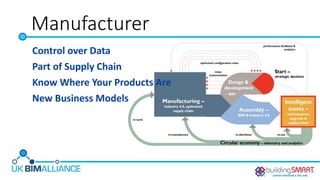
Manufacturer
Control over Data
Part of Supply Chain
Know Where Your Products Are
New Business Models
Our Journey
The way we were…
How did we get here?
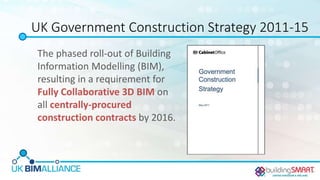
UK Government Construction Strategy 2011-15
The phased roll-out of Building
Information Modelling (BIM),
resulting in a requirement for
Fully Collaborative 3D BIM on
all centrally-procured
construction contracts by 2016.
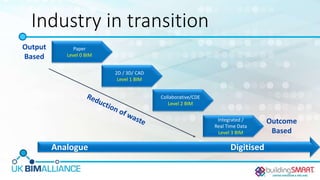
Industry in transition
Paper
Level 0 BIM
2D / 3D/ CAD
Level 1 BIM
Collaborative/CDE
Level 2 BIM
Integrated /
Real Time Data
Level 3 BIM
Analogue Digitised
Output
Based
Outcome
Based
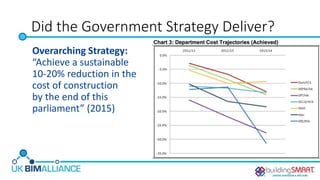
Did the Government Strategy Deliver?
Overarching Strategy:
“Achieve a sustainable
10-20% reduction in the
cost of construction
by the end of this
parliament” (2015)
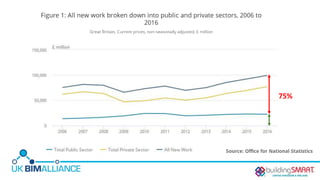
75%
Transformation
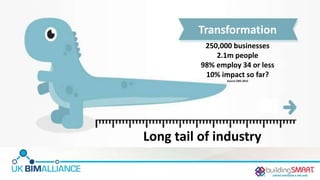
Long tail of industry
250,000 businesses
2.1m people
98% employ 34 or less
10% impact so far?
Source ONS 2015
15
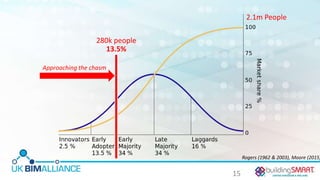
13.5%
2.1m People
280k people
Rogers (1962 & 2003), Moore (2015)
Approaching the chasm
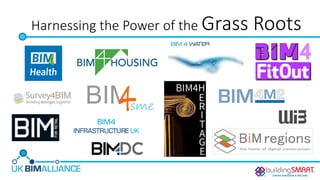
Harnessing the Power of the Grass Roots
GCS
Introducing:
Common understanding; common approach; one voice
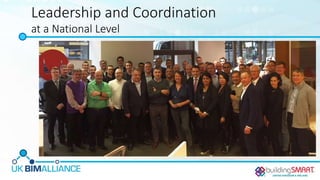
Leadership and Coordination
at a National Level
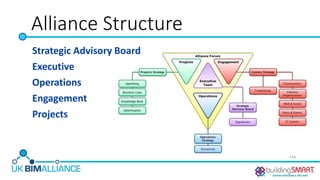
Alliance Structure
Strategic Advisory Board
Executive
Operations
Engagement
Projects
Projects: Finding the Gaps
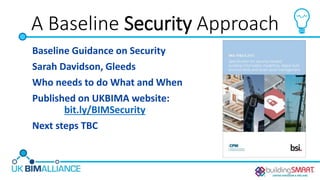
A Baseline Security Approach
Baseline Guidance on Security
Sarah Davidson, Gleeds
Who needs to do What and When
Published on UKBIMA website:
bit.ly/BIMSecurity
Next steps TBC
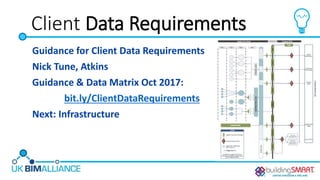
Client Data Requirements
Guidance for Client Data Requirements
Nick Tune, Atkins
Guidance & Data Matrix Oct 2017:
bit.ly/ClientDataRequirements
Next: Infrastructure
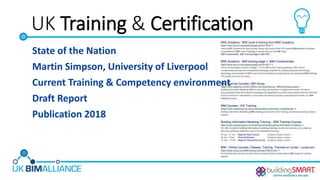
UK Training & Certification
State of the Nation
Martin Simpson, University of Liverpool
Current Training & Competency environment
Draft Report
Publication 2018
Legal and Contractual
Legal and Contractual Barriers to BIM
May Winfield, Carillion &
Sarah Rock, Gowling WLG
Current understanding?
Report in Production
BIMShowLive 2018
Launch Q2 2018
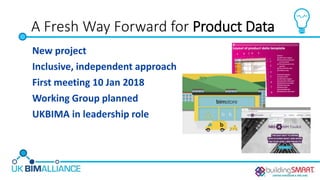
A Fresh Way Forward for Product Data
New project
Inclusive, independent approach
First meeting 10 Jan 2018
Working Group planned
UKBIMA in leadership role
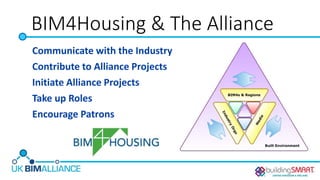
BIM4Housing & The Alliance
Communicate with the Industry
Contribute to Alliance Projects
Initiate Alliance Projects
Take up Roles
Encourage Patrons
Get Involved – Key Contacts
Communities Groups Bi-Annual
next meeting: June, Leeds/Manchester
Alliance Forum Quarterly
next meeting: March, London
Alliance Newsletter bit.ly/UKBIMAnews
info@ukbimalliance.org
www.ukbimalliance.org
Chair: Anne Kemp
chair@ukbimalliance.org
Communities: Andy Boutle
communities@ukbimalliance.org
Engagement: John Eynon
info@ukbimalliance.org
Communications: Pam Bhandal
pam@pambhandal.com
View these Slides: bit.ly/UKBIMABIM4HOUSING

UK BIM Alliance Update: BIM4Housing

Editor's Notes

  • #3 What is BIM? Building Information Modelling (BIM) is a very broad term that describes the process of creating and managing digital information about a built asset 
  • #4 But I like this definition. Which of you feels you always have the right information available in the right place, at the right time? This is what we are aspiring to. Why BIM? Lets have a look at the benefits of BIM from the perspective of different people in the process – all these people have spoken at BIM Region events in the last year about the benefits of BIM to them.
  • #5 Andy Smith of John Lewis Partnership is an client advocate of BIM. This is how he views the benefits of BIM For John Lewis it is about not overcomplicating things, but thinking about the endgame. Clients should approach BIM from a building perspective Making life simpler, cheaper and quicker. How much change can I eliminate from the project? John Lewis have begun from the fundamentals – Standards, Libraries and End User Requirements, and built upon that a collaborative design and construction team. After that they are looking at innovation, everything from programming, cost estimation, energy models, staffing models, off site manufacture, to all contribute to the efficiency. They see BIM as not only a construction tool, but a tool that works for the business ongoing objectives. https://www.youtube.com/watch?v=TWQEq6ubrn8
  • #6 Casey Rutland, Architect and BIM Advocate outlines different but related benefits. BIM Reduces Waste – including cost, materials, rework Improves visibility – the process allows people to see data earlier and act on it This give an architect Greater Confidence in Design – He or she is able to communicate the design better BIM therefore Facilitates multidisciplinary design – better understanding leading to alignment of objectives across a design team. BIM is about collaborative working, not simply a model. It requires and demands it, to everyone’s benefit.
  • #7 To a contractor BIM gives greater confidence too. Jill Guthrie of Willmott Dixon says it enables them Meet client demand (deliver better digital & physical assets and manage expectations) Proactive Rather than reactive - Improve information management and better decision making Reduce double handling of information Accurate digital records – an audit trail too Reduce Risk - Improve H&S by identifying risks proactively and making better informed decisions and Improved communication Increase efficiency and margin http://monfm.net/en/2017/11/23/eleven-companies-to-move-to-menai-science-park/
  • #8 David Mather is a mechanical engineer and chair of the CIBSE Young Engineer’s network. He says that BIM leads to Efficiency of design process - it helps deliver a co-ordinated design as the M&E designer has a better understanding of the physical restrictions when the architect and structural model are loaded in, it also helps resolve clashes when (inevitably) they occur BIM improves communication, helping the client make decisions and helping the rest of the design team understand M&E proposals David has used BIM in high end residential work where it is vital when working with small commercial equipment He also points out that the contractor can price more accurately because he can see that co-ordination has been carried out And BIM also enables energy modelling of course, which eventually may help us bridge the Performance Gap.
  • #9 Finally from a Manufacturer perspective, Paul Surin of Weinerberger often presents on the benefits of BIM to manufacturers. BIM has the potential to finally give manufacturers genuine control and management of their data. It enables the manufacturer to play their part in the supply chain much more effectively Innovations will potentially be able to show manufacturers where their products are, and enable their products to be swiftly identified throughout the process including in existing assets. Ultimately BIM, Paul believes, will bring about new business models, new ways of developing built assets, and a renaissance in the built environment. This illustration is from the CPA report ‘the future of construction product manufacturing’. https://www.constructionproducts.org.uk/publications/corporate-and-industrial/the-future-for-construction-product-manufacturing/
  • #10 So lets begin by looking back to where we started and our journey up to today
  • #11 Back in 2011 the Government Construction Strategy mandated the use of collaborative 3D BIM (that is BIM Level 2) on government procured projects by April 2016. This gave us a deadline.
  • #12 Our industry is in transition from Analogue to Digital The implementation of the Construction Strategy was envisaged as a staged plan with the April 2016 target for business as usual for the government departments, and the industry as a whole would follow along. The target of April 2016 produced the motivation for many initiatives, including the development of the Level 2 standards, various working parties and groups, conferences, formation of the various BIM 4 groups and the BIM Regions, AKA the BIM4Communities to help support the transition. It wasn’t comfortable, it wasn’t easy, there were some dead ends and a mixed reception. There are also exemplars of excellence who are leading the transition to BIM ways of working. But when you think about the digitisation of our lives, you can see that the built environment is behind the curve. The world wants our data, but we are not ready yet. We are the last sector to make this transition. The question is do we want to change ourselves or do we want this done to us as other digital disrupters enter our space and take over? Do we want to be Kodak, Blockbuster and HMV? Where are they now? These are examples of digital technologies transforming industries, winners and losers. Construction will be no different!
  • #13 When the 2016 deadline came, some thought that Level 2 would be a done deal. From a Government perspective, it was. In May 2015 Rob Garvey senior lecturer at the University of Westminster and Academic Partner on the Government Trial projects led a discussion about the 2011 Government Construction Strategy at a London Constructing Excellence event. The event concluded that the actual objective of the strategy had probably been achieved, at least in part. These are the government’s reported savings by department between 2011 and 2014. Though there were concerns about whether those achievements were ‘sustainable’ and there’s a long way before the trial project initiatives are rolled out across industry. So that’s alright for government procured projects, but what about the rest of the industry, and what about Level 2 BIM? https://www.londonconstructingexcellence.org.uk/may-2015-event/ https://www.gov.uk/government/uploads/system/uploads/attachment_data/file/325919/Departmental_Cost_Benchmarks_Cost_Reduction_Trajectories_and_Cost_Reductions_02_July_2014.pdf
  • #14 In any case publicly procured projects made up around 25% by value of all new work in 2016. What about the private sector? https://www.ons.gov.uk/businessindustryandtrade/constructionindustry/articles/constructionstatistics/number182017edition
  • #15 And what about the long tail of industry? In an industry of 2.1m people, with 95% SMEs , if 10% have an understanding of BIM at the moment that might be being over optimistic! Outside Whitehall, we have a long long way to go in getting BIM across to everyone.
  • #16 Essentially you could say adoption of BIM is still at the Early Adopter stage. How are we going to get it adopted more widely?
  • #17 The answer lies not in a top down approach, like we have had from the Government Mandate alone (though that was nice), but a bottom up one. We already have a lot of grass roots groups – the BIM4 groups like BIM4 Housing, whose role is to champion BIM in their own specialist areas, and the BIM Regions, The Special Interest Groups like Women in BIM, the BIM Technology Alliance. But our voice was fragmented, and the Government Task Group’s work was done. We need to harness the power of all these different groups of people. This is how the UK BIM Alliance was born.
  • #18 We are the latest evolution of the UK BIM movement. Our context is the digital formation of the Built Environment. It is not just about BIM, but a broader vision for what our industry can be. We want BIM Level 2 as business as usual by 2020. In an industry of over 2.1M people, where 95% work in SMEs; our mission is to enable all actors to understand the value of a digitally enabled industry. The UK BIM Alliance aims to lead, facilitate and focus this value proposition to industry
  • #19 The Alliance is a movement as much as an organisation. Our role is to provide leadership and co-ordination of these groups at a national level, helping them work together, giving them a voice and speaking as one industry. Here are just a few of those involved attending the Alliance Forum meeting in December.
  • #20 We have an organisation of course, headed by a strategic advisory board, drawn from a group of signatories across industry whose aim is to keep us open, independent and accountable. The alliance is run by the executive team who meet fortnightly. We have an operations element that manages the day to day running, An engagement piece which communicates with all our communities, industry organisations and beyond, And most importantly we have a Projects element.
  • #21 Projects are the most important thing which the Alliance does, because as an industry wide body we’re able to work with our communities to identify where work is not being done, which issues are not being addressed, finding the gaps and the bottlenecks which are preventing BIM Level 2 implementation and looking for ways to plug those gaps or clear those bottlenecks. Here are some of the projects we are currently supporting. In each case I’ll briefly set out What was the need?What has been done?What happens Next?How to get involved? https://www.flickr.com/photos/24354425@N03/24918525807/
  • #22 The first is about security. Appropriately managed data and information security is fundamental to built assets. However, the concept of data and information security is not widely understood or appreciated. PAS 1192-5 was brought out in 2015 but it has been realised that it is very technical and difficult for non-specialists to get started with. This project was aimed at bridging the skills and knowledge gap in the application of PAS1192-5. It looked at bringing together basic, or baseline advice on secure approaches to digital management of the design and construction of built assets. That baseline guidance has been published on the UKBIMAlliance website. Essentially this outlines who needs to do what, and when. It’s a very simple page with links which you can share with anyone – like your CEO to answer the basic questions. This is a starting point like all of our projects, a small step towards dealing with an issue. The team hopes to scope out the next stages in the near future.
  • #23 Many clients are asking for BIM Level 2 within contract documents, but not clearly setting out the data requirements within the AIR (Asset Information Requirement Document). This in turn can lead to the under supply or over supply of data that has little or no value. Asking for CoBie is not enough – that is the format, not the content. Without clearly stating the data requirements and ensuring that they are collected, validated/verified and utilised in the operation of the building, many of the benefits of Level 2 BIM are lost. The project has led to the production of a guide for clients on construction projects, together with a data matrix, which can be used as a practical tool by clients. This is a working document and discussion and suggestions are welcomed. The guidance contains a good set of plain language questions. This project team are now looking to carry out a similar exercise for Infrastructure projects.
  • #24 This project responds to the fact that there is no independent analysis of training and certification of BIM in the UK. As a result the certification landscape is a bit like the Wild West at the moment. The Alliance wanted to know, What is the ‘State of the Nation’? So a study has been carried out into the current training environment with recommendations on what can be done moving forward. It looks at the issue of competency, not just platform based certification. There is general confusion in the industry about the difference between capability and competence. A Draft Report has been produced and this is undergoing peer review with intended publication later this year.
  • #25 Having the right contracts and legal people who understand them is essential to the proper implementation of BIM. However we suspect that current legal understanding is patchy at best. So Winfield and Rock are carrying out a qualitative and quantitative survey and interviews to ascertain how much knowledge there is in the legal profession about BIM and what the issues are. This will lead to better understanding of the problems where they exist and what might be done to plug the gaps. A Report is in production Initial Findings will be presented at BIMShowLive Newcastle 28 Feb/1 March With a proper launch Q2 2018 along with the launch of BIM4Legal
  • #26 This is a new project – it is one of several in the pipeline. A great deal of time and effort has been spent on the topic of product data over the years, and much of this is now coming to a head with projects happening and others being proposed, some dead ends and a lack of focus and leadership in some areas. The UK BIM Alliance wants to help steer a way out of this difficult thicket and help identify an inclusive way forward which as an independent industry representative body, the Alliance can support and facilitate. We hope that this will be the beginning of a sea change in how the industry views product data and the participants in this collaborative venture. So far the alliance has facilitated a meeting of some of the key protagonists (on 10 January) and out of that is expected shortly to come a Working Group who will look at the landscape of product data from a range of perspectives, identifying what work is being done and what solutions already exist. The intention is for the Alliance to provide leadership and direction, so that the industry can focus on what matters and ensure investment is placed in solutions that serve everyone who needs to work with product data.
  • #27 So how can the Alliance help BIM4 Housing and Vice versa? Firstly the Alliance belongs to you, so through our communications channels, we can help BIM4housing to communicate with industry, find the right groups, industry organisations and media to talk to, and share your messages and needs widely. Secondly you may wish to become involved in some of the projects I’ve described – they are all run by volunteers from across industry so its essential that people share their expertise and experience to ensure that we succeed. Thirdly if you identify a need which covers not just Housing or which is applicable to the wider industry, perhaps you might like to propose a project which the Alliance can support. We have a triage system for evaluating projects, and hope to obtain funding for some of them where required. We are also looking for people to help the alliance central organisation – at present we are looking for project managers and a programme manager to join our Projects team, and we’re also looking for non executives to join the Executive team. And lastly our work is funded by Patrons – an increasing number of organisations across industry are coming on board, and we’d welcome enquiries about our patronage scheme which is all set out on our website. Remember the role of the Alliance is to identify and fill the gaps so that the whole of industry can champion Level 2 BIM and the digital transformation of the industry. Let us know how we can help you in this task.
  • #28 There are a variety of ways that BIM4Housing can participate in the alliance activities and decision making. Community groups meet twice a year, and there is a communities lead who can help you find what you need in the meantime The Alliance Forum with representatives from across industry meets quarterly, our next meeting is on We also have a newsletter to keep in touch with all activities and events. I’m very much looking forward to hearing about your plans and activites and sharing these with the executive, if you do want to discuss anything with me I’ll be here all day. Thank you.