







Social Media
Coast Gorad Boat by Mike Baird
What should we be
Su Butcher
justpractising.com
Doing
?
See these slides at
Coast Gorad Boat by Mike Baird
justpractising.com/events/ribalmf2016
Su Butcher
justpractising.com
Su Butcher
• BA (Hons) BArch University of Liverpool
• Practice Management
maap
Inkpen Downie
Barefoot & Gilles
• Social Strategist
In Construction
Est. 2011
Source
Clients
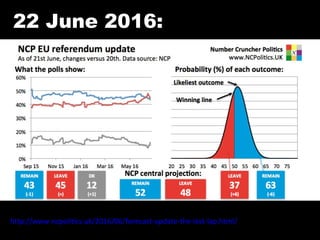
22 June 2016:
http://www.ncpolitics.uk/2016/06/forecast-update-the-last-lap.html/
A Disclaimer
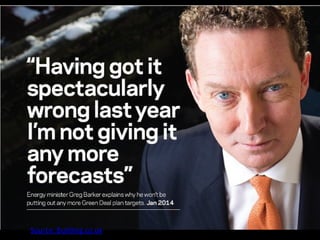
Source: Building.co.uk
Social Media
Coast Gorad Boat by Mike Baird
What should we be
Doing
?
• What and Why?
• Progress & where we are Now
• Opportunities
• Plan for the Future
Shashi Bellamkonda #nlalinkedin
http://theconversationprism.com/
Social Media
Your advocates
speak well of you
when you're not there.
Nicole Bachmann
Golf by Robert Scoble
tylerdurden
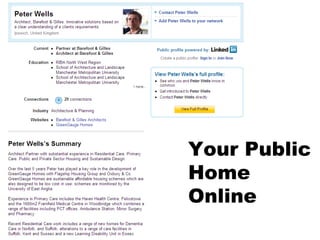
Your Public
Home
Online
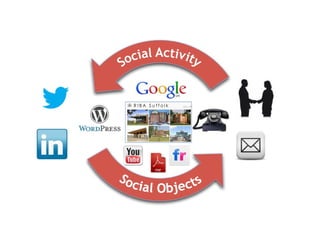
The Social Cycle
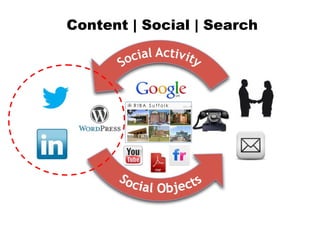
Content | Social | Search
People
make
Social Media
work
SpeedOfLife
© Agency Spring 2016.
Listen
Be Helpful
Be Found
© Agency Spring 2016.
The Big Four
Facebook
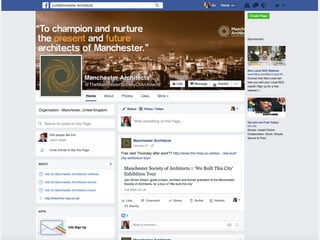
Facebook Pages
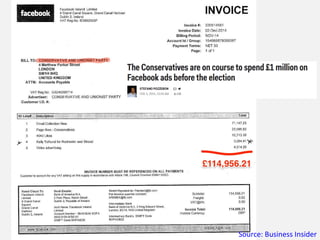
Source: Business Insider
Miguel Baigts Independent Article
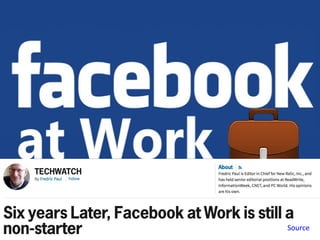
Miguel Baigts Independent ArticleSource
Mikhail Nayko
Watch the tour: https://slack.com/is
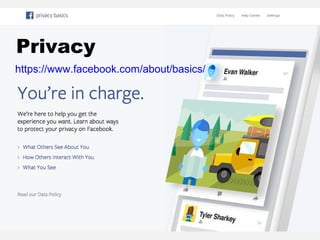
https://www.facebook.com/about/basics/
Privacy
Google Plus
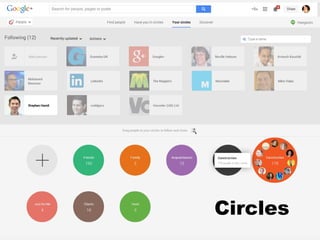
Circles
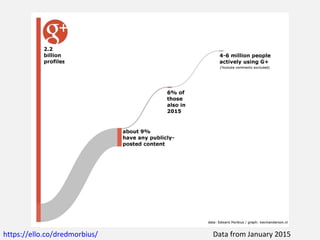
Authorship is Dead
Author Ranking is not
https://ello.co/dredmorbius/ Data from January 2015
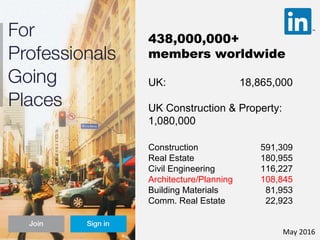
438,000,000+
members worldwide
UK: 18,865,000
UK Construction & Property:
1,080,000
Construction 591,309
Real Estate 180,955
Civil Engineering 116,227
Architecture/Planning 108,845
Building Materials 81,953
Comm. Real Estate 22,923
May 2016
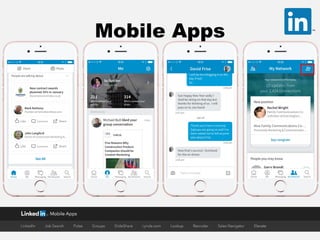
Mobile Apps
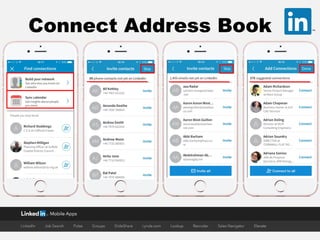
Connect Address Book
HiggySTFC
Advanced Search:
Finding your Audience
mattimattila
Go Hunting
Cafemoka
Make
Yourself
Invisible
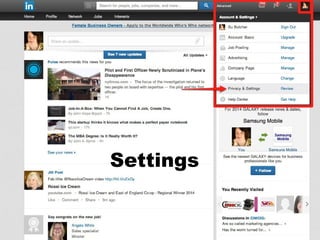
Settings
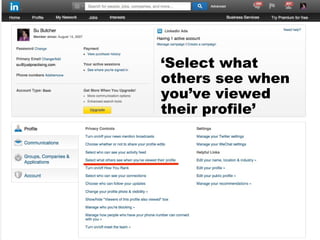
‘Select what
others see when
you’ve viewed
their profile’
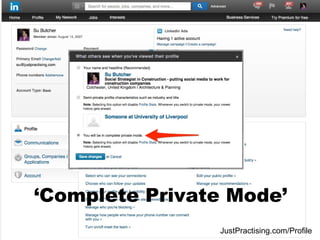
‘Complete Private Mode’
JustPractising.com/Profile
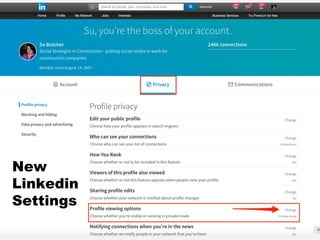
New
Linkedin
Settings
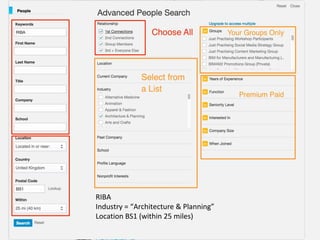
Advanced Search
RIBA
Industry = “Architecture & Planning”
Location BS1 (within 25 miles)
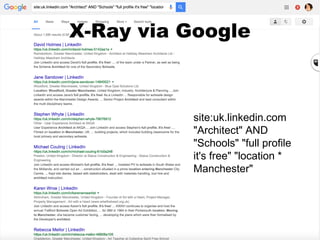
X-Ray via Google
site:uk.linkedin.com
"Architect" AND
"Schools" "full profile
it's free" "location *
Manchester"
Keep in TouchKeep in Touch
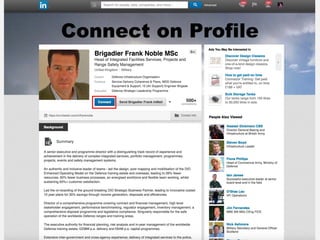
Connect on Profile
Kate Clare
Erix
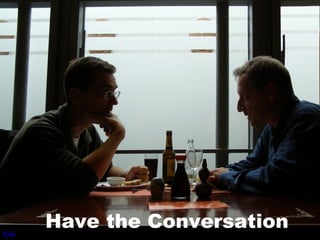
Have the Conversation
Status
Updates
Status
Updates
Receiving
Updates
Sharing =
Engaging
Status Updates
Status Updates
Use Advocates
pickledshark
Twitter
Some
Common
Misconceptions
http://twitter.threadless.com/
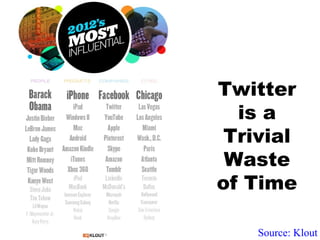
Twitter
is a
Trivial
Waste
of Time
Source: Klout
Firehose
Wikimedia Commons Twitter FIrehose
Twitter SEO Hashtags
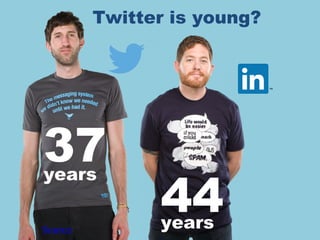
37years
44yearsSource
Twitter is young?
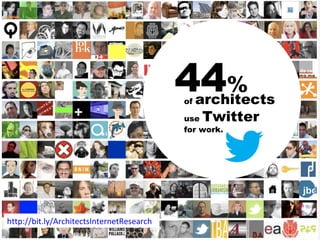
of architects
use Twitter
for work.
44%
http://bit.ly/ArchitectsInternetResearch
You
don’t
have to
be
there
all the
time…
JamesCridland
StickySticky
Twitter isTwitter is
It’s not the PartyIt’s not the Party
jemasmith
Opt
in.
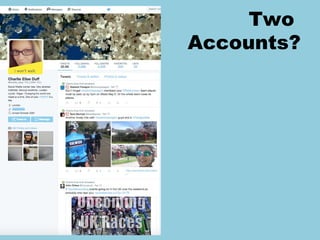
Two
Accounts?
TwitterTwitter
Windows5 minutes
Windows
17 hours
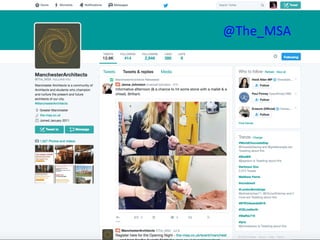
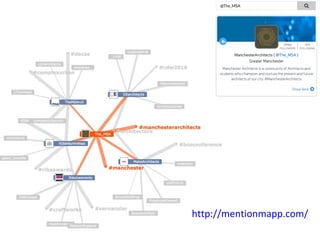
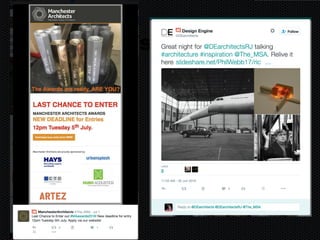
@The_MSA
http://mentionmapp.com/
Windows
2. Windows
Use Advocates
pickledshark
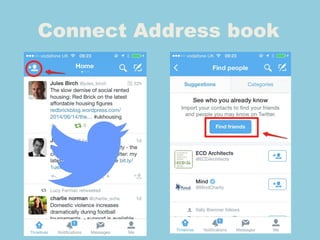
Connect Address book
jasonahowie
Global Web Index Social Summary Q1 2015
Demographic
Global Web Index: Social Summary Q3 2014 (any device)
The Big Four
Source
Smartphones & Tablets
Source
Selfies
Instagram
Tumblr
Pinterest
Youtube
#constructcontent
@DMather4
http://www.theb1m.com/
The Future of Work
My Forecasts
deathtogutenberg
Paulo Otávio
You will
Get more Participants
Paulo Otávio
You will
Get more Participants
If you Listen to members
You will be more visible
erix
You will be more visible
If you talk to people
erix
Things will
happen
Solarpowerrocks.com
Things will
happen
If you are Remarkable
Solarpowerrocks.com
Eggs in one basket
James Lee
Questions
Coast Gorad Boat by Mike Baird
Su Butcher
justpractising.com
?
justpractising.com/events/ribalmf2016

Social Media: What Should We be Doing?

Editor's Notes

  • #2 Lets begin with A disclaimer
  • #3 Lets begin with A disclaimer
  • #5 `
  • #6 Now the first thing to say is that we live in uncertain times, and only a fool would predict the future. This is just one of the many polls that were predicting a 4% win in favour of Remain the day before the EU Referendum vote.
  • #7 But failures to predict the future aren’t new. Greg Barker knows that it’s not a good idea to make forecasts, as he told Building in January 2014. I’ll leave that to Michael Fish. But I’m not completely relieving myself of the responsibility – lets look back…
  • #8 In order to navigate the choppy waters. Lets ask What is social media and why are we talking about it at all? How social media has progressed over the last year or so Where we are now and What that means for you in terms of what you should be doing on social media, using some examples What opportunities are probably coming and how might things change? How we can leverage SM to best advantage and plan for the future for your branch and region.
  • #9 Why do we need Social Media? Because it has changed how people carry out their lives, how they find you and find out about you.
  • #10 What is Social Media People having Conversations and publishing on the internet The Conversation makes it different from traditional media Process of discussing and sharing is what amplifies your message. It is a communications tool. Also it is Digital Media = Publishing Not just talking about other peoples stuff, we have to make our own. Publishing is what makes good social media work Social and Digital Media has changed the way people find you and how you can find them. “Social, be prepared to have the conversation; Media, make it something worth sharing.”
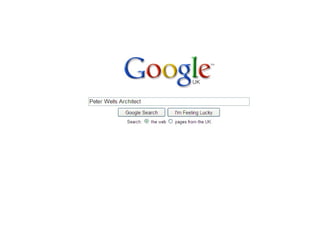
  • #11 An example of How social media works in the real world the world we inhabit, the world of construction. – Peter Wells
  • #13 Notice that we’re talking about an individual here If they have a properly prepared profile on Linkedin, this is what happens next.
  • #14 Because Linkedin is so big and public profiles are indexed by google, its the best way to be found by google, which is where everyone looks. This listing appeared 24 hours after we tweaked his profile back in 2009 – within a week it was right at the top. The developer (or anyone else) who doesn’t know Peter, has enough information to click through from google and he arrives here:
  • #15 This is what you see if you click through. His Public Linkedin profile (not the same as the one you see if you are a Linkedin User – you don’t even have to know what Linkedin is) Designed to tell a target visitor everything they want to know about Peter. Is this the right Peter Wells? What does he do? How do I get in touch or find out more? Linkedin becomes a professional person’s public home online. You can find your audience on social media, and they can find you
  • #16 What does this mean for how we operate an organisation Traditional communications – face to face etc continue People talk about you when you aren’t there
  • #17 Search takes the prospect online Finds website? Possibly But conversations are often between individuals and about individuals. So people looking online will find the places where the individuals are having those conversations. The conversation platforms. They become the stepping stones to your website. You’ll notice there are now many more places for people to find you and get in touch with you. The ones they use will be up to them.
  • #18 What turns this process into a virtuous cycle is the publishing and correct sharing of social objects – useful resources you publish on your website which people can share. Your people and your advocates share social objects driving conversation to the website, Social Objects promote more offline conversations and referrals, and the conversations drive the cycle of search, find, conversation and sharing.
  • #19 Three elements to a successful strategy – Content (make useful stuff), Social (be prepared to have conversations) and Search (people will find you by googling. We need to make that as easy as possible).
  • #20 There’s quite a lot to look at, but today I’m going to talk in particular about this stuff over on the left. Which platforms we use, why we use them and what we can do with them. But across this whole schema one of the most important things to realise is this.
  • #21 The importance of individual people on social media platforms. You can’t do Social Media on your own. You can’t do it solely with a corporate account. You need to integrate it into the activities of your people, because People are what make social media work. And for you that means your membership. And whats the biggest problem with your membership?
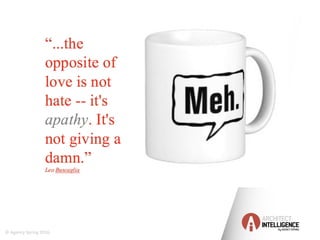
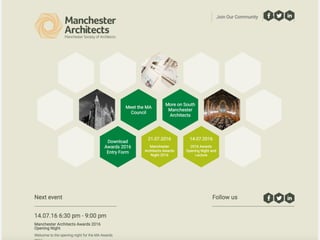
  • #22 Apathy. Manchester Socieity of Architects did some research of their members and realised quite quickly that the bigest problem was that members didn’t want to be involved with the branch because They thought it was not relevant to them Expensive to be a member People didn’t know what the branch did The organisation wasn’t for them or about them, and There were communication problems.
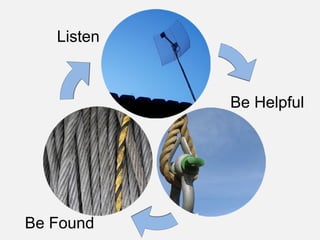
  • #23 Manchester Architects did the first of the 3 steps to achieveing success with social media Listen – learn about your customers, what they care about what they need to know. From there they could move on to Be Helpful – make your offering visible and in a form that they can access – demonstrate your relevance Be Found – make it as simple as possible for them to get the information they require and thereby find you along the way Improving member experience is your ticket to a better relationship. This is a virtuous cycle too.
  • #26 Key part of what they do is use website, email and social together. Mailing list of 2300 they email 2-3 times a week with good opening rates (up to 27%) Council comprises 24 members half under 35 and half female. Programme: Free Monthly CPD (25-45 attendees) Free Bi-monthly lectures (60-65) Bi Monthly Socials - ten pin bowling, pub quizzes, etc (40–50) Craft workshops – gilding, stonemasonry, etc  cost circa £5 ph(~25) Annual MA Awards – 90+ entries this year,( attendees approx 275-300) - last year was bigger than RIBA NW Awards, which they held in Manchester! Annual Dinner – cost approx. £65ph attendees ~350  Almost all of their activities are funded by sponsorship.
  • #27 So where will we begin with the social media? Lets look at the four biggest (most used) social media conversation platforms. What’s been happening with them? What opportunities are there for us? How have Manchester Architects been using them? Four Big Platforms- changes and opportunities in big four
  • #28 Rumours of Facebook’s death were exaggerated (1/3 of US teens left in 2013, record growth in 2014 and since.). Lance Ulanoff of Mashable wrote a piece last week setting out how FB could take on Google. Approx 28million users (half the population) but what do they do there? http://mashable.com/2016/01/28/facebook-domination/ Facebook Decline is Real but Leveling off (Jan 2014) http://mashable.com/2014/01/21/report-teens-declines-on-facebook-similar-to-broader-trend/
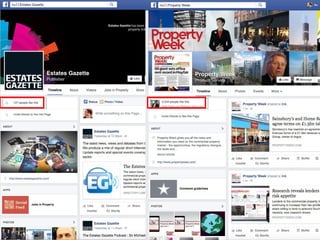
  • #30 PropertyWeek on twitter 48.9k followers Estates Gazette on twitter 43.7k followers
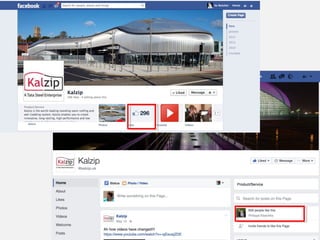
  • #31 Product companies less so. One reason for this is the way people use FB – specifiers for example, use it to talk to friends and family. They aren’t going to tell their mum they like a cladding material.
  • #33 Key is Facebook Ads. Algorithm affects what you see. Companies/organisations need to purchase ads to stay in the game. But the question remains if FB is the right place for your audience.
  • #38 UI – also looks more like Twitter Follower pages Why Google Plus? For Google SEO
  • #42 Linkedin is THE professional network online. Its visitors also have a higher level of education and a higher net worth than the average internet audience. More business people, more professionals.
  • #43 Linkedin is THE professional network online. In October they announced membership had exceeeded 400 million worldwide. Of these over 18 million in the UK and over 1,000,000 UK construction and property professionals, over 20000 UK companies Its visitors also have a higher level of education and a higher net worth than the average internet audience. More business people, more professionals.
  • #49 Now you can Go hunting – in a pack. Work as a team to grow your network in the direction of your target audience. Your team can be colleagues and advocates in other companies who want to work together. Your whole network can be your team – get them organised. Remember each person has a different network, a different set of relationships. Linkedin can make these visible.
  • #50 The other reason to talk to HR is because they know how to use Linkedin. They know how to do this. HR will be visiting people’s profiles anonymously, so that the person can’t see who has visited their profile. Why would you want to do this? Linkedin is the only major platform which tells someone you’ve looked at their stuff, but you can become anonymous if you wish.
  • #51 Do this by visiting your settings page, from the avatar on the top right. BTW You must do this using the browser version of Linkedin.
  • #53 On the front page of the settings, choose ‘Select what others see when you’ve viewed their profile’ and choose to make yourself anonymous. Whilst you have this setting set to anonymous, people will only be able to tell that an anonymous Linkedin user visited their profile. Turn the setting back to identify yourself when you’ve finished snooping around. There are benefits to not being anonymous - you’ll only get to see who’se viewed your own profile when you aren’t anonymous, and letting people know you’ve checked them out is sometimes a good idea.
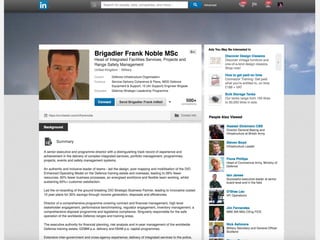
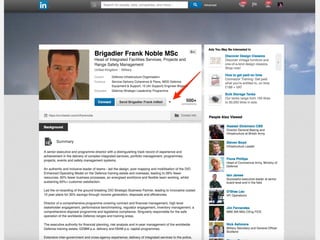
  • #60 I went back to look at Brigadier Frank Noble this week and found yes he’s still using Li – he’s updated his profile and
  • #61 I went back to look at Brigadier Frank Noble this week and found yes he’s still using Li – he’s updated his profile and
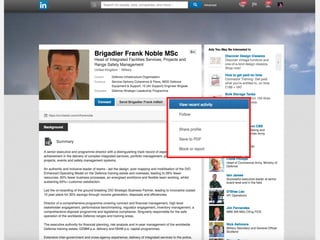
  • #62 If you click on this little arrow you can choose to view his recent activity
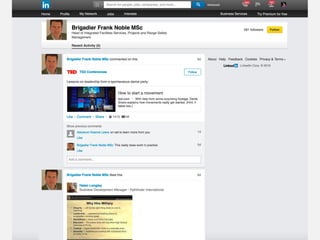
  • #64 And yes he is actually doing stuff on Linkedin – so we can find out even more about him and even participate in conversations.
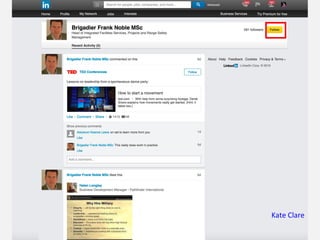
  • #65 What’s more if you don’t mind him knowing you’ve visited his profile, you can even follow him on Li by clicking this button.
  • #66 Next step is about those conversations. Status updates come first.
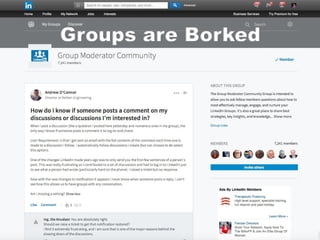
  • #67 Something is "borked" when it doesn't work correctly or misbehaves, generally due to negligence by the person(s) that are responsible for it.  
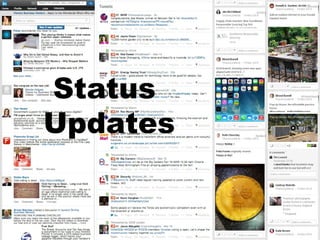
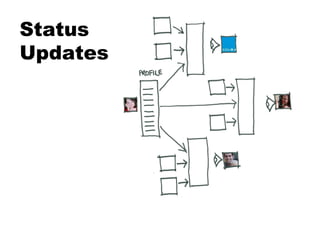
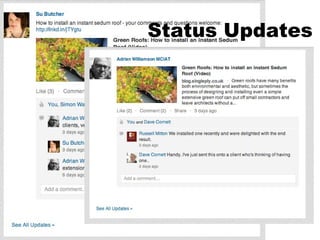
  • #69 Status updates are the starting point for conversations on social media. They are the process by which conversations happen. They exist on all the platforms – here they are on Linkedin, Twitter and Google Plus, for example. If you do share things on Linkedin, and do it right, people will comment, like and share on your content with other people. Here is why its important.
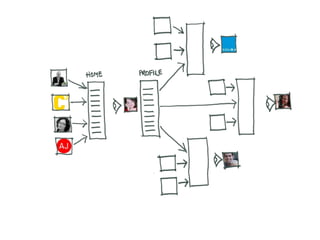
  • #70 Status updates are posted on my profile in chronological order, so people can read them there. But they are also shared on the home pages and read by the people I’m directly connected to, in chronological order, interspersed with those from other people.
  • #71 I’ve got a home page too where I see the status updates from my connections in the same way.
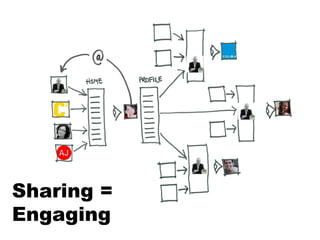
  • #72 But its when I like, comment on or share a status update from one of the people I’m connected to that the real magic happens. By doing this I pass on the content they have shared, with them attached, to the other people in my network, thereby subtly introducing them to my network.
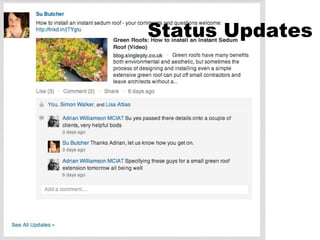
  • #73 Each time Adrian comments on my status update it shares it in his stream, with his network. He also chose to share the link with his network directly, which generated more discussion and passed the link on to people to whom I’m not connected at all. You must have the three key elements: Useful social objects for your target audience People who trust you and value useful content A proactive approach to sharing.
  • #74 Each time Adrian comments on my status update it shares it in his stream, with his network. He also chose to share the link with his network directly, which generated more discussion and passed the link on to people to whom I’m not connected at all. You must have the three key elements: Useful social objects for your target audience People who trust you and value useful content A proactive approach to sharing.
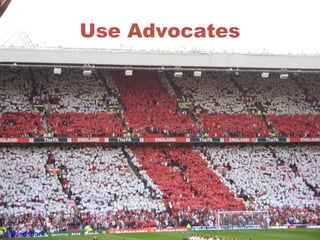
  • #75 Advocates are essential to make social media activity work.
  • #76 UI – larger photos, banners for all. Look like FB! New profiles, Image editing and GIF support Sharing tweets through direct messages Ability to mute people and improvements in flagging/reporting tweets.
  • #79 In Aug 2015 turned firehose back on to Google (first time since 2011) – Following SEO work on hashtag pages increased logged-out user visitors tenfold
  • #80 Data from 2013. The average age of a twitter user? 37. 55% of users are over 35. The average age of a Linkedin User? 44. 79% are over 35. Source Pingdom – click link for article
  • #81 Do you really know what platforms your audience is on? This statistic might be surprising, as twitter is commonly thought of as a ‘socialising’ platform. In the 2013 Construction Marketing Index survey of architects by Competitive Advantage, 44% of architects said they use Twitter to help them in their work. Three years previously 38% of architects said twitter was banned at work, three years later it had shrunk to just 8%
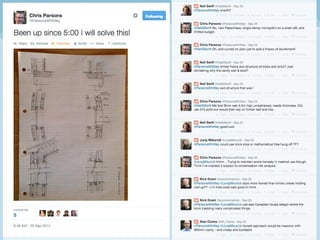
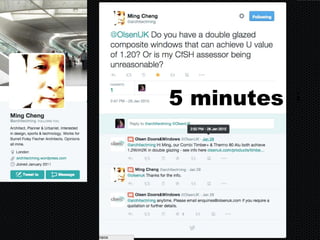
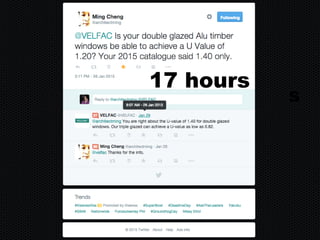
  • #83 Twitter is stretchy and Sticky. Stretchy as it stretches time – you can come back to conversations months or hours later Sticky as you can save thigns for later, and it helps you stick in the minds of people Use a scheduling tool to share tweets at the best time, and use Mobile Notifications to be notified and use the mobile device to have conversations .
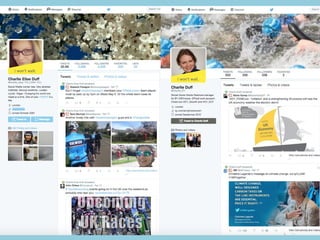
  • #86 What about being more than one person? Many platforms prevent you from having more than one account (Linkedin), others discourage it. But some let you have several accounts, like twitter. All you need is a different email address for each account. Remember however that if people are searching for you, they’ll find the most active account first, and might not think to look for another This happened when I shared a speaking platform with a woman who is Global Social Media Relations Manager for EY. I found her personal account not her business account.
  • #87 The business account had fewer followers (500 as opposed to 3000) Think about why you’re doing it, and remember people will find you via search
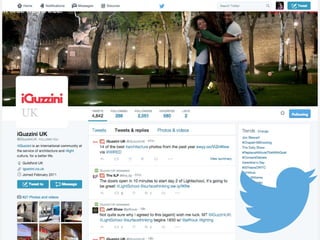
  • #88 Twitter is a wide open network which means you can search for key words and phrases at any time. Groups of people form around subjects and reform around others all the time. Because it is wide open people from anywhere across the network can listen in and check you out until they are ready to approach you. It is entirely opt in.
  • #95 Advocates are essential to make social media activity work.
  • #97 That's the big four. But big isn’t always big, and what you use depends on who you want to talk to. Our generation (30s and 40s) Linkedin, some Twitter, FB for friends and family. Google plus for experimenters   Hard to find comparable statistics for a wide range of platforms.   Look outside the big four at what else is happening.
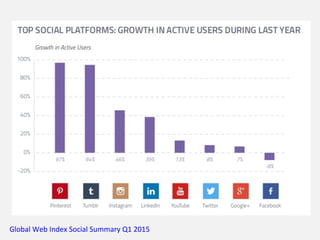
  • #99 This is a breakdown of the top 8 most used platforms worldwide (excluding China) It shows that platform popularity for the under 25s is almost reversed from the over 35s. One of the reasons for this change is the popularity of mobile. http://insight.globalwebindex.net/social-q3-2014 http://www.engagesciences.com/social-target-audience-marketing/
  • #100 The other big four
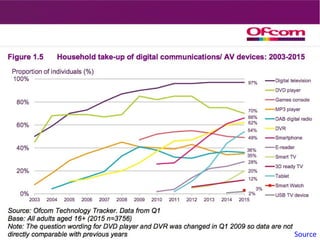
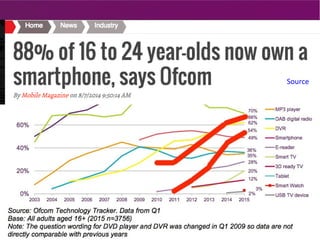
  • #102 And this growth in smartphone use is high in the young.
  • #103 Mobile devices contributed to the mainstreaming of the selfie – here’s Ellen DeGeneres example from the Oscars last March.
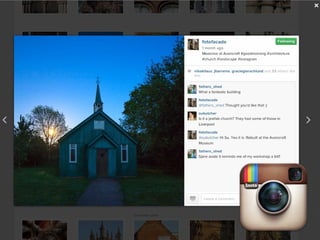
  • #104 For the first time, half (53%) of online US adults ages 18-29 use Instagram. 49% of users use the site daily http://www.pewinternet.org/2015/01/09/social-media-update-2014/ Notice the use of instagram as a conversation platform – almost like a blog with the image as the post.
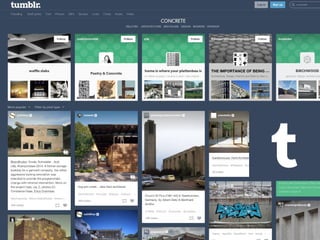
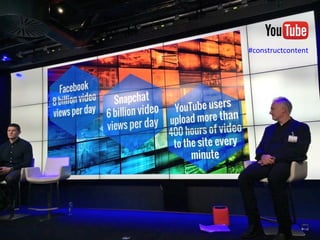
  • #107 All of these four platforms have a much larger proportion of the under 25s than Facebook, Linkedin or Twitter. All of them have post-and-comment structures and conversations are happening there.
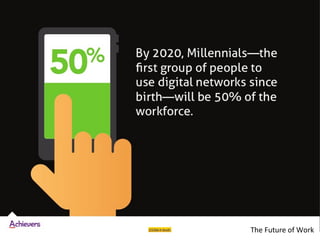
  • #111 Why does this matter? Because younger people are getting older, and older people are retiring. By the end of the decade half the work force will have grown up with the internet. They might not think that its anything to do with work yet, but when they are in their 20s they’ll want to use it.
  • #113 Our first prediction. You will be more visible
  • #114 Our first prediction. You will be more visible
  • #115 Secondly, You will get more traffic
  • #116 If you talk to people online. Which means finding out where your audience is learning how to talk to them there.
  • #117 And finally things will happen – you’ll get more traffic, more downloads, more enquiries, more recruits and more business,
  • #118 If you are remarkable online. And remarkable means making good content people want to remark upon, so they have those conversations, wherever they are.
  • #120 Lets begin with A disclaimer