Implications of the external evaluation of the Livestock and Fish value
chain approach for the Uganda program
Danilo Pezo
Uganda smallholder smallholder pigs value chain review and planning meeting
Kampala, 14-15 May 2015
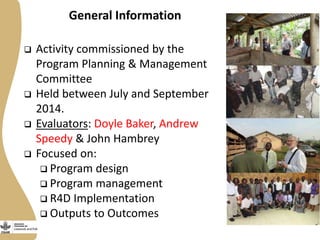
General Information
 Activity commissioned by the
Program Planning & Management
Committee
 Held between July and September
2014.
 Evaluators: Doyle Baker, Andrew
Speedy & John Hambrey
 Focused on:
 Program design
 Program management
 R4D Implementation
 Outputs to Outcomes
Evaluation Approach & Methodology
• Approach:
Consultative and participatory, based on dialogue,
meetings and surveys among staff, partners and external
stakeholders.
• Information and data sources:
– Program documents, i.e. Annual reports
– Group meetings (with program staff, stakeholders and
producers)
– Informant interviews (carried out during field visits with
staff, partners, government officials and value chain
actors)
– Questionnaires
• Program staff in all nine L&F sites
• Partners & stakeholders in the 4 sites visited
• Selected VC experts and SPAC members
– Other sources: program records, progress indicators,
wiki, work plans, case stories
Major Findings for CRP 3.7
 The Livestock and Fish program “brings together
collective capacity with CGIAR and other
partners to develop and deliver appropriate
integrated solutions for the pro-poor
transformation of selected value chains”
 The value chains R4D work in the selected sites
is the most distinctive and defining feature of
the new model.
 The program has faced a number of challenges
in implementing its value chains R4D approach,
including:
 Resourcing and managing the ambitious plan of work
described in the program proposal
 Developing internal capacities and modalities to
implement the proposed value chain approach
Specific Findings Ugandan SPVCD (1)
 Strong engagement process and internal team
approach
 Small and medium private VC actors actively involved in
diagnostic work but are weak and unable to be drivers
 Strong support provided by DVOs to strengthen
services to farmers
 Need to accelerate field research
 Sector policy and regulations are a dilemma
Specific Findings Ugandan SPVCD (2)
 Need for MoUs to stabilize partnerships
 Strong alignment of interests and close collaboration
between LF and A4NH
 Potential for complementarity with regional research
since in most countries, pigs are not a priority
 Small-scale butchers, traders and input suppliers are
facing challenges and need support
 Stakeholders involved in assessments were not clear
on their roles in follow up
Working Suggestions (1)
 Training on business development an
important next step
 Strong opportunities for joint activities with
Agribusiness Department MAK Univ.
 Conduct a regional symposium with
ASARECA to support learning with other sites
and with other projects
 Feasibility appraisal of PPP for integrated
abattoir/processing plant with contract
procurement
Working Suggestions (2)
 Epidemiology and Strategy appraisals for
community-based biosecurity protocols
 Policy on infant industry protection and
how fits into EAC commitments
 Creative strategies for involving medium
scale farmers and butchers
CGIAR is a global partnership that unites organizations engaged in research for a food secure future. The CGIAR
Research Program on Livestock and Fish aims to increase the productivity of small-scale livestock and fish systems
in sustainable ways, making meat, milk and fish more available and affordable across the developing world.
CGIAR Research Program on Livestock and Fish
livestockfish.cgiar.org
THANK YOU!

Implications of the external evaluation of the Livestock and Fish value chain approach for the Uganda program

  • 1.
    Implications of theexternal evaluation of the Livestock and Fish value chain approach for the Uganda program Danilo Pezo Uganda smallholder smallholder pigs value chain review and planning meeting Kampala, 14-15 May 2015
  • 2.
    General Information  Activitycommissioned by the Program Planning & Management Committee  Held between July and September 2014.  Evaluators: Doyle Baker, Andrew Speedy & John Hambrey  Focused on:  Program design  Program management  R4D Implementation  Outputs to Outcomes
  • 3.
    Evaluation Approach &Methodology • Approach: Consultative and participatory, based on dialogue, meetings and surveys among staff, partners and external stakeholders. • Information and data sources: – Program documents, i.e. Annual reports – Group meetings (with program staff, stakeholders and producers) – Informant interviews (carried out during field visits with staff, partners, government officials and value chain actors) – Questionnaires • Program staff in all nine L&F sites • Partners & stakeholders in the 4 sites visited • Selected VC experts and SPAC members – Other sources: program records, progress indicators, wiki, work plans, case stories
  • 4.
    Major Findings forCRP 3.7  The Livestock and Fish program “brings together collective capacity with CGIAR and other partners to develop and deliver appropriate integrated solutions for the pro-poor transformation of selected value chains”  The value chains R4D work in the selected sites is the most distinctive and defining feature of the new model.  The program has faced a number of challenges in implementing its value chains R4D approach, including:  Resourcing and managing the ambitious plan of work described in the program proposal  Developing internal capacities and modalities to implement the proposed value chain approach
  • 5.
    Specific Findings UgandanSPVCD (1)  Strong engagement process and internal team approach  Small and medium private VC actors actively involved in diagnostic work but are weak and unable to be drivers  Strong support provided by DVOs to strengthen services to farmers  Need to accelerate field research  Sector policy and regulations are a dilemma
  • 6.
    Specific Findings UgandanSPVCD (2)  Need for MoUs to stabilize partnerships  Strong alignment of interests and close collaboration between LF and A4NH  Potential for complementarity with regional research since in most countries, pigs are not a priority  Small-scale butchers, traders and input suppliers are facing challenges and need support  Stakeholders involved in assessments were not clear on their roles in follow up
  • 7.
    Working Suggestions (1) Training on business development an important next step  Strong opportunities for joint activities with Agribusiness Department MAK Univ.  Conduct a regional symposium with ASARECA to support learning with other sites and with other projects  Feasibility appraisal of PPP for integrated abattoir/processing plant with contract procurement
  • 8.
    Working Suggestions (2) Epidemiology and Strategy appraisals for community-based biosecurity protocols  Policy on infant industry protection and how fits into EAC commitments  Creative strategies for involving medium scale farmers and butchers
  • 9.
    CGIAR is aglobal partnership that unites organizations engaged in research for a food secure future. The CGIAR Research Program on Livestock and Fish aims to increase the productivity of small-scale livestock and fish systems in sustainable ways, making meat, milk and fish more available and affordable across the developing world. CGIAR Research Program on Livestock and Fish livestockfish.cgiar.org THANK YOU!

Editor's Notes

  • #3 Page title minimum of 30 points and maximum of two lines Main point 6 point smaller than slide title Bullet points 4 point less than main point Font type is Calibri It is advised in one slide maximum 6 bullets We recommend you use images on slides You can change partner logos on front page You have to duplicate this slide for more inside pages
  • #4 Page title minimum of 30 points and maximum of two lines Main point 6 point smaller than slide title Bullet points 4 point less than main point Font type is Calibri It is advised in one slide maximum 6 bullets We recommend you use images on slides You can change partner logos on front page You have to duplicate this slide for more inside pages
  • #5 Page title minimum of 30 points and maximum of two lines Main point 6 point smaller than slide title Bullet points 4 point less than main point Font type is Calibri It is advised in one slide maximum 6 bullets We recommend you use images on slides You can change partner logos on front page You have to duplicate this slide for more inside pages
  • #8 Creative strategies to work back from medium scale farmers and butchers