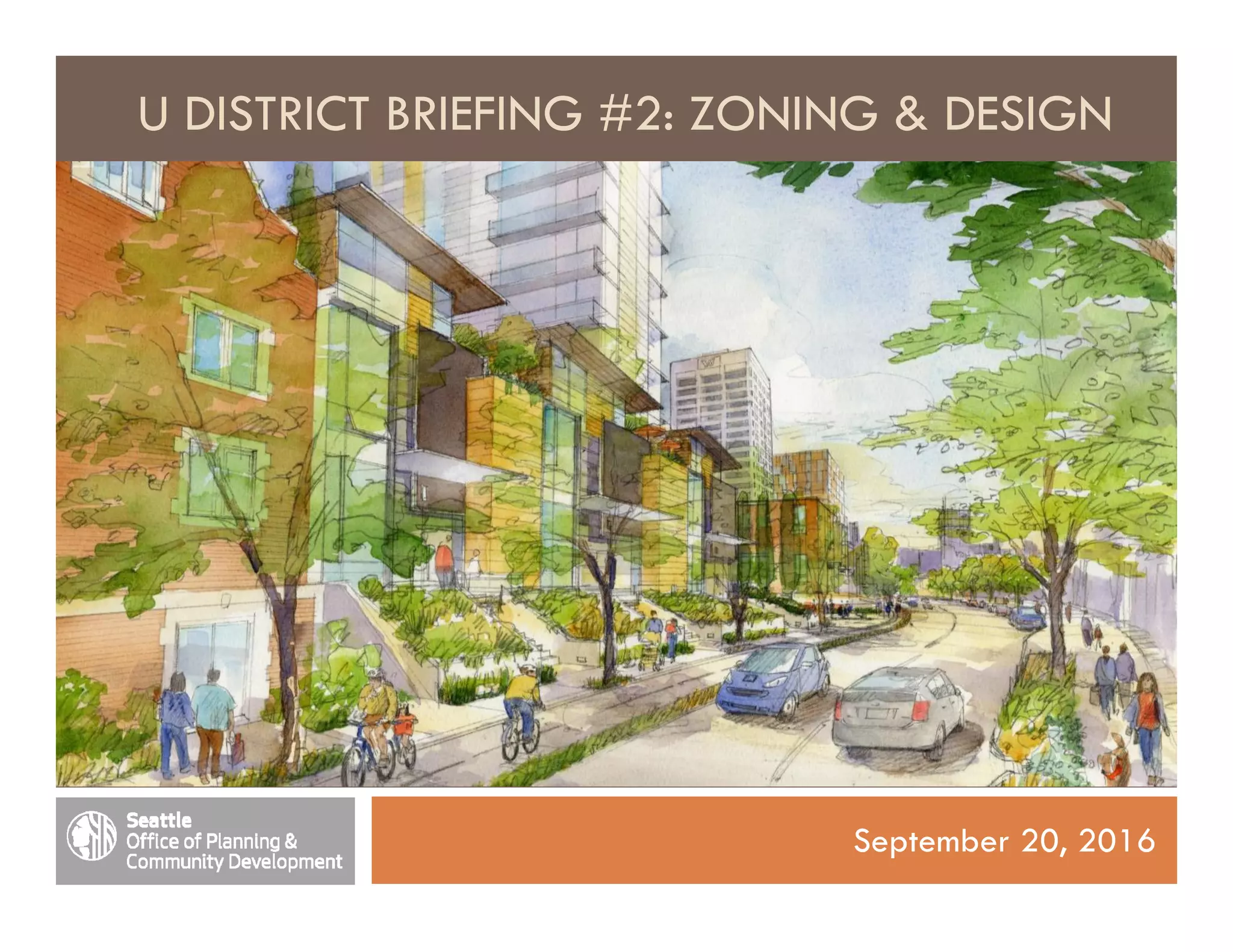
U DISTRICT BRIEFING #2: ZONING & DESIGN
September 20, 2016
2
Overview of the Mayor’s proposal
1. Public investments in the U District
2. Zoning changes
3. New design standards
4. Mandatory Housing Affordability requirements
5. Incentive programs: open space, preservation, childcare…
Today’s
briefing
Oct. - Dec.
3
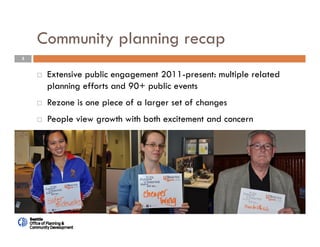
Community planning recap
 Extensive public engagement 2011-present: multiple related
planning efforts and 90+ public events
 Rezone is one piece of a larger set of changes
 People view growth with both excitement and concern
4
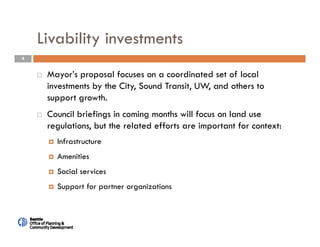
Livability investments
 Mayor’s proposal focuses on a coordinated set of local
investments by the City, Sound Transit, UW, and others to
support growth.
 Council briefings in coming months will focus on land use
regulations, but the related efforts are important for context:
 Infrastructure
 Amenities
 Social services
 Support for partner organizations
5
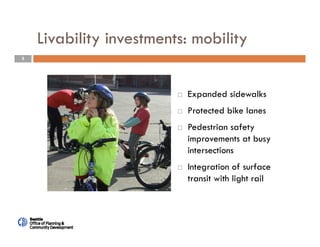
Livability investments: mobility
 Expanded sidewalks
 Protected bike lanes
 Pedestrian safety
improvements at busy
intersections
 Integration of surface
transit with light rail
6
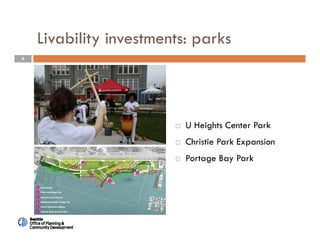
Livability investments: parks
 U Heights Center Park
 Christie Park Expansion
 Portage Bay Park
7
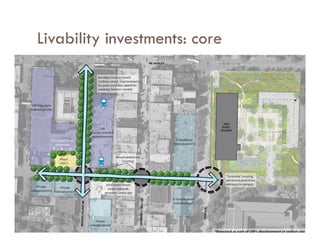
Livability investments: core
8
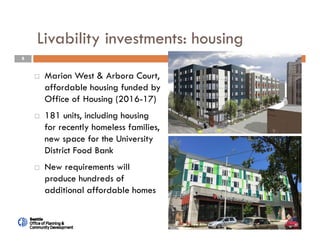
Livability investments: housing
 Marion West & Arbora Court,
affordable housing funded by
Office of Housing (2016-17)
 181 units, including housing
for recently homeless families,
new space for the University
District Food Bank
 New requirements will
produce hundreds of
additional affordable homes
9
Livability investments: partnerships
 Working with ROOTS, U District Partnership,
and UW to create an employment program
for homeless youth in the U District.
 UW providing new childcare facilities in the
neighborhood, working to expand
faculty/staff housing options
 Continued City funding for U Heights Center,
Teen Feed, U District Partnership, many others
10
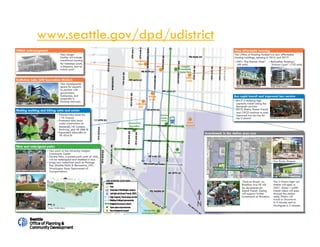
www.seattle.gov/dpd/udistrict
11
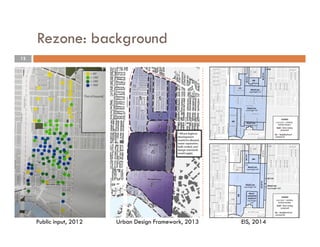
Rezone: background
Reasons people cite for supporting density in the core…
 Focus growth near light rail and campus, reduce pressure
on surrounding areas
 Take advantage of the large redevelopment sites flanking
NE 45th St, context of three existing towers
 Greater variety – avoid uniform midrise by allowing mix
of highrise, midrise, and lowrise w/ design standards
 Capture public benefits through incentive zoning – tie
extra height and floor area to desired services and
amenities
Rezone: background
12
Public input, 2012 Urban Design Framework, 2013 EIS, 2014
Rezone map
13
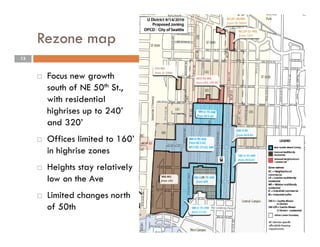
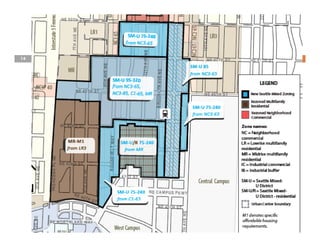
 Focus new growth
south of NE 50th St.,
with residential
highrises up to 240’
and 320’
 Offices limited to 160’
in highrise zones
 Heights stay relatively
low on the Ave
 Limited changes north
of 50th
Rezone map
14
15
16
Design standards
 New requirements added to the Land Use Code as part of the
U District rezone
 Zoning discussions often focus on max height, but design
standards have an equal or greater influence over
neighborhood character
 Much of the work in the planning process has involved tailoring
standards to fit the unique characteristics in the U District: new
“SM-U” or “Seattle Mixed U District” zones
18
Design standards overview
 Maximum width
 Street level uses
 Highrise standards
 Setbacks
 Modulation
 Parking standards
 Floor Area Ratio –
limiting the total amount
of development
 Landscaping and trees
 Large lot open space
requirement
 Residential amenity area
19
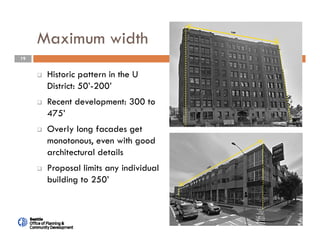
Maximum width
 Historic pattern in the U
District: 50’-200’
 Recent development: 300 to
475’
 Overly long facades get
monotonous, even with good
architectural details
 Proposal limits any individual
building to 250’
20
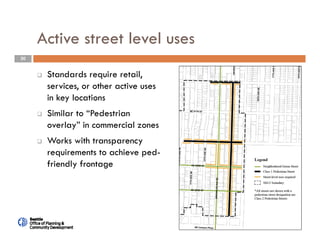
Active street level uses
 Standards require retail,
services, or other active uses
in key locations
 Similar to “Pedestrian
overlay” in commercial zones
 Works with transparency
requirements to achieve ped-
friendly frontage
21
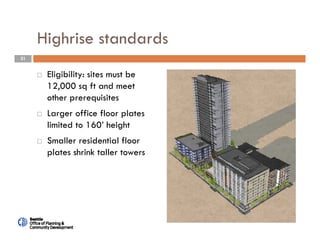
Highrise standards
 Eligibility: sites must be
12,000 sq ft and meet
other prerequisites
 Larger office floor plates
limited to 160’ height
 Smaller residential floor
plates shrink taller towers
22
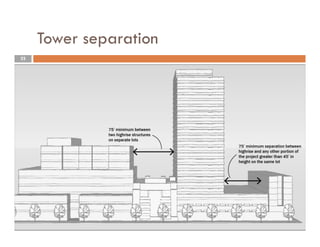
Tower separation
23
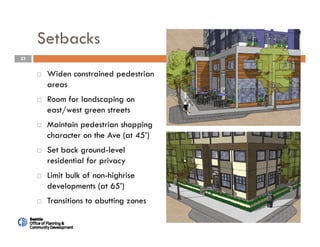
Setbacks
 Widen constrained pedestrian
areas
 Room for landscaping on
east/west green streets
 Maintain pedestrian shopping
character on the Ave (at 45’)
 Set back ground-level
residential for privacy
 Limit bulk of non-highrise
developments (at 65’)
 Transitions to abutting zones
24
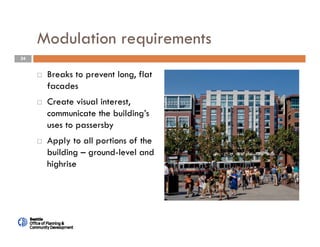
Modulation requirements
 Breaks to prevent long, flat
facades
 Create visual interest,
communicate the building’s
uses to passersby
 Apply to all portions of the
building – ground-level and
highrise
25
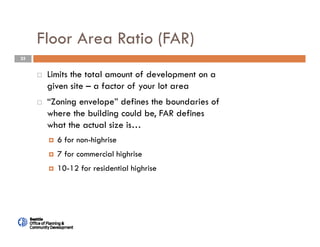
Floor Area Ratio (FAR)
 Limits the total amount of development on a
given site – a factor of your lot area
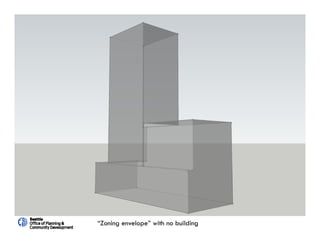
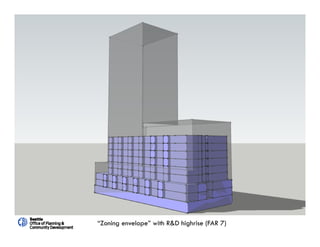
 “Zoning envelope” defines the boundaries of
where the building could be, FAR defines
what the actual size is…
 6 for non-highrise
 7 for commercial highrise
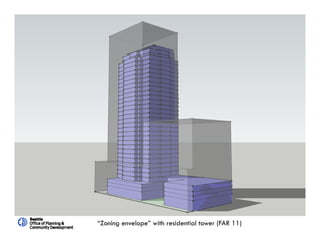
 10-12 for residential highrise
26
Floor Area Ratio (FAR)
“Zoning envelope” with no building
27
Floor Area Ratio (FAR)
“Zoning envelope” with residential tower (FAR 11)
28
Floor Area Ratio (FAR)
“Zoning envelope” with R&D highrise (FAR 7)
29
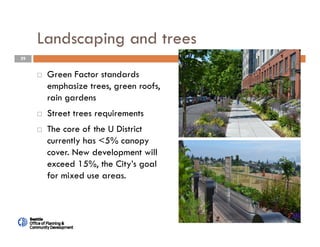
Landscaping and trees
 Green Factor standards
emphasize trees, green roofs,
rain gardens
 Street trees requirements
 The core of the U District
currently has <5% canopy
cover. New development will
exceed 15%, the City’s goal
for mixed use areas.
31
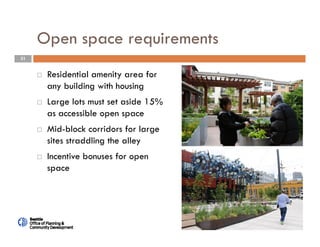
Open space requirements
 Residential amenity area for
any building with housing
 Large lots must set aside 15%
as accessible open space
 Mid-block corridors for large
sites straddling the alley
 Incentive bonuses for open
space
32
Parking requirements
 Any parking at the ground level must be fully
wrapped in other uses, levels above that must
be screened and partially wrapped
 To reduce traffic impacts:
 Parking management plan required for large
developments
 Parking limit for office uses
33
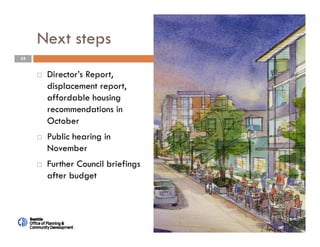
Next steps
 Director’s Report,
displacement report,
affordable housing
recommendations in
October
 Public hearing in
November
 Further Council briefings
after budget
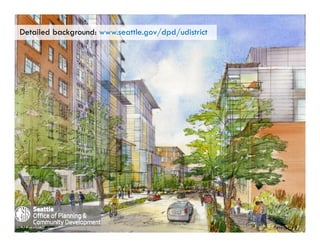
Detailed background: www.seattle.gov/dpd/udistrict

UDistrict Rezone Presentation - PLUZ Committee 9/20/2016

  • 1.
    U DISTRICT BRIEFING#2: ZONING & DESIGN September 20, 2016
  • 2.
    2 Overview of theMayor’s proposal 1. Public investments in the U District 2. Zoning changes 3. New design standards 4. Mandatory Housing Affordability requirements 5. Incentive programs: open space, preservation, childcare… Today’s briefing Oct. - Dec.
  • 3.
    3 Community planning recap Extensive public engagement 2011-present: multiple related planning efforts and 90+ public events  Rezone is one piece of a larger set of changes  People view growth with both excitement and concern
  • 4.
    4 Livability investments  Mayor’sproposal focuses on a coordinated set of local investments by the City, Sound Transit, UW, and others to support growth.  Council briefings in coming months will focus on land use regulations, but the related efforts are important for context:  Infrastructure  Amenities  Social services  Support for partner organizations
  • 5.
    5 Livability investments: mobility Expanded sidewalks  Protected bike lanes  Pedestrian safety improvements at busy intersections  Integration of surface transit with light rail
  • 6.
    6 Livability investments: parks U Heights Center Park  Christie Park Expansion  Portage Bay Park
  • 7.
  • 8.
    8 Livability investments: housing Marion West & Arbora Court, affordable housing funded by Office of Housing (2016-17)  181 units, including housing for recently homeless families, new space for the University District Food Bank  New requirements will produce hundreds of additional affordable homes
  • 9.
    9 Livability investments: partnerships Working with ROOTS, U District Partnership, and UW to create an employment program for homeless youth in the U District.  UW providing new childcare facilities in the neighborhood, working to expand faculty/staff housing options  Continued City funding for U Heights Center, Teen Feed, U District Partnership, many others
  • 10.
  • 11.
    11 Rezone: background Reasons peoplecite for supporting density in the core…  Focus growth near light rail and campus, reduce pressure on surrounding areas  Take advantage of the large redevelopment sites flanking NE 45th St, context of three existing towers  Greater variety – avoid uniform midrise by allowing mix of highrise, midrise, and lowrise w/ design standards  Capture public benefits through incentive zoning – tie extra height and floor area to desired services and amenities
  • 12.
    Rezone: background 12 Public input,2012 Urban Design Framework, 2013 EIS, 2014
  • 13.
    Rezone map 13  Focusnew growth south of NE 50th St., with residential highrises up to 240’ and 320’  Offices limited to 160’ in highrise zones  Heights stay relatively low on the Ave  Limited changes north of 50th
  • 14.
  • 15.
  • 16.
    16 Design standards  Newrequirements added to the Land Use Code as part of the U District rezone  Zoning discussions often focus on max height, but design standards have an equal or greater influence over neighborhood character  Much of the work in the planning process has involved tailoring standards to fit the unique characteristics in the U District: new “SM-U” or “Seattle Mixed U District” zones
  • 18.
    18 Design standards overview Maximum width  Street level uses  Highrise standards  Setbacks  Modulation  Parking standards  Floor Area Ratio – limiting the total amount of development  Landscaping and trees  Large lot open space requirement  Residential amenity area
  • 19.
    19 Maximum width  Historicpattern in the U District: 50’-200’  Recent development: 300 to 475’  Overly long facades get monotonous, even with good architectural details  Proposal limits any individual building to 250’
  • 20.
    20 Active street leveluses  Standards require retail, services, or other active uses in key locations  Similar to “Pedestrian overlay” in commercial zones  Works with transparency requirements to achieve ped- friendly frontage
  • 21.
    21 Highrise standards  Eligibility:sites must be 12,000 sq ft and meet other prerequisites  Larger office floor plates limited to 160’ height  Smaller residential floor plates shrink taller towers
  • 22.
  • 23.
    23 Setbacks  Widen constrainedpedestrian areas  Room for landscaping on east/west green streets  Maintain pedestrian shopping character on the Ave (at 45’)  Set back ground-level residential for privacy  Limit bulk of non-highrise developments (at 65’)  Transitions to abutting zones
  • 24.
    24 Modulation requirements  Breaksto prevent long, flat facades  Create visual interest, communicate the building’s uses to passersby  Apply to all portions of the building – ground-level and highrise
  • 25.
    25 Floor Area Ratio(FAR)  Limits the total amount of development on a given site – a factor of your lot area  “Zoning envelope” defines the boundaries of where the building could be, FAR defines what the actual size is…  6 for non-highrise  7 for commercial highrise  10-12 for residential highrise
  • 26.
    26 Floor Area Ratio(FAR) “Zoning envelope” with no building
  • 27.
    27 Floor Area Ratio(FAR) “Zoning envelope” with residential tower (FAR 11)
  • 28.
    28 Floor Area Ratio(FAR) “Zoning envelope” with R&D highrise (FAR 7)
  • 29.
    29 Landscaping and trees Green Factor standards emphasize trees, green roofs, rain gardens  Street trees requirements  The core of the U District currently has <5% canopy cover. New development will exceed 15%, the City’s goal for mixed use areas.
  • 31.
    31 Open space requirements Residential amenity area for any building with housing  Large lots must set aside 15% as accessible open space  Mid-block corridors for large sites straddling the alley  Incentive bonuses for open space
  • 32.
    32 Parking requirements  Anyparking at the ground level must be fully wrapped in other uses, levels above that must be screened and partially wrapped  To reduce traffic impacts:  Parking management plan required for large developments  Parking limit for office uses
  • 33.
    33 Next steps  Director’sReport, displacement report, affordable housing recommendations in October  Public hearing in November  Further Council briefings after budget
  • 34.