5G Technology
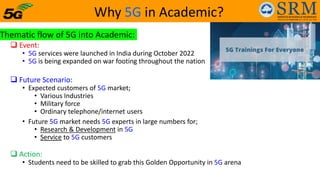
Why 5G in Academic?
 Event:
• 5G services were launched in India during October 2022
• 5G is being expanded on war footing throughout the nation
 Future Scenario:
• Expected customers of 5G market;
• Various Industries
• Military force
• Ordinary telephone/internet users
• Future 5G market needs 5G experts in large numbers for;
• Research & Development in 5G
• Service to 5G customers
 Action:
• Students need to be skilled to grab this Golden Opportunity in 5G arena
Thematic flow of 5G into Academic:
• Overview of 5G Technology
• What makeup 5G
• How 5G is better than 4G
• Potential Applications of 5G
• Challenges in 5G
• 5G in India
Outlines
• 5G: 5th Generation mobile network
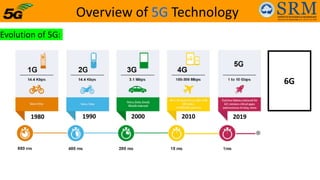
• 5G is a new global wireless standard after 1G, 2G, 3G, and 4G
networks
• 5G was commercialized in 2019
• No company or person invented or owns 5G
• There are several companies within the mobile ecosystem
that are contributing to bringing 5G to life Challenges
• 3rd Generation Partnership Project (3GPP), the industry
organization that defines the global specifications for 3G
UMTS (including HSPA), 4G LTE, and 5G technologies
Overview of 5G Technology
Introduction:
Overview of 5G Technology
Evolution of 5G:
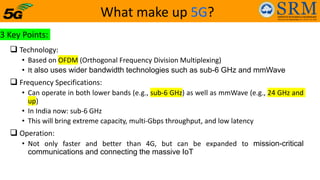
 Technology:
• Based on OFDM (Orthogonal Frequency Division Multiplexing)
• It also uses wider bandwidth technologies such as sub-6 GHz and mmWave
 Frequency Specifications:
• Can operate in both lower bands (e.g., sub-6 GHz) as well as mmWave (e.g., 24 GHz and
up)
• In India now: sub-6 GHz
• This will bring extreme capacity, multi-Gbps throughput, and low latency
 Operation:
• Not only faster and better than 4G, but can be expanded to mission-critical
communications and connecting the massive IoT
What make up 5G?
3 Key Points:
 5G is a Unified Platform that is more capable than 4G
• Not only for Broadband Telephone but also for mission-critical communications and
connecting the massive IoT
• Supports all Spectrum types (licensed, shared, unlicensed) and bands (low, mid, high)
 5G uses Spectrum Better than 4G
• Can use in bands - from low bands below 1 GHz, to mid bands from 1 GHz to 6 GHz, to high
bands known as millimeter wave (mmWave).
 5G is Faster than 4G:
• Delivers up to 20 Gigabits-per-second (Gbps) peak data rates and 100+ Megabits-per-
second (Mbps) average data rates
 5G has More Capacity than 4G
• Support a 100x increase in traffic capacity and network efficiency
 5G has Lower Latency than 4G
• 10x decrease in end-to-end latency
How 5G is better than 4G?
Potential Applications of 5G
Video Game
Live Streaming
Smart Buildings
And Cities
Remote
Health Monitoring
Industry Connection
And Automation
Augmented and
Virtual Reality
Autonomous
Vehicles
Challenges in 5G
 Frequency Bands:
• 5G NR: for sub-6 GHz and millimeter-wave range
• Design of hardware at millimeter waves are much complex than low frequency
range
• To support interoperability -> Needs multiband -> Addition of more band increases
complexity
 High Data Volume:
• To support high resolution video calling, live streaming, downloading -> huge
volume data support is required
 MIMO Technology:
• For High data speed -> MIMO/massive MIMO is need -> Algorithms becomes complex
Key Challenges:
Challenges in 5G
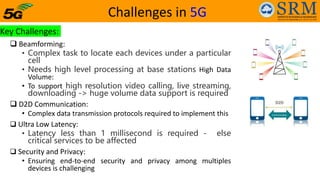
 Beamforming:
• Complex task to locate each devices under a particular
cell
• Needs high level processing at base stations High Data
Volume:
• To support high resolution video calling, live streaming,
downloading -> huge volume data support is required
 D2D Communication:
• Complex data transmission protocols required to implement this
 Ultra Low Latency:
• Latency less than 1 millisecond is required - else
critical services to be affected
 Security and Privacy:
• Ensuring end-to-end security and privacy among multiples
devices is challenging
Key Challenges:
5G in India
 Officially launched in October 2022
 Players: Reliance Jio and Airtel
 As of December 2022: 5G launched in 387 Districts
 December 2024: Target to achieve 100% 5G coverage
 Jio -> 5G standalone (SA) network, Airtel -> 5G non-standalone (NSA) network
Status of 5G in India:
Thank You

5G Introduction.pptx

  • 1.
  • 2.
    Why 5G inAcademic?  Event: • 5G services were launched in India during October 2022 • 5G is being expanded on war footing throughout the nation  Future Scenario: • Expected customers of 5G market; • Various Industries • Military force • Ordinary telephone/internet users • Future 5G market needs 5G experts in large numbers for; • Research & Development in 5G • Service to 5G customers  Action: • Students need to be skilled to grab this Golden Opportunity in 5G arena Thematic flow of 5G into Academic:
  • 3.
    • Overview of5G Technology • What makeup 5G • How 5G is better than 4G • Potential Applications of 5G • Challenges in 5G • 5G in India Outlines
  • 4.
    • 5G: 5thGeneration mobile network • 5G is a new global wireless standard after 1G, 2G, 3G, and 4G networks • 5G was commercialized in 2019 • No company or person invented or owns 5G • There are several companies within the mobile ecosystem that are contributing to bringing 5G to life Challenges • 3rd Generation Partnership Project (3GPP), the industry organization that defines the global specifications for 3G UMTS (including HSPA), 4G LTE, and 5G technologies Overview of 5G Technology Introduction:
  • 5.
    Overview of 5GTechnology Evolution of 5G:
  • 6.
     Technology: • Basedon OFDM (Orthogonal Frequency Division Multiplexing) • It also uses wider bandwidth technologies such as sub-6 GHz and mmWave  Frequency Specifications: • Can operate in both lower bands (e.g., sub-6 GHz) as well as mmWave (e.g., 24 GHz and up) • In India now: sub-6 GHz • This will bring extreme capacity, multi-Gbps throughput, and low latency  Operation: • Not only faster and better than 4G, but can be expanded to mission-critical communications and connecting the massive IoT What make up 5G? 3 Key Points:
  • 7.
     5G isa Unified Platform that is more capable than 4G • Not only for Broadband Telephone but also for mission-critical communications and connecting the massive IoT • Supports all Spectrum types (licensed, shared, unlicensed) and bands (low, mid, high)  5G uses Spectrum Better than 4G • Can use in bands - from low bands below 1 GHz, to mid bands from 1 GHz to 6 GHz, to high bands known as millimeter wave (mmWave).  5G is Faster than 4G: • Delivers up to 20 Gigabits-per-second (Gbps) peak data rates and 100+ Megabits-per- second (Mbps) average data rates  5G has More Capacity than 4G • Support a 100x increase in traffic capacity and network efficiency  5G has Lower Latency than 4G • 10x decrease in end-to-end latency How 5G is better than 4G?
  • 8.
    Potential Applications of5G Video Game Live Streaming Smart Buildings And Cities Remote Health Monitoring Industry Connection And Automation Augmented and Virtual Reality Autonomous Vehicles
  • 9.
    Challenges in 5G Frequency Bands: • 5G NR: for sub-6 GHz and millimeter-wave range • Design of hardware at millimeter waves are much complex than low frequency range • To support interoperability -> Needs multiband -> Addition of more band increases complexity  High Data Volume: • To support high resolution video calling, live streaming, downloading -> huge volume data support is required  MIMO Technology: • For High data speed -> MIMO/massive MIMO is need -> Algorithms becomes complex Key Challenges:
  • 10.
    Challenges in 5G Beamforming: • Complex task to locate each devices under a particular cell • Needs high level processing at base stations High Data Volume: • To support high resolution video calling, live streaming, downloading -> huge volume data support is required  D2D Communication: • Complex data transmission protocols required to implement this  Ultra Low Latency: • Latency less than 1 millisecond is required - else critical services to be affected  Security and Privacy: • Ensuring end-to-end security and privacy among multiples devices is challenging Key Challenges:
  • 11.
    5G in India Officially launched in October 2022  Players: Reliance Jio and Airtel  As of December 2022: 5G launched in 387 Districts  December 2024: Target to achieve 100% 5G coverage  Jio -> 5G standalone (SA) network, Airtel -> 5G non-standalone (NSA) network Status of 5G in India:
  • 12.

Editor's Notes

  • #3 Source: https://dot.gov.in/5g-india-2020
  • #5 Source: https://www.qualcomm.com/
  • #6 Source: https://www.qualcomm.com/
  • #7 Source: https://www.qualcomm.com/
  • #8 Source: https://www.qualcomm.com/
  • #9 Source: https://www.qualcomm.com/
  • #10 Source: https://www.rfpage.com/what-are-the-challenges-in-5g-technology/
  • #11 Source: https://www.rfpage.com/what-are-the-challenges-in-5g-technology/
  • #12 Source: https://telecom.economictimes.indiatimes.com/news/india-will-achieve-100-5g-coverage-by-december-2024-vaishnaw/98297731