Understanding the concepts of
Anthropology, Sociology,
and Political Science
Learning Objectives:
Identify and discuss anthropology,
sociology, and political science;
Recognize the common concerns a
n
d
intersections of anthropology, sociology,
and political science with respect to
phenomenon of change.
Identify the subject of inquiry and goals
of anthropology, sociology, and political
science.
What branch of science
do Anthropology,
Political Science and
Sociology belong?
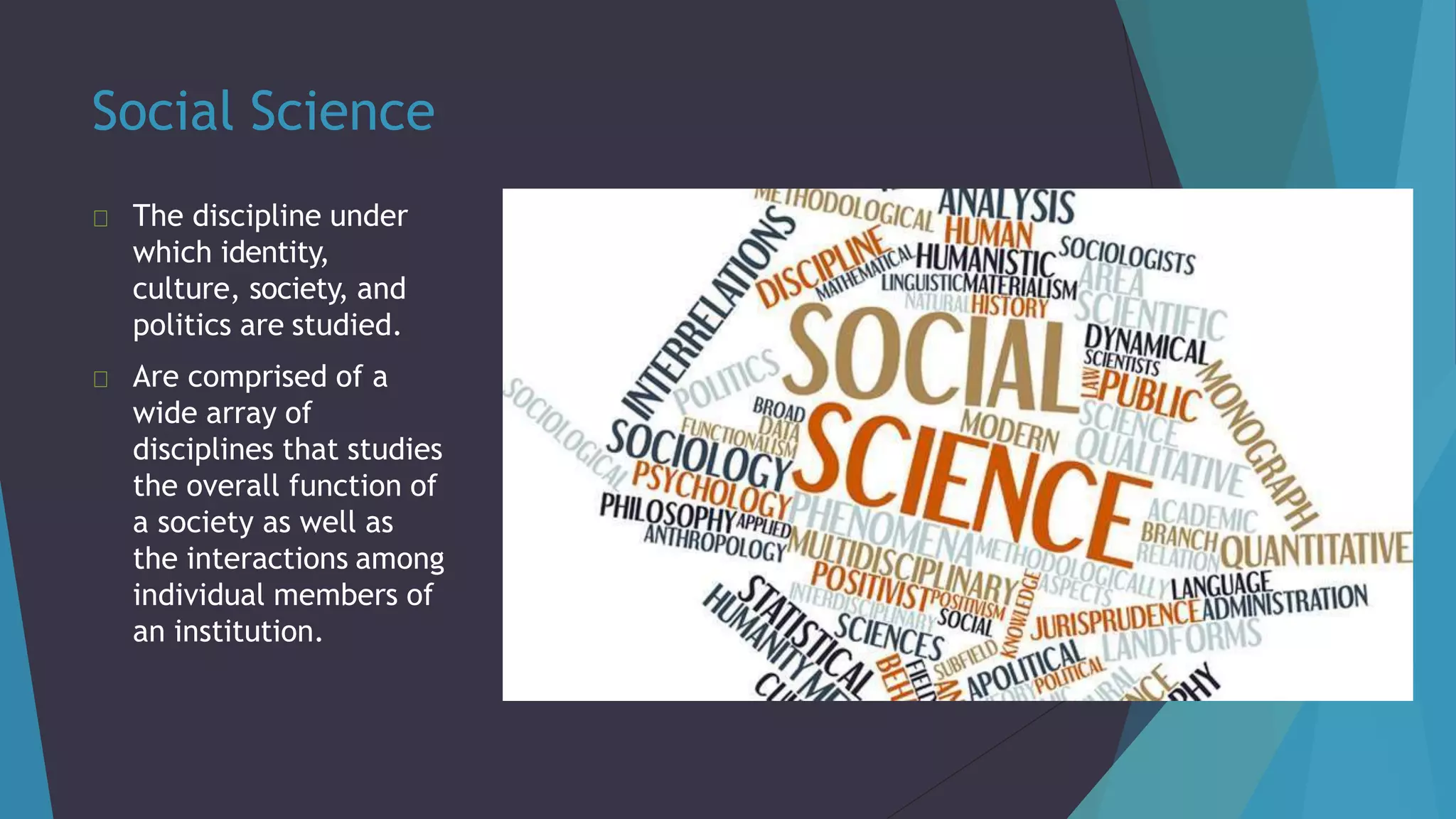
Social Science
The discipline under
which identity,
culture, society, and
politics are studied.
Are comprised of a
wide array of
disciplines that studies
the overall function of
a society as well as
the interactions among
individual members of
an institution.
Fields of Social Science
Anthropology
Sociology
Political Science
Anthropology
• From two Greek words, Anthropos, meaning “MAN”; and Logos, meaning
“STUDY”.
 A systematic study of the biological, cultural, and social aspects of man.
 Diversity and similarity of the way a person live and make connections
as social and cultural beings.
GOALS
ANTHROPOLOGY
Discover what all people have in common –
By studying commonalities (folklores,
traditions, language, etc.) in all humanity,
we could understand more about the
human’s nature.
Produce new knowledge and new theories
about humankind and human behavior –
This new knowledge is then applied in an
attempt to alleviate human challenges.
Discover what makes people different from
one another in order to understand and
preserve diversity – Anthropology attempts
to answer questions like, “What does it
mean to be a Filipino and a citizen of the
world?”
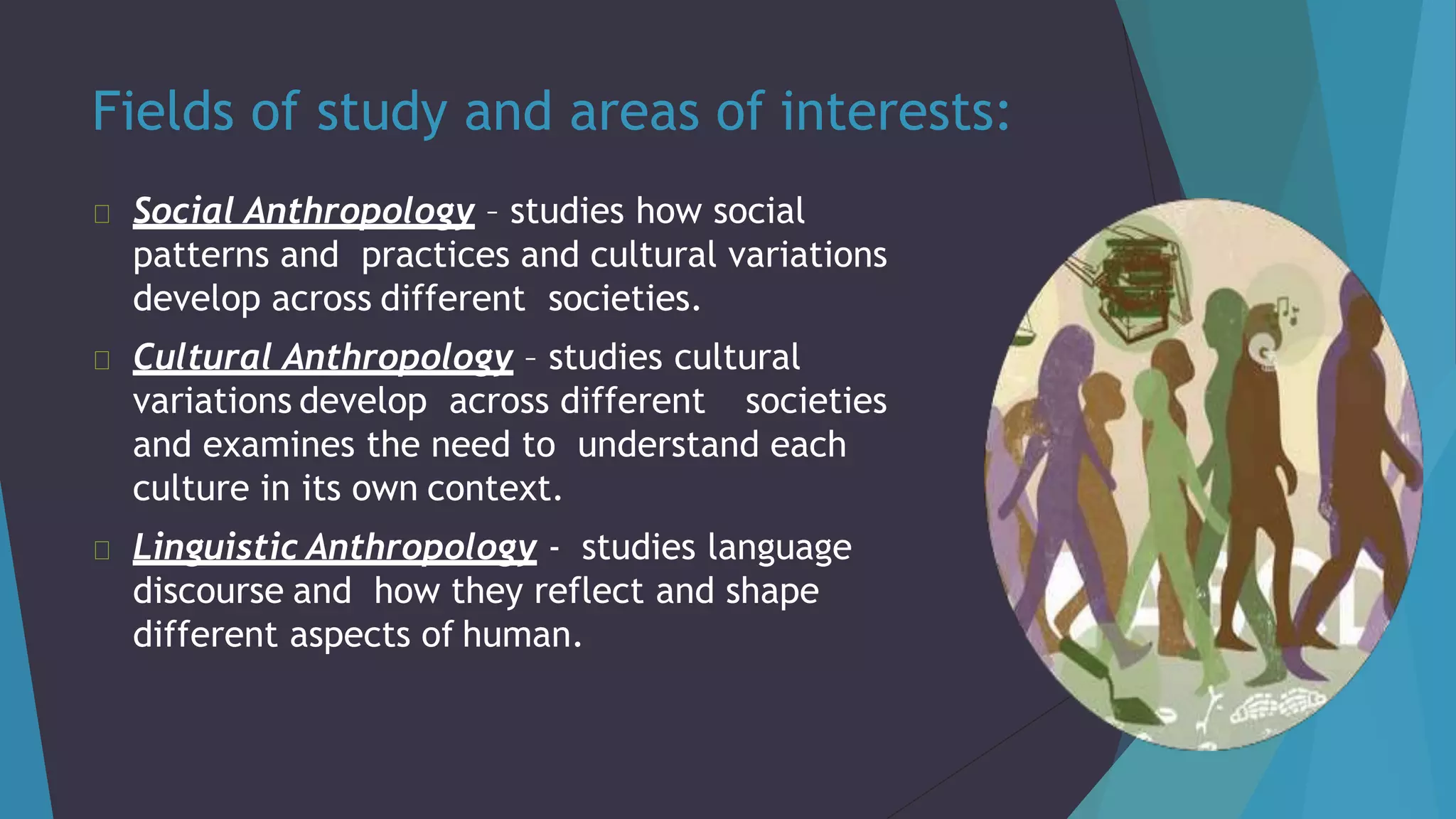
Fields of study and areas of interests:
Social Anthropology – studies how social
patterns and practices and cultural variations
develop across different societies.
Cultural Anthropology – studies cultural
variations develop across different societies
and examines the need to understand each
culture in its own context.
Linguistic Anthropology - studies language
discourse and how they reflect and shape
different aspects of human.
Fields of study and areas of interests:
Biological and Physical Anthropology – studies
origins of humans as well as the interplay
between social factors and process of human
evolution, adaptation, and variations over time.
Political Anthropology- encompasses the
analysis of power, leadership, and influence in
all their social, cultural, symbolic, ritual, and
policy dimensions.
How will you describe
a community without
its own culture?
What is the best way
to study a culture of
a certain community?
Ethnography/ Ethnographic method
-Participant Observation
-Key Informant Interviewing
Ethnography
Ethnographic methods are a
research approach that looks at: people in their
cultural setting; their language, and the
symbols, rituals and shared meanings that
populate their world, with the object of
producing a narrative account of that particular
culture, against a theoretical backdrop.
Participant Observation
Participant observation is a qualitative
research method in which the researcher not
only observes the research participants, but
also actively engages in the activities of the
research participants. This requires the
researcher to become integrated into the
participants' environment while also taking
objective notes about what is going on.
An anthropologist participating in a cocoa
harvest in Ghana in 1972.
Participant observation in a
Tibetan Buddhist monastery
Key informant Interviewing
• Key Informant Interviews involve interviewing
people who have particularly informed
perspectives on an aspect of the study being
researched or evaluated.
• Key informant interviews are "qualitative, in-depth
interviews of 15 to 35 people selected for their
first-hand knowledge about a topic of interest.
Sociology
• “The study of human social
life, groups, and society.” –
Anthony Giddens
• “The systematic study of
human society.” (Macionis,
2012)
• Attempts to provide a deeper
assessment of individual and
group behavior, as well as social
phenomena.
THE SCIENTIFIC STUDY OF
SOCIOLOGY ENABLES US TO:
Obtain possible theories and principles about
society as well as various aspects of social life;
Critically study the nature of humanity, which
also leads to examining our roles within the
society;
Appreciate that all things (in society) are
interdependent with each other. An individual’s
personal history is connected to his/her
environment’s history, which is also tied into
the nation’s history;
Fields of study and areas of interests:
Social Organization- The study of social
institutions, social inequality, social mobility,
religious groups, and bureaucracy.
Applied Sociology- Assist in resolving social
problems through the use of sociological
research.
Sociological Theory and Research-Focuses
on the discovery of theoretical tools, methods,
and techniques to scientifically explain a
particular sociological issue.
Mexican Quote
“Tell me who your friends are and
I’ll tell you who you are.”
Political Science
Systematic study of politics
“Activity through which people make,
preserve, and amend the general
rules under which they live” – Andrew
Heywood
Focuses on fundamental values of
equality, freedom and justice and its
process linked to the dynamics of
conflict, resolution, and cooperation.
The study of Politics has
something to do with power – who
wields it and how it is used. This
means that political science is not just
for politicians or for aspiring lawyers
instead, it is also a give and take
relationship between the government
(as a state apparatus) and its people
(as a subject).
Two Important Terms
 Politics
 Government
POLITICS
It originated from the Greek word ‘polis’,
which means ‘city’ or ‘state’.
It is the art and science of governing
city/state.
It is the social process or strategy in any
position of control which people gain, use,
or lose power.
GOVERNMENT
It is the agency to which the will of the state
is formulated, expressed, and carried out.
It is the organized agency in a state tasked
to impose social control.
Politics VS Government
Politics is often used simultaneously with
government , however, the two are distinct from each
other.
The government typically refers to the established
legislative and executive departments of a nation or
state while politics is a broad term that is related to
the power sharing in any organization.
In other words, politics is an idea while government is
the concrete realization of that idea.
Areas of Interest in Political Science
Public Administration - examines how the
government functions and how decisions and
politics are made.
Political Economy – evaluates the interplay
between economics, politics, and law and its
implications to various institutions within
society.
Comparative Politics – compares domestic
politics and governance systems across
different sovereign states.
• Imagine a society without a
government.
• Describe the scenario you
foresee in such situation.

UCSP Fields of Social Science.pptx

  • 1.
    Understanding the conceptsof Anthropology, Sociology, and Political Science
  • 2.
    Learning Objectives: Identify anddiscuss anthropology, sociology, and political science; Recognize the common concerns a n d intersections of anthropology, sociology, and political science with respect to phenomenon of change. Identify the subject of inquiry and goals of anthropology, sociology, and political science.
  • 3.
    What branch ofscience do Anthropology, Political Science and Sociology belong?
  • 4.
    Social Science The disciplineunder which identity, culture, society, and politics are studied. Are comprised of a wide array of disciplines that studies the overall function of a society as well as the interactions among individual members of an institution.
  • 5.
    Fields of SocialScience Anthropology Sociology Political Science
  • 6.
    Anthropology • From twoGreek words, Anthropos, meaning “MAN”; and Logos, meaning “STUDY”.  A systematic study of the biological, cultural, and social aspects of man.  Diversity and similarity of the way a person live and make connections as social and cultural beings.
  • 7.
  • 8.
    Discover what allpeople have in common – By studying commonalities (folklores, traditions, language, etc.) in all humanity, we could understand more about the human’s nature. Produce new knowledge and new theories about humankind and human behavior – This new knowledge is then applied in an attempt to alleviate human challenges.
  • 9.
    Discover what makespeople different from one another in order to understand and preserve diversity – Anthropology attempts to answer questions like, “What does it mean to be a Filipino and a citizen of the world?”
  • 10.
    Fields of studyand areas of interests: Social Anthropology – studies how social patterns and practices and cultural variations develop across different societies. Cultural Anthropology – studies cultural variations develop across different societies and examines the need to understand each culture in its own context. Linguistic Anthropology - studies language discourse and how they reflect and shape different aspects of human.
  • 11.
    Fields of studyand areas of interests: Biological and Physical Anthropology – studies origins of humans as well as the interplay between social factors and process of human evolution, adaptation, and variations over time. Political Anthropology- encompasses the analysis of power, leadership, and influence in all their social, cultural, symbolic, ritual, and policy dimensions.
  • 12.
    How will youdescribe a community without its own culture?
  • 13.
    What is thebest way to study a culture of a certain community?
  • 14.
    Ethnography/ Ethnographic method -ParticipantObservation -Key Informant Interviewing
  • 15.
    Ethnography Ethnographic methods area research approach that looks at: people in their cultural setting; their language, and the symbols, rituals and shared meanings that populate their world, with the object of producing a narrative account of that particular culture, against a theoretical backdrop.
  • 16.
    Participant Observation Participant observationis a qualitative research method in which the researcher not only observes the research participants, but also actively engages in the activities of the research participants. This requires the researcher to become integrated into the participants' environment while also taking objective notes about what is going on.
  • 17.
    An anthropologist participatingin a cocoa harvest in Ghana in 1972.
  • 18.
    Participant observation ina Tibetan Buddhist monastery
  • 19.
    Key informant Interviewing •Key Informant Interviews involve interviewing people who have particularly informed perspectives on an aspect of the study being researched or evaluated. • Key informant interviews are "qualitative, in-depth interviews of 15 to 35 people selected for their first-hand knowledge about a topic of interest.
  • 20.
    Sociology • “The studyof human social life, groups, and society.” – Anthony Giddens • “The systematic study of human society.” (Macionis, 2012) • Attempts to provide a deeper assessment of individual and group behavior, as well as social phenomena.
  • 21.
    THE SCIENTIFIC STUDYOF SOCIOLOGY ENABLES US TO: Obtain possible theories and principles about society as well as various aspects of social life; Critically study the nature of humanity, which also leads to examining our roles within the society; Appreciate that all things (in society) are interdependent with each other. An individual’s personal history is connected to his/her environment’s history, which is also tied into the nation’s history;
  • 22.
    Fields of studyand areas of interests: Social Organization- The study of social institutions, social inequality, social mobility, religious groups, and bureaucracy. Applied Sociology- Assist in resolving social problems through the use of sociological research. Sociological Theory and Research-Focuses on the discovery of theoretical tools, methods, and techniques to scientifically explain a particular sociological issue.
  • 23.
    Mexican Quote “Tell mewho your friends are and I’ll tell you who you are.”
  • 24.
    Political Science Systematic studyof politics “Activity through which people make, preserve, and amend the general rules under which they live” – Andrew Heywood Focuses on fundamental values of equality, freedom and justice and its process linked to the dynamics of conflict, resolution, and cooperation.
  • 25.
    The study ofPolitics has something to do with power – who wields it and how it is used. This means that political science is not just for politicians or for aspiring lawyers instead, it is also a give and take relationship between the government (as a state apparatus) and its people (as a subject).
  • 26.
    Two Important Terms Politics  Government
  • 27.
    POLITICS It originated fromthe Greek word ‘polis’, which means ‘city’ or ‘state’. It is the art and science of governing city/state. It is the social process or strategy in any position of control which people gain, use, or lose power.
  • 28.
    GOVERNMENT It is theagency to which the will of the state is formulated, expressed, and carried out. It is the organized agency in a state tasked to impose social control.
  • 29.
    Politics VS Government Politicsis often used simultaneously with government , however, the two are distinct from each other. The government typically refers to the established legislative and executive departments of a nation or state while politics is a broad term that is related to the power sharing in any organization. In other words, politics is an idea while government is the concrete realization of that idea.
  • 30.
    Areas of Interestin Political Science Public Administration - examines how the government functions and how decisions and politics are made. Political Economy – evaluates the interplay between economics, politics, and law and its implications to various institutions within society. Comparative Politics – compares domestic politics and governance systems across different sovereign states.
  • 31.
    • Imagine asociety without a government. • Describe the scenario you foresee in such situation.