classroom activity ideas
beginning to the end without waiting
to have their turn.
For the past five years we have
encouraged students at MCI to prepare
a recipe in pictures presented in such a
way that a four year old could follow
and “cook from it” . The following is
an example of Karin Bernard, part time
student who joined the early childhood
course in February and this recipe is
part of her practical life file.
Cooking ‘all by myself’!
Other ideas for photo
book recipes:
Fresh lemonade
Pizza
Vegetable dips
Muesli
Honey –Banana-Yoghurt
Fresh fruit cups
A pictorial recipe idea by Karin Bernard, a part-time student
at MCI introduced by Barbara Isaacs
W
hen I visited
Montessori
schools in Sweden
I noticed children
had many
opportunities for individual food
preparation activities. Classrooms had
child sized areas equipped for food
preparation and children often
contributed to preparations for snack or
lunch. Although it is difficult to
reproduce this kind of facility in the
UK, where most nurseries operate from
church halls, I wondered whether it
would be possible to set up “cooking
activities” ready for individual use?
The advantages would be the same as
with any other activity available to the
child in the favourable environment.
Children could select it
spontaneously and get involved
in the whole process from the
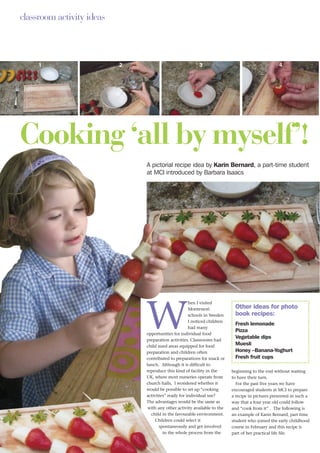
1 2 3 4
Strawberry and Banana Sticks
The Strawberry and Banana Sticks are
a colourful, tasty and healthy cooking
activity that can be done individually
by very young children in the nursery.
Always aiming for independence the
children will be grateful to prepare
their own snacks.
This simple recipe requires the child
to have developed some coordination
and fine motor skills from first
experiences with practical life activities.
It is necessary that the child has already
practiced pouring water from a jug into
a bowl and knows how to thread beads
following a pattern.
JULY – SEPTEMBER 2008 Montessori International 21
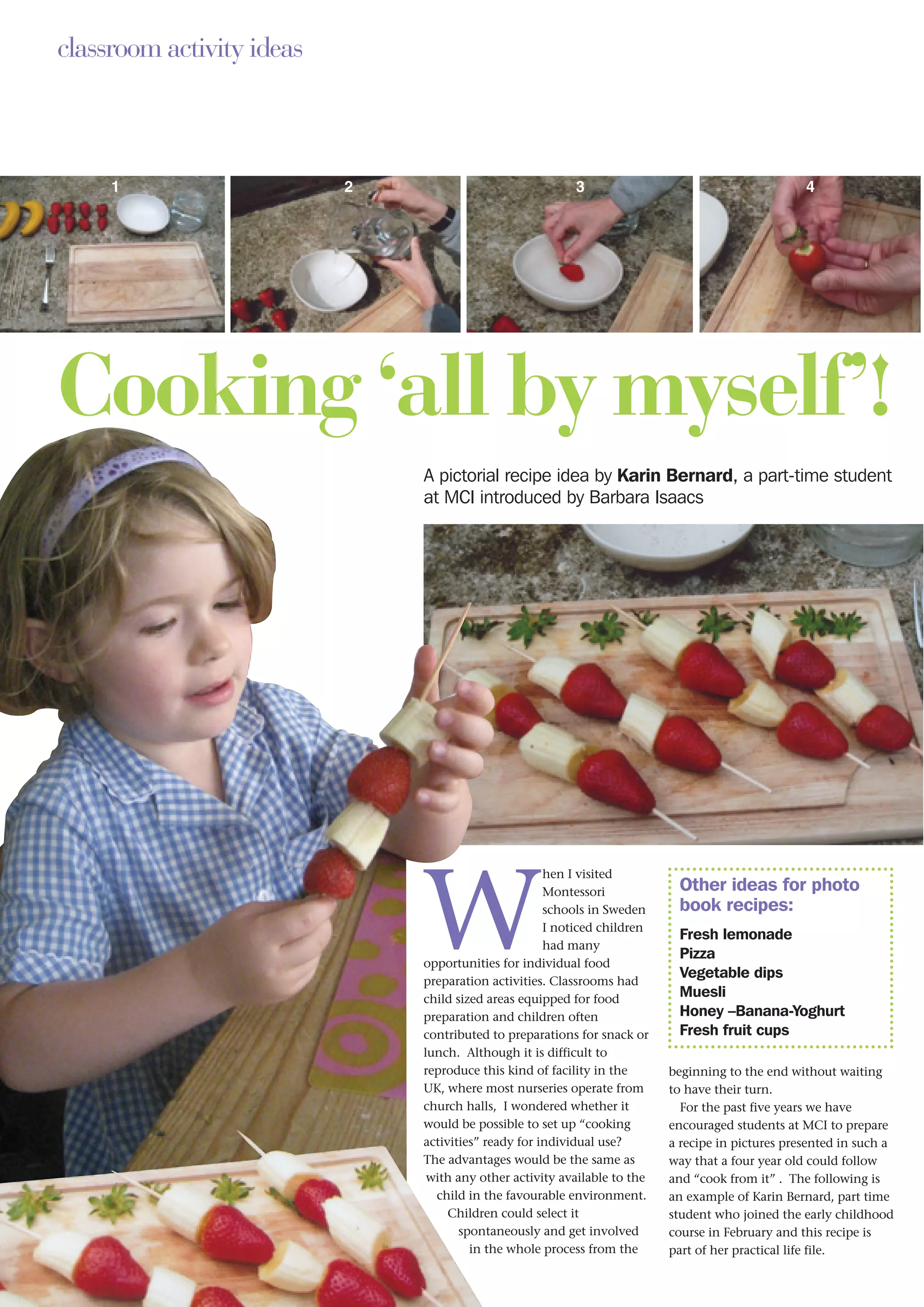
The recipe is presented in the form of
a photo book and each photo represents
one particular movement. The child can
only see one picture at a time. Turning
the page to see the next step helps the
child to structure the cooking process
by doing one step after the other.
The activity might be prepared by the
teacher and presented on a table as
illustrated in picture 1. Another option
is for the teacher to make sure that all
ingredients are available in the
cooking/snack area. The first step of the
activity is then for the child to prepare
his/her own personal cooking area by
assembling all necessary utensils and
fruits.
The sticks can be made with any fruit.
However, for young children
strawberries and bananas have several
advantages; they can be prepared
without the use of a knife, they are soft
and therefore can be put on the stick
quite easily, and last but not least
children usually love these fruits, and
they look very decorative on the stick! ࡯
The recipe above is
presented in the
form of a photo
book.
If you have pictorial recipes which
you have tried with children why not
share them with the readers of
Montessori International? Email the
editor, amanda@montessori.org.uk
A selection will be published in
forthcoming issues.
NutriSkill
TM
As seen at the Education Show
2008
NEW®
®
G An innovative, unique and proven resource for teaching healthy eating as a
practical life skill
G The resource enables exciting lessons to be taught and evaluated accurately,
with no prior knowledge, training or planning required
G The programme is flexible and versatile to suit your teaching style, providing
all you need to feel confident right from the start
G In addition to 100 high quality real food image cards, the resource also
includes many more teaching aids, together with physical games to engage
and empower children
G A cooking or 'cooker-less cooking' section is included, which allows for
theoretical as well as practical sessions to be run
G Children develop the skills and confidence to make their own informed food
choices
A new and exciting way for you to teach children the important life skill of healthy eating
For more information please visit
www.nutriskill.co.uk or call o845 388 0789
Tailored Learning Resources Ltd. Highbank, Ryefields, Spratton, Northants, NN6 8HQ
NutriSkill
‘
‘“The children are
definitely more aware of
healthy food choices”
“Children are trying to
make better food choices
at lunch time”
5 6 7 8

U6 ael s4-p1-mi88(kb)

  • 1.
    classroom activity ideas beginningto the end without waiting to have their turn. For the past five years we have encouraged students at MCI to prepare a recipe in pictures presented in such a way that a four year old could follow and “cook from it” . The following is an example of Karin Bernard, part time student who joined the early childhood course in February and this recipe is part of her practical life file. Cooking ‘all by myself’! Other ideas for photo book recipes: Fresh lemonade Pizza Vegetable dips Muesli Honey –Banana-Yoghurt Fresh fruit cups A pictorial recipe idea by Karin Bernard, a part-time student at MCI introduced by Barbara Isaacs W hen I visited Montessori schools in Sweden I noticed children had many opportunities for individual food preparation activities. Classrooms had child sized areas equipped for food preparation and children often contributed to preparations for snack or lunch. Although it is difficult to reproduce this kind of facility in the UK, where most nurseries operate from church halls, I wondered whether it would be possible to set up “cooking activities” ready for individual use? The advantages would be the same as with any other activity available to the child in the favourable environment. Children could select it spontaneously and get involved in the whole process from the 1 2 3 4
  • 2.
    Strawberry and BananaSticks The Strawberry and Banana Sticks are a colourful, tasty and healthy cooking activity that can be done individually by very young children in the nursery. Always aiming for independence the children will be grateful to prepare their own snacks. This simple recipe requires the child to have developed some coordination and fine motor skills from first experiences with practical life activities. It is necessary that the child has already practiced pouring water from a jug into a bowl and knows how to thread beads following a pattern. JULY – SEPTEMBER 2008 Montessori International 21 The recipe is presented in the form of a photo book and each photo represents one particular movement. The child can only see one picture at a time. Turning the page to see the next step helps the child to structure the cooking process by doing one step after the other. The activity might be prepared by the teacher and presented on a table as illustrated in picture 1. Another option is for the teacher to make sure that all ingredients are available in the cooking/snack area. The first step of the activity is then for the child to prepare his/her own personal cooking area by assembling all necessary utensils and fruits. The sticks can be made with any fruit. However, for young children strawberries and bananas have several advantages; they can be prepared without the use of a knife, they are soft and therefore can be put on the stick quite easily, and last but not least children usually love these fruits, and they look very decorative on the stick! ࡯ The recipe above is presented in the form of a photo book. If you have pictorial recipes which you have tried with children why not share them with the readers of Montessori International? Email the editor, amanda@montessori.org.uk A selection will be published in forthcoming issues. NutriSkill TM As seen at the Education Show 2008 NEW® ® G An innovative, unique and proven resource for teaching healthy eating as a practical life skill G The resource enables exciting lessons to be taught and evaluated accurately, with no prior knowledge, training or planning required G The programme is flexible and versatile to suit your teaching style, providing all you need to feel confident right from the start G In addition to 100 high quality real food image cards, the resource also includes many more teaching aids, together with physical games to engage and empower children G A cooking or 'cooker-less cooking' section is included, which allows for theoretical as well as practical sessions to be run G Children develop the skills and confidence to make their own informed food choices A new and exciting way for you to teach children the important life skill of healthy eating For more information please visit www.nutriskill.co.uk or call o845 388 0789 Tailored Learning Resources Ltd. Highbank, Ryefields, Spratton, Northants, NN6 8HQ NutriSkill ‘ ‘“The children are definitely more aware of healthy food choices” “Children are trying to make better food choices at lunch time” 5 6 7 8