I
n the last two decades, research
into the workings of the human
brain has expanded enormously,
aided particularly by new
scanning technologies such as
Magnetic Resonance Imaging (MRI)
which allow medical professionals and
researchers to see a living brain ‘at
work’. Such images, together with
more traditional methods of examining
brain function and development have
provided great insights into brain
function and development. They have
also provided the neurological/
physiological underpinning for what
many theorists working to understand
human behaviour have suspected and
suggested for many years, which is that
human development is profoundly
influenced by the quality of early
experience.
But, how does this happen and what
are the implications? To answer this, we
need to not only broadly know how
the brain works but also to
acknowledge that it grows and
develops within an interactive, social
environment. Cozolino (2006), for
example, notes that the brain “depends
on social interactions with others for its
survival and acts as an interface
between experience and genetics”.
In the newborn baby, the brain has
its basic structure with much of the
older, more primitive parts of the brain
formed and fully functioning with
early connections between the 100
billion neurons already in existence.
Then, during these early years, millions
of connections are made between
neurons, ‘pruned’ and then reformed
dependent on sensory and emotional
experience. Patterns of activity are laid
down becoming more established via
the consistency, predictability and
quality of those experiences. This last
sentence presents a clue to the
importance of interactions between
parent and infant because these will
form the pathways between the more
instinctive and emotional areas of the
brain and the frontal lobes
(Sunderland, 2006).
Parents are the child’s first contact
with the world and the very
helplessness of the infant together with
their brain being ‘on alert’ for
experience means that the way in
which parents interact with their child
sets the scene for the emergence of the
child’s own unique personality.
Particularly important are face to face
interactions. At only a few hours old,
babies will respond differently to
happy, sad or surprised faces and are
able to display facial, vocal and bodily
signs of general contentment and
distress which over the first year
become more differentiated into joy,
sadness, anger, fear and disgust
(Soussigan & Schaal, 2005; Cozolino,
2006).
Babies, of course, are not passive
recipients but their responses also
influence the parents’ responses. For
example, Messinger (2002)
demonstrated how the width of a
baby’s smile influenced parental
reactions and such reactions/
interpretations of an infant’s
expressions have very real implications
in the life of the baby. This is because
the quality of interactions is based on
this understanding and interpretation
of the child’s facial and bodily signals
by the adult. Such interpretation
becomes the mechanism by which
relationships are formed and crucially
the ‘correctness’ or otherwise of the
interpretation will also influence the
further response from the child and
this synchrony or disharmony will
contribute over time to the child’s
ongoing emotional state and
burgeoning sense of self.
‘Nature’ or evolution plays its part
too as parents talk to babies in a very
special ‘sing song’ way with extended
vowels, exaggerated facial expressions
and mouth movements. Not only is
brain and behaviour
10 Montessori International JANUARY - MARCH 2008
Beginning the journey
Maria Robinson explains how daily interactions between a
baby and its main carer have a direct impact on the way the
brain develops.
‘‘“At only a few hours old, babies will
respond differently to happy, sad or
surprised faces and are able to display
facial, vocal and bodily signs of
general contentment and distress...
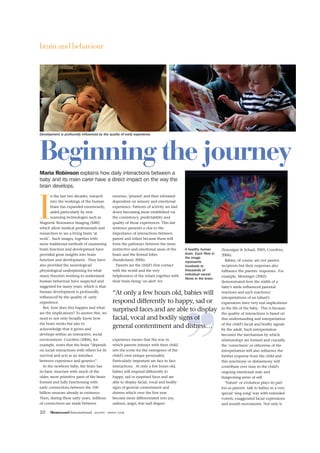
A healthy human
brain. Each fibre in
the image
represents
hundreds to
thousands of
individual neural
fibres in the brain.
Development is profoundly influenced by the quality of early experience
being spoken to and responding so
pleasurable in most situations, but the
mobile face attracts a baby’s attention.
This supports all aspects of
development by helping babies to
localise sound on the midline, match
sounds to mouth movements, helping
the eyes to focus and the exaggerated
facial expressions help the immature
brain to link the movements of the face
with feelings. This is supported even
further by the almost instinctive way in
which parents and carers will copy the
baby’s expression and also help to
modulate it. A potential neurological
support to this process has been the
discovery, originally in primates ‘of the
existence of individual neurons in the
cortex’, which responded to the
observation of an action using the
hands acting on an object as if the
primate was carrying out the same
procedure (Rizzolatti et al, 1996, 2002).
This was a breakthrough in considering
the neural basis for imitation and these
neurons were therefore termed ‘mirror
neurons’. Similar neurons have been
found in the human cortex, which
respond to both visual and motor
sensory input. While it is not currently
known whether these are active at
birth, the findings by some researchers,
particularly Meltzoff (2002), of
newborns imitating some facial
gestures is suggestive of, at the very
least, a rudimentary innate capacity for
‘mirroring’ observed actions. If this is
the case, when the baby is imitated,
these immature mirror neurons may
also activate so the child will
experience its feelings reflected back.
Also, if the parent is ‘tuned in’, there
will also be a sense of these feelings
being ‘managed’ as the parent aims to
raise or lower levels of mood. All the
basic emotions of happiness, sadness,
anger, fear, disgust and surprise
(Ekman, 2004) can be discovered and
perhaps reflected by those around the
baby and so, dependent on the quality
of these responses, the baby will learn
about the overarching emotional
quality of their inner world. These
interactions, impacting on this rapidly
growing brain, therefore set the course
for a child who learns to trust or for a
child who treads his path with wariness
and a watchful eye for danger.
Sunderland (2006) provides a graphic
picture of the brain scan of a child from
a Romanian orphanage where a lack of
affection as well as physical care has
resulted in inactivity of those parts of
the brain which deal with processing
and regulating emotions. While this is
an extreme example, it should not be
dismissed as irrelevant to ‘ordinary’
situations because children feel real
pain when their distress is not
comforted, resulting in a highly
stressful state with raised levels of the
stress hormone, cortisol. This normally
has peaks and troughs throughout the
day but consistently unmet distress
needs means that the child’s brain
becomes organised around fear and
rigidity which also affects the child’s
ability to learn. On the other hand,
being nurtured creates a chemical
buffer against stressful challenges and
so as Cozolino says, “good parenting
tells the child he or she is loved
accepted and valued; fortifies the body
for growth and strengthens
immunological functioning” (P.221).
Children blossom when nurtured! ࡯
Maria Robinson is a qualified lecturer,
counsellor, trainer and adviser in early
years’ development. She is the author
of From birth to one- the year of
opportunity, (2003) and Child
Development 0-8 – A journey through
the early years.
References/bibliography
Cozolino, L., (2006) Attachment and the
Developing Brain: New York, W.W. Norton
and Company
Ekman, P., (2004) Emotions Revealed –
Understanding Faces and Feelings:
London, Orion Books
Meltzoff, A. (2002) Elements of a
Developmental Theory of Imitation in
Metlzoff, A., Prinz, W., (Eds) The Imitative
Mind pp.42-62 Cambridge, Cambridge
University Press
Messinger, D.S., (2002) Positive and
Negative: Infant Facial Expressions and
Emotions: Journal of Current Directions in
Psychological Science; Vol 11,
No.1,February
Rizzolatti, G.,Fadiga, L., Fogassi, L.,
Gallese, V., (2002) From Mirror Neurons
to Imitation: Facts and Speculation: in
Metlzoff, A., Prinz, W., (Eds) The imitative
Mind pp.42-62 Cambridge, Cambridge
University Press
Soussignan R., Schaal, B., (2005)
Emotional Processes in Human Newborns:
a Functionalist Perspective in Nadel, J.,
Muir, D., (Eds) Emotional Development:
Oxford, Oxford University Press
Sunderland, M., (2006) The Science of
Parenting: Dorling Kindersley, London.
Tronick, E., Als, H. Adamson L, et al
(1978) The Infants Response to
Entrapment Between Contradictory
Messages in Face to Face Interaction.
Journal of the American Academy of
Psychiatry, 17 1-13
JANUARY - MARCH 2008 Montessori International 11
‘‘... a lack of affection as well as
physical care has resulted in
inactivity of those parts of the brain
which deal with processing and
regulating emotions.
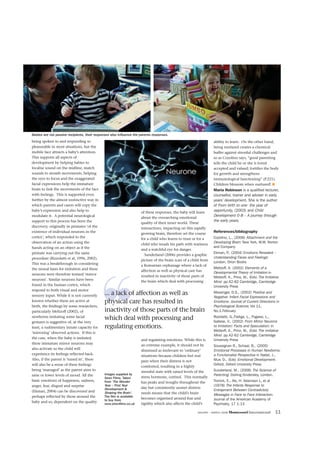
Babies are not passive recipients, their responses also influence the parents responses.
Images supplied by
Siren Films. Taken
from ‘The Wonder
Year – First Year
Development &
Shaping the Brain’.
The film is available
to buy from
www.sirenfilms.co.uk

U3 cds2 p2-pdf1rb

  • 1.
    I n the lasttwo decades, research into the workings of the human brain has expanded enormously, aided particularly by new scanning technologies such as Magnetic Resonance Imaging (MRI) which allow medical professionals and researchers to see a living brain ‘at work’. Such images, together with more traditional methods of examining brain function and development have provided great insights into brain function and development. They have also provided the neurological/ physiological underpinning for what many theorists working to understand human behaviour have suspected and suggested for many years, which is that human development is profoundly influenced by the quality of early experience. But, how does this happen and what are the implications? To answer this, we need to not only broadly know how the brain works but also to acknowledge that it grows and develops within an interactive, social environment. Cozolino (2006), for example, notes that the brain “depends on social interactions with others for its survival and acts as an interface between experience and genetics”. In the newborn baby, the brain has its basic structure with much of the older, more primitive parts of the brain formed and fully functioning with early connections between the 100 billion neurons already in existence. Then, during these early years, millions of connections are made between neurons, ‘pruned’ and then reformed dependent on sensory and emotional experience. Patterns of activity are laid down becoming more established via the consistency, predictability and quality of those experiences. This last sentence presents a clue to the importance of interactions between parent and infant because these will form the pathways between the more instinctive and emotional areas of the brain and the frontal lobes (Sunderland, 2006). Parents are the child’s first contact with the world and the very helplessness of the infant together with their brain being ‘on alert’ for experience means that the way in which parents interact with their child sets the scene for the emergence of the child’s own unique personality. Particularly important are face to face interactions. At only a few hours old, babies will respond differently to happy, sad or surprised faces and are able to display facial, vocal and bodily signs of general contentment and distress which over the first year become more differentiated into joy, sadness, anger, fear and disgust (Soussigan & Schaal, 2005; Cozolino, 2006). Babies, of course, are not passive recipients but their responses also influence the parents’ responses. For example, Messinger (2002) demonstrated how the width of a baby’s smile influenced parental reactions and such reactions/ interpretations of an infant’s expressions have very real implications in the life of the baby. This is because the quality of interactions is based on this understanding and interpretation of the child’s facial and bodily signals by the adult. Such interpretation becomes the mechanism by which relationships are formed and crucially the ‘correctness’ or otherwise of the interpretation will also influence the further response from the child and this synchrony or disharmony will contribute over time to the child’s ongoing emotional state and burgeoning sense of self. ‘Nature’ or evolution plays its part too as parents talk to babies in a very special ‘sing song’ way with extended vowels, exaggerated facial expressions and mouth movements. Not only is brain and behaviour 10 Montessori International JANUARY - MARCH 2008 Beginning the journey Maria Robinson explains how daily interactions between a baby and its main carer have a direct impact on the way the brain develops. ‘‘“At only a few hours old, babies will respond differently to happy, sad or surprised faces and are able to display facial, vocal and bodily signs of general contentment and distress... A healthy human brain. Each fibre in the image represents hundreds to thousands of individual neural fibres in the brain. Development is profoundly influenced by the quality of early experience
  • 2.
    being spoken toand responding so pleasurable in most situations, but the mobile face attracts a baby’s attention. This supports all aspects of development by helping babies to localise sound on the midline, match sounds to mouth movements, helping the eyes to focus and the exaggerated facial expressions help the immature brain to link the movements of the face with feelings. This is supported even further by the almost instinctive way in which parents and carers will copy the baby’s expression and also help to modulate it. A potential neurological support to this process has been the discovery, originally in primates ‘of the existence of individual neurons in the cortex’, which responded to the observation of an action using the hands acting on an object as if the primate was carrying out the same procedure (Rizzolatti et al, 1996, 2002). This was a breakthrough in considering the neural basis for imitation and these neurons were therefore termed ‘mirror neurons’. Similar neurons have been found in the human cortex, which respond to both visual and motor sensory input. While it is not currently known whether these are active at birth, the findings by some researchers, particularly Meltzoff (2002), of newborns imitating some facial gestures is suggestive of, at the very least, a rudimentary innate capacity for ‘mirroring’ observed actions. If this is the case, when the baby is imitated, these immature mirror neurons may also activate so the child will experience its feelings reflected back. Also, if the parent is ‘tuned in’, there will also be a sense of these feelings being ‘managed’ as the parent aims to raise or lower levels of mood. All the basic emotions of happiness, sadness, anger, fear, disgust and surprise (Ekman, 2004) can be discovered and perhaps reflected by those around the baby and so, dependent on the quality of these responses, the baby will learn about the overarching emotional quality of their inner world. These interactions, impacting on this rapidly growing brain, therefore set the course for a child who learns to trust or for a child who treads his path with wariness and a watchful eye for danger. Sunderland (2006) provides a graphic picture of the brain scan of a child from a Romanian orphanage where a lack of affection as well as physical care has resulted in inactivity of those parts of the brain which deal with processing and regulating emotions. While this is an extreme example, it should not be dismissed as irrelevant to ‘ordinary’ situations because children feel real pain when their distress is not comforted, resulting in a highly stressful state with raised levels of the stress hormone, cortisol. This normally has peaks and troughs throughout the day but consistently unmet distress needs means that the child’s brain becomes organised around fear and rigidity which also affects the child’s ability to learn. On the other hand, being nurtured creates a chemical buffer against stressful challenges and so as Cozolino says, “good parenting tells the child he or she is loved accepted and valued; fortifies the body for growth and strengthens immunological functioning” (P.221). Children blossom when nurtured! ࡯ Maria Robinson is a qualified lecturer, counsellor, trainer and adviser in early years’ development. She is the author of From birth to one- the year of opportunity, (2003) and Child Development 0-8 – A journey through the early years. References/bibliography Cozolino, L., (2006) Attachment and the Developing Brain: New York, W.W. Norton and Company Ekman, P., (2004) Emotions Revealed – Understanding Faces and Feelings: London, Orion Books Meltzoff, A. (2002) Elements of a Developmental Theory of Imitation in Metlzoff, A., Prinz, W., (Eds) The Imitative Mind pp.42-62 Cambridge, Cambridge University Press Messinger, D.S., (2002) Positive and Negative: Infant Facial Expressions and Emotions: Journal of Current Directions in Psychological Science; Vol 11, No.1,February Rizzolatti, G.,Fadiga, L., Fogassi, L., Gallese, V., (2002) From Mirror Neurons to Imitation: Facts and Speculation: in Metlzoff, A., Prinz, W., (Eds) The imitative Mind pp.42-62 Cambridge, Cambridge University Press Soussignan R., Schaal, B., (2005) Emotional Processes in Human Newborns: a Functionalist Perspective in Nadel, J., Muir, D., (Eds) Emotional Development: Oxford, Oxford University Press Sunderland, M., (2006) The Science of Parenting: Dorling Kindersley, London. Tronick, E., Als, H. Adamson L, et al (1978) The Infants Response to Entrapment Between Contradictory Messages in Face to Face Interaction. Journal of the American Academy of Psychiatry, 17 1-13 JANUARY - MARCH 2008 Montessori International 11 ‘‘... a lack of affection as well as physical care has resulted in inactivity of those parts of the brain which deal with processing and regulating emotions. Babies are not passive recipients, their responses also influence the parents responses. Images supplied by Siren Films. Taken from ‘The Wonder Year – First Year Development & Shaping the Brain’. The film is available to buy from www.sirenfilms.co.uk