Typography & Motion Graphics
Alexis Sansone sp.2016
History of typography in motion graphics
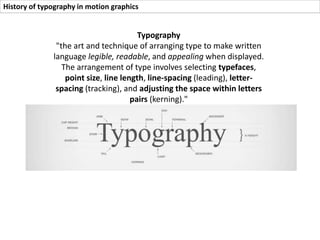
Typography
"the art and technique of arranging type to make written
language legible, readable, and appealing when displayed.
The arrangement of type involves selecting typefaces,
point size, line length, line-spacing (leading), letter-
spacing (tracking), and adjusting the space within letters
pairs (kerning)."
History of typography in motion graphics
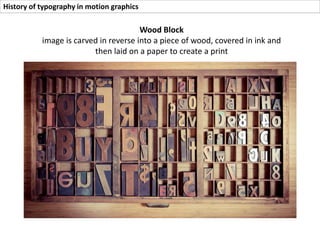
Wood Block
image is carved in reverse into a piece of wood, covered in ink and
then laid on a paper to create a print
History of typography in motion graphics
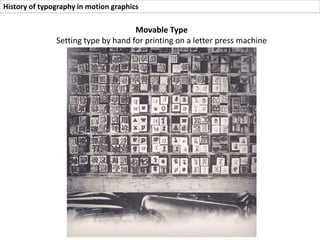
Movable Type
Setting type by hand for printing on a letter press machine
History of typography in motion graphics
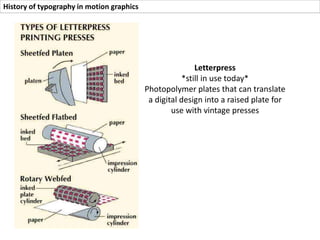
Letterpress
*still in use today*
Photopolymer plates that can translate
a digital design into a raised plate for
use with vintage presses
History of typography in motion graphics
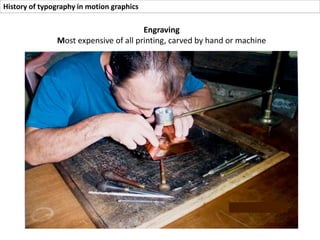
Engraving
Most expensive of all printing, carved by hand or machine
History of typography in motion graphics
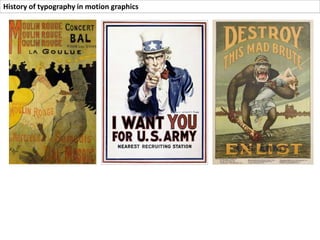
Development of the Poster
History of typography in motion graphics
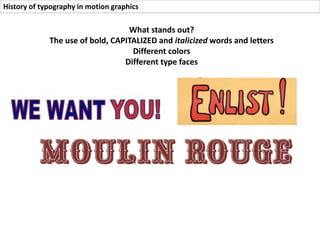
What stands out?
The use of bold, CAPITALIZED and italicized words and letters
Different colors
Different type faces
History of typography in motion graphics
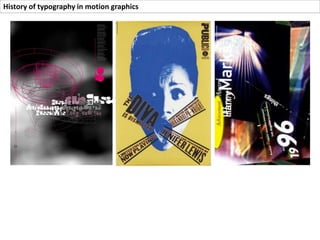
Post- Modernism Designs
History of typography in motion graphics
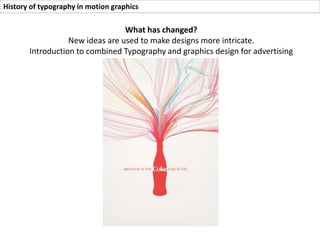
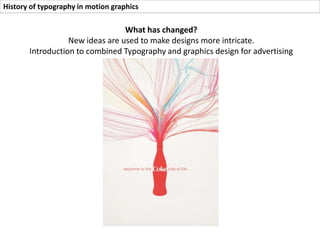
What has changed?
New ideas are used to make designs more intricate.
Introduction to combined Typography and graphics design for advertising
History of typography in motion graphics
History of motion graphics
What is a motion graphic?
Digital footage and/or animation technology to create the illusion of motion or
rotation, and are usually combined with audio for use in multimedia projects.
History of motion graphics
The earliest forms of motion graphics can be found in cave drawings from
hundreds of years ago. Although these drawings are not "animated" the
represent motion of a story.
Motion graphics can be shown in the forms of art, photography, text or videoOne
of the first successful devices for creating the illusion of motion was the
thaumatrope .
History of motion graphics
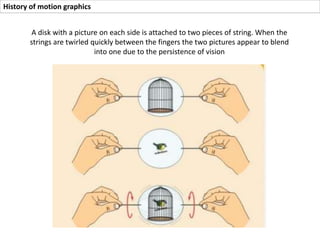
A disk with a picture on each side is attached to two pieces of string. When the
strings are twirled quickly between the fingers the two pictures appear to blend
into one due to the persistence of vision
History of motion graphics
William George Horner invents the Zoetrope
a 19th-century optical toy consisting of a cylinder with a series of pictures on the
inner surface that, when viewed through slits with the cylinder rotating, give an
impression of continuous motion.
Example: Cartoon Network Bumpers - Magical Zoetrope
History of motion graphics
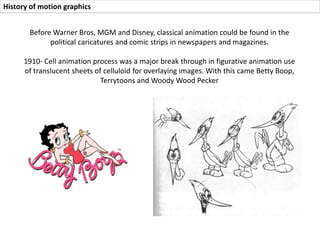
Before Warner Bros, MGM and Disney, classical animation could be found in the
political caricatures and comic strips in newspapers and magazines.
1910- Cell animation process was a major break through in figurative animation use
of translucent sheets of celluloid for overlaying images. With this came Betty Boop,
Terrytoons and Woody Wood Pecker
History of motion graphics
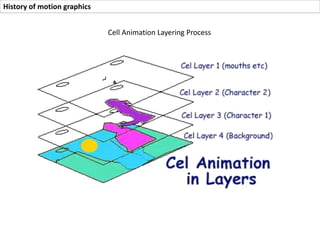
Cell Animation Layering Process
History of motion graphics
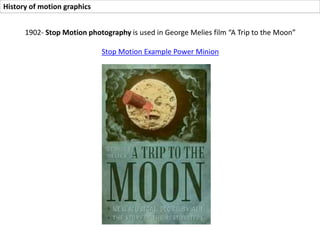
1902- Stop Motion photography is used in George Melies film “A Trip to the Moon”
Stop Motion Example Power Minion
History of motion graphics
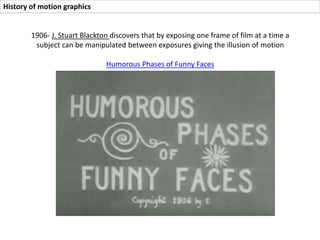
1906- J. Stuart Blackton discovers that by exposing one frame of film at a time a
subject can be manipulated between exposures giving the illusion of motion
Humorous Phases of Funny Faces
History of motion graphics
Emily Cohl and Max Fleischer begin to mix live footage with hand-drawn elements.
Experimental Animationturn of 20th century-- postwar industrial advances and
changing social, economical, and cultural conditions throughout Europe fuel artist to
reject classical representation
Dadaist and Surrealist artists seek to overthrow traditional restraints by exploring the
spontaneous and the irrational
History of motion graphics
1970- Frank & Caroline Mouris develop collage animation
Animators begin to be brought onto feature films and mini films to create opening or
closing animations
Pink Panther Opening sequence, Loony Toons mini films
Pink Panther Opening Motion Graphic
Typography within motion graphics
How is Typography integrated in a motion
graphic?
Typography within motion graphics
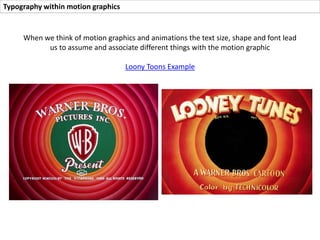
When we think of motion graphics and animations the text size, shape and font lead
us to assume and associate different things with the motion graphic
Loony Toons Example
Typography within motion graphics
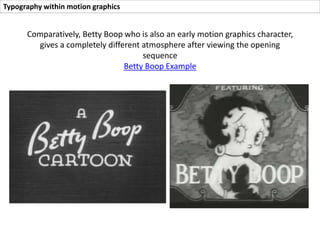
Comparatively, Betty Boop who is also an early motion graphics character,
gives a completely different atmosphere after viewing the opening
sequence
Betty Boop Example
Typography within motion graphics
A leader in motion graphics and advancements in typography within motion
graphics from their beginning stages of development is Walt Disney Pictures
Mickey Mouse Example
Disney Example

Typography and Motion Graphics

  • 1.
    Typography & MotionGraphics Alexis Sansone sp.2016
  • 2.
    History of typographyin motion graphics Typography "the art and technique of arranging type to make written language legible, readable, and appealing when displayed. The arrangement of type involves selecting typefaces, point size, line length, line-spacing (leading), letter- spacing (tracking), and adjusting the space within letters pairs (kerning)."
  • 3.
    History of typographyin motion graphics Wood Block image is carved in reverse into a piece of wood, covered in ink and then laid on a paper to create a print
  • 4.
    History of typographyin motion graphics Movable Type Setting type by hand for printing on a letter press machine
  • 5.
    History of typographyin motion graphics Letterpress *still in use today* Photopolymer plates that can translate a digital design into a raised plate for use with vintage presses
  • 6.
    History of typographyin motion graphics Engraving Most expensive of all printing, carved by hand or machine
  • 7.
    History of typographyin motion graphics
  • 8.
    History of typographyin motion graphics Development of the Poster
  • 9.
    History of typographyin motion graphics What stands out? The use of bold, CAPITALIZED and italicized words and letters Different colors Different type faces
  • 10.
    History of typographyin motion graphics Post- Modernism Designs
  • 11.
    History of typographyin motion graphics What has changed? New ideas are used to make designs more intricate. Introduction to combined Typography and graphics design for advertising
  • 12.
    History of typographyin motion graphics
  • 13.
    History of motiongraphics What is a motion graphic? Digital footage and/or animation technology to create the illusion of motion or rotation, and are usually combined with audio for use in multimedia projects.
  • 14.
    History of motiongraphics The earliest forms of motion graphics can be found in cave drawings from hundreds of years ago. Although these drawings are not "animated" the represent motion of a story. Motion graphics can be shown in the forms of art, photography, text or videoOne of the first successful devices for creating the illusion of motion was the thaumatrope .
  • 15.
    History of motiongraphics A disk with a picture on each side is attached to two pieces of string. When the strings are twirled quickly between the fingers the two pictures appear to blend into one due to the persistence of vision
  • 16.
    History of motiongraphics William George Horner invents the Zoetrope a 19th-century optical toy consisting of a cylinder with a series of pictures on the inner surface that, when viewed through slits with the cylinder rotating, give an impression of continuous motion. Example: Cartoon Network Bumpers - Magical Zoetrope
  • 17.
    History of motiongraphics Before Warner Bros, MGM and Disney, classical animation could be found in the political caricatures and comic strips in newspapers and magazines. 1910- Cell animation process was a major break through in figurative animation use of translucent sheets of celluloid for overlaying images. With this came Betty Boop, Terrytoons and Woody Wood Pecker
  • 18.
    History of motiongraphics Cell Animation Layering Process
  • 19.
    History of motiongraphics 1902- Stop Motion photography is used in George Melies film “A Trip to the Moon” Stop Motion Example Power Minion
  • 20.
    History of motiongraphics 1906- J. Stuart Blackton discovers that by exposing one frame of film at a time a subject can be manipulated between exposures giving the illusion of motion Humorous Phases of Funny Faces
  • 21.
    History of motiongraphics Emily Cohl and Max Fleischer begin to mix live footage with hand-drawn elements. Experimental Animationturn of 20th century-- postwar industrial advances and changing social, economical, and cultural conditions throughout Europe fuel artist to reject classical representation Dadaist and Surrealist artists seek to overthrow traditional restraints by exploring the spontaneous and the irrational
  • 22.
    History of motiongraphics 1970- Frank & Caroline Mouris develop collage animation Animators begin to be brought onto feature films and mini films to create opening or closing animations Pink Panther Opening sequence, Loony Toons mini films Pink Panther Opening Motion Graphic
  • 23.
    Typography within motiongraphics How is Typography integrated in a motion graphic?
  • 24.
    Typography within motiongraphics When we think of motion graphics and animations the text size, shape and font lead us to assume and associate different things with the motion graphic Loony Toons Example
  • 25.
    Typography within motiongraphics Comparatively, Betty Boop who is also an early motion graphics character, gives a completely different atmosphere after viewing the opening sequence Betty Boop Example
  • 26.
    Typography within motiongraphics A leader in motion graphics and advancements in typography within motion graphics from their beginning stages of development is Walt Disney Pictures Mickey Mouse Example Disney Example