INTRO. TO 2D
ANIMATION
The World of
ANIMATION
Share your thoughts and expectations
when it comes to the world animation
What is
ANIMATION
The technique of photographing successive drawings or positions of models to
create an illusion of movement when the film is shown as a sequence.
A simulation of movement or the perception of motion created by the rapid
display of a series of still images
–Aaron Blaise
History of
ANIMATION
History of
ANIMATION
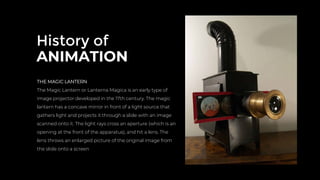
THE MAGIC LANTERN
The Magic Lantern or Lanterna Magica is an early type of
image projector developed in the 17th century. The magic
lantern has a concave mirror in front of a light source that
gathers light and projects it through a slide with an image
scanned onto it. The light rays cross an aperture (which is an
opening at the front of the apparatus), and hit a lens. The
lens throws an enlarged picture of the original image from
the slide onto a screen
History of
ANIMATION
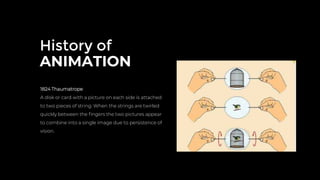
1824 Thaumatrope
A disk or card with a picture on each side is attached
to two pieces of string. When the strings are twirled
quickly between the fingers the two pictures appear
to combine into a single image due to persistence of
vision.
History of
ANIMATION
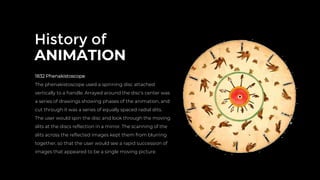
1832 Phenakistoscope
The phenakistoscope used a spinning disc attached
vertically to a handle. Arrayed around the disc's center was
a series of drawings showing phases of the animation, and
cut through it was a series of equally spaced radial slits.
The user would spin the disc and look through the moving
slits at the discs reflection in a mirror. The scanning of the
slits across the reflected images kept them from blurring
together, so that the user would see a rapid succession of
images that appeared to be a single moving picture.
History of
ANIMATION
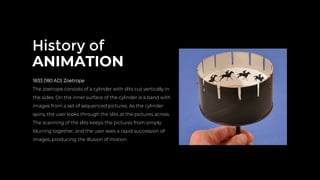
1833 (180 AD) Zoetrope
The zoetrope consists of a cylinder with slits cut vertically in
the sides. On the inner surface of the cylinder is a band with
images from a set of sequenced pictures. As the cylinder
spins, the user looks through the slits at the pictures across.
The scanning of the slits keeps the pictures from simply
blurring together, and the user sees a rapid succession of
images, producing the illusion of motion.
History of
ANIMATION
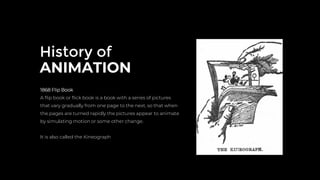
1868 Flip Book
A flip book or flick book is a book with a series of pictures
that vary gradually from one page to the next, so that when
the pages are turned rapidly the pictures appear to animate
by simulating motion or some other change.
It is also called the Kineograph
History of
ANIMATION
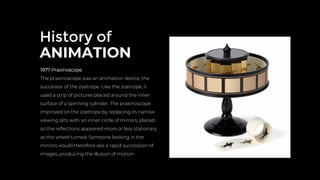
1877 Praxinoscope
The praxinoscope was an animation device, the
successor of the zoetrope. Like the zoetrope, it
used a strip of pictures placed around the inner
surface of a spinning cylinder. The praxinoscope
improved on the zoetrope by replacing its narrow
viewing slits with an inner circle of mirrors, placed
so the reflections appeared more or less stationary
as the wheel turned. Someone looking in the
mirrors would therefore see a rapid succession of
images, producing the illusion of motion
History of
ANIMATION
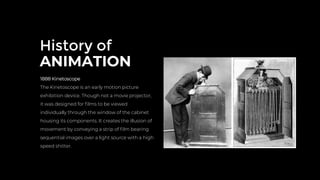
1888 Kinetoscope
The Kinetoscope is an early motion picture
exhibition device. Though not a movie projector,
it was designed for films to be viewed
individually through the window of the cabinet
housing its components. It creates the illusion of
movement by conveying a strip of film bearing
sequential images over a light source with a high
speed shitter.
History of
ANIMATION
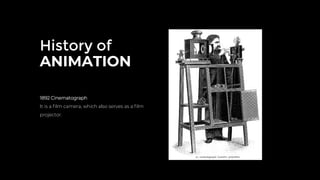
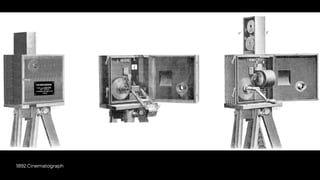
1892 Cinematograph
It is a film camera, which also serves as a film
projector.
1892 Cinematograph
History of
ANIMATION
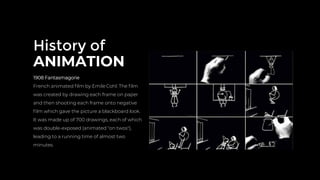
1908 Fantasmagorie
French animated film by Emile Cohl. The film
was created by drawing each frame on paper
and then shooting each frame onto negative
film which gave the picture a blackboard look.
It was made up of 700 drawings, each of which
was double-exposed (animated "on twos"),
leading to a running time of almost two
minutes.
History of
ANIMATION
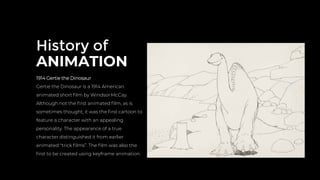
1914 Gertie the Dinosaur
Gertie the Dinosaur is a 1914 American
animated short film by Windsor McCay.
Although not the first animated film, as is
sometimes thought, it was the first cartoon to
feature a character with an appealing
personality. The appearance of a true
character distinguished it from earlier
animated "trick films”. The film was also the
first to be created using keyframe animation.
History of
ANIMATION
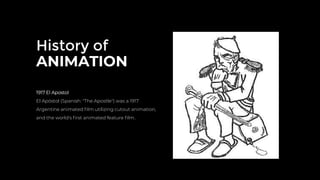
1917 El Apostol
El Apóstol (Spanish: "The Apostle") was a 1917
Argentine animated film utilizing cutout animation,
and the world's first animated feature film..
History of
ANIMATION
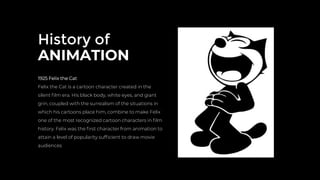
1925 Felix the Cat
Felix the Cat is a cartoon character created in the
silent film era. His black body, white eyes, and giant
grin, coupled with the surrealism of the situations in
which his cartoons place him, combine to make Felix
one of the most recognized cartoon characters in film
history. Felix was the first character from animation to
attain a level of popularity sufficient to draw movie
audiences
History of
ANIMATION
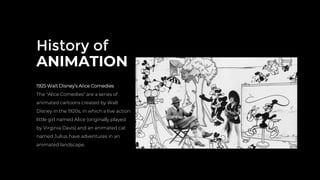
1925 Walt Disney’s Alice Comedies
The "Alice Comedies" are a series of
animated cartoons created by Walt
Disney in the 1920s, in which a live action
little girl named Alice (originally played
by Virginia Davis) and an animated cat
named Julius have adventures in an
animated landscape.
History of
ANIMATION
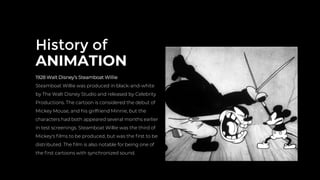
1928 Walt Disney’s Steamboat Willie
Steamboat Willie was produced in black-and-white
by The Walt Disney Studio and released by Celebrity
Productions. The cartoon is considered the debut of
Mickey Mouse, and his girlfriend Minnie, but the
characters had both appeared several months earlier
in test screenings. Steamboat Willie was the third of
Mickey's films to be produced, but was the first to be
distributed. The film is also notable for being one of
the first cartoons with synchronized sound.
History of
ANIMATION
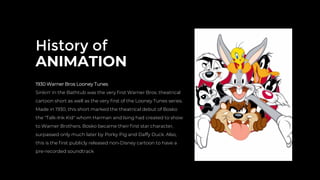
1930 Warner Bros Looney Tunes
Sinkin' in the Bathtub was the very first Warner Bros. theatrical
cartoon short as well as the very first of the Looney Tunes series.
Made in 1930, this short marked the theatrical debut of Bosko
the "Talk-Ink Kid" whom Harman and Ising had created to show
to Warner Brothers. Bosko became their first star character,
surpassed only much later by Porky Pig and Daffy Duck. Also,
this is the first publicly released non-Disney cartoon to have a
pre-recorded soundtrack
History of
ANIMATION
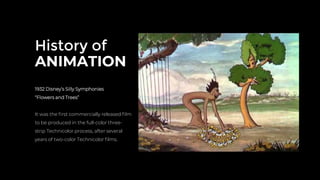
1932 Disney’s Silly Symphonies
“Flowers and Trees”
It was the first commercially released film
to be produced in the full-color three-
strip Technicolor process, after several
years of two-color Technicolor films.
History of
ANIMATION
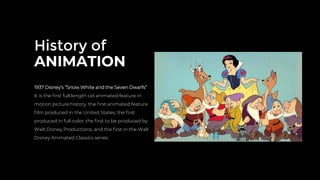
1937 Disney’s “Snow White and the Seven Dwarfs”
It is the first full-length cel animated feature in
motion picture history, the first animated feature
film produced in the United States, the first
produced in full color, the first to be produced by
Walt Disney Productions, and the first in the Walt
Disney Animated Classics series.
History of
ANIMATION
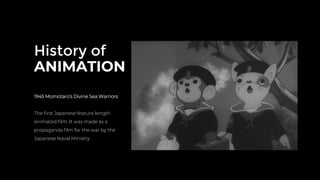
1945 Momotaro’s Divine Sea Warriors
The first Japanese feature length
animated film. It was made as a
propaganda film for the war by the
Japanese Naval Ministry
Importance of
ANIMATION
• It’s an avenue to tell stories without limitations nor further explanations
• It is a very flexible and versatile medium to expressing your view of the
world and other issues
• It has a very wide target audience
. . . . . . . . . . . . .
Types of
ANIMATION
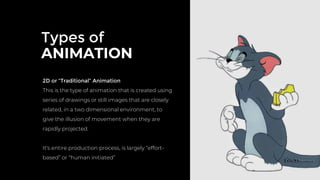
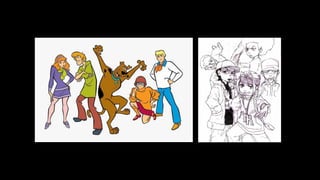
2D or “Traditional” Animation
This is the type of animation that is created using
series of drawings or still images that are closely
related, in a two dimensional environment, to
give the illusion of movement when they are
rapidly projected.
It’s entire production process, is largely “effort-
based” or “human initiated”
Types of
ANIMATION
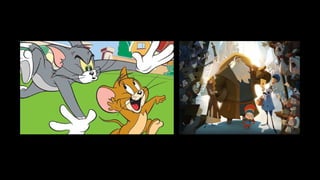
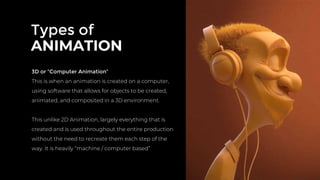
3D or “Computer Animation”
This is when an animation is created on a computer,
using software that allows for objects to be created,
animated, and composited in a 3D environment.
This unlike 2D Animation, largely everything that is
created and is used throughout the entire production
without the need to recreate them each step of the
way. It is heavily “machine / computer based”
Types of
ANIMATION
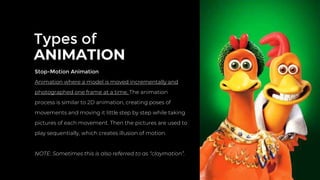
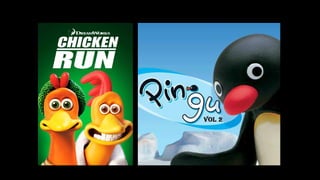
Stop-Motion Animation
Animation where a model is moved incrementally and
photographed one frame at a time. The animation
process is similar to 2D animation, creating poses of
movements and moving it little step by step while taking
pictures of each movement. Then the pictures are used to
play sequentially, which creates illusion of motion.
NOTE: Sometimes this is also referred to as “claymation”.
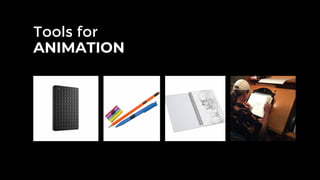
Tools for
ANIMATION
Tools for
ANIMATION
Tools for
ANIMATION
ANIMATION
Vocabulary
Animatic
An animated storyboard; a series of still images edited together and displayed in sequence. Often,
a rough dialogue/soundtrack is added to it to test whether the sound and images work together.
Arcs
Animation technique used to plan and simulate realistic motion paths.
Armature
A framework around which a sculpture (physical or digital) is built, allowing movements of the
figure to be animated such as arms and legs.
ANIMATION
Vocabulary
Boiling Line
The inevitable wobble of hand-drawn lines, particularly noticeable when characters are redrawn
in every frame even though they are standing still.
Breakdowns
Animation frames used to plan significant movement in a sequence
Claymation
Animation using figures made from clay or similar material
ANIMATION
Vocabulary
Cel
Short for celluloid, the material from which the first transparent sheets, used for animating on
several levels, were made. Now used as a term interchangeable with 2D animation.
CGI
Computer generated images. Can be 2D, often drawn using a graphic tablet or 3D, using
specialist software to create a virtual world.
Compositing
The technique of constructing an image from multiple digital sources.
ANIMATION
Vocabulary
Copy stand (also known as rostrum camera)
A adjustable camera mounting device used for photographing a still image from above.
Cut out animation
Cut paper shapes moved around with stop motion technique under a glass plate
Double Frame
Technique for photographing every other frame to create 12 frames per second. This is
sometimes called “on Twos”.
ANIMATION
Vocabulary
Inbetweening
A process in cell animation, usually referred to as pope to pose, in which an animator or
assistant illustrates the frames and action between key poses in an animated sequence.
Key positions
Usually the start and end pose in an animated scene from which an animator will the plan or
breakdown other key poses before the in-between frames are completed
Layout stage
The stage in 2D animation in which key positions and poses are laid out in advance of frame by
frame animation.
ANIMATION
Vocabulary
Onion Skinning
When an animator is able see a relief or impression of the previous frame either through the
animation paper or on a computer.
Rotoscope
An animation technique in which live-action images are traced either manually or
automatically.
Rig
A usually hidden system used to support and manipulate an animation model, be it digital
or physical.
ANIMATION
Vocabulary
Scene
A sequence of continuous action usually demarcated by location
Timeline
An editable liner representation of a moving image sequence used in digital editing and
animation software.
Walk cycle
A repeatable sequence of frames needed for an animated character to walk
NOTE:
All reference images used are solely for academic purposes.
All reference images remain the property of their respective owners

Animation Extra notes.pdf

  • 1.
  • 2.
    The World of ANIMATION Shareyour thoughts and expectations when it comes to the world animation
  • 3.
    What is ANIMATION The techniqueof photographing successive drawings or positions of models to create an illusion of movement when the film is shown as a sequence. A simulation of movement or the perception of motion created by the rapid display of a series of still images –Aaron Blaise
  • 4.
  • 5.
    History of ANIMATION THE MAGICLANTERN The Magic Lantern or Lanterna Magica is an early type of image projector developed in the 17th century. The magic lantern has a concave mirror in front of a light source that gathers light and projects it through a slide with an image scanned onto it. The light rays cross an aperture (which is an opening at the front of the apparatus), and hit a lens. The lens throws an enlarged picture of the original image from the slide onto a screen
  • 6.
    History of ANIMATION 1824 Thaumatrope Adisk or card with a picture on each side is attached to two pieces of string. When the strings are twirled quickly between the fingers the two pictures appear to combine into a single image due to persistence of vision.
  • 7.
    History of ANIMATION 1832 Phenakistoscope Thephenakistoscope used a spinning disc attached vertically to a handle. Arrayed around the disc's center was a series of drawings showing phases of the animation, and cut through it was a series of equally spaced radial slits. The user would spin the disc and look through the moving slits at the discs reflection in a mirror. The scanning of the slits across the reflected images kept them from blurring together, so that the user would see a rapid succession of images that appeared to be a single moving picture.
  • 8.
    History of ANIMATION 1833 (180AD) Zoetrope The zoetrope consists of a cylinder with slits cut vertically in the sides. On the inner surface of the cylinder is a band with images from a set of sequenced pictures. As the cylinder spins, the user looks through the slits at the pictures across. The scanning of the slits keeps the pictures from simply blurring together, and the user sees a rapid succession of images, producing the illusion of motion.
  • 9.
    History of ANIMATION 1868 FlipBook A flip book or flick book is a book with a series of pictures that vary gradually from one page to the next, so that when the pages are turned rapidly the pictures appear to animate by simulating motion or some other change. It is also called the Kineograph
  • 10.
    History of ANIMATION 1877 Praxinoscope Thepraxinoscope was an animation device, the successor of the zoetrope. Like the zoetrope, it used a strip of pictures placed around the inner surface of a spinning cylinder. The praxinoscope improved on the zoetrope by replacing its narrow viewing slits with an inner circle of mirrors, placed so the reflections appeared more or less stationary as the wheel turned. Someone looking in the mirrors would therefore see a rapid succession of images, producing the illusion of motion
  • 11.
    History of ANIMATION 1888 Kinetoscope TheKinetoscope is an early motion picture exhibition device. Though not a movie projector, it was designed for films to be viewed individually through the window of the cabinet housing its components. It creates the illusion of movement by conveying a strip of film bearing sequential images over a light source with a high speed shitter.
  • 12.
    History of ANIMATION 1892 Cinematograph Itis a film camera, which also serves as a film projector.
  • 13.
  • 14.
    History of ANIMATION 1908 Fantasmagorie Frenchanimated film by Emile Cohl. The film was created by drawing each frame on paper and then shooting each frame onto negative film which gave the picture a blackboard look. It was made up of 700 drawings, each of which was double-exposed (animated "on twos"), leading to a running time of almost two minutes.
  • 15.
    History of ANIMATION 1914 Gertiethe Dinosaur Gertie the Dinosaur is a 1914 American animated short film by Windsor McCay. Although not the first animated film, as is sometimes thought, it was the first cartoon to feature a character with an appealing personality. The appearance of a true character distinguished it from earlier animated "trick films”. The film was also the first to be created using keyframe animation.
  • 16.
    History of ANIMATION 1917 ElApostol El Apóstol (Spanish: "The Apostle") was a 1917 Argentine animated film utilizing cutout animation, and the world's first animated feature film..
  • 17.
    History of ANIMATION 1925 Felixthe Cat Felix the Cat is a cartoon character created in the silent film era. His black body, white eyes, and giant grin, coupled with the surrealism of the situations in which his cartoons place him, combine to make Felix one of the most recognized cartoon characters in film history. Felix was the first character from animation to attain a level of popularity sufficient to draw movie audiences
  • 18.
    History of ANIMATION 1925 WaltDisney’s Alice Comedies The "Alice Comedies" are a series of animated cartoons created by Walt Disney in the 1920s, in which a live action little girl named Alice (originally played by Virginia Davis) and an animated cat named Julius have adventures in an animated landscape.
  • 19.
    History of ANIMATION 1928 WaltDisney’s Steamboat Willie Steamboat Willie was produced in black-and-white by The Walt Disney Studio and released by Celebrity Productions. The cartoon is considered the debut of Mickey Mouse, and his girlfriend Minnie, but the characters had both appeared several months earlier in test screenings. Steamboat Willie was the third of Mickey's films to be produced, but was the first to be distributed. The film is also notable for being one of the first cartoons with synchronized sound.
  • 20.
    History of ANIMATION 1930 WarnerBros Looney Tunes Sinkin' in the Bathtub was the very first Warner Bros. theatrical cartoon short as well as the very first of the Looney Tunes series. Made in 1930, this short marked the theatrical debut of Bosko the "Talk-Ink Kid" whom Harman and Ising had created to show to Warner Brothers. Bosko became their first star character, surpassed only much later by Porky Pig and Daffy Duck. Also, this is the first publicly released non-Disney cartoon to have a pre-recorded soundtrack
  • 21.
    History of ANIMATION 1932 Disney’sSilly Symphonies “Flowers and Trees” It was the first commercially released film to be produced in the full-color three- strip Technicolor process, after several years of two-color Technicolor films.
  • 22.
    History of ANIMATION 1937 Disney’s“Snow White and the Seven Dwarfs” It is the first full-length cel animated feature in motion picture history, the first animated feature film produced in the United States, the first produced in full color, the first to be produced by Walt Disney Productions, and the first in the Walt Disney Animated Classics series.
  • 23.
    History of ANIMATION 1945 Momotaro’sDivine Sea Warriors The first Japanese feature length animated film. It was made as a propaganda film for the war by the Japanese Naval Ministry
  • 24.
    Importance of ANIMATION • It’san avenue to tell stories without limitations nor further explanations • It is a very flexible and versatile medium to expressing your view of the world and other issues • It has a very wide target audience . . . . . . . . . . . . .
  • 25.
    Types of ANIMATION 2D or“Traditional” Animation This is the type of animation that is created using series of drawings or still images that are closely related, in a two dimensional environment, to give the illusion of movement when they are rapidly projected. It’s entire production process, is largely “effort- based” or “human initiated”
  • 28.
    Types of ANIMATION 3D or“Computer Animation” This is when an animation is created on a computer, using software that allows for objects to be created, animated, and composited in a 3D environment. This unlike 2D Animation, largely everything that is created and is used throughout the entire production without the need to recreate them each step of the way. It is heavily “machine / computer based”
  • 31.
    Types of ANIMATION Stop-Motion Animation Animationwhere a model is moved incrementally and photographed one frame at a time. The animation process is similar to 2D animation, creating poses of movements and moving it little step by step while taking pictures of each movement. Then the pictures are used to play sequentially, which creates illusion of motion. NOTE: Sometimes this is also referred to as “claymation”.
  • 33.
  • 34.
  • 35.
  • 36.
    ANIMATION Vocabulary Animatic An animated storyboard;a series of still images edited together and displayed in sequence. Often, a rough dialogue/soundtrack is added to it to test whether the sound and images work together. Arcs Animation technique used to plan and simulate realistic motion paths. Armature A framework around which a sculpture (physical or digital) is built, allowing movements of the figure to be animated such as arms and legs.
  • 37.
    ANIMATION Vocabulary Boiling Line The inevitablewobble of hand-drawn lines, particularly noticeable when characters are redrawn in every frame even though they are standing still. Breakdowns Animation frames used to plan significant movement in a sequence Claymation Animation using figures made from clay or similar material
  • 38.
    ANIMATION Vocabulary Cel Short for celluloid,the material from which the first transparent sheets, used for animating on several levels, were made. Now used as a term interchangeable with 2D animation. CGI Computer generated images. Can be 2D, often drawn using a graphic tablet or 3D, using specialist software to create a virtual world. Compositing The technique of constructing an image from multiple digital sources.
  • 39.
    ANIMATION Vocabulary Copy stand (alsoknown as rostrum camera) A adjustable camera mounting device used for photographing a still image from above. Cut out animation Cut paper shapes moved around with stop motion technique under a glass plate Double Frame Technique for photographing every other frame to create 12 frames per second. This is sometimes called “on Twos”.
  • 40.
    ANIMATION Vocabulary Inbetweening A process incell animation, usually referred to as pope to pose, in which an animator or assistant illustrates the frames and action between key poses in an animated sequence. Key positions Usually the start and end pose in an animated scene from which an animator will the plan or breakdown other key poses before the in-between frames are completed Layout stage The stage in 2D animation in which key positions and poses are laid out in advance of frame by frame animation.
  • 41.
    ANIMATION Vocabulary Onion Skinning When ananimator is able see a relief or impression of the previous frame either through the animation paper or on a computer. Rotoscope An animation technique in which live-action images are traced either manually or automatically. Rig A usually hidden system used to support and manipulate an animation model, be it digital or physical.
  • 42.
    ANIMATION Vocabulary Scene A sequence ofcontinuous action usually demarcated by location Timeline An editable liner representation of a moving image sequence used in digital editing and animation software. Walk cycle A repeatable sequence of frames needed for an animated character to walk
  • 43.
    NOTE: All reference imagesused are solely for academic purposes. All reference images remain the property of their respective owners