Mouth and teethMouth and teeth
Your smile is often the first thing people notice when they look at you.Your smile is often the first thing people notice when they look at you.
It's the facial expression that most engages others. With the help of theIt's the facial expression that most engages others. With the help of the
teeth — which provide structural support for the face muscles — yourteeth — which provide structural support for the face muscles — your
mouth also forms your frown and lots of other expressions that showmouth also forms your frown and lots of other expressions that show
on your face.on your face.
The mouth also plays a key role in theThe mouth also plays a key role in the digestive systemdigestive system, but it does, but it does
much more than get digestion started. The mouth — especially themuch more than get digestion started. The mouth — especially the
teeth, lips, and tongue — is essential for speech. The tongue, whichteeth, lips, and tongue — is essential for speech. The tongue, which
allows us to taste, also enables us to form words when we speak.allows us to taste, also enables us to form words when we speak.
The lips that line the outside of the mouth both help holdThe lips that line the outside of the mouth both help hold
food in while we chew and pronounce words when we talk.food in while we chew and pronounce words when we talk.
With the lips and tongue, teeth help form words byWith the lips and tongue, teeth help form words by
controlling air flow out of the mouth. The tongue strikes thecontrolling air flow out of the mouth. The tongue strikes the
teeth as certain sounds are made.teeth as certain sounds are made.
The hardest substances in the body, the teeth are alsoThe hardest substances in the body, the teeth are also
necessary for chewing (or mastication) — the process bynecessary for chewing (or mastication) — the process by
which we tear, cut, and grind food in preparation forwhich we tear, cut, and grind food in preparation for
swallowing. Chewing allows enzymes and lubricantsswallowing. Chewing allows enzymes and lubricants
released in the mouth to further digest food.released in the mouth to further digest food.
Here's how each aspect of the mouth and teeth plays anHere's how each aspect of the mouth and teeth plays an
important role in our daily lives.important role in our daily lives.
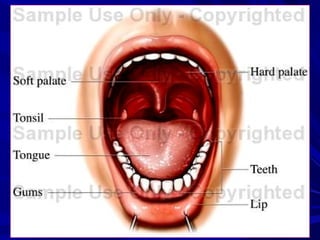
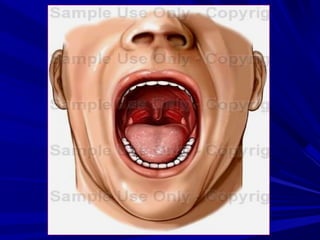
Basic Anatomy of the Mouth
The entrance to the digestive tract, the mouth is lined
with mucous membranes. The membrane-covered roof of
the mouth is called the palate. The front part consists of a
bony portion called the hard palate, with a fleshy rear
part called the soft palate. The hard palate divides the
mouth and the nasal passages above. The soft palate
forms a curtain between the mouth and the throat, or
pharynx, to the rear. The soft palate contains the uvula,
the dangling flesh at the back of the mouth. The tonsils
are located on either side of the uvula and look like twin
pillars holding up the opening to the pharynx.
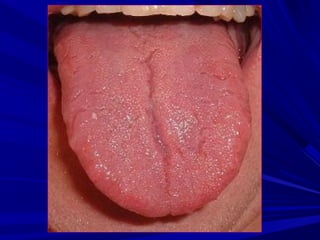
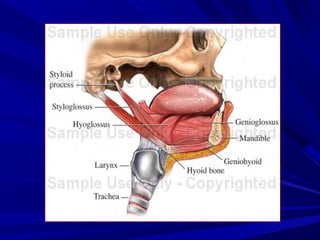
A bundle of muscles extends from the floor of the mouth toA bundle of muscles extends from the floor of the mouth to
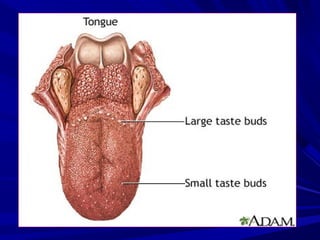
form theform the tongue.tongue. The upper surface of the tongue is coveredThe upper surface of the tongue is covered
with tiny bumps called papillae. These contain tiny poreswith tiny bumps called papillae. These contain tiny pores
that are our taste buds. Four kinds of taste buds are groupedthat are our taste buds. Four kinds of taste buds are grouped
together on certain areas of the tongue — those that sensetogether on certain areas of the tongue — those that sense
sweet, salty, sour, and bitter tastes. Three pairs ofsweet, salty, sour, and bitter tastes. Three pairs of salivarysalivary
glandsglands secrete saliva, which contains a digestive enzymesecrete saliva, which contains a digestive enzyme
called amylase that starts the breakdown of carbohydratescalled amylase that starts the breakdown of carbohydrates
even before food enters the stomach.even before food enters the stomach.
The lipsThe lips are covered with skin on the outside and withare covered with skin on the outside and with
slippery mucous membranes on the inside of the mouth. Theslippery mucous membranes on the inside of the mouth. The
major lip muscle, called the orbicularis oris, allows for themajor lip muscle, called the orbicularis oris, allows for the
lips' mobility. The reddish tint of the lips comes fromlips' mobility. The reddish tint of the lips comes from
underlying blood vessels. The inside portion of both lips isunderlying blood vessels. The inside portion of both lips is
connected to theconnected to the gums.gums.
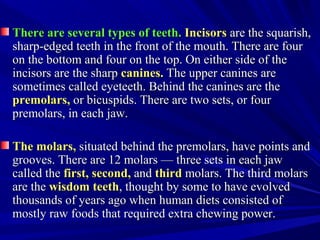
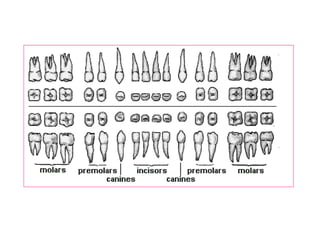
There are several types of teeth.There are several types of teeth. IncisorsIncisors are the squarish,are the squarish,
sharp-edged teeth in the front of the mouth. There are foursharp-edged teeth in the front of the mouth. There are four
on the bottom and four on the top. On either side of theon the bottom and four on the top. On either side of the
incisors are the sharpincisors are the sharp canines.canines. The upper canines areThe upper canines are
sometimes called eyeteeth. Behind the canines are thesometimes called eyeteeth. Behind the canines are the
premolars,premolars, or bicuspids. There are two sets, or fouror bicuspids. There are two sets, or four
premolars, in each jaw.premolars, in each jaw.
The molars,The molars, situated behind the premolars, have points andsituated behind the premolars, have points and
grooves. There are 12 molars — three sets in each jawgrooves. There are 12 molars — three sets in each jaw
called thecalled the first, second,first, second, andand thirdthird molars. The third molarsmolars. The third molars
are theare the wisdom teethwisdom teeth, thought by some to have evolved, thought by some to have evolved
thousands of years ago when human diets consisted ofthousands of years ago when human diets consisted of
mostly raw foods that required extra chewing power.mostly raw foods that required extra chewing power.
Normal Development of the Mouth & TeethNormal Development of the Mouth & Teeth
Humans are diphyodont, meaning that they develop two setsHumans are diphyodont, meaning that they develop two sets
of teeth. The first set of 20 deciduous teeth are also calledof teeth. The first set of 20 deciduous teeth are also called
thethe milk, primary, temporarymilk, primary, temporary, falling-off, or baby teeth., falling-off, or baby teeth.
They begin to develop before birth & begin to fall out whenThey begin to develop before birth & begin to fall out when
a child is around 6 years old. They're replaced by a set of 32a child is around 6 years old. They're replaced by a set of 32
permanent teeth, which are also calledpermanent teeth, which are also called secondary or adultsecondary or adult
teeth.teeth.
Around the 8th week after conception, oval-shaped toothAround the 8th week after conception, oval-shaped tooth
buds consisting of cells form in the embryo. These budsbuds consisting of cells form in the embryo. These buds
begin to harden about the 16th week. Although teeth aren'tbegin to harden about the 16th week. Although teeth aren't
visible at birth, both the primary and permanent teeth arevisible at birth, both the primary and permanent teeth are
forming below the gums. The crown, or the hard enamel-forming below the gums. The crown, or the hard enamel-
covered part that's visible in the mouth, develops first. Whencovered part that's visible in the mouth, develops first. When
the crown is fully grown, the root begins to develop.the crown is fully grown, the root begins to develop.
Between the ages of 6 months & 1 year, the deciduous teethBetween the ages of 6 months & 1 year, the deciduous teeth
begin to push through the gums. This process is calledbegin to push through the gums. This process is called
eruptioneruption oror teethingteething. At this point, the crown is complete &. At this point, the crown is complete &
the root is almost fully formed. By the time a child is 3 yearsthe root is almost fully formed. By the time a child is 3 years
old, he has a set of 20 deciduous teeth, 10 in the lower & 10old, he has a set of 20 deciduous teeth, 10 in the lower & 10
in the upper jaw. Each jaw has four incisors, two canines, &in the upper jaw. Each jaw has four incisors, two canines, &
four molars. The molars' purpose is to grind food, and thefour molars. The molars' purpose is to grind food, and the
incisors and canine teeth are used to bite into and tear food.incisors and canine teeth are used to bite into and tear food.
The primary teeth help the permanent teeth erupt in theirThe primary teeth help the permanent teeth erupt in their
normal positions; most of the permanent teeth form close tonormal positions; most of the permanent teeth form close to
the roots of the primary teeth. When a primary tooth isthe roots of the primary teeth. When a primary tooth is
preparing to fall out, its root begins to dissolve. This root haspreparing to fall out, its root begins to dissolve. This root has
completely dissolved by the time the permanent tooth belowcompletely dissolved by the time the permanent tooth below
it is ready to erupt.it is ready to erupt.
Kids start to lose theirKids start to lose their primary teethprimary teeth, or baby teeth, at, or baby teeth, at
about 6 years old. This begins a phase ofabout 6 years old. This begins a phase of permanent toothpermanent tooth
development that lasts over the next 15 years, as the jawdevelopment that lasts over the next 15 years, as the jaw
steadily grows into its adult form. From ages 6 to 9, thesteadily grows into its adult form. From ages 6 to 9, the
incisors and first molars start to come in. Between ages 10incisors and first molars start to come in. Between ages 10
and 12, the first and second premolars, as well as theand 12, the first and second premolars, as well as the
canines, erupt. From 12 to 13, the second molars come in.canines, erupt. From 12 to 13, the second molars come in.
The wisdom teeth (third molars) erupt between the ages ofThe wisdom teeth (third molars) erupt between the ages of
17 and 21.17 and 21.
What the Mouth and Teeth DoWhat the Mouth and Teeth Do
The first step of digestion involves the mouth and teeth.The first step of digestion involves the mouth and teeth.
Food enters the mouth and is immediately broken down intoFood enters the mouth and is immediately broken down into
smaller pieces by our teeth.smaller pieces by our teeth. Each type of tooth serves aEach type of tooth serves a
different function in the chewing processdifferent function in the chewing process.. IncisorsIncisors cut foodscut foods
when you bite into them. The sharper and longerwhen you bite into them. The sharper and longer caninescanines
tear food. Thetear food. The premolars,premolars, which are flatter than the canines,which are flatter than the canines,
grind and mash food.grind and mash food. Molars,Molars, with their points and grooves,with their points and grooves,
are responsible for the most vigorous chewing. All theare responsible for the most vigorous chewing. All the
while, thewhile, the tonguetongue helps to push the food up against ourhelps to push the food up against our
teeth.teeth.
During chewingDuring chewing salivary glandssalivary glands in the walls and floor ofin the walls and floor of
the mouth secretethe mouth secrete salivasaliva, which moistens the food and helps, which moistens the food and helps
break it down even more. Saliva makes it easier to chew andbreak it down even more. Saliva makes it easier to chew and
swallow foods (especially dry foods), and it containsswallow foods (especially dry foods), and it contains
enzymesenzymes that aid in the digestion of carbohydratesthat aid in the digestion of carbohydrates..
Once food has been converted into a soft, moist mass, it'sOnce food has been converted into a soft, moist mass, it's
pushed into thepushed into the throat (or pharynx)throat (or pharynx) at the back of theat the back of the
mouth and ismouth and is swallowed.swallowed. When we swallow, theWhen we swallow, the soft palatesoft palate
closes off the nasal passages from the throat to prevent foodcloses off the nasal passages from the throat to prevent food
from entering the nose.from entering the nose.
PHYSIOLOGY OF THE TEETHPHYSIOLOGY OF THE TEETH
Functional Anatomy.Functional Anatomy.
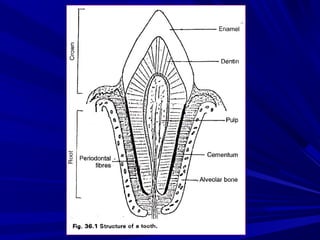
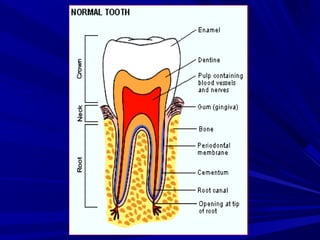
The anatomical structure of the tooth is shown below. TheThe anatomical structure of the tooth is shown below. The
tooth can betooth can be divided into two parts, the crown and thedivided into two parts, the crown and the
rootroot. Part of. Part of the tooth covered with enamel is called thethe tooth covered with enamel is called the
anatomic crownanatomic crown. Some of the anatomic crown is covered by. Some of the anatomic crown is covered by
the gums (gingiva). The rest of the crown, visible in thethe gums (gingiva). The rest of the crown, visible in the
mouth, is called themouth, is called the clinical crownclinical crown. The root is contained. The root is contained
within the bony tooth socket made up of alveolar bone of thewithin the bony tooth socket made up of alveolar bone of the
maxilla or the mandible.maxilla or the mandible.
Each tooth consists ofEach tooth consists of dentinedentine surrounding a core ofsurrounding a core of
connective tissue called theconnective tissue called the pulppulp. Dentine is covered with. Dentine is covered with
enamelenamel in the crown andin the crown and cementumcementum in the root.in the root.
Enamel is acellular and non-livingEnamel is acellular and non-living.. It is one ofIt is one of the hardestthe hardest
structures of the bodystructures of the body, resistant to acids, enzymes, and other, resistant to acids, enzymes, and other
corrosive agents. Its extreme hardness is related to very highcorrosive agents. Its extreme hardness is related to very high
content (96% by weight) of hydroxyapatite. Water andcontent (96% by weight) of hydroxyapatite. Water and
organic matter constitute only 3% and 1% of the weight oforganic matter constitute only 3% and 1% of the weight of
the tooth respectively.the tooth respectively.
The tooth isThe tooth is very brittlevery brittle also, but elasticity of thealso, but elasticity of the
underlying dentine and periodontal ligaments protects theunderlying dentine and periodontal ligaments protects the
enamel from damage during mastication of hard componentsenamel from damage during mastication of hard components
of food.of food.
Dentine contains about 70% by weight of hydroxyapatite.Dentine contains about 70% by weight of hydroxyapatite.
So its hardness resembles any other bone of the body. TheSo its hardness resembles any other bone of the body. The
organic component consists mainly of collagen type I.organic component consists mainly of collagen type I.
Unlike enamel, dentine is a living tissue, but it does notUnlike enamel, dentine is a living tissue, but it does not
contain osteoblasts, osteocytes, or osteoclasts. Instead itcontain osteoblasts, osteocytes, or osteoclasts. Instead it
contains cells calledcontains cells called odontoblasts.odontoblasts.
These cells form a layer of cells between the dental pulp andThese cells form a layer of cells between the dental pulp and
dentine. The collagen fibers give high tensile anddentine. The collagen fibers give high tensile and
compressive strength to dentine which helps it to toleratecompressive strength to dentine which helps it to tolerate
masticatory stresses and strains as well as act as a shockmasticatory stresses and strains as well as act as a shock
absorber for the enamel.absorber for the enamel.
The dental pulp contains fibroblast cells, connective tissueThe dental pulp contains fibroblast cells, connective tissue
fibres and large number of blood vessels, lymphatics andfibres and large number of blood vessels, lymphatics and
nerve fibres. Each root canal opens at the root apex tonerve fibres. Each root canal opens at the root apex to
communicate with periodontal space.communicate with periodontal space.
Cementum is a thin layer of bone-like tissue covering theCementum is a thin layer of bone-like tissue covering the
root dentine. Its mineral content and collagen content areroot dentine. Its mineral content and collagen content are
similar to that of a common bone. The intrinsic collagen ofsimilar to that of a common bone. The intrinsic collagen of
cementum is enmeshed with extrinsic collagen fibres ofcementum is enmeshed with extrinsic collagen fibres of
periodontal ligaments. Thus the periodontal ligamentsperiodontal ligaments. Thus the periodontal ligaments
constitute a firm attachment between the tooth and toothconstitute a firm attachment between the tooth and tooth
sockets of the alveolar bone.sockets of the alveolar bone.
The periodontal ligaments consist of bundles of collagenThe periodontal ligaments consist of bundles of collagen
fibres containing fibroblast cells oriented in specificfibres containing fibroblast cells oriented in specific
directions, so as to resist axial, rotational, and tilting stressesdirections, so as to resist axial, rotational, and tilting stresses
on the tooth.on the tooth.
Alveolar bonesAlveolar bones are parts of maxilla or mandible, in whichare parts of maxilla or mandible, in which
bony sockets are present. The teeth are anchored into thebony sockets are present. The teeth are anchored into the
sockets by the periodontal ligaments.sockets by the periodontal ligaments.
Innervation of the teeth.Innervation of the teeth.
The upper teeth are innervated byThe upper teeth are innervated by superior alveolarsuperior alveolar
nerves,nerves, which are branches of maxillary division ofwhich are branches of maxillary division of
trigeminal nerve. The lower teeth are innervated bytrigeminal nerve. The lower teeth are innervated by inferiorinferior
alveolar nervesalveolar nerves which are branches of mandibular divisionwhich are branches of mandibular division
of trigeminal nerve.of trigeminal nerve.
These nerves form a rich network of nerve plexus in theThese nerves form a rich network of nerve plexus in the
dental pulp. Hence dental pulp is andental pulp. Hence dental pulp is an extremely sensitiveextremely sensitive
tissue.tissue.
From these nerve plexuses some fine branches can be tracedFrom these nerve plexuses some fine branches can be traced
for short distance into dentine tubules. However, on thefor short distance into dentine tubules. However, on the
whole, dentine is awhole, dentine is a poorly innervatedpoorly innervated structure. In spite ofstructure. In spite of
this fact dentine is an extremely sensitive tissue. Applicationthis fact dentine is an extremely sensitive tissue. Application
of thermal, osmotic, electrical, or mechanical stimuli in aof thermal, osmotic, electrical, or mechanical stimuli in a
tooth with exposed dentine causes exeruciating pain. Thetooth with exposed dentine causes exeruciating pain. The
mechanism of such sensitivity of poorlymechanism of such sensitivity of poorly innervated dentineinnervated dentine
is not clear.is not clear.
Enamel is a non-vital tissue and hence has no sensation. ItEnamel is a non-vital tissue and hence has no sensation. It
can be cut or crushed without any pain. During operativecan be cut or crushed without any pain. During operative
procedures on the enamel only vibrational sensation is feltprocedures on the enamel only vibrational sensation is felt
because it is transmitted by the tooth to the periodontalbecause it is transmitted by the tooth to the periodontal
tissues.tissues.
Metabolism of the teeth.Metabolism of the teeth.
Basically teeth are bones and their formation andBasically teeth are bones and their formation and
metabolism resemble any other bone. However, there aremetabolism resemble any other bone. However, there are
some important developmental and metabolic differencessome important developmental and metabolic differences
between the two. The formation of the teeth is notbetween the two. The formation of the teeth is not
accompanied by resorptive and remodelling processesaccompanied by resorptive and remodelling processes
which occur in the bone.which occur in the bone.
After a tooth has been formed, osteoclastic resorption doesAfter a tooth has been formed, osteoclastic resorption does
not occur in the teeth. Mature enamel is a non-living tissue,not occur in the teeth. Mature enamel is a non-living tissue,
and does not contain any cells equivalent to osteocytes ofand does not contain any cells equivalent to osteocytes of
the bones.the bones.
In the dentine the odontoblasts' long processes penetrateIn the dentine the odontoblasts' long processes penetrate
into dentine tubules, but unlike the processes of osteocytes,into dentine tubules, but unlike the processes of osteocytes,
they are not capable of transforming Cathey are not capable of transforming Ca2+2+
from the dentine.from the dentine.
That' is why, even during severe dietary deficiency, teethThat' is why, even during severe dietary deficiency, teeth
are not usually involved in the metabolic bone disease.are not usually involved in the metabolic bone disease.
The mineral metabolism of the enamel and dentine isThe mineral metabolism of the enamel and dentine is
limited to what can occur on the exposed surfaces by ionlimited to what can occur on the exposed surfaces by ion
exchange or recrystallization. For example, radioactiveexchange or recrystallization. For example, radioactive
isotope uptake can be demonstrated at surfaces of the teethisotope uptake can be demonstrated at surfaces of the teeth
exposed to extracellular fluid, e.g. outer surface of theexposed to extracellular fluid, e.g. outer surface of the
enamel in contact with oral fluid.enamel in contact with oral fluid.
Effect of age on the teethEffect of age on the teeth
Loss of teeth is so common in old age that it has beenLoss of teeth is so common in old age that it has been
accepted as much physiologic as greying of the hair.accepted as much physiologic as greying of the hair.
However whereas the consequence of greying of hair isHowever whereas the consequence of greying of hair is
only cosmetic, the loss of dentition has far reaching effects.only cosmetic, the loss of dentition has far reaching effects.
In human beings, with proper dental care there is no reasonIn human beings, with proper dental care there is no reason
that the teeth should not last as long as the person lives.that the teeth should not last as long as the person lives.
There are two main courses of tooth loss, namelyThere are two main courses of tooth loss, namely
1- dental decay1- dental decay
2- and periodontal disease.2- and periodontal disease.
Neither of them should be considered physiological.Neither of them should be considered physiological.
Osteoporosis of the mandible and the maxilla may beOsteoporosis of the mandible and the maxilla may be
considered more physiological effect of aging; since itconsidered more physiological effect of aging; since it
affects other bones of the body and is universally observed.affects other bones of the body and is universally observed.
However, alveolar bone loss is more commonly due toHowever, alveolar bone loss is more commonly due to
associated periodontal disease. Alveolar bone loss becomesassociated periodontal disease. Alveolar bone loss becomes
more severe with the use of artificial dentures.more severe with the use of artificial dentures.
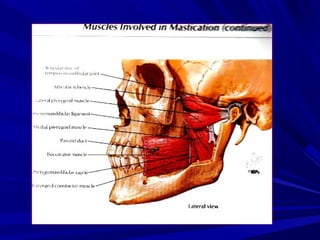
MASTICATIONMASTICATION
A bolus of soft semiliquid material like boiled riceA bolus of soft semiliquid material like boiled rice
or banana may be swallowed as such. However,or banana may be swallowed as such. However,
most of the foods have to be thoroughly chewedmost of the foods have to be thoroughly chewed
(masticated) before they can be swallowed.(masticated) before they can be swallowed.
Besides pulverization of food mastication servesBesides pulverization of food mastication serves
many other useful functions.many other useful functions.
The masticatory processThe masticatory process
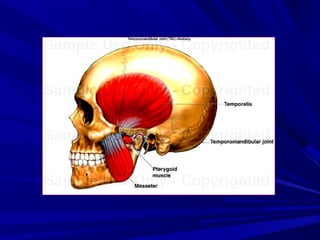
The masticatory movements of the lower jaw consist mainlyThe masticatory movements of the lower jaw consist mainly
of depression and elevation of the jaw, although there isof depression and elevation of the jaw, although there is
small degree of forward, backward, and lateral movementsmall degree of forward, backward, and lateral movement
also. Each masticatory cycle consists ofalso. Each masticatory cycle consists of three phasesthree phases,,
namely, annamely, an openingopening phase, aphase, a closingclosing phase, andphase, and occlusalocclusal
phase. Large amount of active tension develops in thephase. Large amount of active tension develops in the
elevator muscles of the lower jaw in the later stages of theelevator muscles of the lower jaw in the later stages of the
closing phase and in occlusal phase.closing phase and in occlusal phase.
During these phases the muscles of the tongue and cheekDuring these phases the muscles of the tongue and cheek
play a crucial role of keeping the food between the grindingplay a crucial role of keeping the food between the grinding
surfaces of the teeth without getting injured. Thissurfaces of the teeth without getting injured. This
coordination is disturbed if one try to talk duringcoordination is disturbed if one try to talk during
mastication, because muscles of the tongue are subjected tomastication, because muscles of the tongue are subjected to
conflicting functions. Tongue-bite is a commonconflicting functions. Tongue-bite is a common
consequence of such a mishap.consequence of such a mishap.
During normal masticatory process the jaws develop 7-20During normal masticatory process the jaws develop 7-20
kg of crushing force depending on the nature of the materialkg of crushing force depending on the nature of the material
being chewed. However man is capable of generating muchbeing chewed. However man is capable of generating much
higher chewing forces, If a dynameter is placed between thehigher chewing forces, If a dynameter is placed between the
first molars, a maximum chewing force of 50 kg can usuallyfirst molars, a maximum chewing force of 50 kg can usually
be recorded. Eskimos, who consume uncooked meat canbe recorded. Eskimos, who consume uncooked meat can
generate a force as high as 150 kg. The value may be verygenerate a force as high as 150 kg. The value may be very
low in individuals who habitually consume heavily cookedlow in individuals who habitually consume heavily cooked
soft food.soft food.
Neural controlNeural control
A.A. Reflex controlReflex control
(a) Stretch reflex.(a) Stretch reflex.
In a decerebrate cat the muscles of mastication participateIn a decerebrate cat the muscles of mastication participate
in generalized hypertonia seen in antigravity muscles. Inin generalized hypertonia seen in antigravity muscles. In
such an animal, the jaw is closed but not tightly. A gap ofsuch an animal, the jaw is closed but not tightly. A gap of
few millimetres can be seen between the two jaws. Anyfew millimetres can be seen between the two jaws. Any
effort to open the mouth results in forceful contraction ofeffort to open the mouth results in forceful contraction of
the mandible.the mandible.
(b) Jaw jerk.(b) Jaw jerk.
This phenomenon, called jaw jerk, can be demonstrated inThis phenomenon, called jaw jerk, can be demonstrated in
normal human by tapping the chin of a person whose jawnormal human by tapping the chin of a person whose jaw
is slightly open. There is an immediate reflex closure ofis slightly open. There is an immediate reflex closure of
the jaw. Jaw jerk (like other tendon jerks) depends on thethe jaw. Jaw jerk (like other tendon jerks) depends on the
stimulation of muscle spindles of the elevator muscles ofstimulation of muscle spindles of the elevator muscles of
the jaw.the jaw.
(c) Jaw opening reflex.(c) Jaw opening reflex.
The rhythmic chewing movement comes to an abrupt stopThe rhythmic chewing movement comes to an abrupt stop
if the teeth come in contact with a hard object, not expectedif the teeth come in contact with a hard object, not expected
in the bolus of food, e.g. a small piece of stone in a curry orin the bolus of food, e.g. a small piece of stone in a curry or
a small piece of bone in meat or fish. This reflex inhibitiona small piece of bone in meat or fish. This reflex inhibition
of mastication is brought about by mechanoreceptorsof mastication is brought about by mechanoreceptors
located in periodontal ligaments. This reflex preventslocated in periodontal ligaments. This reflex prevents
damage to teeth and periodontal tissues. This reflex maydamage to teeth and periodontal tissues. This reflex may
also regulate the degree of crushing force generated whilealso regulate the degree of crushing force generated while
chewing on a hard object e.g. cracking a nut.chewing on a hard object e.g. cracking a nut.
B.B. Higher controlHigher control
Electrical stimulation of the lowermost part of pre­centralElectrical stimulation of the lowermost part of pre­central
gyrus results in alternating opening and closing of thegyrus results in alternating opening and closing of the
mouth, just as during mastication. In experimental animals,mouth, just as during mastication. In experimental animals,
if the mandible is split into two halves, unilateral corticalif the mandible is split into two halves, unilateral cortical
stimulation shows that basically the cortical control isstimulation shows that basically the cortical control is
contralateral but there is a moderate degree of bilateralcontralateral but there is a moderate degree of bilateral
representation also.representation also.
Thus mastication is not entirely a reflex process. After aThus mastication is not entirely a reflex process. After a
bolus of food is put into the mouth, the masticatory processbolus of food is put into the mouth, the masticatory process
is initiated by a voluntary act. Then the stereotype repetitiveis initiated by a voluntary act. Then the stereotype repetitive
chewing movements continue in an automatic reflexchewing movements continue in an automatic reflex
manner, till they are brought to stop voluntarily andmanner, till they are brought to stop voluntarily and
followed by the act of deglutition.followed by the act of deglutition.
Thus a conscious effort is required only to initiate andThus a conscious effort is required only to initiate and
terminate the process.terminate the process.
Functions of MasticationFunctions of Mastication
1. Maceration of food.1. Maceration of food. Most of the foods are boiled andMost of the foods are boiled and
cooked so that they can be swallowed and digested. Evencooked so that they can be swallowed and digested. Even
then such foods as well as raw vegetables and fruits need tothen such foods as well as raw vegetables and fruits need to
be further macerated by the process of mastication, beforebe further macerated by the process of mastication, before
they can be easily swallowed.they can be easily swallowed.
2. Role in taste sensation.2. Role in taste sensation. During mastication food isDuring mastication food is
intimately mixed with saliva leading to stimulation of tasteintimately mixed with saliva leading to stimulation of taste
buds and olfactory mucosa. Therefore, mastication helps inbuds and olfactory mucosa. Therefore, mastication helps in
appreciation of taste and flavours. The enjoyment of eatingappreciation of taste and flavours. The enjoyment of eating
a tasty food is lost if it is simply swallowed withouta tasty food is lost if it is simply swallowed without
mastication.mastication.
3. Role in digestion of food.3. Role in digestion of food. Only a few foodstuffs like egg,Only a few foodstuffs like egg,
fish, bread, and cheese are digested properly, whether theyfish, bread, and cheese are digested properly, whether they
are chewed or swallowed as such. However, most of theare chewed or swallowed as such. However, most of the
foods like meat, potato, peas, and raw vegetables are onlyfoods like meat, potato, peas, and raw vegetables are only
partially digested, if not chewed properly.partially digested, if not chewed properly.
Mastication helps in the digestion of food in a variety ofMastication helps in the digestion of food in a variety of
ways:ways:
(a) The masticatory process reduces the foods to smaller(a) The masticatory process reduces the foods to smaller
particles which provide greater surface area for the actionparticles which provide greater surface area for the action
of digestive enzymes. It may further help in digestion byof digestive enzymes. It may further help in digestion by
breaking the cellulose membranes of grains, rawbreaking the cellulose membranes of grains, raw
vegetables and fruits.vegetables and fruits.
(b) The intimate mixing of macerated food with saliva helps(b) The intimate mixing of macerated food with saliva helps
in the digestion of starch by the salivary amylase.in the digestion of starch by the salivary amylase.
(c) Stimulation of taste buds during mastication initiates not(c) Stimulation of taste buds during mastication initiates not
only salivary secretion but also many otheronly salivary secretion but also many other
gastrointestinal secretions, specially the gastric secretion.gastrointestinal secretions, specially the gastric secretion.
SALIVARY SECRETIONSALIVARY SECRETION
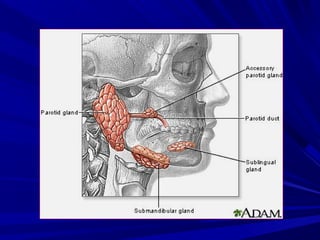
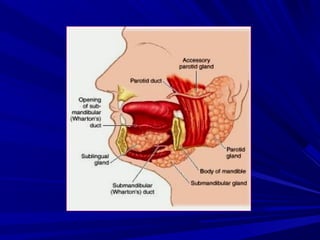
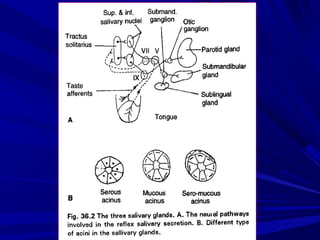
The saliva is secreted byThe saliva is secreted by three pairsthree pairs of major salivaryof major salivary
glands, namely,theglands, namely,the parotid glandsparotid glands,, submandibular glandssubmandibular glands
andand sublingual glandssublingual glands as well as by many small groups ofas well as by many small groups of
aciniacini (Fig. 36.2) scattered in the mucous membrane of(Fig. 36.2) scattered in the mucous membrane of
buccal cavity. The salivary glands secrete approximatelybuccal cavity. The salivary glands secrete approximately
1500 ml of saliva per day.1500 ml of saliva per day.
Saliva consists of 99% water and only 1% solids. TheSaliva consists of 99% water and only 1% solids. The
organic components of the solids includeorganic components of the solids include mucousmucous,, aa
digestive enzyme calleddigestive enzyme called amylase,amylase, andand lysozyme,lysozyme, an enzymean enzyme
which prevents the growth of pathogenic. The importantwhich prevents the growth of pathogenic. The important
inorganic constituents include Nainorganic constituents include Na++
, K, K++
, Cl, Cl­­
, HCo, HCo­­
33, and Ca, and Ca2+2+
..
The salivary pH is around 6.4­7.0 .The salivary pH is around 6.4­7.0 .
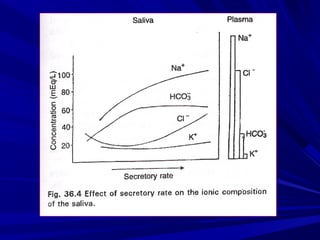
Under resting conditions the concentrations of NaUnder resting conditions the concentrations of Na++
and Cland Cl­­
inin
the saliva is always lower than that in the plasma.the saliva is always lower than that in the plasma.
Consequently the saliva is always hypotonic.Consequently the saliva is always hypotonic.
On the other hand, the concentration of KOn the other hand, the concentration of K++
and HCOand HCO­­
33, is, is
higher than that in the plasma. The saliva secreted by thehigher than that in the plasma. The saliva secreted by the
parotid gland is aparotid gland is a serousserous fluid containing the enzymefluid containing the enzyme
amylase. The sublingual gland secretes aamylase. The sublingual gland secretes a mucoidmucoid type oftype of
fluid containing mucous. The secretion of submandibularfluid containing mucous. The secretion of submandibular
gland isgland is seromucous.seromucous.
The ionic composition of saliva varies with its rate of flow.The ionic composition of saliva varies with its rate of flow.
MECHANISM OF SALIVARY SECRETIONMECHANISM OF SALIVARY SECRETION
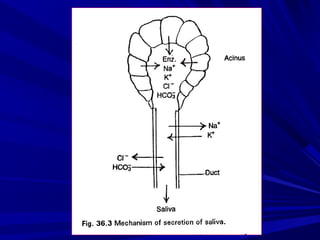
Saliva is formed as a result of primary acinar secretion,Saliva is formed as a result of primary acinar secretion,
followed by its modification in the ducts of the salivaryfollowed by its modification in the ducts of the salivary
glands. The primary secretion contains organic as well asglands. The primary secretion contains organic as well as
the inorganic constituents. This fluid is isotonic withthe inorganic constituents. This fluid is isotonic with
plasma. As the secretion passes through the ducts, theplasma. As the secretion passes through the ducts, the
ductal cells actively reabsorb Naductal cells actively reabsorb Na++
and in exchange transferand in exchange transfer
some Ksome K++
into the lumen (see below). Since the ductalinto the lumen (see below). Since the ductal
epithelium is impermeable to water the saliva becomesepithelium is impermeable to water the saliva becomes
hypotonic. As the rate of salivary secretion increases, lesshypotonic. As the rate of salivary secretion increases, less
time is available for the ionic exchange in the ducts.time is available for the ionic exchange in the ducts.
Consequently the NaCI concentration of salivary secretinConsequently the NaCI concentration of salivary secretin
increases. Its tonicity increases but even at the highest rateincreases. Its tonicity increases but even at the highest rate
of flow, saliva remains hypotonic with respect to plasma.of flow, saliva remains hypotonic with respect to plasma.
At high rates of salivary secretion the secretory rate ofAt high rates of salivary secretion the secretory rate of
HCOHCO33
­­
, also increases. Hence the salivary pH tends to, also increases. Hence the salivary pH tends to
increase from the resting value of about 6.4 to a value ofincrease from the resting value of about 6.4 to a value of
about 7.8 (Fig. 36.4).about 7.8 (Fig. 36.4).
Mouth and-teeth-ch1
Mouth and-teeth-ch1

Mouth and-teeth-ch1

  • 1.
    Mouth and teethMouthand teeth Your smile is often the first thing people notice when they look at you.Your smile is often the first thing people notice when they look at you. It's the facial expression that most engages others. With the help of theIt's the facial expression that most engages others. With the help of the teeth — which provide structural support for the face muscles — yourteeth — which provide structural support for the face muscles — your mouth also forms your frown and lots of other expressions that showmouth also forms your frown and lots of other expressions that show on your face.on your face. The mouth also plays a key role in theThe mouth also plays a key role in the digestive systemdigestive system, but it does, but it does much more than get digestion started. The mouth — especially themuch more than get digestion started. The mouth — especially the teeth, lips, and tongue — is essential for speech. The tongue, whichteeth, lips, and tongue — is essential for speech. The tongue, which allows us to taste, also enables us to form words when we speak.allows us to taste, also enables us to form words when we speak.
  • 3.
    The lips thatline the outside of the mouth both help holdThe lips that line the outside of the mouth both help hold food in while we chew and pronounce words when we talk.food in while we chew and pronounce words when we talk. With the lips and tongue, teeth help form words byWith the lips and tongue, teeth help form words by controlling air flow out of the mouth. The tongue strikes thecontrolling air flow out of the mouth. The tongue strikes the teeth as certain sounds are made.teeth as certain sounds are made. The hardest substances in the body, the teeth are alsoThe hardest substances in the body, the teeth are also necessary for chewing (or mastication) — the process bynecessary for chewing (or mastication) — the process by which we tear, cut, and grind food in preparation forwhich we tear, cut, and grind food in preparation for swallowing. Chewing allows enzymes and lubricantsswallowing. Chewing allows enzymes and lubricants released in the mouth to further digest food.released in the mouth to further digest food. Here's how each aspect of the mouth and teeth plays anHere's how each aspect of the mouth and teeth plays an important role in our daily lives.important role in our daily lives.
  • 4.
    Basic Anatomy ofthe Mouth The entrance to the digestive tract, the mouth is lined with mucous membranes. The membrane-covered roof of the mouth is called the palate. The front part consists of a bony portion called the hard palate, with a fleshy rear part called the soft palate. The hard palate divides the mouth and the nasal passages above. The soft palate forms a curtain between the mouth and the throat, or pharynx, to the rear. The soft palate contains the uvula, the dangling flesh at the back of the mouth. The tonsils are located on either side of the uvula and look like twin pillars holding up the opening to the pharynx.
  • 7.
    A bundle ofmuscles extends from the floor of the mouth toA bundle of muscles extends from the floor of the mouth to form theform the tongue.tongue. The upper surface of the tongue is coveredThe upper surface of the tongue is covered with tiny bumps called papillae. These contain tiny poreswith tiny bumps called papillae. These contain tiny pores that are our taste buds. Four kinds of taste buds are groupedthat are our taste buds. Four kinds of taste buds are grouped together on certain areas of the tongue — those that sensetogether on certain areas of the tongue — those that sense sweet, salty, sour, and bitter tastes. Three pairs ofsweet, salty, sour, and bitter tastes. Three pairs of salivarysalivary glandsglands secrete saliva, which contains a digestive enzymesecrete saliva, which contains a digestive enzyme called amylase that starts the breakdown of carbohydratescalled amylase that starts the breakdown of carbohydrates even before food enters the stomach.even before food enters the stomach. The lipsThe lips are covered with skin on the outside and withare covered with skin on the outside and with slippery mucous membranes on the inside of the mouth. Theslippery mucous membranes on the inside of the mouth. The major lip muscle, called the orbicularis oris, allows for themajor lip muscle, called the orbicularis oris, allows for the lips' mobility. The reddish tint of the lips comes fromlips' mobility. The reddish tint of the lips comes from underlying blood vessels. The inside portion of both lips isunderlying blood vessels. The inside portion of both lips is connected to theconnected to the gums.gums.
  • 12.
    There are severaltypes of teeth.There are several types of teeth. IncisorsIncisors are the squarish,are the squarish, sharp-edged teeth in the front of the mouth. There are foursharp-edged teeth in the front of the mouth. There are four on the bottom and four on the top. On either side of theon the bottom and four on the top. On either side of the incisors are the sharpincisors are the sharp canines.canines. The upper canines areThe upper canines are sometimes called eyeteeth. Behind the canines are thesometimes called eyeteeth. Behind the canines are the premolars,premolars, or bicuspids. There are two sets, or fouror bicuspids. There are two sets, or four premolars, in each jaw.premolars, in each jaw. The molars,The molars, situated behind the premolars, have points andsituated behind the premolars, have points and grooves. There are 12 molars — three sets in each jawgrooves. There are 12 molars — three sets in each jaw called thecalled the first, second,first, second, andand thirdthird molars. The third molarsmolars. The third molars are theare the wisdom teethwisdom teeth, thought by some to have evolved, thought by some to have evolved thousands of years ago when human diets consisted ofthousands of years ago when human diets consisted of mostly raw foods that required extra chewing power.mostly raw foods that required extra chewing power.
  • 14.
    Normal Development ofthe Mouth & TeethNormal Development of the Mouth & Teeth Humans are diphyodont, meaning that they develop two setsHumans are diphyodont, meaning that they develop two sets of teeth. The first set of 20 deciduous teeth are also calledof teeth. The first set of 20 deciduous teeth are also called thethe milk, primary, temporarymilk, primary, temporary, falling-off, or baby teeth., falling-off, or baby teeth. They begin to develop before birth & begin to fall out whenThey begin to develop before birth & begin to fall out when a child is around 6 years old. They're replaced by a set of 32a child is around 6 years old. They're replaced by a set of 32 permanent teeth, which are also calledpermanent teeth, which are also called secondary or adultsecondary or adult teeth.teeth. Around the 8th week after conception, oval-shaped toothAround the 8th week after conception, oval-shaped tooth buds consisting of cells form in the embryo. These budsbuds consisting of cells form in the embryo. These buds begin to harden about the 16th week. Although teeth aren'tbegin to harden about the 16th week. Although teeth aren't visible at birth, both the primary and permanent teeth arevisible at birth, both the primary and permanent teeth are forming below the gums. The crown, or the hard enamel-forming below the gums. The crown, or the hard enamel- covered part that's visible in the mouth, develops first. Whencovered part that's visible in the mouth, develops first. When the crown is fully grown, the root begins to develop.the crown is fully grown, the root begins to develop.
  • 15.
    Between the agesof 6 months & 1 year, the deciduous teethBetween the ages of 6 months & 1 year, the deciduous teeth begin to push through the gums. This process is calledbegin to push through the gums. This process is called eruptioneruption oror teethingteething. At this point, the crown is complete &. At this point, the crown is complete & the root is almost fully formed. By the time a child is 3 yearsthe root is almost fully formed. By the time a child is 3 years old, he has a set of 20 deciduous teeth, 10 in the lower & 10old, he has a set of 20 deciduous teeth, 10 in the lower & 10 in the upper jaw. Each jaw has four incisors, two canines, &in the upper jaw. Each jaw has four incisors, two canines, & four molars. The molars' purpose is to grind food, and thefour molars. The molars' purpose is to grind food, and the incisors and canine teeth are used to bite into and tear food.incisors and canine teeth are used to bite into and tear food. The primary teeth help the permanent teeth erupt in theirThe primary teeth help the permanent teeth erupt in their normal positions; most of the permanent teeth form close tonormal positions; most of the permanent teeth form close to the roots of the primary teeth. When a primary tooth isthe roots of the primary teeth. When a primary tooth is preparing to fall out, its root begins to dissolve. This root haspreparing to fall out, its root begins to dissolve. This root has completely dissolved by the time the permanent tooth belowcompletely dissolved by the time the permanent tooth below it is ready to erupt.it is ready to erupt.
  • 16.
    Kids start tolose theirKids start to lose their primary teethprimary teeth, or baby teeth, at, or baby teeth, at about 6 years old. This begins a phase ofabout 6 years old. This begins a phase of permanent toothpermanent tooth development that lasts over the next 15 years, as the jawdevelopment that lasts over the next 15 years, as the jaw steadily grows into its adult form. From ages 6 to 9, thesteadily grows into its adult form. From ages 6 to 9, the incisors and first molars start to come in. Between ages 10incisors and first molars start to come in. Between ages 10 and 12, the first and second premolars, as well as theand 12, the first and second premolars, as well as the canines, erupt. From 12 to 13, the second molars come in.canines, erupt. From 12 to 13, the second molars come in. The wisdom teeth (third molars) erupt between the ages ofThe wisdom teeth (third molars) erupt between the ages of 17 and 21.17 and 21.
  • 17.
    What the Mouthand Teeth DoWhat the Mouth and Teeth Do The first step of digestion involves the mouth and teeth.The first step of digestion involves the mouth and teeth. Food enters the mouth and is immediately broken down intoFood enters the mouth and is immediately broken down into smaller pieces by our teeth.smaller pieces by our teeth. Each type of tooth serves aEach type of tooth serves a different function in the chewing processdifferent function in the chewing process.. IncisorsIncisors cut foodscut foods when you bite into them. The sharper and longerwhen you bite into them. The sharper and longer caninescanines tear food. Thetear food. The premolars,premolars, which are flatter than the canines,which are flatter than the canines, grind and mash food.grind and mash food. Molars,Molars, with their points and grooves,with their points and grooves, are responsible for the most vigorous chewing. All theare responsible for the most vigorous chewing. All the while, thewhile, the tonguetongue helps to push the food up against ourhelps to push the food up against our teeth.teeth.
  • 18.
    During chewingDuring chewingsalivary glandssalivary glands in the walls and floor ofin the walls and floor of the mouth secretethe mouth secrete salivasaliva, which moistens the food and helps, which moistens the food and helps break it down even more. Saliva makes it easier to chew andbreak it down even more. Saliva makes it easier to chew and swallow foods (especially dry foods), and it containsswallow foods (especially dry foods), and it contains enzymesenzymes that aid in the digestion of carbohydratesthat aid in the digestion of carbohydrates.. Once food has been converted into a soft, moist mass, it'sOnce food has been converted into a soft, moist mass, it's pushed into thepushed into the throat (or pharynx)throat (or pharynx) at the back of theat the back of the mouth and ismouth and is swallowed.swallowed. When we swallow, theWhen we swallow, the soft palatesoft palate closes off the nasal passages from the throat to prevent foodcloses off the nasal passages from the throat to prevent food from entering the nose.from entering the nose.
  • 19.
    PHYSIOLOGY OF THETEETHPHYSIOLOGY OF THE TEETH Functional Anatomy.Functional Anatomy. The anatomical structure of the tooth is shown below. TheThe anatomical structure of the tooth is shown below. The tooth can betooth can be divided into two parts, the crown and thedivided into two parts, the crown and the rootroot. Part of. Part of the tooth covered with enamel is called thethe tooth covered with enamel is called the anatomic crownanatomic crown. Some of the anatomic crown is covered by. Some of the anatomic crown is covered by the gums (gingiva). The rest of the crown, visible in thethe gums (gingiva). The rest of the crown, visible in the mouth, is called themouth, is called the clinical crownclinical crown. The root is contained. The root is contained within the bony tooth socket made up of alveolar bone of thewithin the bony tooth socket made up of alveolar bone of the maxilla or the mandible.maxilla or the mandible. Each tooth consists ofEach tooth consists of dentinedentine surrounding a core ofsurrounding a core of connective tissue called theconnective tissue called the pulppulp. Dentine is covered with. Dentine is covered with enamelenamel in the crown andin the crown and cementumcementum in the root.in the root.
  • 22.
    Enamel is acellularand non-livingEnamel is acellular and non-living.. It is one ofIt is one of the hardestthe hardest structures of the bodystructures of the body, resistant to acids, enzymes, and other, resistant to acids, enzymes, and other corrosive agents. Its extreme hardness is related to very highcorrosive agents. Its extreme hardness is related to very high content (96% by weight) of hydroxyapatite. Water andcontent (96% by weight) of hydroxyapatite. Water and organic matter constitute only 3% and 1% of the weight oforganic matter constitute only 3% and 1% of the weight of the tooth respectively.the tooth respectively. The tooth isThe tooth is very brittlevery brittle also, but elasticity of thealso, but elasticity of the underlying dentine and periodontal ligaments protects theunderlying dentine and periodontal ligaments protects the enamel from damage during mastication of hard componentsenamel from damage during mastication of hard components of food.of food.
  • 23.
    Dentine contains about70% by weight of hydroxyapatite.Dentine contains about 70% by weight of hydroxyapatite. So its hardness resembles any other bone of the body. TheSo its hardness resembles any other bone of the body. The organic component consists mainly of collagen type I.organic component consists mainly of collagen type I. Unlike enamel, dentine is a living tissue, but it does notUnlike enamel, dentine is a living tissue, but it does not contain osteoblasts, osteocytes, or osteoclasts. Instead itcontain osteoblasts, osteocytes, or osteoclasts. Instead it contains cells calledcontains cells called odontoblasts.odontoblasts. These cells form a layer of cells between the dental pulp andThese cells form a layer of cells between the dental pulp and dentine. The collagen fibers give high tensile anddentine. The collagen fibers give high tensile and compressive strength to dentine which helps it to toleratecompressive strength to dentine which helps it to tolerate masticatory stresses and strains as well as act as a shockmasticatory stresses and strains as well as act as a shock absorber for the enamel.absorber for the enamel.
  • 24.
    The dental pulpcontains fibroblast cells, connective tissueThe dental pulp contains fibroblast cells, connective tissue fibres and large number of blood vessels, lymphatics andfibres and large number of blood vessels, lymphatics and nerve fibres. Each root canal opens at the root apex tonerve fibres. Each root canal opens at the root apex to communicate with periodontal space.communicate with periodontal space. Cementum is a thin layer of bone-like tissue covering theCementum is a thin layer of bone-like tissue covering the root dentine. Its mineral content and collagen content areroot dentine. Its mineral content and collagen content are similar to that of a common bone. The intrinsic collagen ofsimilar to that of a common bone. The intrinsic collagen of cementum is enmeshed with extrinsic collagen fibres ofcementum is enmeshed with extrinsic collagen fibres of periodontal ligaments. Thus the periodontal ligamentsperiodontal ligaments. Thus the periodontal ligaments constitute a firm attachment between the tooth and toothconstitute a firm attachment between the tooth and tooth sockets of the alveolar bone.sockets of the alveolar bone. The periodontal ligaments consist of bundles of collagenThe periodontal ligaments consist of bundles of collagen fibres containing fibroblast cells oriented in specificfibres containing fibroblast cells oriented in specific directions, so as to resist axial, rotational, and tilting stressesdirections, so as to resist axial, rotational, and tilting stresses on the tooth.on the tooth.
  • 25.
    Alveolar bonesAlveolar bonesare parts of maxilla or mandible, in whichare parts of maxilla or mandible, in which bony sockets are present. The teeth are anchored into thebony sockets are present. The teeth are anchored into the sockets by the periodontal ligaments.sockets by the periodontal ligaments.
  • 26.
    Innervation of theteeth.Innervation of the teeth. The upper teeth are innervated byThe upper teeth are innervated by superior alveolarsuperior alveolar nerves,nerves, which are branches of maxillary division ofwhich are branches of maxillary division of trigeminal nerve. The lower teeth are innervated bytrigeminal nerve. The lower teeth are innervated by inferiorinferior alveolar nervesalveolar nerves which are branches of mandibular divisionwhich are branches of mandibular division of trigeminal nerve.of trigeminal nerve. These nerves form a rich network of nerve plexus in theThese nerves form a rich network of nerve plexus in the dental pulp. Hence dental pulp is andental pulp. Hence dental pulp is an extremely sensitiveextremely sensitive tissue.tissue. From these nerve plexuses some fine branches can be tracedFrom these nerve plexuses some fine branches can be traced for short distance into dentine tubules. However, on thefor short distance into dentine tubules. However, on the whole, dentine is awhole, dentine is a poorly innervatedpoorly innervated structure. In spite ofstructure. In spite of this fact dentine is an extremely sensitive tissue. Applicationthis fact dentine is an extremely sensitive tissue. Application of thermal, osmotic, electrical, or mechanical stimuli in aof thermal, osmotic, electrical, or mechanical stimuli in a tooth with exposed dentine causes exeruciating pain. Thetooth with exposed dentine causes exeruciating pain. The mechanism of such sensitivity of poorlymechanism of such sensitivity of poorly innervated dentineinnervated dentine is not clear.is not clear.
  • 27.
    Enamel is anon-vital tissue and hence has no sensation. ItEnamel is a non-vital tissue and hence has no sensation. It can be cut or crushed without any pain. During operativecan be cut or crushed without any pain. During operative procedures on the enamel only vibrational sensation is feltprocedures on the enamel only vibrational sensation is felt because it is transmitted by the tooth to the periodontalbecause it is transmitted by the tooth to the periodontal tissues.tissues.
  • 28.
    Metabolism of theteeth.Metabolism of the teeth. Basically teeth are bones and their formation andBasically teeth are bones and their formation and metabolism resemble any other bone. However, there aremetabolism resemble any other bone. However, there are some important developmental and metabolic differencessome important developmental and metabolic differences between the two. The formation of the teeth is notbetween the two. The formation of the teeth is not accompanied by resorptive and remodelling processesaccompanied by resorptive and remodelling processes which occur in the bone.which occur in the bone. After a tooth has been formed, osteoclastic resorption doesAfter a tooth has been formed, osteoclastic resorption does not occur in the teeth. Mature enamel is a non-living tissue,not occur in the teeth. Mature enamel is a non-living tissue, and does not contain any cells equivalent to osteocytes ofand does not contain any cells equivalent to osteocytes of the bones.the bones. In the dentine the odontoblasts' long processes penetrateIn the dentine the odontoblasts' long processes penetrate into dentine tubules, but unlike the processes of osteocytes,into dentine tubules, but unlike the processes of osteocytes, they are not capable of transforming Cathey are not capable of transforming Ca2+2+ from the dentine.from the dentine. That' is why, even during severe dietary deficiency, teethThat' is why, even during severe dietary deficiency, teeth are not usually involved in the metabolic bone disease.are not usually involved in the metabolic bone disease.
  • 29.
    The mineral metabolismof the enamel and dentine isThe mineral metabolism of the enamel and dentine is limited to what can occur on the exposed surfaces by ionlimited to what can occur on the exposed surfaces by ion exchange or recrystallization. For example, radioactiveexchange or recrystallization. For example, radioactive isotope uptake can be demonstrated at surfaces of the teethisotope uptake can be demonstrated at surfaces of the teeth exposed to extracellular fluid, e.g. outer surface of theexposed to extracellular fluid, e.g. outer surface of the enamel in contact with oral fluid.enamel in contact with oral fluid.
  • 30.
    Effect of ageon the teethEffect of age on the teeth Loss of teeth is so common in old age that it has beenLoss of teeth is so common in old age that it has been accepted as much physiologic as greying of the hair.accepted as much physiologic as greying of the hair. However whereas the consequence of greying of hair isHowever whereas the consequence of greying of hair is only cosmetic, the loss of dentition has far reaching effects.only cosmetic, the loss of dentition has far reaching effects. In human beings, with proper dental care there is no reasonIn human beings, with proper dental care there is no reason that the teeth should not last as long as the person lives.that the teeth should not last as long as the person lives. There are two main courses of tooth loss, namelyThere are two main courses of tooth loss, namely 1- dental decay1- dental decay 2- and periodontal disease.2- and periodontal disease. Neither of them should be considered physiological.Neither of them should be considered physiological.
  • 31.
    Osteoporosis of themandible and the maxilla may beOsteoporosis of the mandible and the maxilla may be considered more physiological effect of aging; since itconsidered more physiological effect of aging; since it affects other bones of the body and is universally observed.affects other bones of the body and is universally observed. However, alveolar bone loss is more commonly due toHowever, alveolar bone loss is more commonly due to associated periodontal disease. Alveolar bone loss becomesassociated periodontal disease. Alveolar bone loss becomes more severe with the use of artificial dentures.more severe with the use of artificial dentures.
  • 32.
    MASTICATIONMASTICATION A bolus ofsoft semiliquid material like boiled riceA bolus of soft semiliquid material like boiled rice or banana may be swallowed as such. However,or banana may be swallowed as such. However, most of the foods have to be thoroughly chewedmost of the foods have to be thoroughly chewed (masticated) before they can be swallowed.(masticated) before they can be swallowed. Besides pulverization of food mastication servesBesides pulverization of food mastication serves many other useful functions.many other useful functions.
  • 35.
    The masticatory processThemasticatory process The masticatory movements of the lower jaw consist mainlyThe masticatory movements of the lower jaw consist mainly of depression and elevation of the jaw, although there isof depression and elevation of the jaw, although there is small degree of forward, backward, and lateral movementsmall degree of forward, backward, and lateral movement also. Each masticatory cycle consists ofalso. Each masticatory cycle consists of three phasesthree phases,, namely, annamely, an openingopening phase, aphase, a closingclosing phase, andphase, and occlusalocclusal phase. Large amount of active tension develops in thephase. Large amount of active tension develops in the elevator muscles of the lower jaw in the later stages of theelevator muscles of the lower jaw in the later stages of the closing phase and in occlusal phase.closing phase and in occlusal phase. During these phases the muscles of the tongue and cheekDuring these phases the muscles of the tongue and cheek play a crucial role of keeping the food between the grindingplay a crucial role of keeping the food between the grinding surfaces of the teeth without getting injured. Thissurfaces of the teeth without getting injured. This coordination is disturbed if one try to talk duringcoordination is disturbed if one try to talk during mastication, because muscles of the tongue are subjected tomastication, because muscles of the tongue are subjected to conflicting functions. Tongue-bite is a commonconflicting functions. Tongue-bite is a common consequence of such a mishap.consequence of such a mishap.
  • 36.
    During normal masticatoryprocess the jaws develop 7-20During normal masticatory process the jaws develop 7-20 kg of crushing force depending on the nature of the materialkg of crushing force depending on the nature of the material being chewed. However man is capable of generating muchbeing chewed. However man is capable of generating much higher chewing forces, If a dynameter is placed between thehigher chewing forces, If a dynameter is placed between the first molars, a maximum chewing force of 50 kg can usuallyfirst molars, a maximum chewing force of 50 kg can usually be recorded. Eskimos, who consume uncooked meat canbe recorded. Eskimos, who consume uncooked meat can generate a force as high as 150 kg. The value may be verygenerate a force as high as 150 kg. The value may be very low in individuals who habitually consume heavily cookedlow in individuals who habitually consume heavily cooked soft food.soft food.
  • 38.
    Neural controlNeural control A.A.Reflex controlReflex control (a) Stretch reflex.(a) Stretch reflex. In a decerebrate cat the muscles of mastication participateIn a decerebrate cat the muscles of mastication participate in generalized hypertonia seen in antigravity muscles. Inin generalized hypertonia seen in antigravity muscles. In such an animal, the jaw is closed but not tightly. A gap ofsuch an animal, the jaw is closed but not tightly. A gap of few millimetres can be seen between the two jaws. Anyfew millimetres can be seen between the two jaws. Any effort to open the mouth results in forceful contraction ofeffort to open the mouth results in forceful contraction of the mandible.the mandible.
  • 39.
    (b) Jaw jerk.(b)Jaw jerk. This phenomenon, called jaw jerk, can be demonstrated inThis phenomenon, called jaw jerk, can be demonstrated in normal human by tapping the chin of a person whose jawnormal human by tapping the chin of a person whose jaw is slightly open. There is an immediate reflex closure ofis slightly open. There is an immediate reflex closure of the jaw. Jaw jerk (like other tendon jerks) depends on thethe jaw. Jaw jerk (like other tendon jerks) depends on the stimulation of muscle spindles of the elevator muscles ofstimulation of muscle spindles of the elevator muscles of the jaw.the jaw.
  • 40.
    (c) Jaw openingreflex.(c) Jaw opening reflex. The rhythmic chewing movement comes to an abrupt stopThe rhythmic chewing movement comes to an abrupt stop if the teeth come in contact with a hard object, not expectedif the teeth come in contact with a hard object, not expected in the bolus of food, e.g. a small piece of stone in a curry orin the bolus of food, e.g. a small piece of stone in a curry or a small piece of bone in meat or fish. This reflex inhibitiona small piece of bone in meat or fish. This reflex inhibition of mastication is brought about by mechanoreceptorsof mastication is brought about by mechanoreceptors located in periodontal ligaments. This reflex preventslocated in periodontal ligaments. This reflex prevents damage to teeth and periodontal tissues. This reflex maydamage to teeth and periodontal tissues. This reflex may also regulate the degree of crushing force generated whilealso regulate the degree of crushing force generated while chewing on a hard object e.g. cracking a nut.chewing on a hard object e.g. cracking a nut.
  • 41.
    B.B. Higher controlHighercontrol Electrical stimulation of the lowermost part of pre­centralElectrical stimulation of the lowermost part of pre­central gyrus results in alternating opening and closing of thegyrus results in alternating opening and closing of the mouth, just as during mastication. In experimental animals,mouth, just as during mastication. In experimental animals, if the mandible is split into two halves, unilateral corticalif the mandible is split into two halves, unilateral cortical stimulation shows that basically the cortical control isstimulation shows that basically the cortical control is contralateral but there is a moderate degree of bilateralcontralateral but there is a moderate degree of bilateral representation also.representation also. Thus mastication is not entirely a reflex process. After aThus mastication is not entirely a reflex process. After a bolus of food is put into the mouth, the masticatory processbolus of food is put into the mouth, the masticatory process is initiated by a voluntary act. Then the stereotype repetitiveis initiated by a voluntary act. Then the stereotype repetitive chewing movements continue in an automatic reflexchewing movements continue in an automatic reflex manner, till they are brought to stop voluntarily andmanner, till they are brought to stop voluntarily and followed by the act of deglutition.followed by the act of deglutition. Thus a conscious effort is required only to initiate andThus a conscious effort is required only to initiate and terminate the process.terminate the process.
  • 42.
    Functions of MasticationFunctionsof Mastication 1. Maceration of food.1. Maceration of food. Most of the foods are boiled andMost of the foods are boiled and cooked so that they can be swallowed and digested. Evencooked so that they can be swallowed and digested. Even then such foods as well as raw vegetables and fruits need tothen such foods as well as raw vegetables and fruits need to be further macerated by the process of mastication, beforebe further macerated by the process of mastication, before they can be easily swallowed.they can be easily swallowed. 2. Role in taste sensation.2. Role in taste sensation. During mastication food isDuring mastication food is intimately mixed with saliva leading to stimulation of tasteintimately mixed with saliva leading to stimulation of taste buds and olfactory mucosa. Therefore, mastication helps inbuds and olfactory mucosa. Therefore, mastication helps in appreciation of taste and flavours. The enjoyment of eatingappreciation of taste and flavours. The enjoyment of eating a tasty food is lost if it is simply swallowed withouta tasty food is lost if it is simply swallowed without mastication.mastication. 3. Role in digestion of food.3. Role in digestion of food. Only a few foodstuffs like egg,Only a few foodstuffs like egg, fish, bread, and cheese are digested properly, whether theyfish, bread, and cheese are digested properly, whether they are chewed or swallowed as such. However, most of theare chewed or swallowed as such. However, most of the foods like meat, potato, peas, and raw vegetables are onlyfoods like meat, potato, peas, and raw vegetables are only partially digested, if not chewed properly.partially digested, if not chewed properly.
  • 43.
    Mastication helps inthe digestion of food in a variety ofMastication helps in the digestion of food in a variety of ways:ways: (a) The masticatory process reduces the foods to smaller(a) The masticatory process reduces the foods to smaller particles which provide greater surface area for the actionparticles which provide greater surface area for the action of digestive enzymes. It may further help in digestion byof digestive enzymes. It may further help in digestion by breaking the cellulose membranes of grains, rawbreaking the cellulose membranes of grains, raw vegetables and fruits.vegetables and fruits. (b) The intimate mixing of macerated food with saliva helps(b) The intimate mixing of macerated food with saliva helps in the digestion of starch by the salivary amylase.in the digestion of starch by the salivary amylase. (c) Stimulation of taste buds during mastication initiates not(c) Stimulation of taste buds during mastication initiates not only salivary secretion but also many otheronly salivary secretion but also many other gastrointestinal secretions, specially the gastric secretion.gastrointestinal secretions, specially the gastric secretion.
  • 44.
    SALIVARY SECRETIONSALIVARY SECRETION Thesaliva is secreted byThe saliva is secreted by three pairsthree pairs of major salivaryof major salivary glands, namely,theglands, namely,the parotid glandsparotid glands,, submandibular glandssubmandibular glands andand sublingual glandssublingual glands as well as by many small groups ofas well as by many small groups of aciniacini (Fig. 36.2) scattered in the mucous membrane of(Fig. 36.2) scattered in the mucous membrane of buccal cavity. The salivary glands secrete approximatelybuccal cavity. The salivary glands secrete approximately 1500 ml of saliva per day.1500 ml of saliva per day. Saliva consists of 99% water and only 1% solids. TheSaliva consists of 99% water and only 1% solids. The organic components of the solids includeorganic components of the solids include mucousmucous,, aa digestive enzyme calleddigestive enzyme called amylase,amylase, andand lysozyme,lysozyme, an enzymean enzyme which prevents the growth of pathogenic. The importantwhich prevents the growth of pathogenic. The important inorganic constituents include Nainorganic constituents include Na++ , K, K++ , Cl, Cl­­ , HCo, HCo­­ 33, and Ca, and Ca2+2+ .. The salivary pH is around 6.4­7.0 .The salivary pH is around 6.4­7.0 . Under resting conditions the concentrations of NaUnder resting conditions the concentrations of Na++ and Cland Cl­­ inin the saliva is always lower than that in the plasma.the saliva is always lower than that in the plasma. Consequently the saliva is always hypotonic.Consequently the saliva is always hypotonic.
  • 45.
    On the otherhand, the concentration of KOn the other hand, the concentration of K++ and HCOand HCO­­ 33, is, is higher than that in the plasma. The saliva secreted by thehigher than that in the plasma. The saliva secreted by the parotid gland is aparotid gland is a serousserous fluid containing the enzymefluid containing the enzyme amylase. The sublingual gland secretes aamylase. The sublingual gland secretes a mucoidmucoid type oftype of fluid containing mucous. The secretion of submandibularfluid containing mucous. The secretion of submandibular gland isgland is seromucous.seromucous. The ionic composition of saliva varies with its rate of flow.The ionic composition of saliva varies with its rate of flow.
  • 47.
    MECHANISM OF SALIVARYSECRETIONMECHANISM OF SALIVARY SECRETION Saliva is formed as a result of primary acinar secretion,Saliva is formed as a result of primary acinar secretion, followed by its modification in the ducts of the salivaryfollowed by its modification in the ducts of the salivary glands. The primary secretion contains organic as well asglands. The primary secretion contains organic as well as the inorganic constituents. This fluid is isotonic withthe inorganic constituents. This fluid is isotonic with plasma. As the secretion passes through the ducts, theplasma. As the secretion passes through the ducts, the ductal cells actively reabsorb Naductal cells actively reabsorb Na++ and in exchange transferand in exchange transfer some Ksome K++ into the lumen (see below). Since the ductalinto the lumen (see below). Since the ductal epithelium is impermeable to water the saliva becomesepithelium is impermeable to water the saliva becomes hypotonic. As the rate of salivary secretion increases, lesshypotonic. As the rate of salivary secretion increases, less time is available for the ionic exchange in the ducts.time is available for the ionic exchange in the ducts. Consequently the NaCI concentration of salivary secretinConsequently the NaCI concentration of salivary secretin increases. Its tonicity increases but even at the highest rateincreases. Its tonicity increases but even at the highest rate of flow, saliva remains hypotonic with respect to plasma.of flow, saliva remains hypotonic with respect to plasma. At high rates of salivary secretion the secretory rate ofAt high rates of salivary secretion the secretory rate of HCOHCO33 ­­ , also increases. Hence the salivary pH tends to, also increases. Hence the salivary pH tends to increase from the resting value of about 6.4 to a value ofincrease from the resting value of about 6.4 to a value of about 7.8 (Fig. 36.4).about 7.8 (Fig. 36.4).