WHAT IS CREATIVE
WRITING?
•“the art of making
things up”
• A vital part of modern
society
• Traditionally termed
as literature
• Original and self-
expressive.
TYPES OF CREATIVEWRITING
Poetry
Plays
Movie and
television
scripts
Fictions
(novels,
novellas,
and short
stories)
Songs
Speeches
Memoirs
Personal
Essays
7.
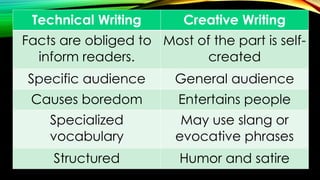
Technical Writing CreativeWriting
Facts are obliged to
inform readers.
Most of the part is self-
created
Specific audience General audience
Causes boredom Entertains people
Specialized
vocabulary
May use slang or
evocative phrases
Structured Humor and satire
8.
FORMS OF WRITING:EXPOSITORY
1. Expository
• Expository writing's main purpose is to explain.
• It is a subject-oriented writing style, in which authors
focus on telling you about a given topic or subject
without voicing their personal opinions.
• These types of essays or articles furnish you with
relevant facts and figures but do not include their
opinions.
• This is one of the most common types of writing.
9.
FORMS OF WRITING:EXPOSITORY
Key Points:
• Usually explains something in a process.
• Is often equipped with facts and figures.
• Is usually in a logical order and sequence.
10.
FORMS OF WRITING:EXPOSITORY
When You Would Use Expository Writing:
• Textbook writing.
• How-to articles.
• Recipes.
• News stories (not including opinion or editorial
pieces).
• Business, technical, or scientific writing.
11.
FORMS OF WRITING:DESCRIPTIVE
2. Descriptive
• Descriptive writing's main purpose is to describe
• It is a style of writing that focuses on describing a
character, an event, or a place in great detail.
• It can be poetic when the author takes the time
to be very specific in his or her descriptions.
12.
FORMS OF WRITING:DESCRIPTIVE
Key Points:
• It is often poetic in nature
• It describes places, people, events, situations, or
locations in a highly-detailed manner.
• The author visualizes what he or she sees, hears,
tastes, smells, and feels.
13.
FORMS OF WRITING:DESCRIPTIVE
When You Would Use Descriptive Writing:
• Poetry
• Journal or diary writing
• Nature writing
• Descriptive passages in fiction
14.
FORMS OF WRITING:PERSUASIVE
3. Persuasive
• Persuasive writing's main purpose is to convince.
• Persuasive writing contains the opinions and biases of the
author.
• To convince others to agree with the author's point of
view, persuasive writing contains justifications and reasons.
• It is often used in letters of complaint, advertisements or
commercials, affiliate marketing pitches, cover letters,
and newspaper opinion and editorial pieces.
15.
FORMS OF WRITING:PERSUASIVE
Key Points:
• Persuasive writing is equipped with reasons,
arguments, and justifications.
• In persuasive writing, the author takes a stand and
asks you to agree with his or her point of view.
• It often asks for readers to do something about
the situation (this is called a call-to-action).
16.
FORMS OF WRITING:PERSUASIVE
When You Would Use Persuasive Writing:
• Opinion and editorial newspaper pieces.
• Advertisements.
• Reviews (of books, music, movie, restaurants,
etc.).
• Letter of recommendation.
• Letter of complaint.
• Cover letters
17.
FORMS OF WRITING:NARRATIVE
4. Narrative
• Narrative writing's main purpose is to tell a story.
• The author will create different characters and tell
you what happens to them (sometimes the author
writes from the point of view of one of the
characters—this is known as first person narration).
18.
FORMS OF WRITING:NARRATIVE
• Novels, short stories, novellas, poetry, and
biographies can all fall in the narrative writing
style.
• Simply, narrative writing answers the question:
“What happened then?”
19.
FORMS OF WRITING:NARRATIVE
Key Points:
• A person tells a story or event.
• Has characters and dialogue.
• Has definite and logical beginnings, intervals, and
endings.
• Often has situations like actions, motivational
events, and disputes or conflicts with their
eventual solutions.
20.
FORMS OF WRITING:
NARRATIVE
Examplesof When You Would Use
Persuasive Writing:
• Novels
• Short stories
• Novellas
• Poetry
• Autobiographies or biographies
• Anecdotes
• Oral histories
21.
WHAT IS
SENSORY
EXPERIENCE?
Writer’s abilityto make a memorable
story by incorporating the use of the 5
senses.
Sensory details include sight, sound,
touch, smell, and taste. Writers
employ the five senses to engage a
reader's interest.
Readers can personally experience
what the author is trying to describe,
reminding them of their own
experiences.
22.
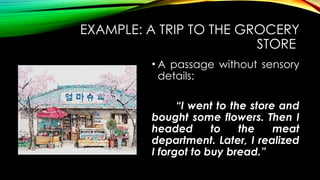
EXAMPLE: A TRIPTO THE GROCERY
STORE
• A passage without sensory
details:
“I went to the store and
bought some flowers. Then I
headed to the meat
department. Later, I realized
I forgot to buy bread.”
23.
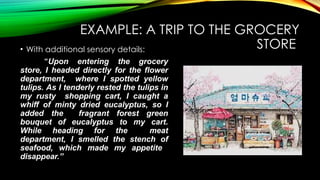
EXAMPLE: A TRIPTO THE GROCERY
STORE
• With additional sensory details:
“Upon entering the grocery
store, I headed directly for the flower
department, where I spotted yellow
tulips. As I tenderly rested the tulips in
my rusty shopping cart, I caught a
whiff of minty dried eucalyptus, so I
added the fragrant forest green
bouquet of eucalyptus to my cart.
While heading for the meat
department, I smelled the stench of
seafood, which made my appetite
disappear.”
24.
LANGUAGE OF CREATIVE
WRITING:IMAGERY
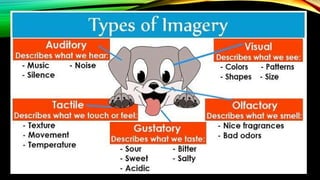
1. Imagery
• Language used by poets, novelists and other
writers to create images in the mind of the reader.
• Includes to figurative and metaphorical language
improve the reader’s experience through their
senses.
25.
IMAGERY USING VISUALS
“Thenight was black as ever, but bright stars lit up the sky in
beautiful and varied constellations which were sprinkled
across the astronomical landscape.”
26.
IMAGERY USING SCENTS
(OLFACTORY)
“Shesmelled the scent of sweet hibiscus wafting
through the air, its tropical smell a reminder that she
was on vacation in a beautiful place.”
27.
IMAGERY USING TASTE
(GUSTATORY)
“Thecandy melted in her mouth and swirls of
bittersweet chocolate and slightly sweet but salty
caramel blended together on her tongue.”
28.
IMAGERY USING TOUCH(TACTILE)
“After the long run, he collapsed in the grass with tired
and burning muscles. The grass tickled his skin and
sweat cooled on his brow.”
IMPORTANCE OF IMAGERY
•It allows readers to directly sympathize with
characters and narrators as they imagine having the
same sense experiences.
• Imagery is found throughout literature in poems, plays,
stories, novels and other creative compositions.
Simile
She as whiteas a snow.
Personification
The flowers dance in the wind.
Metaphor
She is a growling tiger.
34.
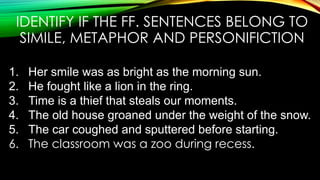
IDENTIFY IF THEFF. SENTENCES BELONG TO
SIMILE, METAPHOR AND PERSONIFICTION
1. Her smile was as bright as the morning sun.
2. He fought like a lion in the ring.
3. Time is a thief that steals our moments.
4. The old house groaned under the weight of the snow.
5. The car coughed and sputtered before starting.
6. The classroom was a zoo during recess.
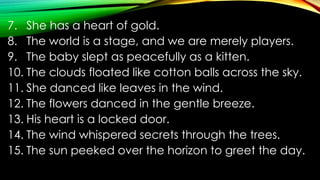
35.
7. She hasa heart of gold.
8. The world is a stage, and we are merely players.
9. The baby slept as peacefully as a kitten.
10. The clouds floated like cotton balls across the sky.
11. She danced like leaves in the wind.
12. The flowers danced in the gentle breeze.
13. His heart is a locked door.
14. The wind whispered secrets through the trees.
15. The sun peeked over the horizon to greet the day.
36.
LANGUAGE OF CREATIVE
WRITING:DICTION
DICTION
• as style of speaking or writing,
determined by the choice of
words by a speakeror a writer.
• Diction, or choice of words,
often separates good writing
from bad writing.
37.
TYPES OF DICTION
Individualsvary their diction depending on different contexts and
settings. Therefore, we come across various types of diction.
• Formal diction – formal words are used in formal situations, such as
press conferences and presentations.
• Informal diction – uses informal words and conversation, such as
writing or talking to friends.
• Colloquial diction – uses words common in everyday speech, which
may be different in different regions or communities.
• Slang diction – is the use of words that are newly coined, or even
impolite.
38.
FUNCTION OF DICTION
•In literature, writers choose words to create and
convey a typical mood, tone, and atmosphere to
their readers.
• A writer’s choice of words, and his selection of
graphic words, not only affect the reader’s attitude,
but also conveys the writer’s feelings toward the
literary work.
WHAT IS EXACTLYA WRITER?
•THE ONE WHO EXPRESSES EMOTION OR IDEA.
•THEIR THOUGHT ARE WORTH UTTERING AND MUST BE
SHARED TO THE REST OF THE WORLD.
•PLAY WITH WORDS AND THE VARIOUS FORMS, AND THE
CHALLENGES WRITING HAS INTRODUCED TO THEIR LIVES
•MAKE LIVING THROUGH WRITING AND AIM TO
CONNECT TO PEOPLE AND SHARE THEIR VISIONS AND
EXPERIENCES.
42.
CHARACTERISTICS OF AWRITER
•Disciplined
•Imaginative
•Passion
However, without technique and
diligence to the craft, writing will not be
successful.
43.
A WRITER ISA READER
•A good writer has instilled working habits
throughout his/her career that enable
him/her to sustain his/her writing.
•A writer is a lifelong student of the craft, and
this entails being a lifelong reader as well.
•Without the ability to read widely and
deeply, one cannot entirely call
himself/herself a writer.
44.
•Necessitates that thewriter becomes an
active participant of the world.
•Exposing oneself to different forms of
expression enriches one’s writing.
45.
WORKING HABITS
•Habit ofwriting is setting a time of the day and
a place where you can practice.
•When you run out of ideas and exhaust every
words in a topic, better to step away and go
somewhere else to gain fresh perspective.
46.
HERE ARE FEWPROMPTS YOU MAY USE TO
JUMP-START YOUR WRITING:
1. Try to recall your earliest childhood memory.
2. Write about your favorite body part.
3. Continue this opening line: It was a dark and
stormy night…
4. If you could have a superpower, what would it
be?
5. Look back to the first time you fell in love or had
a crush. What were those initial feelings like?
47.
6. Think ofways you can earn money for yourself
even as a student.
7. Do you have a favorite word? Explain what you
like about this word aside from what it means.
8. Discuss the concepts of good and evil. Do they
really exist?
9. Write about an ugly reality of life, such as war or
hate, but find the beauty in it.
10. Who is your personal hero?
48.
JOURNAL WRITING
•Another toolthat aids in the development of a
writer is keeping a writing journal. In the past
you may have kept a diary of your daily
events or even maintained several types of
journal, like food blog or a dream journal.
Editor's Notes
#3 Creative writing is often described as “the art of making things up.” which involves using imagination and originality to craft unique narratives, characters, and worlds. It transcends mere storytelling; it is a profound form of expression that allows writers to explore the depths of their creativity and convey emotions and ideas that might otherwise remain unexpressed
encompasses written works, often considered an art form, including poetry, fiction, and drama, but also nonfiction and other forms.
#4 by weaving engaging narratives, fostering emotional connections, providing escapism, and exploring complex ideas. Through humor, artistic expression, and relatable themes, it captivates readers and enriches their lives, making it a cherished form of art and communication.
By reflecting inner thoughts, exploring unique narratives, fostering empathy, and connecting cultural contexts, it allows writers to convey the complexities of life in ways that resonate deeply with readers. Through imaginative storytelling, creative writing not only entertains but also enriches our understanding of ourselves and others, highlighting the shared journey of being human.
#6 specialized form of communication that focuses on conveying complex information in a clear and concise manner. It is essential in various fields, including technology, medicine, and engineering, where precise instructions and explanations are crucial for understanding and implementation.
#8 is a form of writing that aims to explain, inform, or describe a particular topic clearly and logically. Unlike other writing styles, such as persuasive or creative writing, expository writing is strictly factual and devoid of personal opinions or emotional language.
#11 is a literary style that aims to create a vivid picture in the reader's mind by using detailed observations and sensory language. This form of writing emphasizes the use of adjectives, adverbs, and figurative language to paint a picture of a scene, character, or event, allowing the reader to experience the subject fully.
#14 is a form of writing that aims to convince the reader to adopt a particular point of view or take a specific action. This style of writing is commonly used in advertisements, opinion pieces, and essays where the writer seeks to influence the reader's beliefs, attitudes, or behaviors.
#17 is a storytelling form that recounts events, experiences, or tales in a structured format. It can be fictional or based on real-life experiences and is characterized by its ability to engage readers through characters, plot, and setting. The purpose of narrative writing is to entertain, inform, or convey a deeper meaning through the unfolding of a story.
#21 refers to the perception and reception of information through the five senses: sight, hearing, touch, taste, and smell.
These experiences are fundamental to how individuals interact with and interpret their environment, shaping their understanding and emotional responses to various stimuli.
#33 Metaphor: A comparison between two unlike things without using "like" or "as." It suggests that one thing is another to highlight similarities.
Example: "Time is a thief."
Simile: A comparison between two unlike things using "like" or "as." It draws a resemblance between the two to emphasize a specific quality.
Example: "Her smile was as bright as the sun."
Personification: Attributing human qualities or characteristics to non-human objects or abstract concepts.
Example: "The wind whispered through the trees."
Hyperbole: An exaggerated statement not meant to be taken literally, often used for emphasis or humor.
Example: "I’m so hungry I could eat a horse."
Alliteration: The repetition of the same initial consonant sound in a series of words to create rhythm or focus.
Example: "Peter Piper picked a peck of pickled peppers."
Onomatopoeia: A word that imitates the sound it represents.
Example: "The bees buzzed in the garden."
Oxymoron: A figure of speech that combines contradictory terms to create a paradoxical effect.
Example: "Bittersweet."
Idioms: Expressions that have a figurative meaning different from their literal meaning.
Example: "It’s raining cats and dogs."
Irony: A contrast between expectation and reality, often highlighting a discrepancy between what is said and what is meant.
Example: A fire station burns down.
Symbolism: Using symbols to represent ideas or concepts, where a physical object or action stands for a larger meaning.
Example: A dove symbolizes peace











![IM Creative Writing - Grade 11 [Midterms]](https://cdn.slidesharecdn.com/ss_thumbnails/imcreativewritingmidterms-250113073731-7c8f2846-thumbnail.jpg?width=640&height=640&fit=bounds)


