TYPES OF SPEECHES
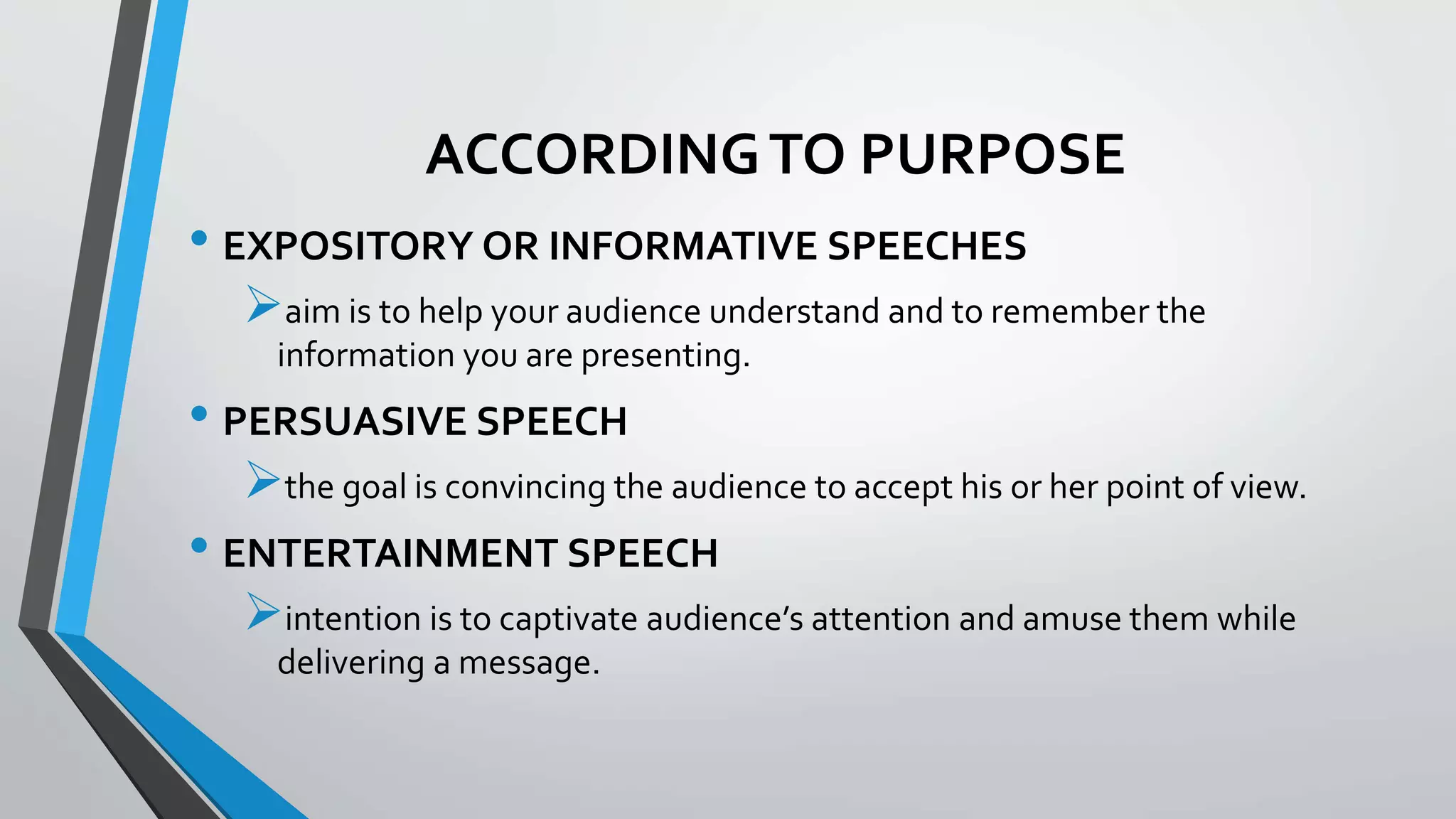
ACCORDINGTO PURPOSE
• EXPOSITORY OR INFORMATIVE SPEECHES
aim is to help your audience understand and to remember the
information you are presenting.
• PERSUASIVE SPEECH
the goal is convincing the audience to accept his or her point of view.
• ENTERTAINMENT SPEECH
intention is to captivate audience’s attention and amuse them while
delivering a message.
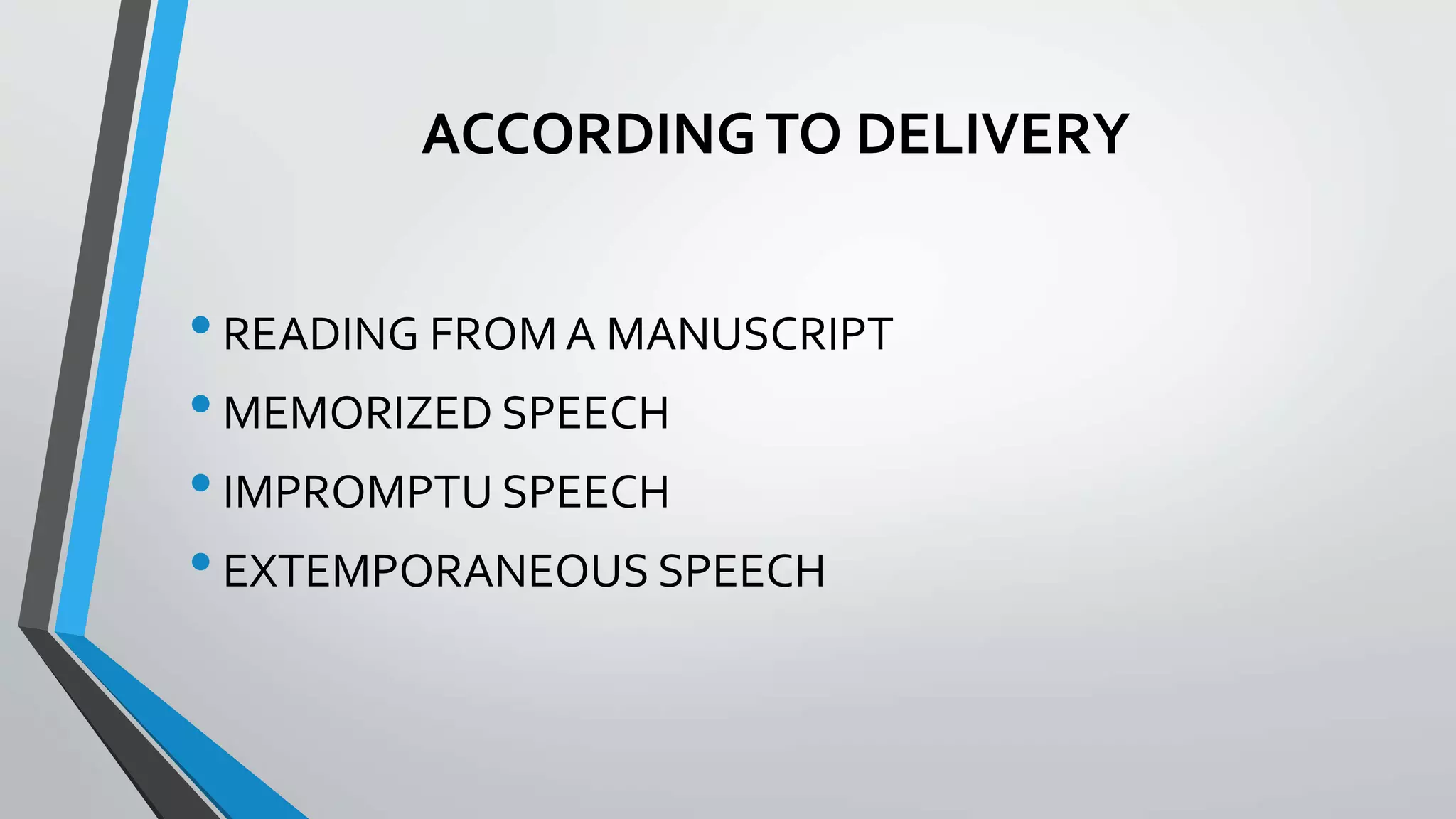
ACCORDINGTO DELIVERY
•READING FROM A MANUSCRIPT
•MEMORIZED SPEECH
•IMPROMPTU SPEECH
•EXTEMPORANEOUS SPEECH
PRINCIPLES OF SPEECHWRITING
Choosing the topic
Analyzing the Audience
Sourcing the Information
Outlining and Organizing the Speech
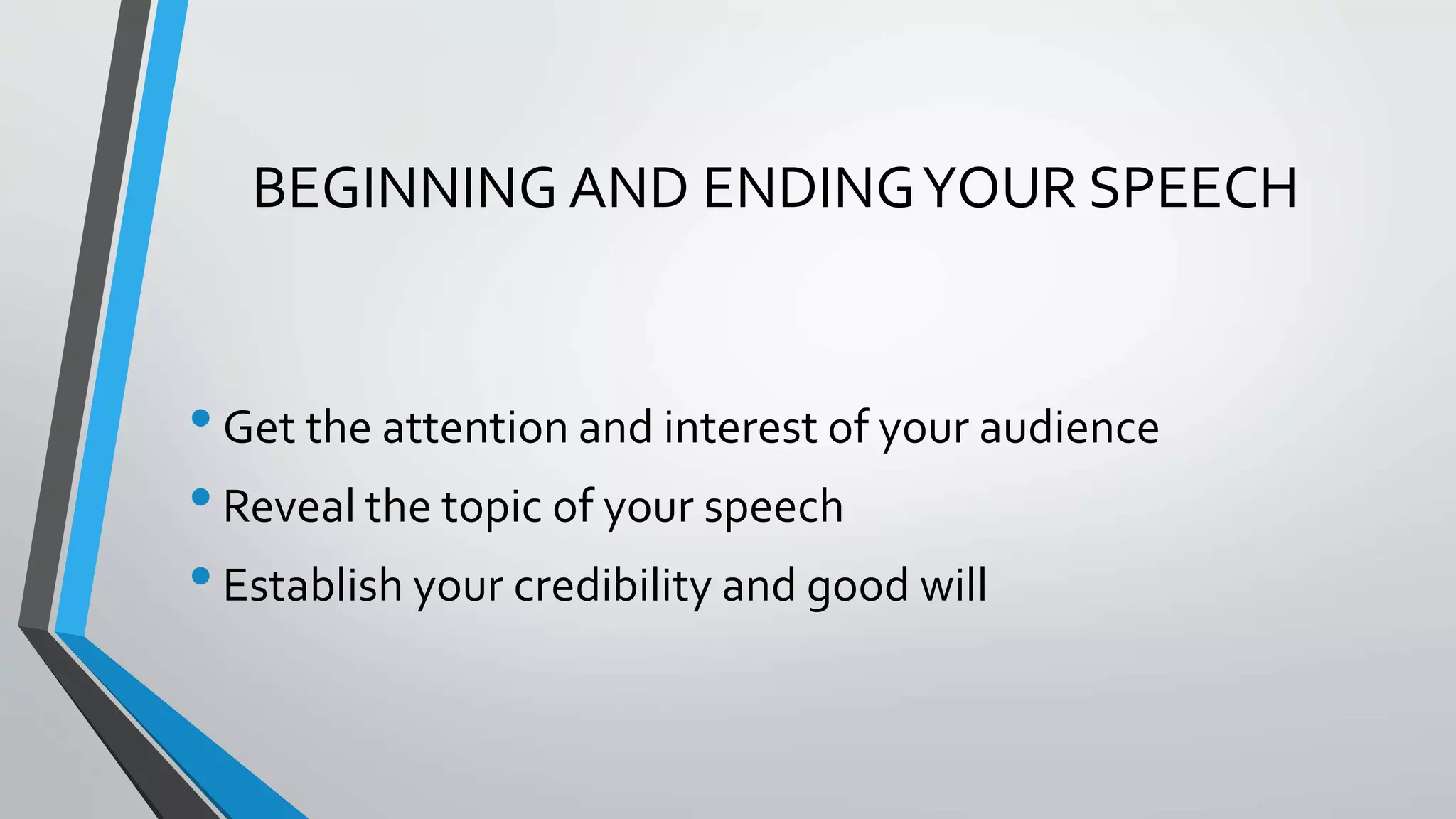
BEGINNING AND ENDINGYOUR SPEECH
•Get the attention and interest of your audience
•Reveal the topic of your speech
•Establish your credibility and good will
Tips inWriting your Speech
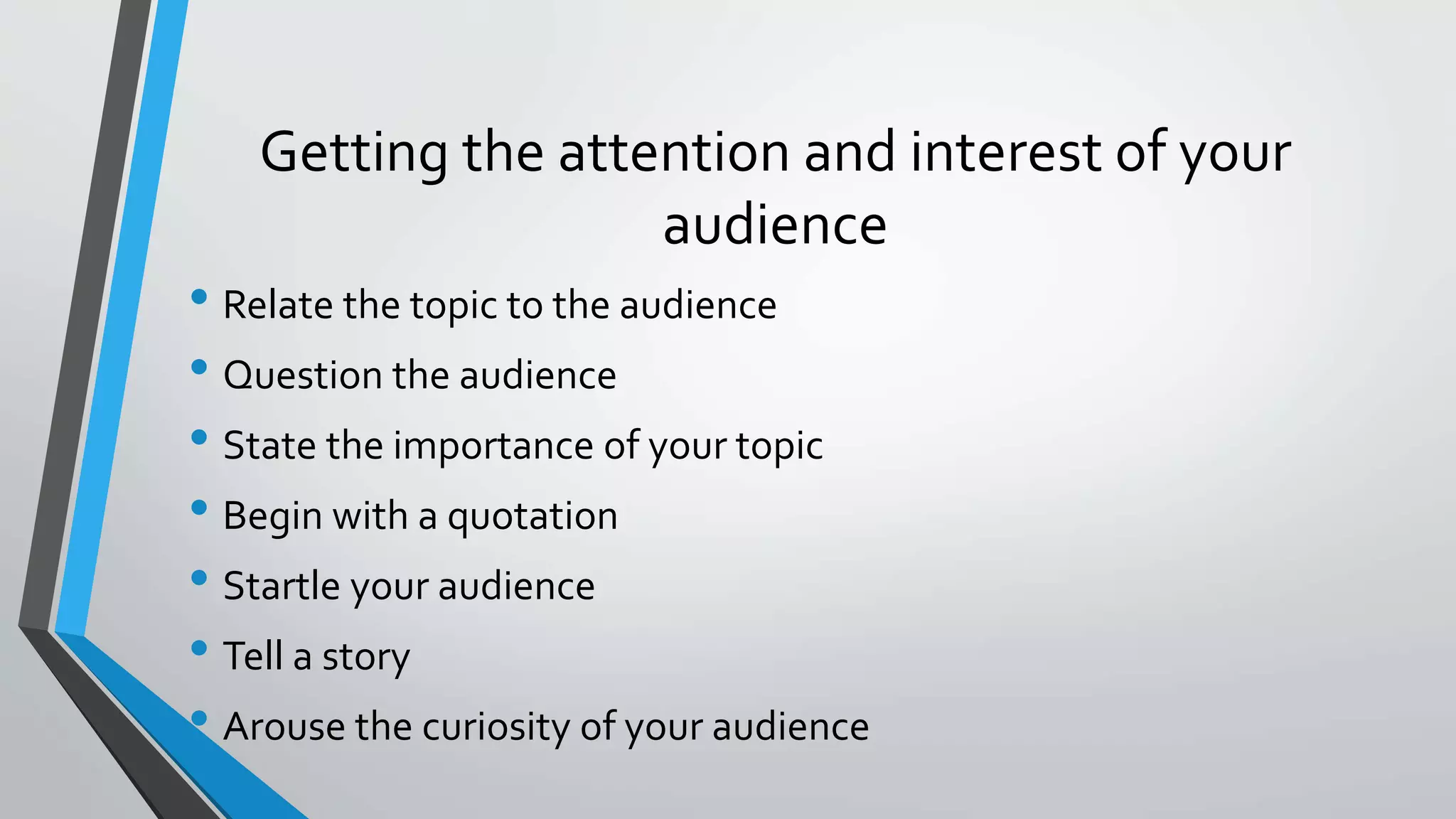
Getting the attention and interest of your
audience
• Relate the topic to the audience
• Question the audience
• State the importance of your topic
• Begin with a quotation
• Startle your audience
• Tell a story
• Arouse the curiosity of your audience
EndingYour Speech
•Two functions of a conclusion:
To let the audience know you are ending the speech
The reinforce the audience’s understanding or commitment
to the central idea
PRINCIPPLES OF SPEECH DELIVERY
VOICE MODULATION
•Pace, pitch, power, and volume of your voice
•Also includes the emotion of your voice
FACIAL EXPERSSION
POSTURE
GESTURES
TIPS
• Always convey your message with the variation in pitch and tempo. Never
deliver your speech in a monotone as it will not only bore but will send your
audience to sleep.
• Speak at a rate so that your audience can understand you because fast
delivery shows lack of confidence.
• Speak normally at around 125 to 150 words per minute.
• Pronounce words properly.
• Speak loud enough so that everyone in the audience can hear you clearly.
• Pause for a moment in between sentences to control your speed and
approach better.
• Refrain from vocalized pauses.
• Take care that you do not repeatedly use such phrases as “you see”, “I
mean”, “you know”, and “okay”.
Get ready for your variety show! Good luck and
have fun!

Types of speeches and principles of speech writing and delivery

  • 1.
  • 2.
    ACCORDINGTO PURPOSE • EXPOSITORYOR INFORMATIVE SPEECHES aim is to help your audience understand and to remember the information you are presenting. • PERSUASIVE SPEECH the goal is convincing the audience to accept his or her point of view. • ENTERTAINMENT SPEECH intention is to captivate audience’s attention and amuse them while delivering a message.
  • 3.
    ACCORDINGTO DELIVERY •READING FROMA MANUSCRIPT •MEMORIZED SPEECH •IMPROMPTU SPEECH •EXTEMPORANEOUS SPEECH
  • 4.
  • 5.
  • 6.
  • 7.
  • 8.
  • 9.
    BEGINNING AND ENDINGYOURSPEECH •Get the attention and interest of your audience •Reveal the topic of your speech •Establish your credibility and good will
  • 11.
  • 12.
    Getting the attentionand interest of your audience • Relate the topic to the audience • Question the audience • State the importance of your topic • Begin with a quotation • Startle your audience • Tell a story • Arouse the curiosity of your audience
  • 13.
    EndingYour Speech •Two functionsof a conclusion: To let the audience know you are ending the speech The reinforce the audience’s understanding or commitment to the central idea
  • 14.
  • 15.
    VOICE MODULATION •Pace, pitch,power, and volume of your voice •Also includes the emotion of your voice
  • 16.
  • 17.
  • 18.
  • 19.
    TIPS • Always conveyyour message with the variation in pitch and tempo. Never deliver your speech in a monotone as it will not only bore but will send your audience to sleep. • Speak at a rate so that your audience can understand you because fast delivery shows lack of confidence. • Speak normally at around 125 to 150 words per minute. • Pronounce words properly. • Speak loud enough so that everyone in the audience can hear you clearly. • Pause for a moment in between sentences to control your speed and approach better. • Refrain from vocalized pauses. • Take care that you do not repeatedly use such phrases as “you see”, “I mean”, “you know”, and “okay”.
  • 20.
    Get ready foryour variety show! Good luck and have fun!