Types of pattern repeats
Straight Repeat
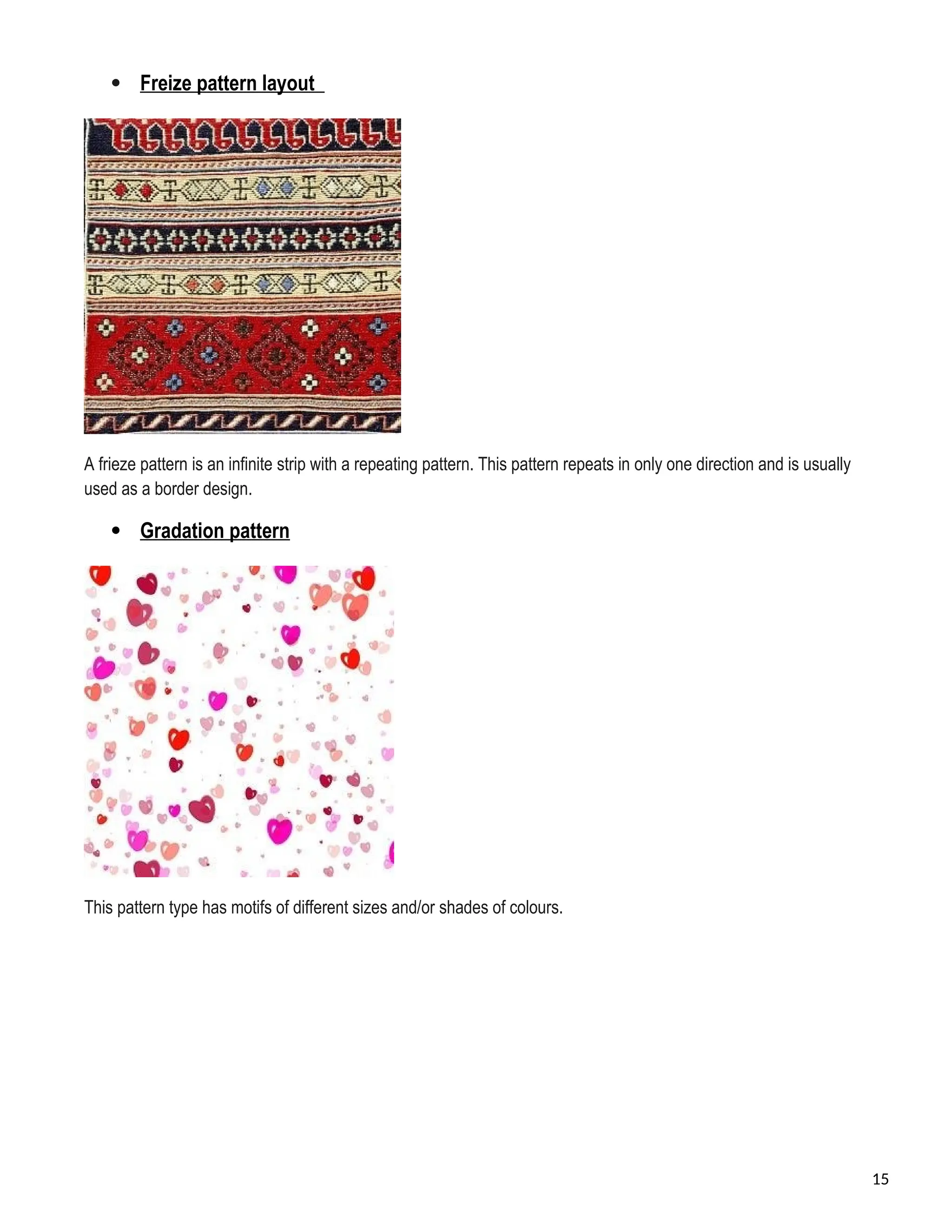
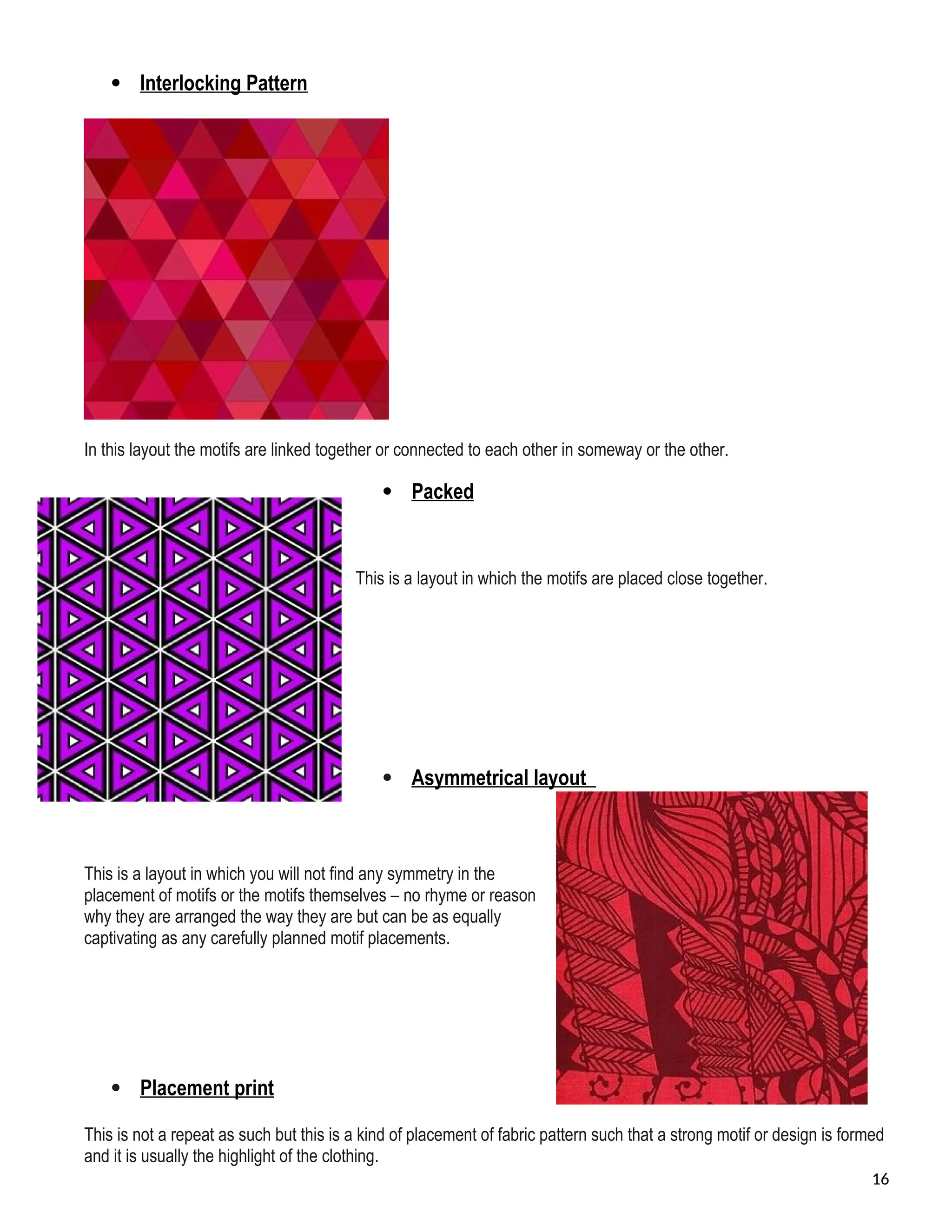
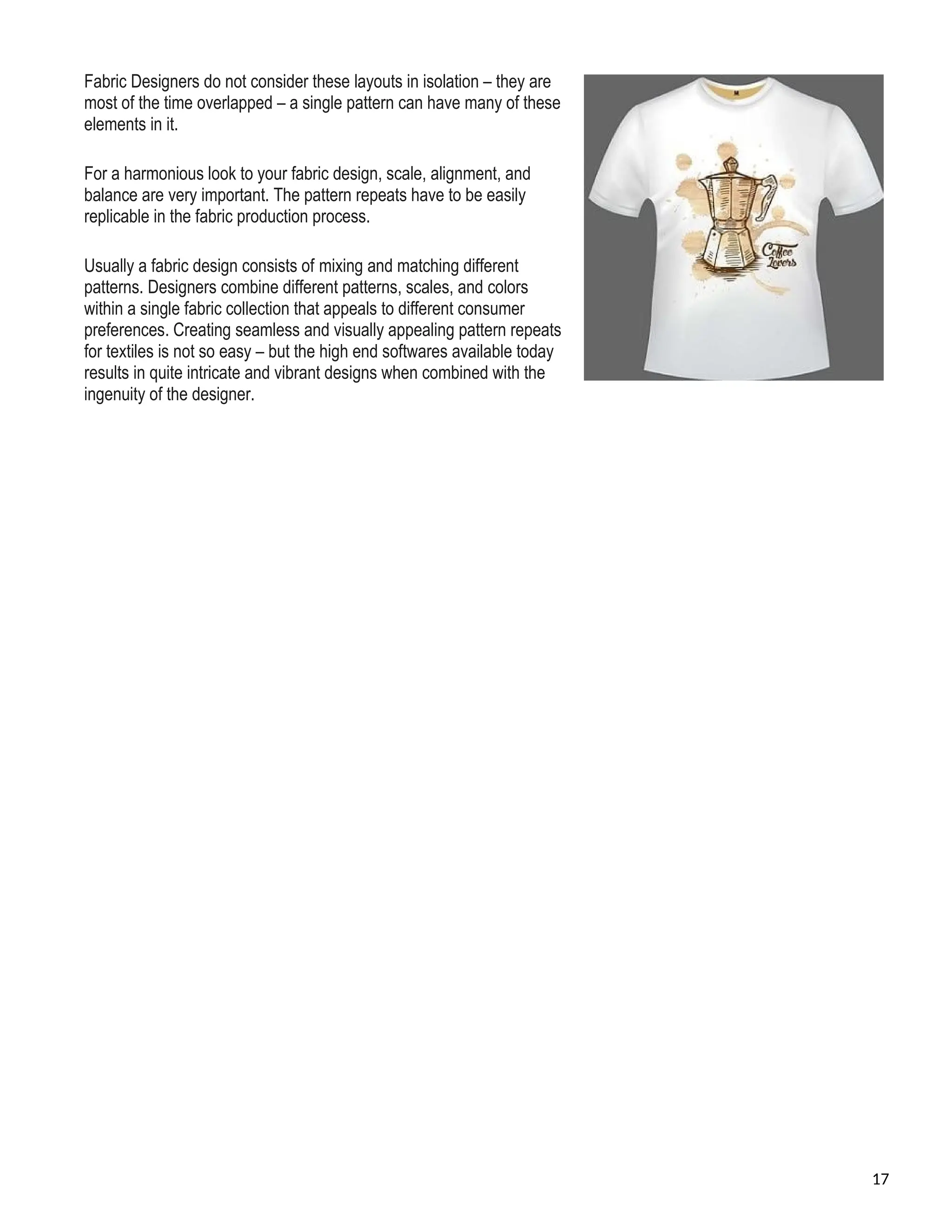
This is the most basic layout where the motif repeats
out directly in a horizontal line to the left or right, or the
original motif.
FULL DROP/BLOCK PATTERN REPEAT
One of the most common and simplest of all repeat systems
is the full drop or block surface pattern repeat. The repeat
unit is created by stacking the original repeat block in a grid
format. Although it’s often created as a square unit, full drop
repeats can also be rectangular.
HALF DROP
PATTERN REPEAT
Another very commonly used surface pattern repeat is the half
drop. It consists of the repeat unit being stacked vertically in a
column format which is then offset by half in the next vertical
row. Because of this, half drop pattern repeats are a great way
at quickly allowing the design to look less formal.
BRICK PATTERN REPEAT
Just like the half
drop, the brick
repeat unit is also very commonly used in surface
pattern repeats. It’s very similar to the half drop
pattern repeat except instead of the repeat unit being
stacked vertically in a column format, it is stacked
horizontally. The repeat unit is then offset by half in
the next horizontal row resembling a brick wall. As a
result, just like with the half drop pattern repeats,
brick repeats allow a design to look less formal.
1
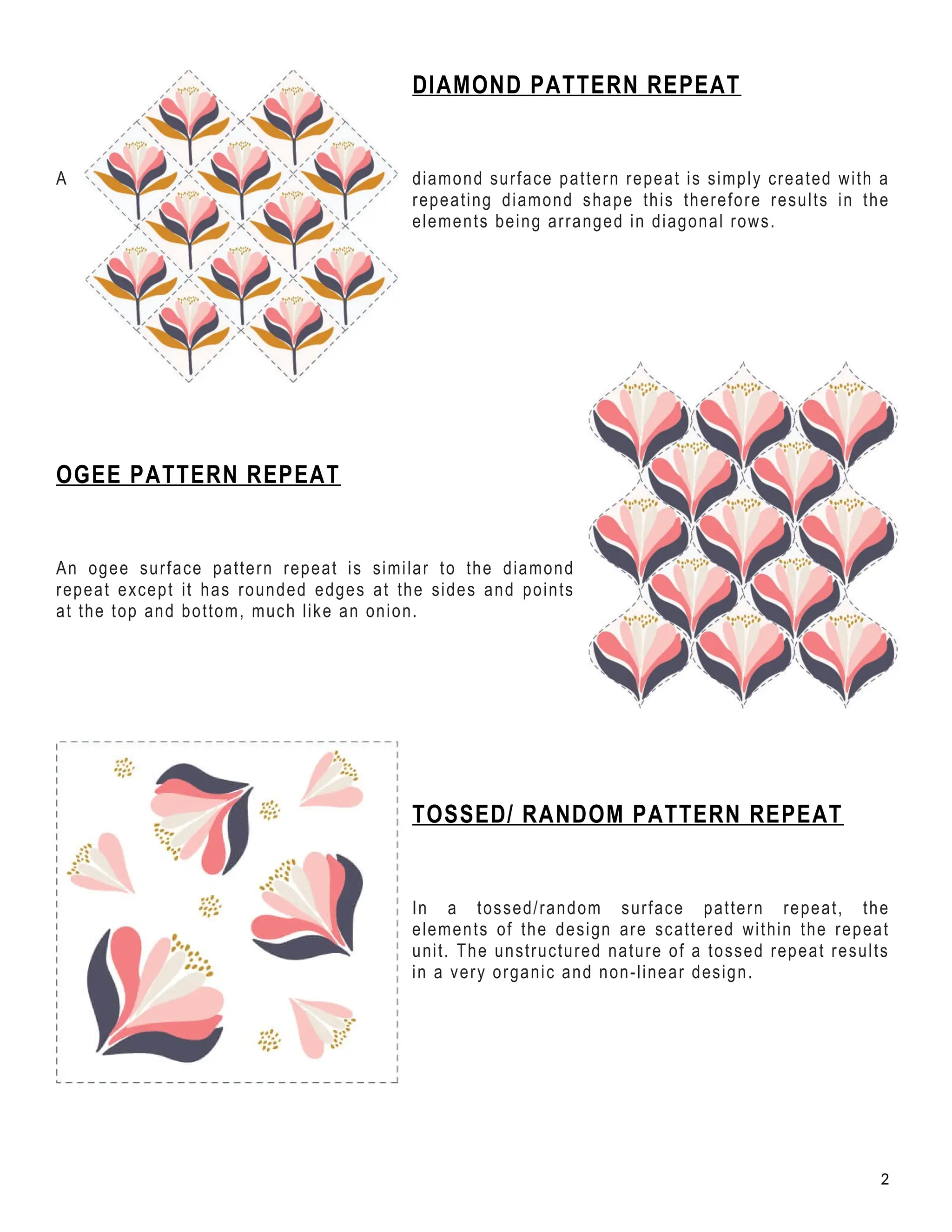
DIAMOND PATTERN REPEAT
A diamond surface pattern repeat is simply created with a
repeating diamond shape this therefore results in the
elements being arranged in diagonal rows.
OGEE PATTERN REPEAT
An ogee surface pattern repeat is similar to the diamond
repeat except it has rounded edges at the sides and points
at the top and bottom, much like an onion.
TOSSED/ RANDOM PATTERN REPEAT
In a tossed/random surface pattern repeat, the
elements of the design are scattered within the repeat
unit. The unstructured nature of a tossed repeat results
in a very organic and non-linear design.
2
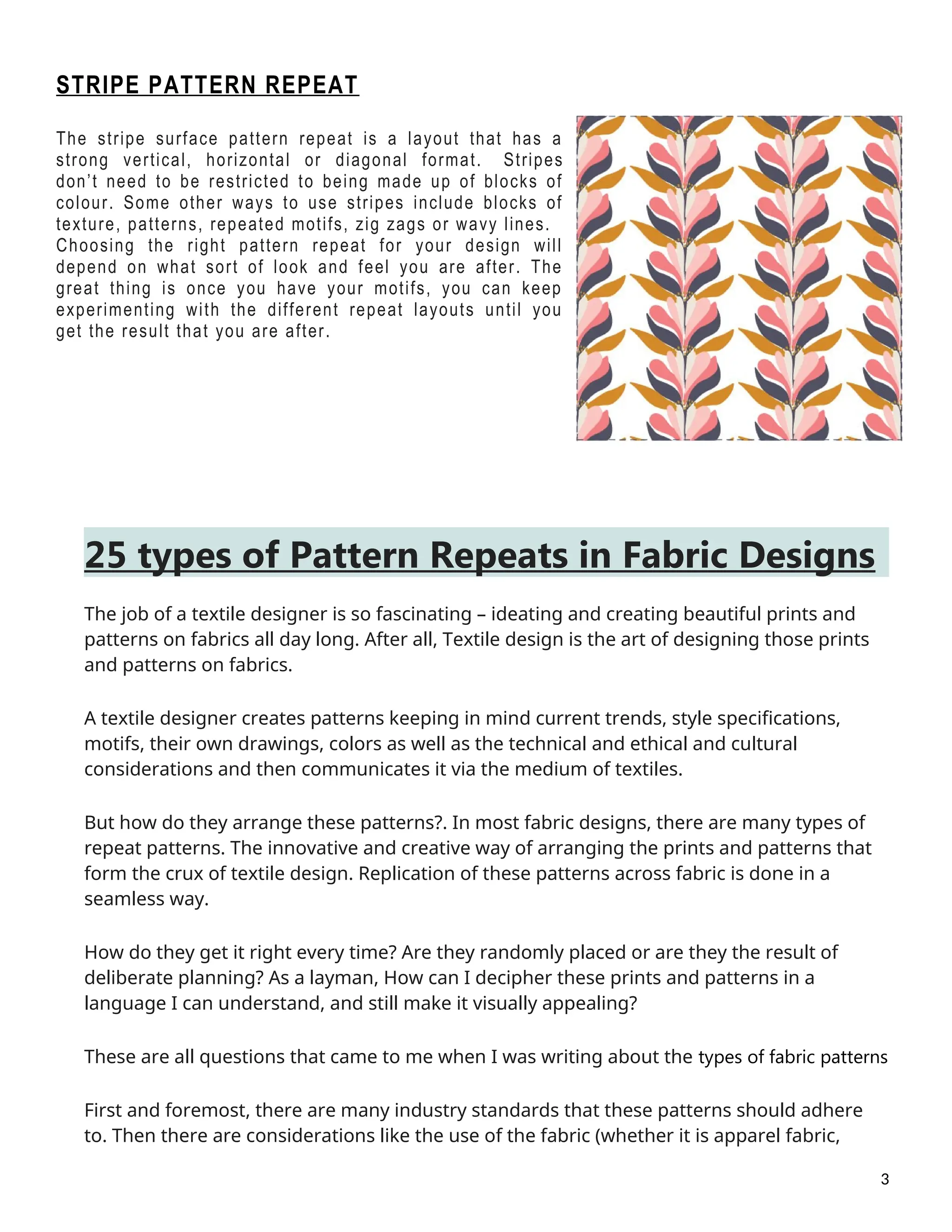
STRIPE PATTERN REPEAT
The stripe surface pattern repeat is a layout that has a
strong vertical, horizontal or diagonal format. Stripes
don’t need to be restricted to being made up of blocks of
colour. Some other ways to use stripes include blocks of
texture, patterns, repeated motifs, zig zags or wavy lines.
Choosing the right pattern repeat for your design will
depend on what sort of look and feel you are after. The
great thing is once you have your motifs, you can keep
experimenting with the different repeat layouts until you
get the result that you are after.
25 types of Pattern Repeats in Fabric Designs
The job of a textile designer is so fascinating – ideating and creating beautiful prints and
patterns on fabrics all day long. After all, Textile design is the art of designing those prints
and patterns on fabrics.
A textile designer creates patterns keeping in mind current trends, style specifications,
motifs, their own drawings, colors as well as the technical and ethical and cultural
considerations and then communicates it via the medium of textiles.
But how do they arrange these patterns?. In most fabric designs, there are many types of
repeat patterns. The innovative and creative way of arranging the prints and patterns that
form the crux of textile design. Replication of these patterns across fabric is done in a
seamless way.
How do they get it right every time? Are they randomly placed or are they the result of
deliberate planning? As a layman, How can I decipher these prints and patterns in a
language I can understand, and still make it visually appealing?
These are all questions that came to me when I was writing about the types of fabric patterns
First and foremost, there are many industry standards that these patterns should adhere
to. Then there are considerations like the use of the fabric (whether it is apparel fabric,
3
furnishing textile etc) and the type of the fabric itself (whether it is woven or knitted etc.).
Then finally comes the task of arranging the motifs.
In all patterns and prints on textiles, you will find there is a repeat – ie the identical or
dissimilar motifs are arranged with horizontal or vertical distance between them in a
repeated manner. There are infinite ways of arranging these repeats on the fabric – but
some basic layouts are commonly used individually or collectively to form the patterns that
you see on fabrics
Types of Pattern Repeats.
 Types of Pattern Repeats.
 Allover layout (Overall)
 Block Repeat
 Tossed layout
 Border layout
 Brick Layout
 Half-drop repeat layout
 Diamond layout
 Striped layout
 Check layout
 Turnover layout
 Composite repeat
 Counterchange
 Diaper
 Fall-On
 Foulard
 One-directional
 Two-directional Pattern
 Four-way Layout
 Positive-Negative layout
 Freize pattern layout
 Gradation pattern
 Interlocking Pattern
 Packed
 Asymmetrical layout
 Placement print
4
25 classifications of patterns in textile designs according
to the arrangement of motifs in the pattern
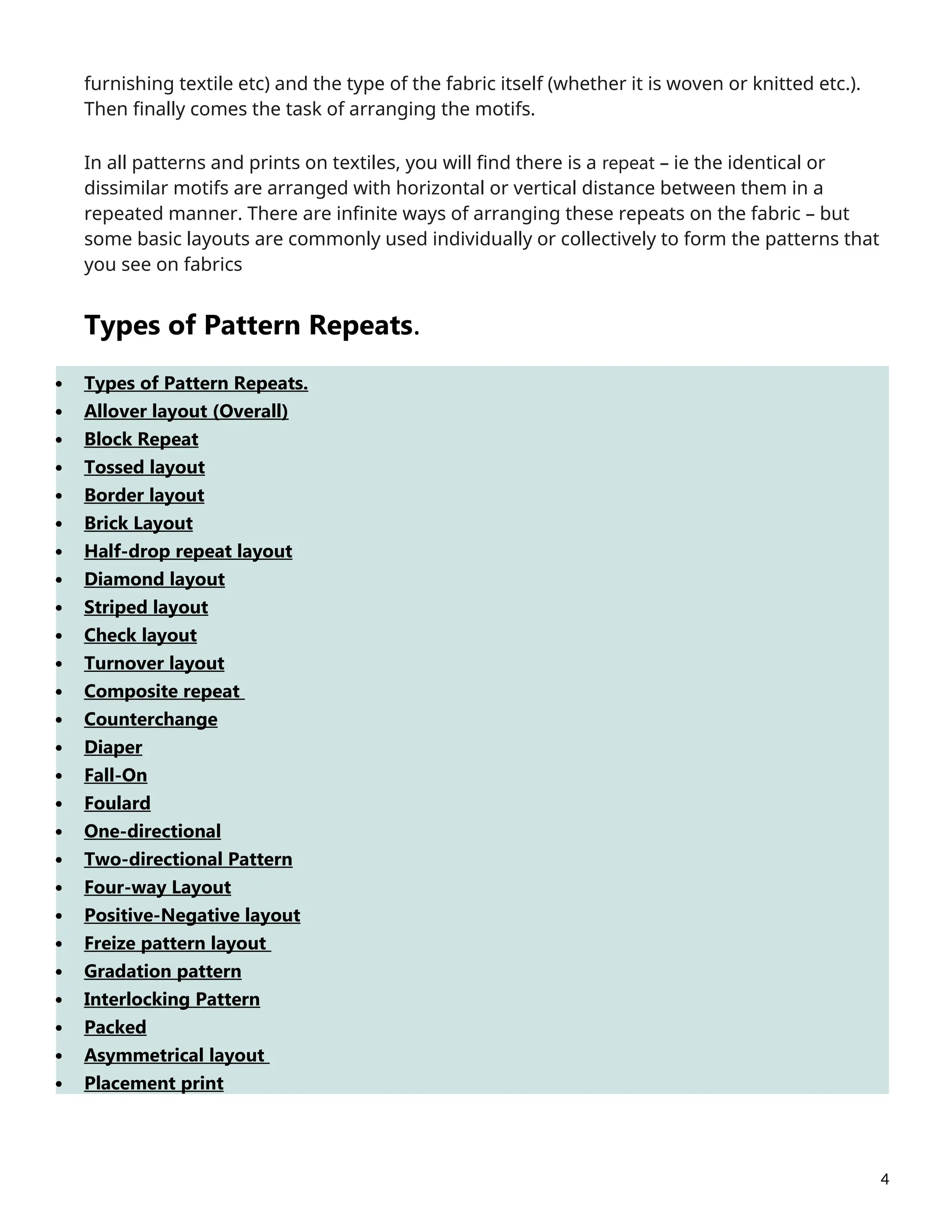
 Allover layout (Overall)
Allover basically means covering the whole extent or surface. This is a layout with motifs distributed all over the fabric
– Here the motifs are randomly placed with regular or irregular spacing between them, but usually very close to each
other and facing different directions
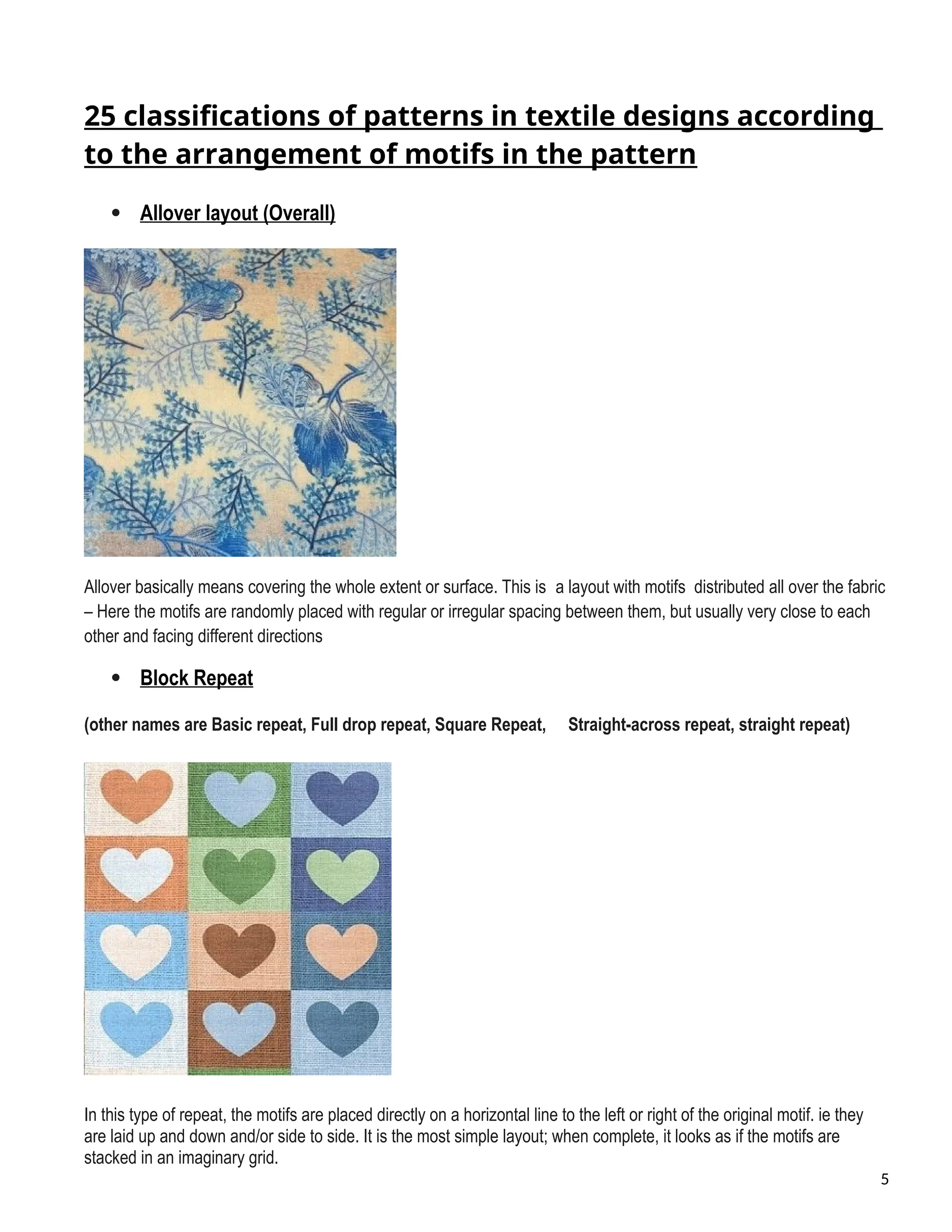
 Block Repeat
(other names are Basic repeat, Full drop repeat, Square Repeat, Straight-across repeat, straight repeat)
In this type of repeat, the motifs are placed directly on a horizontal line to the left or right of the original motif. ie they
are laid up and down and/or side to side. It is the most simple layout; when complete, it looks as if the motifs are
stacked in an imaginary grid.
5
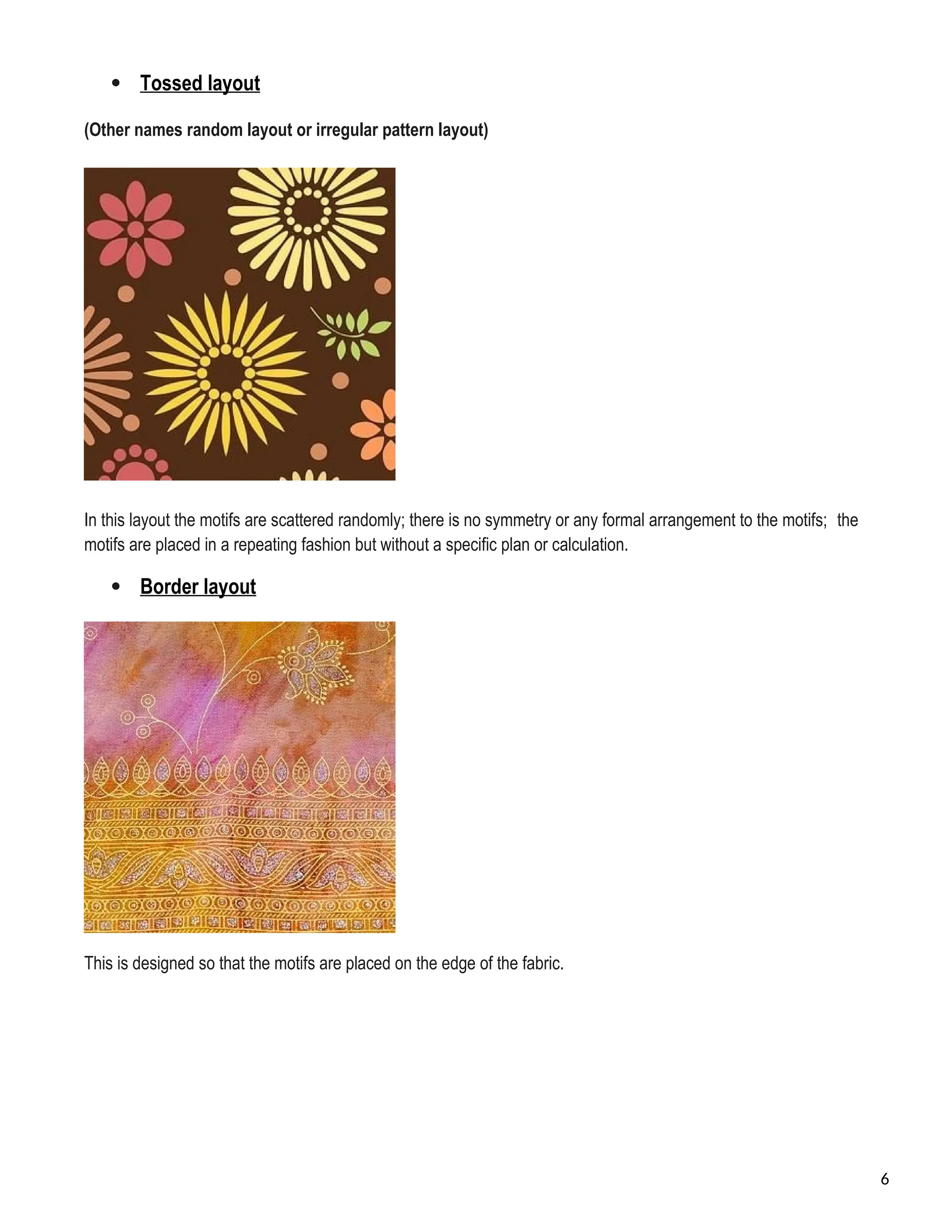
 Tossed layout
(Other names random layout or irregular pattern layout)
In this layout the motifs are scattered randomly; there is no symmetry or any formal arrangement to the motifs; the
motifs are placed in a repeating fashion but without a specific plan or calculation.
 Border layout
This is designed so that the motifs are placed on the edge of the fabric.
6
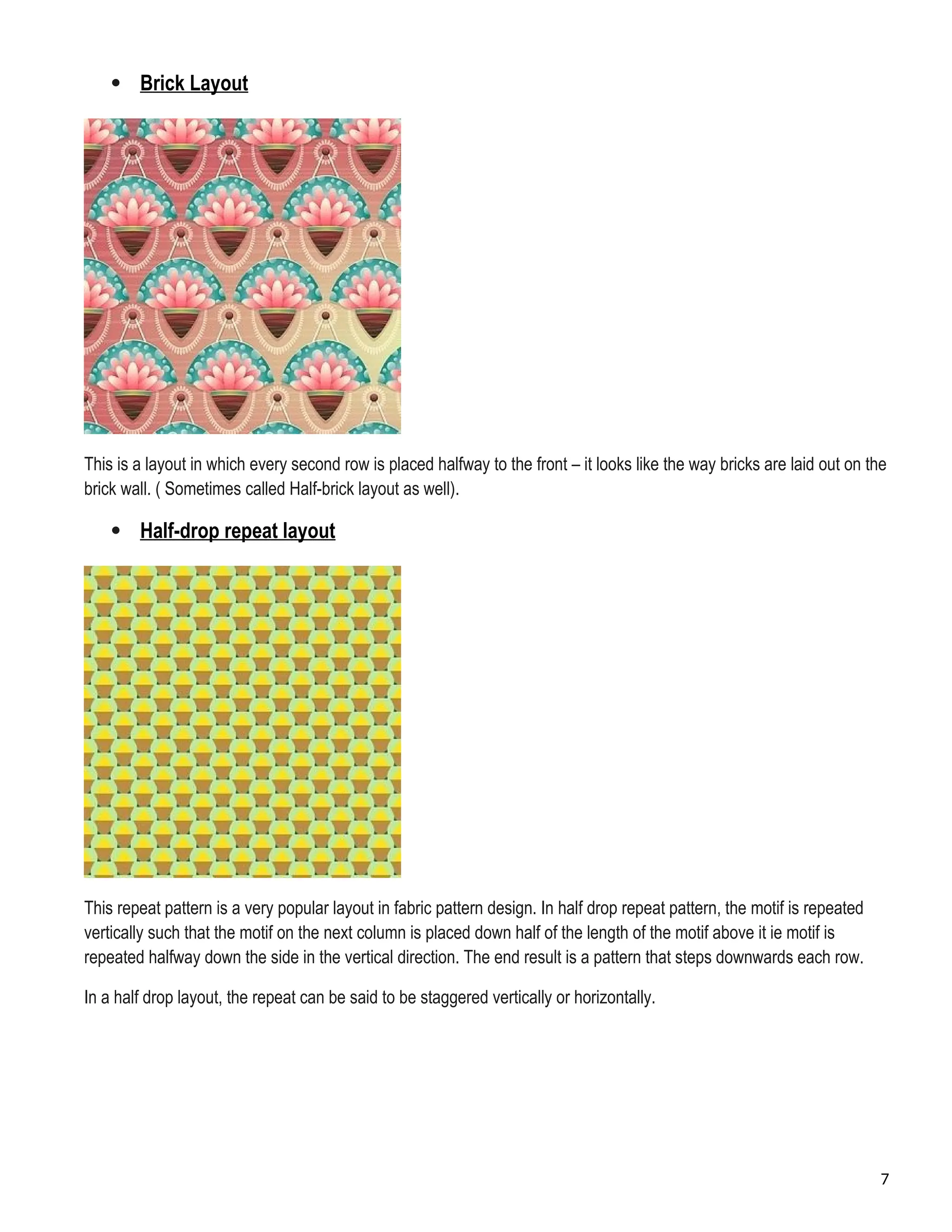
 Brick Layout
This is a layout in which every second row is placed halfway to the front – it looks like the way bricks are laid out on the
brick wall. ( Sometimes called Half-brick layout as well).
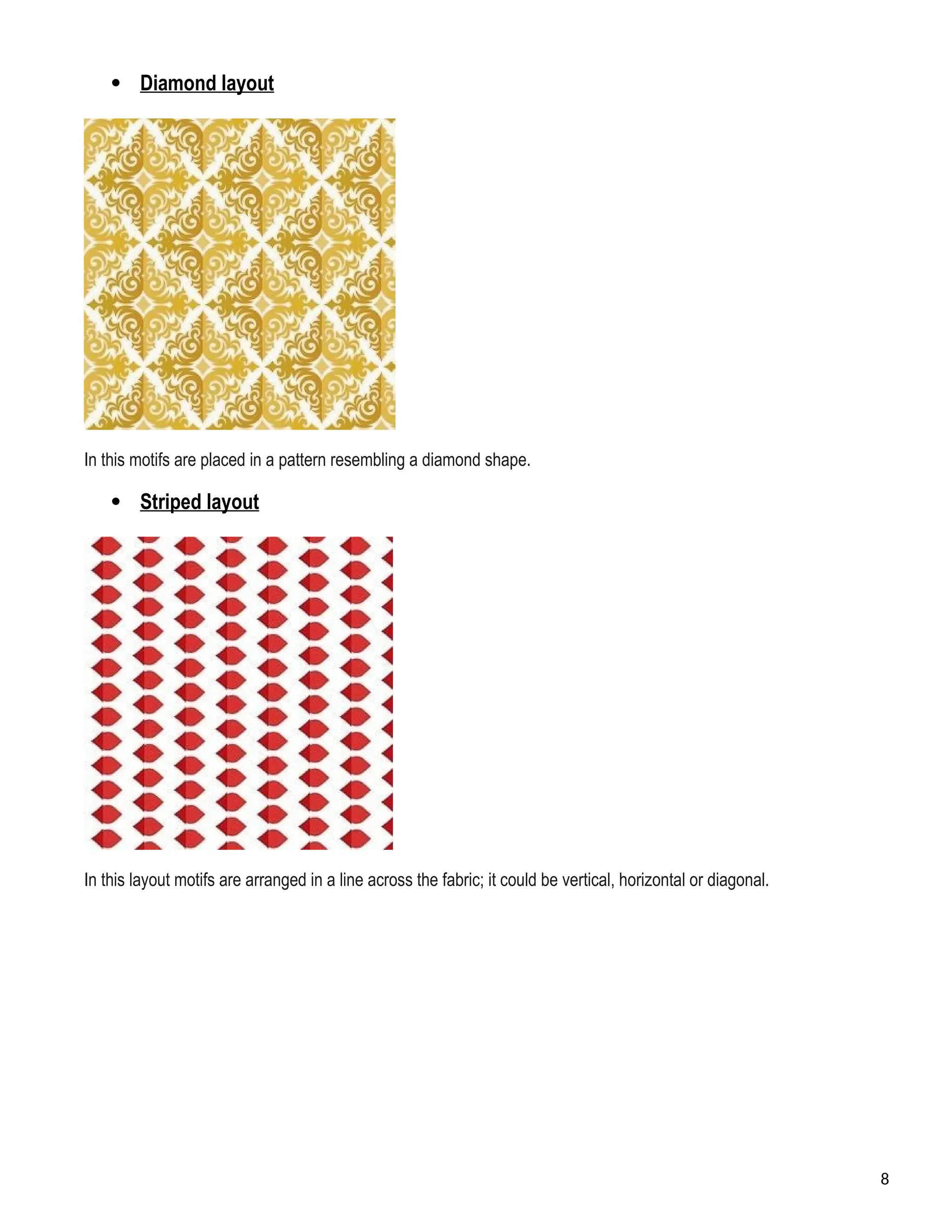
 Half-drop repeat layout
This repeat pattern is a very popular layout in fabric pattern design. In half drop repeat pattern, the motif is repeated
vertically such that the motif on the next column is placed down half of the length of the motif above it ie motif is
repeated halfway down the side in the vertical direction. The end result is a pattern that steps downwards each row.
In a half drop layout, the repeat can be said to be staggered vertically or horizontally.
7
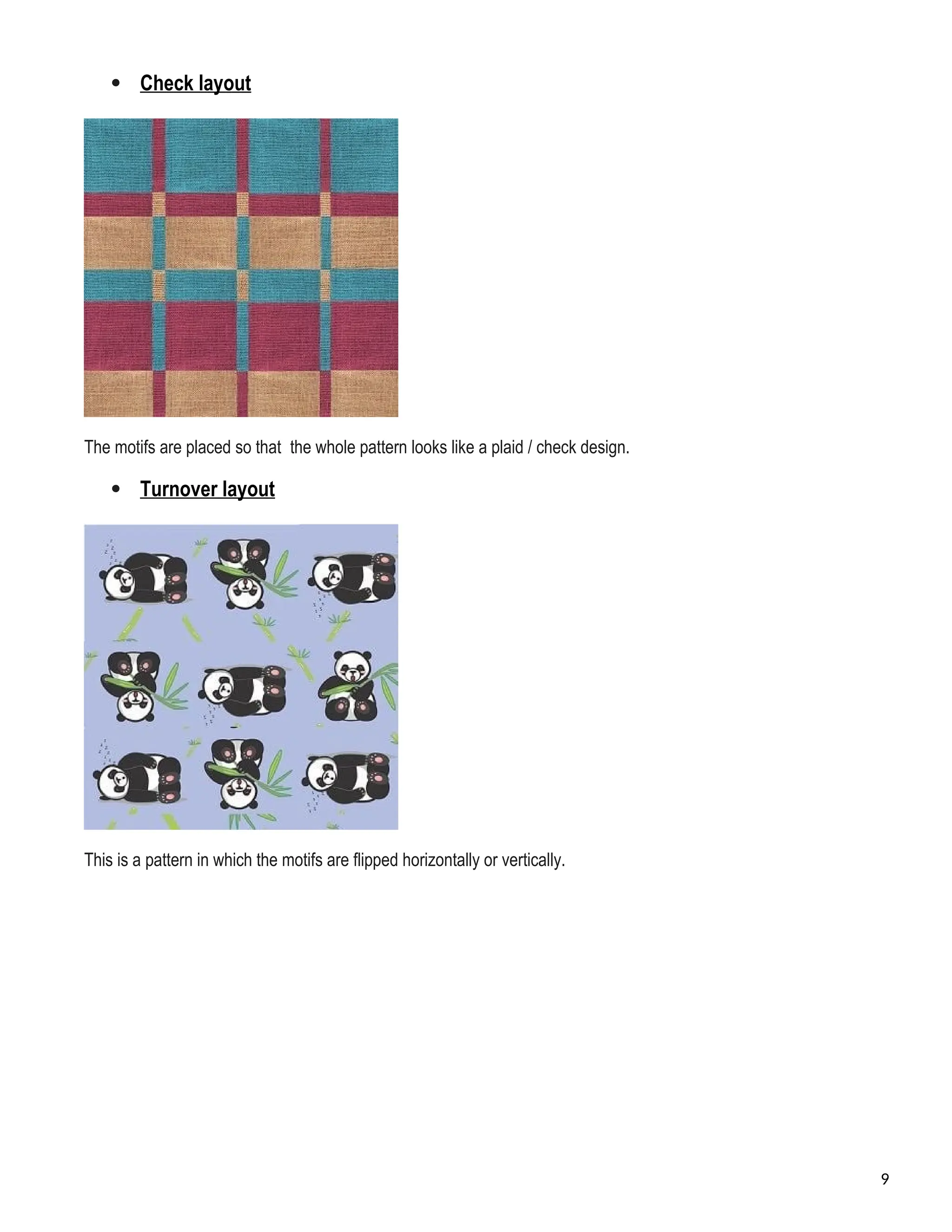
 Diamond layout
In this motifs are placed in a pattern resembling a diamond shape.
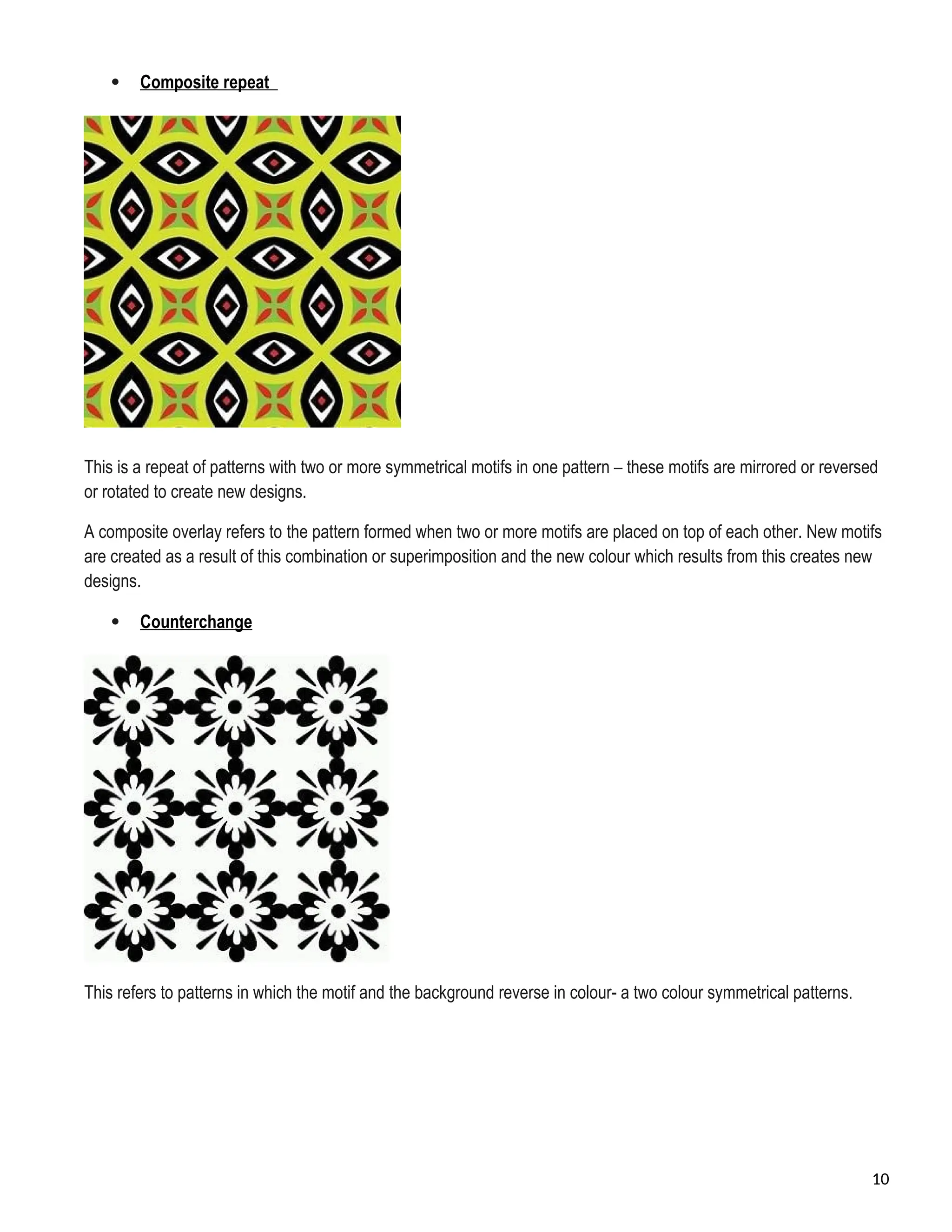
 Striped layout
In this layout motifs are arranged in a line across the fabric; it could be vertical, horizontal or diagonal.
8
 Check layout
The motifs are placed so that the whole pattern looks like a plaid / check design.
 Turnover layout
This is a pattern in which the motifs are flipped horizontally or vertically.
9
 Composite repeat
This is a repeat of patterns with two or more symmetrical motifs in one pattern – these motifs are mirrored or reversed
or rotated to create new designs.
A composite overlay refers to the pattern formed when two or more motifs are placed on top of each other. New motifs
are created as a result of this combination or superimposition and the new colour which results from this creates new
designs.
 Counterchange
This refers to patterns in which the motif and the background reverse in colour- a two colour symmetrical patterns.
10
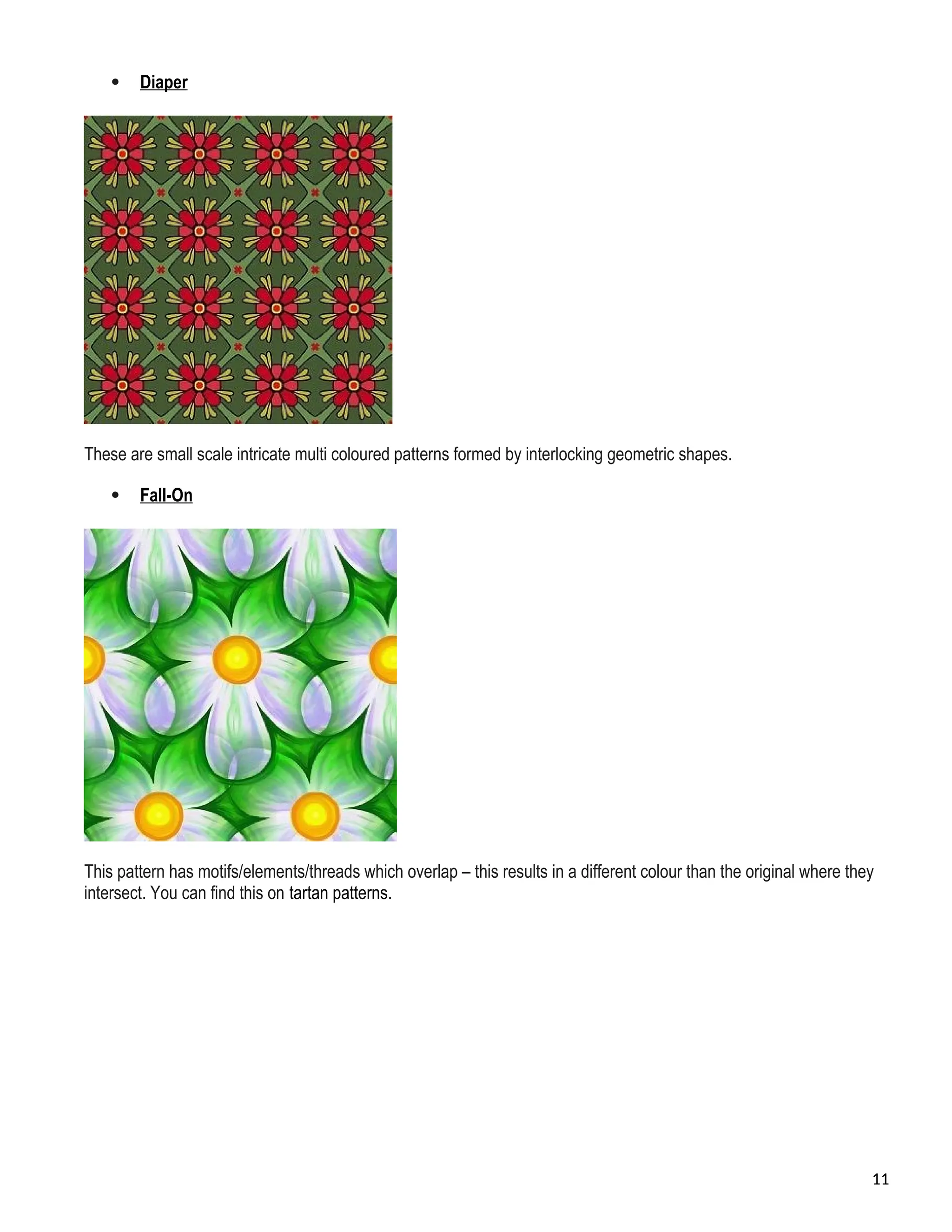
 Diaper
These are small scale intricate multi coloured patterns formed by interlocking geometric shapes.
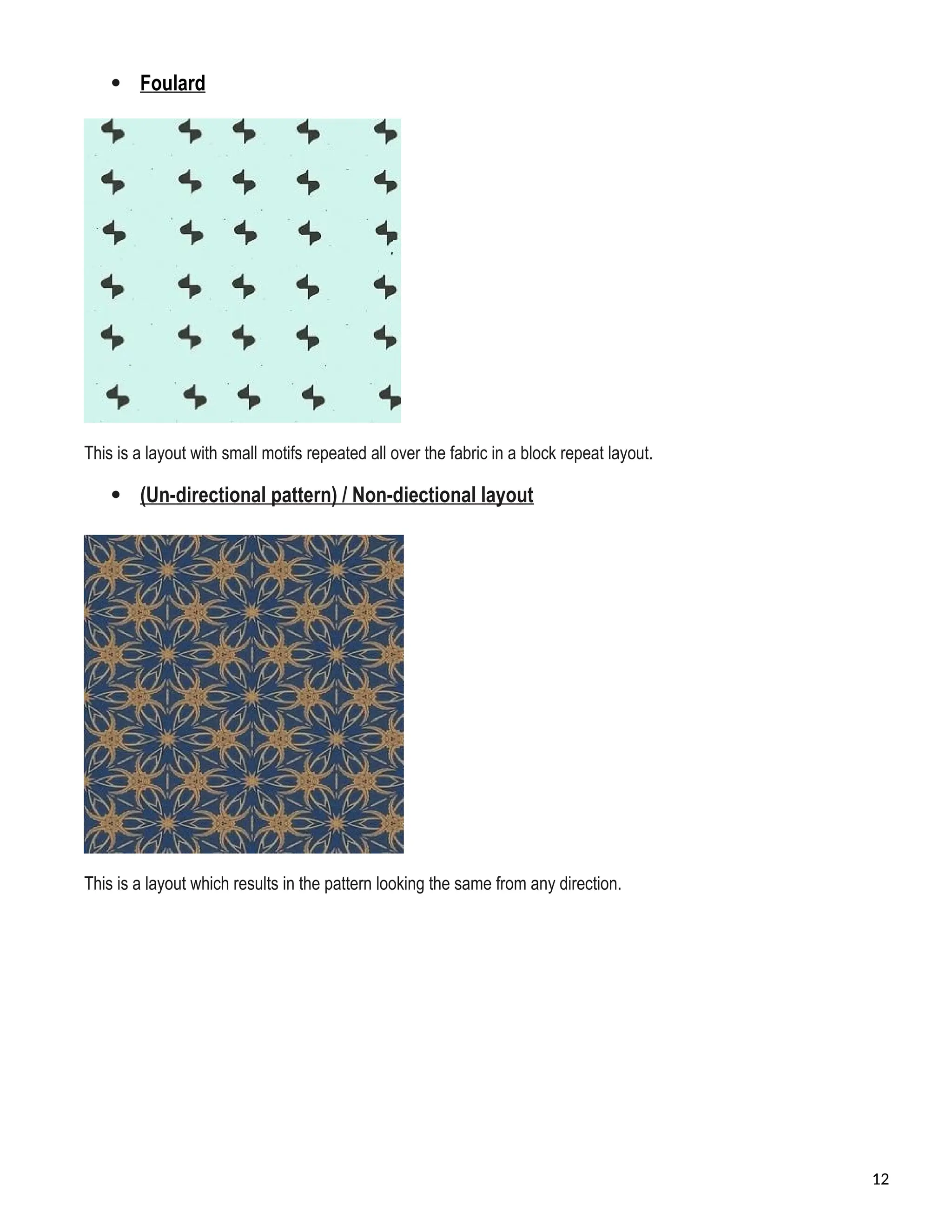
 Fall-On
This pattern has motifs/elements/threads which overlap – this results in a different colour than the original where they
intersect. You can find this on tartan patterns.
11
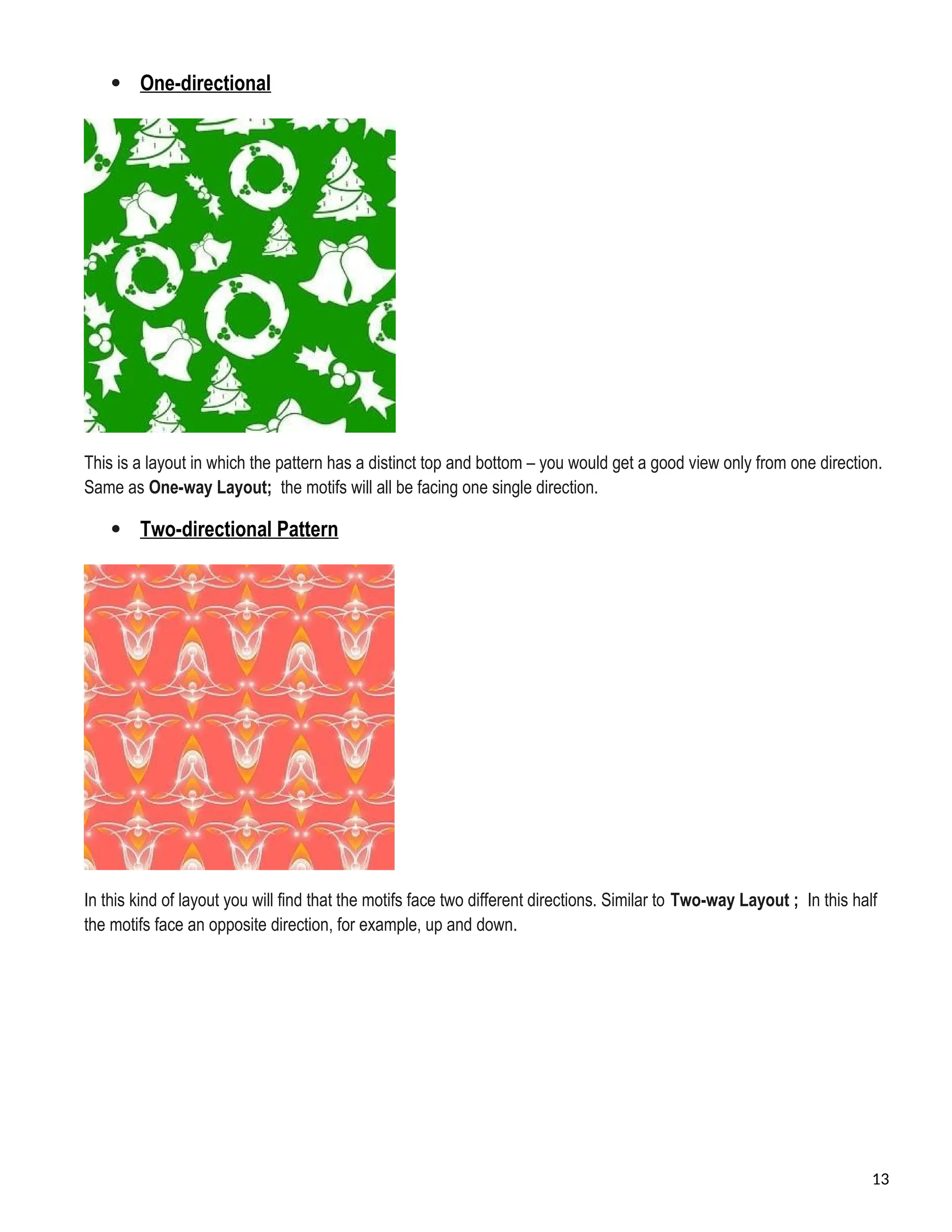
 Foulard
This is a layout with small motifs repeated all over the fabric in a block repeat layout.
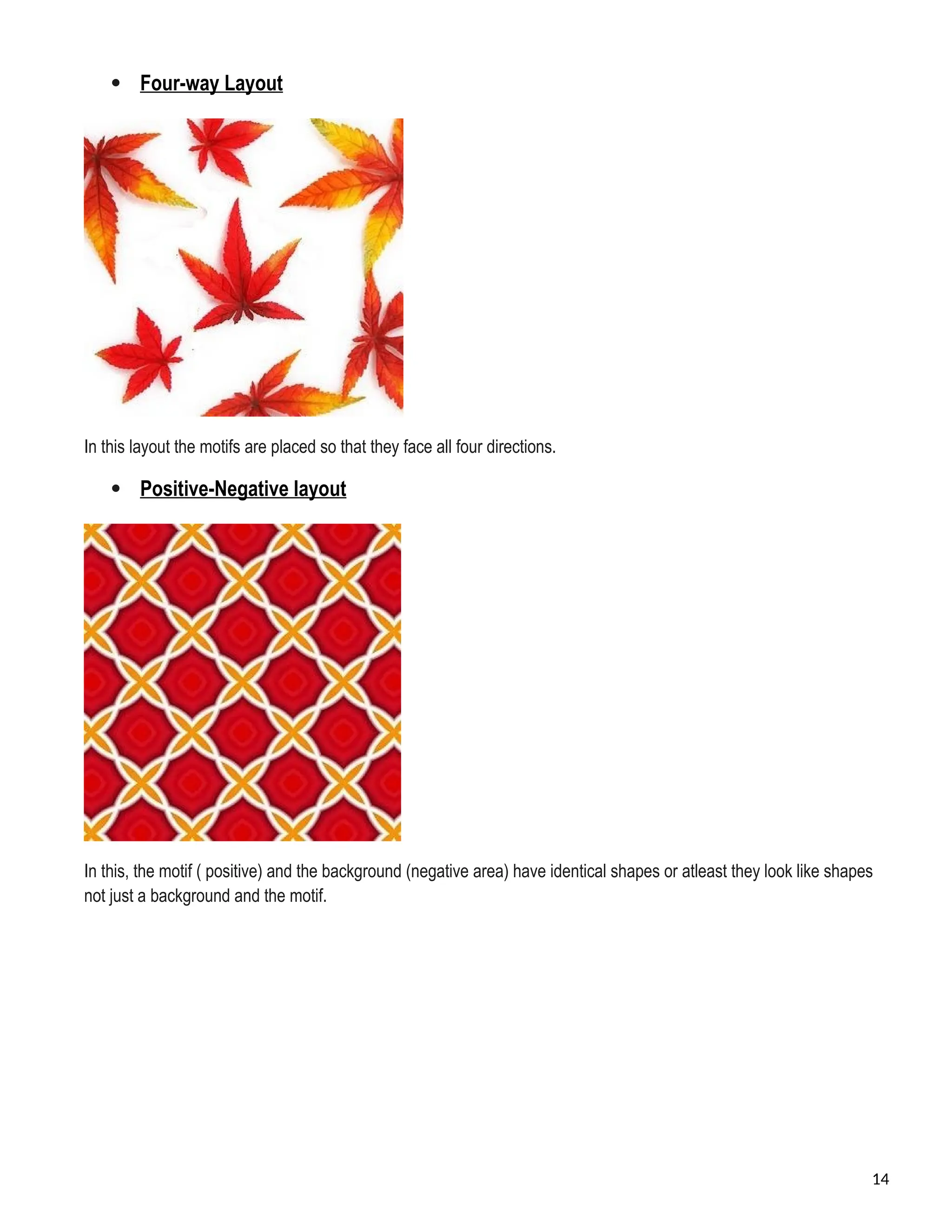
 (Un-directional pattern) / Non-diectional layout
This is a layout which results in the pattern looking the same from any direction.
12
 One-directional
This is a layout in which the pattern has a distinct top and bottom – you would get a good view only from one direction.
Same as One-way Layout; the motifs will all be facing one single direction.
 Two-directional Pattern
In this kind of layout you will find that the motifs face two different directions. Similar to Two-way Layout ; In this half
the motifs face an opposite direction, for example, up and down.
13
 Four-way Layout
In this layout the motifs are placed so that they face all four directions.
 Positive-Negative layout
In this, the motif ( positive) and the background (negative area) have identical shapes or atleast they look like shapes
not just a background and the motif.
14
 Freize pattern layout
A frieze pattern is an infinite strip with a repeating pattern. This pattern repeats in only one direction and is usually
used as a border design.
 Gradation pattern
This pattern type has motifs of different sizes and/or shades of colours.
15
 Interlocking Pattern
In this layout the motifs are linked together or connected to each other in someway or the other.
 Packed
This is a layout in which the motifs are placed close together.
 Asymmetrical layout
This is a layout in which you will not find any symmetry in the
placement of motifs or the motifs themselves – no rhyme or reason
why they are arranged the way they are but can be as equally
captivating as any carefully planned motif placements.
 Placement print
This is not a repeat as such but this is a kind of placement of fabric pattern such that a strong motif or design is formed
and it is usually the highlight of the clothing.
16
Fabric Designers do not consider these layouts in isolation – they are
most of the time overlapped – a single pattern can have many of these
elements in it.
For a harmonious look to your fabric design, scale, alignment, and
balance are very important. The pattern repeats have to be easily
replicable in the fabric production process.
Usually a fabric design consists of mixing and matching different
patterns. Designers combine different patterns, scales, and colors
within a single fabric collection that appeals to different consumer
preferences. Creating seamless and visually appealing pattern repeats
for textiles is not so easy – but the high end softwares available today
results in quite intricate and vibrant designs when combined with the
ingenuity of the designer.
17
Types of pattern repeats and for printing in sue in textile design.docx

  • 1.
    Types of patternrepeats Straight Repeat This is the most basic layout where the motif repeats out directly in a horizontal line to the left or right, or the original motif. FULL DROP/BLOCK PATTERN REPEAT One of the most common and simplest of all repeat systems is the full drop or block surface pattern repeat. The repeat unit is created by stacking the original repeat block in a grid format. Although it’s often created as a square unit, full drop repeats can also be rectangular. HALF DROP PATTERN REPEAT Another very commonly used surface pattern repeat is the half drop. It consists of the repeat unit being stacked vertically in a column format which is then offset by half in the next vertical row. Because of this, half drop pattern repeats are a great way at quickly allowing the design to look less formal. BRICK PATTERN REPEAT Just like the half drop, the brick repeat unit is also very commonly used in surface pattern repeats. It’s very similar to the half drop pattern repeat except instead of the repeat unit being stacked vertically in a column format, it is stacked horizontally. The repeat unit is then offset by half in the next horizontal row resembling a brick wall. As a result, just like with the half drop pattern repeats, brick repeats allow a design to look less formal. 1
  • 2.
    DIAMOND PATTERN REPEAT Adiamond surface pattern repeat is simply created with a repeating diamond shape this therefore results in the elements being arranged in diagonal rows. OGEE PATTERN REPEAT An ogee surface pattern repeat is similar to the diamond repeat except it has rounded edges at the sides and points at the top and bottom, much like an onion. TOSSED/ RANDOM PATTERN REPEAT In a tossed/random surface pattern repeat, the elements of the design are scattered within the repeat unit. The unstructured nature of a tossed repeat results in a very organic and non-linear design. 2
  • 3.
    STRIPE PATTERN REPEAT Thestripe surface pattern repeat is a layout that has a strong vertical, horizontal or diagonal format. Stripes don’t need to be restricted to being made up of blocks of colour. Some other ways to use stripes include blocks of texture, patterns, repeated motifs, zig zags or wavy lines. Choosing the right pattern repeat for your design will depend on what sort of look and feel you are after. The great thing is once you have your motifs, you can keep experimenting with the different repeat layouts until you get the result that you are after. 25 types of Pattern Repeats in Fabric Designs The job of a textile designer is so fascinating – ideating and creating beautiful prints and patterns on fabrics all day long. After all, Textile design is the art of designing those prints and patterns on fabrics. A textile designer creates patterns keeping in mind current trends, style specifications, motifs, their own drawings, colors as well as the technical and ethical and cultural considerations and then communicates it via the medium of textiles. But how do they arrange these patterns?. In most fabric designs, there are many types of repeat patterns. The innovative and creative way of arranging the prints and patterns that form the crux of textile design. Replication of these patterns across fabric is done in a seamless way. How do they get it right every time? Are they randomly placed or are they the result of deliberate planning? As a layman, How can I decipher these prints and patterns in a language I can understand, and still make it visually appealing? These are all questions that came to me when I was writing about the types of fabric patterns First and foremost, there are many industry standards that these patterns should adhere to. Then there are considerations like the use of the fabric (whether it is apparel fabric, 3
  • 4.
    furnishing textile etc)and the type of the fabric itself (whether it is woven or knitted etc.). Then finally comes the task of arranging the motifs. In all patterns and prints on textiles, you will find there is a repeat – ie the identical or dissimilar motifs are arranged with horizontal or vertical distance between them in a repeated manner. There are infinite ways of arranging these repeats on the fabric – but some basic layouts are commonly used individually or collectively to form the patterns that you see on fabrics Types of Pattern Repeats.  Types of Pattern Repeats.  Allover layout (Overall)  Block Repeat  Tossed layout  Border layout  Brick Layout  Half-drop repeat layout  Diamond layout  Striped layout  Check layout  Turnover layout  Composite repeat  Counterchange  Diaper  Fall-On  Foulard  One-directional  Two-directional Pattern  Four-way Layout  Positive-Negative layout  Freize pattern layout  Gradation pattern  Interlocking Pattern  Packed  Asymmetrical layout  Placement print 4
  • 5.
    25 classifications ofpatterns in textile designs according to the arrangement of motifs in the pattern  Allover layout (Overall) Allover basically means covering the whole extent or surface. This is a layout with motifs distributed all over the fabric – Here the motifs are randomly placed with regular or irregular spacing between them, but usually very close to each other and facing different directions  Block Repeat (other names are Basic repeat, Full drop repeat, Square Repeat, Straight-across repeat, straight repeat) In this type of repeat, the motifs are placed directly on a horizontal line to the left or right of the original motif. ie they are laid up and down and/or side to side. It is the most simple layout; when complete, it looks as if the motifs are stacked in an imaginary grid. 5
  • 6.
     Tossed layout (Othernames random layout or irregular pattern layout) In this layout the motifs are scattered randomly; there is no symmetry or any formal arrangement to the motifs; the motifs are placed in a repeating fashion but without a specific plan or calculation.  Border layout This is designed so that the motifs are placed on the edge of the fabric. 6
  • 7.
     Brick Layout Thisis a layout in which every second row is placed halfway to the front – it looks like the way bricks are laid out on the brick wall. ( Sometimes called Half-brick layout as well).  Half-drop repeat layout This repeat pattern is a very popular layout in fabric pattern design. In half drop repeat pattern, the motif is repeated vertically such that the motif on the next column is placed down half of the length of the motif above it ie motif is repeated halfway down the side in the vertical direction. The end result is a pattern that steps downwards each row. In a half drop layout, the repeat can be said to be staggered vertically or horizontally. 7
  • 8.
     Diamond layout Inthis motifs are placed in a pattern resembling a diamond shape.  Striped layout In this layout motifs are arranged in a line across the fabric; it could be vertical, horizontal or diagonal. 8
  • 9.
     Check layout Themotifs are placed so that the whole pattern looks like a plaid / check design.  Turnover layout This is a pattern in which the motifs are flipped horizontally or vertically. 9
  • 10.
     Composite repeat Thisis a repeat of patterns with two or more symmetrical motifs in one pattern – these motifs are mirrored or reversed or rotated to create new designs. A composite overlay refers to the pattern formed when two or more motifs are placed on top of each other. New motifs are created as a result of this combination or superimposition and the new colour which results from this creates new designs.  Counterchange This refers to patterns in which the motif and the background reverse in colour- a two colour symmetrical patterns. 10
  • 11.
     Diaper These aresmall scale intricate multi coloured patterns formed by interlocking geometric shapes.  Fall-On This pattern has motifs/elements/threads which overlap – this results in a different colour than the original where they intersect. You can find this on tartan patterns. 11
  • 12.
     Foulard This isa layout with small motifs repeated all over the fabric in a block repeat layout.  (Un-directional pattern) / Non-diectional layout This is a layout which results in the pattern looking the same from any direction. 12
  • 13.
     One-directional This isa layout in which the pattern has a distinct top and bottom – you would get a good view only from one direction. Same as One-way Layout; the motifs will all be facing one single direction.  Two-directional Pattern In this kind of layout you will find that the motifs face two different directions. Similar to Two-way Layout ; In this half the motifs face an opposite direction, for example, up and down. 13
  • 14.
     Four-way Layout Inthis layout the motifs are placed so that they face all four directions.  Positive-Negative layout In this, the motif ( positive) and the background (negative area) have identical shapes or atleast they look like shapes not just a background and the motif. 14
  • 15.
     Freize patternlayout A frieze pattern is an infinite strip with a repeating pattern. This pattern repeats in only one direction and is usually used as a border design.  Gradation pattern This pattern type has motifs of different sizes and/or shades of colours. 15
  • 16.
     Interlocking Pattern Inthis layout the motifs are linked together or connected to each other in someway or the other.  Packed This is a layout in which the motifs are placed close together.  Asymmetrical layout This is a layout in which you will not find any symmetry in the placement of motifs or the motifs themselves – no rhyme or reason why they are arranged the way they are but can be as equally captivating as any carefully planned motif placements.  Placement print This is not a repeat as such but this is a kind of placement of fabric pattern such that a strong motif or design is formed and it is usually the highlight of the clothing. 16
  • 17.
    Fabric Designers donot consider these layouts in isolation – they are most of the time overlapped – a single pattern can have many of these elements in it. For a harmonious look to your fabric design, scale, alignment, and balance are very important. The pattern repeats have to be easily replicable in the fabric production process. Usually a fabric design consists of mixing and matching different patterns. Designers combine different patterns, scales, and colors within a single fabric collection that appeals to different consumer preferences. Creating seamless and visually appealing pattern repeats for textiles is not so easy – but the high end softwares available today results in quite intricate and vibrant designs when combined with the ingenuity of the designer. 17