Types of Network
By:
Vaibhav Madaan
What is a Network?
• A computer network is essentially a
group of computers that are
connected to each other so that they
can share information and files
amongst each other
• A computer network can consist of just
two computers all the way up to
thousands.
Types of Networks
Computer networks can be characterized by their size
as well as their purpose.
The size of a network can be expressed by the
geographic area they occupy and the number of
computers that are part of the network.
Networks can cover anything from a handful of devices
within a single room to millions of devices spread across
the entire globe.
Categorization based on size
• · Local-area networks (LANs): The computers are
geographically close together (that is, in the same building).
• · Wide-area networks (WANs): The computers are farther apart
and are connected by telephone lines or radio waves.
• · Campus-area networks (CANs): The computers are within a
limited geographic area, such as a campus or military base.
• · Metropolitan-area networks MANs): A data network
designed for a town or city.
• · Home-area networks (HANs): A network contained within a
user's home that connects a person's digital devices.
Networks based on their main
purpose
 Storage area network(SAN)- A storage-area network
(SAN) is a dedicated high-speed network (or sub network)
that interconnects and presents shared pools of storage
devices to multiple servers.
 Enterprise private network(EPN)- An EPN is a computer
network that is entirely controlled by one organization, and
it is used to connect multiple locations.
 Virtual private network(VPN)- A VPN is used to connect
to a private network, such as a company's internal network.
Networks in Companies
Business Networks and the Internet
The Internet is a global network of networks. A business can set up virtual private
network (VPN) servers to support remote access , with employees' computers
configured to use matching VPN client software and security settings.
Intranets and Extranets
Companies can set up internal Web servers to share private business information with
employees. They may also put in place internal email, instant messaging (IM) and other
private communication systems. Together these systems make a business Intranet.
Advanced business networks also allow sharing certain controlled data between
companies. These are called Extranets or business-to-business (B2B) networks, these
communication systems involve remote access methods and/or log-in protected Web
sites.
Business Network Security
Companies employ centralized sign-on security systems.
Use of Networks in Large companies
Hundreds of local area networks (LANs) linked to
firm wide corporate network
Corporate Intranet, Extranet
Backend systems
Mobile wireless LANs (Wi-Fi networks)
Video conferencing system
Telephone network ( handle voice data)
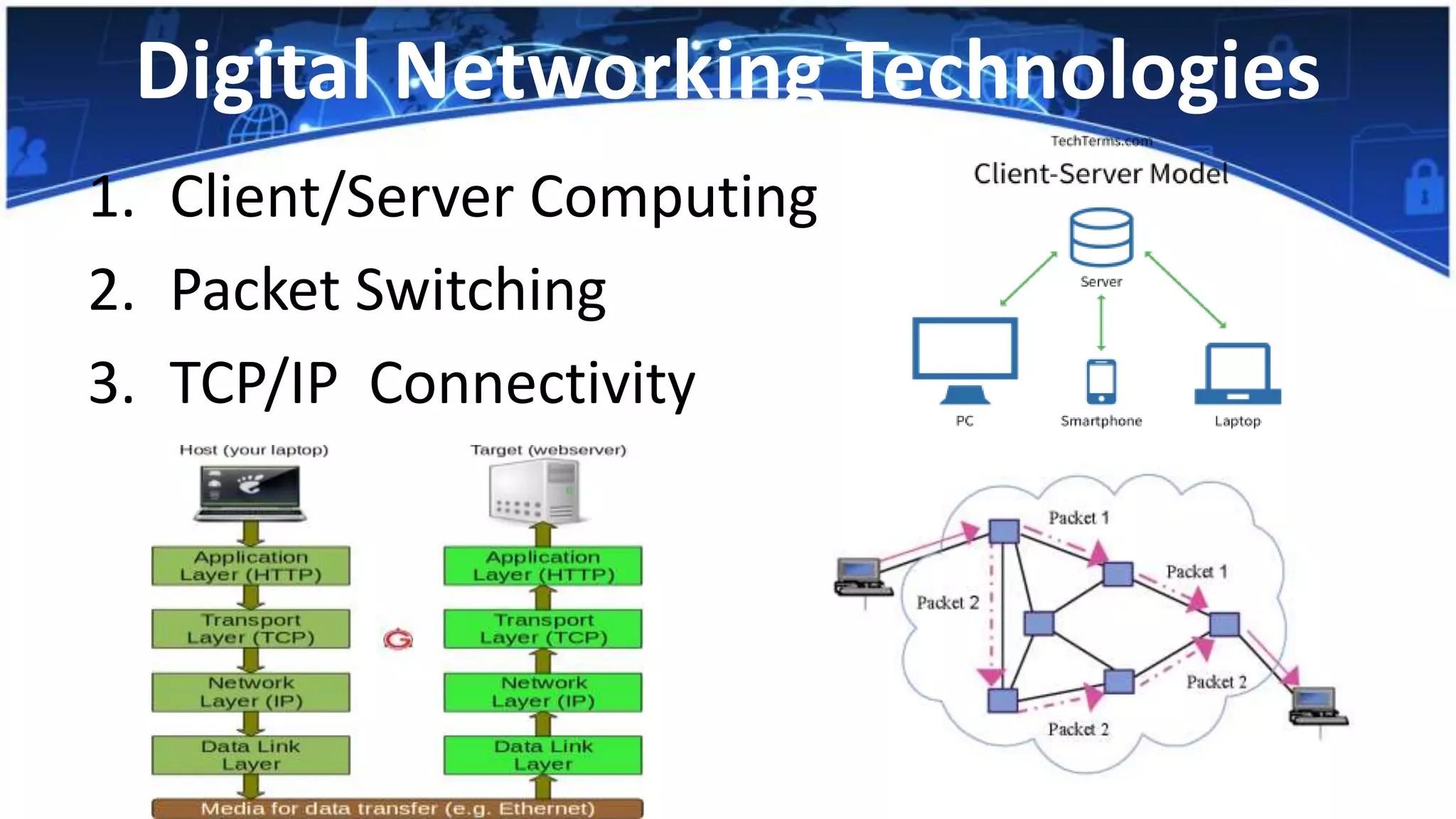
Digital Networking Technologies
1. Client/Server Computing
2. Packet Switching
3. TCP/IP Connectivity
VMWare Airwatch
Vmware lets you run multiple virtual machines on a single physical machine,
with each virtual machine sharing the resources of that one physical computer
across multiple environments. Different virtual machines can run different
operating systems and multiple applications on the same physical computer.
AirWatch serves the administrative area dealing with deploying, securing,
monitoring, integrating and managing mobile devices, such as smartphones,
tablets and notebooks, in the workplace.
Mobility Management
Support every endpoint and every user from a single management console.
Hence provides a solution for mobility management.
Mobile Productivity
Keep employees connected and able to work anytime, anywhere, on any device,
which helps to increase productivity for the organization.
Enterprise Security
Security at every layer for complete protection of the corporate data.
Taggle Solutions
Taggle’s low power wide area (LPWA) radio network offers low-cost,
low-power, long range communications for many types of sensors and
devices.
Taggle deploys Australia’s only dedicated m2m (machine-to-machine)
network to enable the cost-effective collection of data from thousands of
devices across very wide areas.
Radio networks consist of one or more highly sensitive radio receivers
located strategically in an area and very low-cost battery powered
transmitters fitted to end user devices such as water, gas or electricity
meters, environmental sensors and security devices.
The wireless networks contribute to the Internet of Things (IoT) which is
basically an infrastructure that enables networks to gather data from
millions of devices and all sorts of sensors.
Li-Fi
Li-Fi is a wireless optical networking technology that uses light-emitting
diodes (LEDs) for data transmission.
Li-Fi is designed to use LED light bulbs similar to those currently in use in
many energy-conscious homes and offices.
However, Li-Fi bulbs are outfitted with a chip that modulates the light
imperceptibly for optical data transmission.
Li-Fi data is transmitted by the LED bulbs and received by photoreceptors.
Li-Fi vs Wi-Fi
Li-Fi can be thought of as a light-based Wi-Fi. That is, it uses light instead
of radio waves to transmit information.
Instead of Wi-Fi modems, Li-Fi would use transceiver-fitted LED lamps
that can light a room as well as transmit and receive information.
Wi-Fi is great for general wireless coverage within building and Li-Fi is
ideal for high density wireless data coverage in confined area and for
relieving radio interference issues.
The two technologies can be considered complimentary.
How does Li-Fi work?
Conclusion
Types of networks penetrate the business
world in varied ways.
Connectivity, Speed & Security of networks are
going to increase manifold in the future.

Types of network

  • 1.
  • 2.
    What is aNetwork? • A computer network is essentially a group of computers that are connected to each other so that they can share information and files amongst each other • A computer network can consist of just two computers all the way up to thousands.
  • 3.
    Types of Networks Computernetworks can be characterized by their size as well as their purpose. The size of a network can be expressed by the geographic area they occupy and the number of computers that are part of the network. Networks can cover anything from a handful of devices within a single room to millions of devices spread across the entire globe.
  • 4.
    Categorization based onsize • · Local-area networks (LANs): The computers are geographically close together (that is, in the same building). • · Wide-area networks (WANs): The computers are farther apart and are connected by telephone lines or radio waves. • · Campus-area networks (CANs): The computers are within a limited geographic area, such as a campus or military base. • · Metropolitan-area networks MANs): A data network designed for a town or city. • · Home-area networks (HANs): A network contained within a user's home that connects a person's digital devices.
  • 5.
    Networks based ontheir main purpose  Storage area network(SAN)- A storage-area network (SAN) is a dedicated high-speed network (or sub network) that interconnects and presents shared pools of storage devices to multiple servers.  Enterprise private network(EPN)- An EPN is a computer network that is entirely controlled by one organization, and it is used to connect multiple locations.  Virtual private network(VPN)- A VPN is used to connect to a private network, such as a company's internal network.
  • 6.
    Networks in Companies BusinessNetworks and the Internet The Internet is a global network of networks. A business can set up virtual private network (VPN) servers to support remote access , with employees' computers configured to use matching VPN client software and security settings. Intranets and Extranets Companies can set up internal Web servers to share private business information with employees. They may also put in place internal email, instant messaging (IM) and other private communication systems. Together these systems make a business Intranet. Advanced business networks also allow sharing certain controlled data between companies. These are called Extranets or business-to-business (B2B) networks, these communication systems involve remote access methods and/or log-in protected Web sites. Business Network Security Companies employ centralized sign-on security systems.
  • 7.
    Use of Networksin Large companies Hundreds of local area networks (LANs) linked to firm wide corporate network Corporate Intranet, Extranet Backend systems Mobile wireless LANs (Wi-Fi networks) Video conferencing system Telephone network ( handle voice data)
  • 8.
    Digital Networking Technologies 1.Client/Server Computing 2. Packet Switching 3. TCP/IP Connectivity
  • 9.
    VMWare Airwatch Vmware letsyou run multiple virtual machines on a single physical machine, with each virtual machine sharing the resources of that one physical computer across multiple environments. Different virtual machines can run different operating systems and multiple applications on the same physical computer. AirWatch serves the administrative area dealing with deploying, securing, monitoring, integrating and managing mobile devices, such as smartphones, tablets and notebooks, in the workplace. Mobility Management Support every endpoint and every user from a single management console. Hence provides a solution for mobility management. Mobile Productivity Keep employees connected and able to work anytime, anywhere, on any device, which helps to increase productivity for the organization. Enterprise Security Security at every layer for complete protection of the corporate data.
  • 10.
    Taggle Solutions Taggle’s lowpower wide area (LPWA) radio network offers low-cost, low-power, long range communications for many types of sensors and devices. Taggle deploys Australia’s only dedicated m2m (machine-to-machine) network to enable the cost-effective collection of data from thousands of devices across very wide areas. Radio networks consist of one or more highly sensitive radio receivers located strategically in an area and very low-cost battery powered transmitters fitted to end user devices such as water, gas or electricity meters, environmental sensors and security devices. The wireless networks contribute to the Internet of Things (IoT) which is basically an infrastructure that enables networks to gather data from millions of devices and all sorts of sensors.
  • 12.
    Li-Fi Li-Fi is awireless optical networking technology that uses light-emitting diodes (LEDs) for data transmission. Li-Fi is designed to use LED light bulbs similar to those currently in use in many energy-conscious homes and offices. However, Li-Fi bulbs are outfitted with a chip that modulates the light imperceptibly for optical data transmission. Li-Fi data is transmitted by the LED bulbs and received by photoreceptors.
  • 13.
    Li-Fi vs Wi-Fi Li-Fican be thought of as a light-based Wi-Fi. That is, it uses light instead of radio waves to transmit information. Instead of Wi-Fi modems, Li-Fi would use transceiver-fitted LED lamps that can light a room as well as transmit and receive information. Wi-Fi is great for general wireless coverage within building and Li-Fi is ideal for high density wireless data coverage in confined area and for relieving radio interference issues. The two technologies can be considered complimentary.
  • 14.
  • 15.
    Conclusion Types of networkspenetrate the business world in varied ways. Connectivity, Speed & Security of networks are going to increase manifold in the future.