Software Analysis and
Testing
SEC5261
Week 11
Murtaza Munawar Fazal
Type Systems
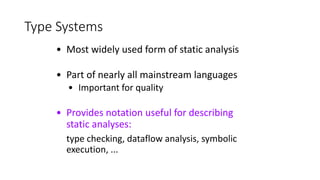
Type Systems
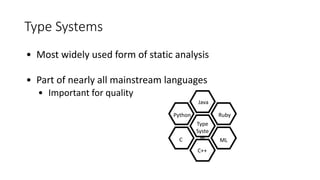
• Most widely used form of static analysis
• Part of nearly all mainstream languages
• Important for quality
Type
Syste
m
Java
Python
C
C++
ML
Ruby
Motivation
prompt$ javac T.java
T.java:4: error: incompatible types
if (a)
^
required: boolean
found: float
T.java:7: error: incompatible types
return c;
^
required: int
found: int[]
2 errors
1: class T {
2: int f(float a, int b,
3: int[] c) {
4: if (a)
5: return b;
6: else
7: return c;
8: }
9: }
File T.java
Type Systems
• Most widely used form of static analysis
• Part of nearly all mainstream languages
• Important for quality
• Provides notation useful for describing
static analyses:
type checking, dataflow analysis, symbolic
execution, ...
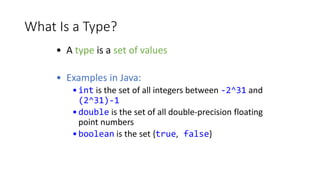
What Is a Type?
• A type is a set of values
• Examples in Java:
•int is the set of all integers between -2^31 and
(2^31)-1
•double is the set of all double-precision floating
point numbers
•boolean is the set {true, false}
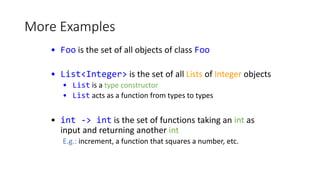
More Examples
• Foo is the set of all objects of class Foo
• List<Integer> is the set of all Lists of Integer objects
• List is a type constructor
• List acts as a function from types to types
• int -> int is the set of functions taking an int as
input and returning another int
E.g.: increment, a function that squares a number, etc.
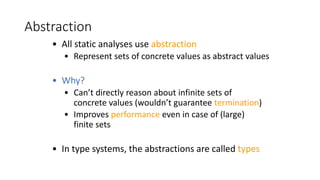
Abstraction
• All static analyses use abstraction
• Represent sets of concrete values as abstract values
• Why?
• Can’t directly reason about infinite sets of
concrete values (wouldn’t guarantee termination)
• Improves performance even in case of (large)
finite sets
• In type systems, the abstractions are called types
What Is a Type?
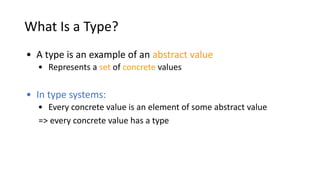
• A type is an example of an abstract value
• Represents a set of concrete values
• In type systems:
• Every concrete value is an element of some abstract value
=> every concrete value has a type
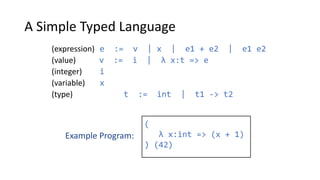
A Simple Typed Language
(expression) e := v | x | e1 + e2 | e1 e2
(value) v := i | λ x:t => e
(integer) i
(variable) x
(type) t := int | t1 -> t2
(
λ x:int => (x + 1)
) (42)
Example Program:
The Next Steps
• Notation for Type Systems
• Properties of Type Systems
• Describing Other Analyses Using Types
Notation
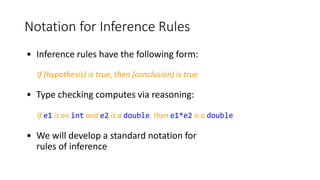
Notation for Inference Rules
• Inference rules have the following form:
If (hypothesis) is true, then (conclusion) is true
• Type checking computes via reasoning:
If e1 is an int and e2 is a double, then e1*e2 is a double
• We will develop a standard notation for
rules of inference
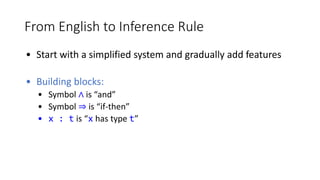
From English to Inference Rule
• Start with a simplified system and gradually add features
• Building blocks:
• Symbol ∧ is “and”
• Symbol ⇒ is “if-then”
• x : t is “x has type t”
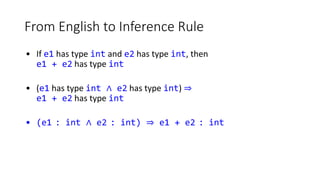
From English to Inference Rule
• If e1 has type int and e2 has type int, then
e1 + e2 has type int
• (e1 has type int ∧ e2 has type int) ⇒
e1 + e2 has type int
• (e1 : int ∧ e2 : int) ⇒ e1 + e2 : int
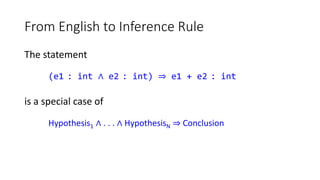
From English to Inference Rule
The statement
(e1 : int ∧ e2 : int) ⇒ e1 + e2 : int
is a special case of
Hypothesis1 ∧ . . . ∧ HypothesisN ⇒ Conclusion
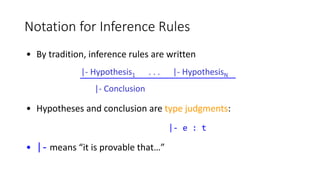
Notation for Inference Rules
• By tradition, inference rules are written
|- Hypothesis1 . . . |- HypothesisN
|- Conclusion
• Hypotheses and conclusion are type judgments:
|- e : t
• |- means “it is provable that…”
Rules for Integers
|- i : int
|- e1 : int |- e2 : int
|- e1 + e2 : int
[Int]
[Add]
Rules for Integers
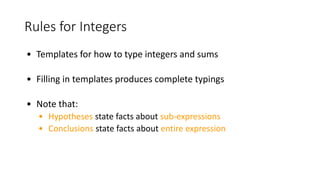
• Templates for how to type integers and sums
• Filling in templates produces complete typings
• Note that:
• Hypotheses state facts about sub-expressions
• Conclusions state facts about entire expression
Example: 1 + 2
|- 1 : int
|- 1+2 : int
[Int] [Int]
[Add]
|- 2 : int
A Problem
What is the type of a variable reference?
[Var]
Doesn’t carry enough
information to give x a type
|- e + e : int
Carries type information
for e in hypotheses
|- e : int
|- x : ?
A Solution
• Put more information in the rules!
• An environment gives types for free variables
• A variable is free in an expression if not defined
within the expression; otherwise it is bound
• An environment is a function from variables to types
• May map variables to other abstract values in
different static analyses
[Var]
|- x : ?
Type Environments
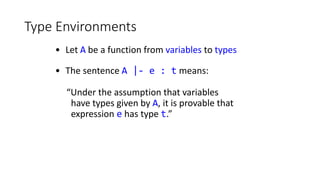
• Let A be a function from variables to types
• The sentence A |- e : t means:
“Under the assumption that variables
have types given by A, it is provable that
expression e has type t.”
Modified Rules
• The type environment is added to all rules:
A |- e1 : int A |- e2 : int
A |- e1 + e2 : int
A |- i : int [Int]
[Add]
A New Rule
• And we can write new rules:
A |- x : A(x)
[Var]
Rules for Functions
A |- e : t’
A |- λ x:t => e : t -> t’
A |- e1 : t1 -> t2 A |- e2 : t1
A |- e1 e2 : t2
A[x↦t] means “A modified to map x to type t”
[x↦t]
[Def]
[Call]
All Rules Together
A |- i : int
A [x↦t] |- e : t’
A |- λ x:t => e : t -> t’
[Def]
A |- e1 : int A |- e2 : int
A |- e1 + e2 : int
[Add]
[Int]
A |- x : A(x)
[Var]
A |- e1 : t1 -> t2 A |- e2 : t1
A |- e1 e2 : t2
[Call]
Type Derivations: Example
[x↦int] |- x : int [x↦int] |- 1 : int
[x↦int] |- x + 1 : int
[] |- λ x:int => (x + 1) : int -> int [] |- 42 : int
[] |- (λ x:int => (x + 1)) (42) : int [Call]
[Int]
[Def]
[Var] [Int]
[Add]
Type Derivations: Example
[x↦int] |- x : int [x↦int] |- 1 : int
[x↦int] |- x + 1 : int
[] |- λ x:int => (x + 1) : int -> int [] |- 42 : int
[] |- (λ x:int => (x + 1)) (42) : int [Call]
[Int]
[Def]
[Var] [Int]
[Add]
Back to the Original Example
prompt$ javac T.java
T.java:4: error: incompatible types
if (a)
^
required: boolean
found: float
T.java:7: error: incompatible types
return c;
^
required: int
found: int[]
2 errors
1: class T {
2: int f(float a, int b,
3: int[] c) {
4: if (a)
5: return b;
6: else
7: return c;
8: }
9: }
File T.java
A More Complex Rule
A |- e0 : bool
A |- e1 : t1
A |- e2 : t2
t1 = t2
A |- if e0 then e1 else e2 : t1
[If-Then-Else]
We’ll use this rule to illustrate several ideas . . .
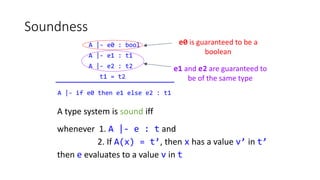
A |- e0 : bool
A |- e1 : t1
A |- e2 : t2
t1 = t2
A |- if e0 then e1 else e2 : t1
Soundness
A type system is sound iff
whenever 1. A |- e : t and
2. If A(x) = t’, then x has a value v’ in t’
then e evaluates to a value v in t
e0 is guaranteed to be a
boolean
e1 and e2 are guaranteed to
be of the same type
Comments on Soundness
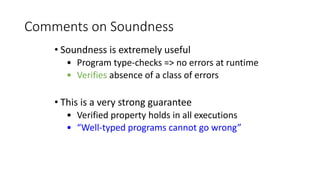
• Soundness is extremely useful
• Program type-checks => no errors at runtime
• Verifies absence of a class of errors
• This is a very strong guarantee
• Verified property holds in all executions
• “Well-typed programs cannot go wrong”
Comments on Soundness
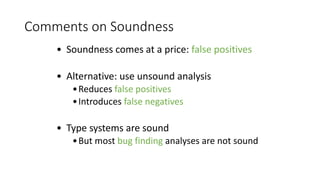
• Soundness comes at a price: false positives
• Alternative: use unsound analysis
•Reduces false positives
•Introduces false negatives
• Type systems are sound
•But most bug finding analyses are not sound
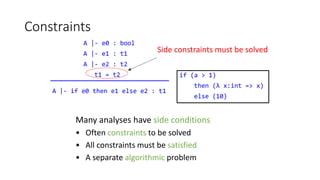
Constraints
A |- e0 : bool
A |- e1 : t1
A |- e2 : t2
t1 = t2
A |- if e0 then e1 else e2 : t1
if (a > 1)
then (λ x:int => x)
else (10)
Many analyses have side conditions
• Often constraints to be solved
• All constraints must be satisfied
• A separate algorithmic problem
Side constraints must be solved
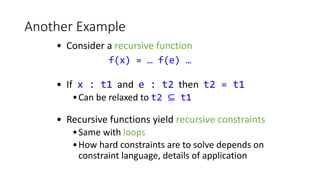
Another Example
• Consider a recursive function
f(x) = … f(e) …
• If x : t1 and e : t2 then t2 = t1
•Can be relaxed to t2 ⊆ t1
• Recursive functions yield recursive constraints
•Same with loops
•How hard constraints are to solve depends on
constraint language, details of application

Software analysis and testing

  • 1.
  • 2.
  • 3.
    Type Systems • Mostwidely used form of static analysis • Part of nearly all mainstream languages • Important for quality Type Syste m Java Python C C++ ML Ruby
  • 4.
    Motivation prompt$ javac T.java T.java:4:error: incompatible types if (a) ^ required: boolean found: float T.java:7: error: incompatible types return c; ^ required: int found: int[] 2 errors 1: class T { 2: int f(float a, int b, 3: int[] c) { 4: if (a) 5: return b; 6: else 7: return c; 8: } 9: } File T.java
  • 5.
    Type Systems • Mostwidely used form of static analysis • Part of nearly all mainstream languages • Important for quality • Provides notation useful for describing static analyses: type checking, dataflow analysis, symbolic execution, ...
  • 6.
    What Is aType? • A type is a set of values • Examples in Java: •int is the set of all integers between -2^31 and (2^31)-1 •double is the set of all double-precision floating point numbers •boolean is the set {true, false}
  • 7.
    More Examples • Foois the set of all objects of class Foo • List<Integer> is the set of all Lists of Integer objects • List is a type constructor • List acts as a function from types to types • int -> int is the set of functions taking an int as input and returning another int E.g.: increment, a function that squares a number, etc.
  • 8.
    Abstraction • All staticanalyses use abstraction • Represent sets of concrete values as abstract values • Why? • Can’t directly reason about infinite sets of concrete values (wouldn’t guarantee termination) • Improves performance even in case of (large) finite sets • In type systems, the abstractions are called types
  • 9.
    What Is aType? • A type is an example of an abstract value • Represents a set of concrete values • In type systems: • Every concrete value is an element of some abstract value => every concrete value has a type
  • 10.
    A Simple TypedLanguage (expression) e := v | x | e1 + e2 | e1 e2 (value) v := i | λ x:t => e (integer) i (variable) x (type) t := int | t1 -> t2 ( λ x:int => (x + 1) ) (42) Example Program:
  • 11.
    The Next Steps •Notation for Type Systems • Properties of Type Systems • Describing Other Analyses Using Types Notation
  • 12.
    Notation for InferenceRules • Inference rules have the following form: If (hypothesis) is true, then (conclusion) is true • Type checking computes via reasoning: If e1 is an int and e2 is a double, then e1*e2 is a double • We will develop a standard notation for rules of inference
  • 13.
    From English toInference Rule • Start with a simplified system and gradually add features • Building blocks: • Symbol ∧ is “and” • Symbol ⇒ is “if-then” • x : t is “x has type t”
  • 14.
    From English toInference Rule • If e1 has type int and e2 has type int, then e1 + e2 has type int • (e1 has type int ∧ e2 has type int) ⇒ e1 + e2 has type int • (e1 : int ∧ e2 : int) ⇒ e1 + e2 : int
  • 15.
    From English toInference Rule The statement (e1 : int ∧ e2 : int) ⇒ e1 + e2 : int is a special case of Hypothesis1 ∧ . . . ∧ HypothesisN ⇒ Conclusion
  • 16.
    Notation for InferenceRules • By tradition, inference rules are written |- Hypothesis1 . . . |- HypothesisN |- Conclusion • Hypotheses and conclusion are type judgments: |- e : t • |- means “it is provable that…”
  • 17.
    Rules for Integers |-i : int |- e1 : int |- e2 : int |- e1 + e2 : int [Int] [Add]
  • 18.
    Rules for Integers •Templates for how to type integers and sums • Filling in templates produces complete typings • Note that: • Hypotheses state facts about sub-expressions • Conclusions state facts about entire expression
  • 19.
    Example: 1 +2 |- 1 : int |- 1+2 : int [Int] [Int] [Add] |- 2 : int
  • 20.
    A Problem What isthe type of a variable reference? [Var] Doesn’t carry enough information to give x a type |- e + e : int Carries type information for e in hypotheses |- e : int |- x : ?
  • 21.
    A Solution • Putmore information in the rules! • An environment gives types for free variables • A variable is free in an expression if not defined within the expression; otherwise it is bound • An environment is a function from variables to types • May map variables to other abstract values in different static analyses [Var] |- x : ?
  • 22.
    Type Environments • LetA be a function from variables to types • The sentence A |- e : t means: “Under the assumption that variables have types given by A, it is provable that expression e has type t.”
  • 23.
    Modified Rules • Thetype environment is added to all rules: A |- e1 : int A |- e2 : int A |- e1 + e2 : int A |- i : int [Int] [Add]
  • 24.
    A New Rule •And we can write new rules: A |- x : A(x) [Var]
  • 25.
    Rules for Functions A|- e : t’ A |- λ x:t => e : t -> t’ A |- e1 : t1 -> t2 A |- e2 : t1 A |- e1 e2 : t2 A[x↦t] means “A modified to map x to type t” [x↦t] [Def] [Call]
  • 26.
    All Rules Together A|- i : int A [x↦t] |- e : t’ A |- λ x:t => e : t -> t’ [Def] A |- e1 : int A |- e2 : int A |- e1 + e2 : int [Add] [Int] A |- x : A(x) [Var] A |- e1 : t1 -> t2 A |- e2 : t1 A |- e1 e2 : t2 [Call]
  • 27.
    Type Derivations: Example [x↦int]|- x : int [x↦int] |- 1 : int [x↦int] |- x + 1 : int [] |- λ x:int => (x + 1) : int -> int [] |- 42 : int [] |- (λ x:int => (x + 1)) (42) : int [Call] [Int] [Def] [Var] [Int] [Add]
  • 28.
    Type Derivations: Example [x↦int]|- x : int [x↦int] |- 1 : int [x↦int] |- x + 1 : int [] |- λ x:int => (x + 1) : int -> int [] |- 42 : int [] |- (λ x:int => (x + 1)) (42) : int [Call] [Int] [Def] [Var] [Int] [Add]
  • 29.
    Back to theOriginal Example prompt$ javac T.java T.java:4: error: incompatible types if (a) ^ required: boolean found: float T.java:7: error: incompatible types return c; ^ required: int found: int[] 2 errors 1: class T { 2: int f(float a, int b, 3: int[] c) { 4: if (a) 5: return b; 6: else 7: return c; 8: } 9: } File T.java
  • 30.
    A More ComplexRule A |- e0 : bool A |- e1 : t1 A |- e2 : t2 t1 = t2 A |- if e0 then e1 else e2 : t1 [If-Then-Else] We’ll use this rule to illustrate several ideas . . .
  • 31.
    A |- e0: bool A |- e1 : t1 A |- e2 : t2 t1 = t2 A |- if e0 then e1 else e2 : t1 Soundness A type system is sound iff whenever 1. A |- e : t and 2. If A(x) = t’, then x has a value v’ in t’ then e evaluates to a value v in t e0 is guaranteed to be a boolean e1 and e2 are guaranteed to be of the same type
  • 32.
    Comments on Soundness •Soundness is extremely useful • Program type-checks => no errors at runtime • Verifies absence of a class of errors • This is a very strong guarantee • Verified property holds in all executions • “Well-typed programs cannot go wrong”
  • 33.
    Comments on Soundness •Soundness comes at a price: false positives • Alternative: use unsound analysis •Reduces false positives •Introduces false negatives • Type systems are sound •But most bug finding analyses are not sound
  • 34.
    Constraints A |- e0: bool A |- e1 : t1 A |- e2 : t2 t1 = t2 A |- if e0 then e1 else e2 : t1 if (a > 1) then (λ x:int => x) else (10) Many analyses have side conditions • Often constraints to be solved • All constraints must be satisfied • A separate algorithmic problem Side constraints must be solved
  • 35.
    Another Example • Considera recursive function f(x) = … f(e) … • If x : t1 and e : t2 then t2 = t1 •Can be relaxed to t2 ⊆ t1 • Recursive functions yield recursive constraints •Same with loops •How hard constraints are to solve depends on constraint language, details of application