Type Casting in
     C++

    Presented by Sachin
         Sharma
Type Casting
• Type Casting is used to convert the
 type of a variable, function, object,
 expression or return value to another type.
 It is the process of converting one type
 into another. In other words converting an
 expression of a given type into another is
 called type casting.
Types of Type Casting
 There are two ways of achieving the Type
 Casting. These are:
• Implicit Conversion
• Explicit Conversion
 Implicit Conversion

• Implicit type conversion is not done by
 any conversions or operators. In other
 words, the value that gets automatically
 converted to the specific type to which it is
 assigned, is known as implicit type
 conversion.
Explicit Conversion
• Explicit conversion can be done using
 type cast operator. In other words, the
 value that gets converted to the specific
 type by using type cast operator is known
 as explicit type conversion. In C++, the
 type casting can be done in either of the
 two ways mentioned below namely:
• ‘C’-style casting
• ‘C++’-style casting
C-style casting
• In ‘C’ Language, the type casting is made
  by putting the bracketed name of the
  required type just before the value of other
  data type. This converts the given data
  type into bracketed data type.
Example to use ‘C’-style type
               casting
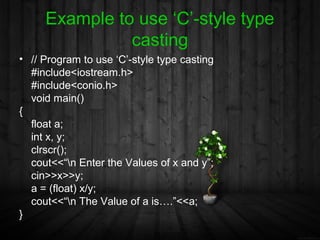
• // Program to use ‘C’-style type casting
  #include<iostream.h>
  #include<conio.h>
  void main()
{
  float a;
  int x, y;
  clrscr();
  cout<<“n Enter the Values of x and y”;
  cin>>x>>y;
  a = (float) x/y;
  cout<<“n The Value of a is….”<<a;
}
Output
Enter the Values of x and y6
4
The Value of a is…. 1.500000
‘C++’-style casting
•   C++ permits explicit type conversion of
    variables or expressions using the type
    cast operators. C++ has the following
    new type cast operators:
    1.     const_cast
    2.     static_cast
    3.     dynamic_cast
    4.     reinterpret_cast
The const_cast Operator
• A const_cast operator is used to add or
  remove a const or volatile modifier to or
  from a type.
  In general, it is dangerous to use
  the const_cast operator, because it allows
  a program to modify a variable that was
  declared const, and thus was not
  supposed to be modifiable.
The static_cast Operator
• The static-cast operator is used to
  convert a given expression to the specified
  type. static_cast operator can be used to
  convert an int to a char.
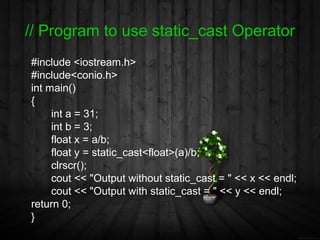
// Program to use static_cast Operator
#include <iostream.h>
#include<conio.h>
int main()
{
     int a = 31;
     int b = 3;
     float x = a/b;
     float y = static_cast<float>(a)/b;
     clrscr();
     cout << "Output without static_cast = " << x << endl;
     cout << "Output with static_cast = " << y << endl;
return 0;
}
Output
Output without static_cast = 10
Output with static_cast = 10.3333
The dynamic_cast Operator
• The dynamic_cast operator performs
  type conversions at run time.
The reinterpret_cast Operator
• The reinterpret_cast operator changes
  one data type into another. It should be
  used to cast between incompatible pointer
  types.
  The reinterpret_cast operator can be used
  for conversions such as char* to int*, or
  One_class* to Unrelated_class*, which are
  inherently unsafe.
Thank You

Type Casting in C++

  • 1.
    Type Casting in C++ Presented by Sachin Sharma
  • 2.
    Type Casting • TypeCasting is used to convert the type of a variable, function, object, expression or return value to another type. It is the process of converting one type into another. In other words converting an expression of a given type into another is called type casting.
  • 3.
    Types of TypeCasting There are two ways of achieving the Type Casting. These are: • Implicit Conversion • Explicit Conversion
  • 4.
     Implicit Conversion • Implicittype conversion is not done by any conversions or operators. In other words, the value that gets automatically converted to the specific type to which it is assigned, is known as implicit type conversion.
  • 5.
    Explicit Conversion • Explicitconversion can be done using type cast operator. In other words, the value that gets converted to the specific type by using type cast operator is known as explicit type conversion. In C++, the type casting can be done in either of the two ways mentioned below namely: • ‘C’-style casting • ‘C++’-style casting
  • 6.
    C-style casting • In‘C’ Language, the type casting is made by putting the bracketed name of the required type just before the value of other data type. This converts the given data type into bracketed data type.
  • 7.
    Example to use‘C’-style type casting • // Program to use ‘C’-style type casting #include<iostream.h> #include<conio.h> void main() { float a; int x, y; clrscr(); cout<<“n Enter the Values of x and y”; cin>>x>>y; a = (float) x/y; cout<<“n The Value of a is….”<<a; }
  • 8.
    Output Enter the Valuesof x and y6 4 The Value of a is…. 1.500000
  • 9.
    ‘C++’-style casting • C++ permits explicit type conversion of variables or expressions using the type cast operators. C++ has the following new type cast operators: 1. const_cast 2. static_cast 3. dynamic_cast 4. reinterpret_cast
  • 10.
    The const_cast Operator •A const_cast operator is used to add or remove a const or volatile modifier to or from a type. In general, it is dangerous to use the const_cast operator, because it allows a program to modify a variable that was declared const, and thus was not supposed to be modifiable.
  • 11.
    The static_cast Operator •The static-cast operator is used to convert a given expression to the specified type. static_cast operator can be used to convert an int to a char.
  • 12.
    // Program touse static_cast Operator #include <iostream.h> #include<conio.h> int main() { int a = 31; int b = 3; float x = a/b; float y = static_cast<float>(a)/b; clrscr(); cout << "Output without static_cast = " << x << endl; cout << "Output with static_cast = " << y << endl; return 0; }
  • 13.
    Output Output without static_cast= 10 Output with static_cast = 10.3333
  • 14.
    The dynamic_cast Operator •The dynamic_cast operator performs type conversions at run time.
  • 15.
    The reinterpret_cast Operator •The reinterpret_cast operator changes one data type into another. It should be used to cast between incompatible pointer types. The reinterpret_cast operator can be used for conversions such as char* to int*, or One_class* to Unrelated_class*, which are inherently unsafe.
  • 16.