Two new elements to
opensees
Javier Pereiro Barceló
Manuel Fernández Baños
Introduction
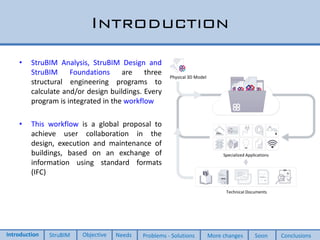
• StruBIM Analysis, StruBIM Design and
StruBIM Foundations are three
structural engineering programs to
calculate and/or design buildings. Every
program is integrated in the workflow
• This workflow is a global proposal to
achieve user collaboration in the
design, execution and maintenance of
buildings, based on an exchange of
information using standard formats
(IFC)
Physical 3D Model
Specialized Applications
Technical Documents
Introduction StruBIM Objective Needs Problems - Solutions More changes Soon Conclusions
StruBIM
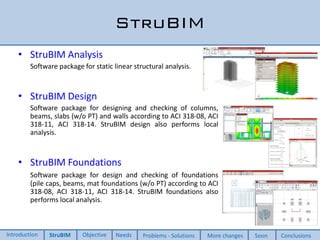
• StruBIM Analysis
Software package for static linear structural analysis.
• StruBIM Design
Software package for designing and checking of columns,
beams, slabs (w/o PT) and walls according to ACI 318-08, ACI
318-11, ACI 318-14. StruBIM design also performs local
analysis.
• StruBIM Foundations
Software package for design and checking of foundations
(pile caps, beams, mat foundations (w/o PT) according to ACI
318-08, ACI 318-11, ACI 318-14. StruBIM foundations also
performs local analysis.
Introduction StruBIM Objective Needs Problems - Solutions More changes Soon Conclusions
Objective
Cype wants to have well-known, fast and reliable analysis engines in every building discipline.
Nowadays we use the following engines:
 Acoubat – Centre Scientifique et Technique du Bâtiment for acoustics
 Randiance - Lawrence Berkeley National Laboratory for illumination
 EnergyPlus - U.S. Department of Energy Building Technologies Office for energetic analysis
 Ashrae - American Society of Heating, Refrigerating and Air-Conditioning Engineers for
thermal comfort
 Epanet - U.S. Environmental Protection Agency for water supply
 For structural analysis  OpenSees
Introduction StruBIM Objective Needs Problems - Solutions More changes Soon Conclusions
Objective
Introduction StruBIM Objective Needs Problems - Solutions More changes Soon Conclusions
Needs
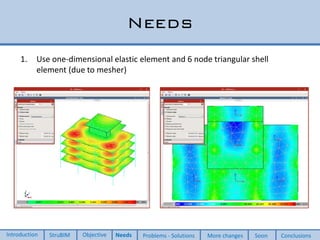
1. Use one-dimensional elastic element and 6 node triangular shell
element (due to mesher)
Introduction StruBIM Objective Needs Problems - Solutions More changes Soon Conclusions
Needs
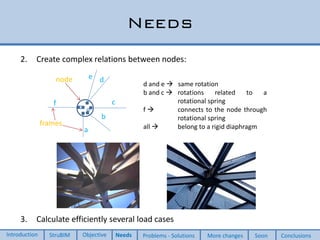
2. Create complex relations between nodes:
3. Calculate efficiently several load cases
d and e  same rotation
b and c  rotations related to a
rotational spring
f  connects to the node through
rotational spring
all  belong to a rigid diaphragma
b
c
e
f
dnode
frames
Introduction StruBIM Objective Needs Problems - Solutions More changes Soon Conclusions
Problems - Solutions
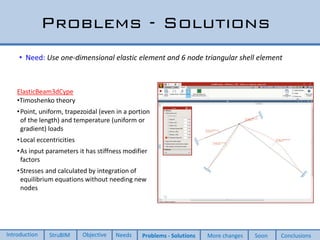
• Need: Use one-dimensional elastic element and 6 node triangular shell element
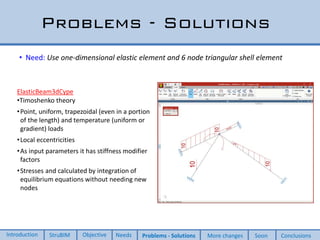
ElasticBeam3dCype
•Timoshenko theory
•Point, uniform, trapezoidal (even in a portion
of the length) and temperature (uniform or
gradient) loads
•Local eccentricities
•As input parameters it has stiffness modifier
factors
•Stresses and calculated by integration of
equilibrium equations without needing new
nodes
Introduction StruBIM Objective Needs Problems - Solutions More changes Soon Conclusions
Problems - Solutions
• Need: Use one-dimensional elastic element and 6 node triangular shell element
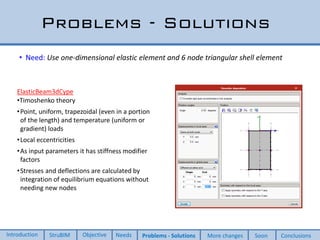
ElasticBeam3dCype
•Timoshenko theory
•Point, uniform, trapezoidal (even in a portion
of the length) and temperature (uniform or
gradient) loads
•Local eccentricities
•As input parameters it has stiffness modifier
factors
•Stresses and calculated by integration of
equilibrium equations without needing new
nodes
Introduction StruBIM Objective Needs Problems - Solutions More changes Soon Conclusions
Problems - Solutions
• Need: Use one-dimensional elastic element and 6 node triangular shell element
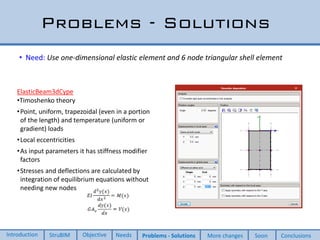
ElasticBeam3dCype
•Timoshenko theory
•Point, uniform, trapezoidal (even in a portion
of the length) and temperature (uniform or
gradient) loads
•Local eccentricities
•As input parameters it has stiffness modifier
factors
•Stresses and deflections are calculated by
integration of equilibrium equations without
needing new nodes
Introduction StruBIM Objective Needs Problems - Solutions More changes Soon Conclusions
Problems - Solutions
• Need: Use one-dimensional elastic element and 6 node triangular shell element
ElasticBeam3dCype
•Timoshenko theory
•Point, uniform, trapezoidal (even in a portion
of the length) and temperature (uniform or
gradient) loads
•Local eccentricities
•As input parameters it has stiffness modifier
factors
•Stresses and deflections are calculated by
integration of equilibrium equations without
needing new nodes
Introduction StruBIM Objective Needs Problems - Solutions More changes Soon Conclusions
Problems - Solutions
• Need: Use one-dimensional elastic element and 6 node triangular shell element
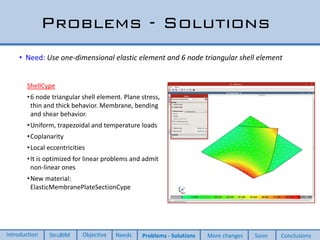
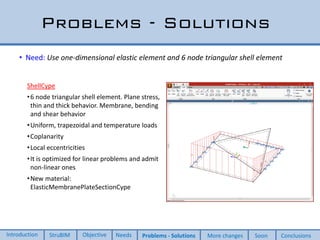
ShellCype
•6 node triangular shell element. Plane stress,
thin and thick behavior. Membrane, bending
and shear behavior.
•Uniform, trapezoidal and temperature loads
•Coplanarity
•Local eccentricities
•It is optimized for linear problems and admit
non-linear ones
•New material:
ElasticMembranePlateSectionCype
Introduction StruBIM Objective Needs Problems - Solutions More changes Soon Conclusions
Problems - Solutions
• Need: Use one-dimensional elastic element and 6 node triangular shell element
ShellCype
•6 node triangular shell element. Plane stress,
thin and thick behavior. Membrane, bending
and shear behavior
•Uniform, trapezoidal and temperature loads
•Coplanarity
•Local eccentricities
•It is optimized for linear problems and admit
non-linear ones
•New material:
ElasticMembranePlateSectionCype
Introduction StruBIM Objective Needs Problems - Solutions More changes Soon Conclusions
More changes
o We have created a new way to manage constraints:
dofRelation, CYPEConstraintsHandler , Transformation_DOFGroupCYPE
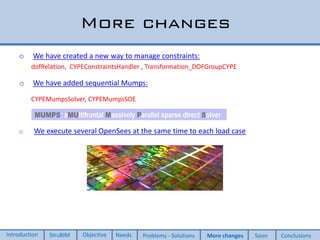
o We have added sequential Mumps:
CYPEMumpsSolver, CYPEMumpsSOE
o We execute several OpenSees at the same time to each load case
Introduction StruBIM Objective Needs Problems - Solutions More changes Soon Conclusions
Soon
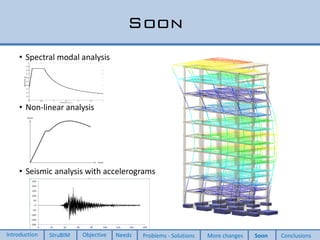
• Spectral modal analysis
• Non-linear analysis
• Seismic analysis with accelerograms
Introduction StruBIM Objective Needs Problems - Solutions More changes Soon Conclusions
Conclusions
• Cype has developed two new elements, a constraint handler and has
implemented sequential MUMPS to OpenSees. They will be available soon
in the OpenSees repository
• Previous additions allows to integrate OpenSees in a BIM workflow
• In the near future, Cype will perform dynamic non-linear analysis with
OpenSees
THANK YOU
Introduction StruBIM Objective Needs Problems - Solutions More changes Soon Conclusions
Two new elements to
opensees
Javier Pereiro Barceló
Manuel Fernández Baños

Two new elements to OpenSees

  • 1.
    Two new elementsto opensees Javier Pereiro Barceló Manuel Fernández Baños
  • 2.
    Introduction • StruBIM Analysis,StruBIM Design and StruBIM Foundations are three structural engineering programs to calculate and/or design buildings. Every program is integrated in the workflow • This workflow is a global proposal to achieve user collaboration in the design, execution and maintenance of buildings, based on an exchange of information using standard formats (IFC) Physical 3D Model Specialized Applications Technical Documents Introduction StruBIM Objective Needs Problems - Solutions More changes Soon Conclusions
  • 3.
    StruBIM • StruBIM Analysis Softwarepackage for static linear structural analysis. • StruBIM Design Software package for designing and checking of columns, beams, slabs (w/o PT) and walls according to ACI 318-08, ACI 318-11, ACI 318-14. StruBIM design also performs local analysis. • StruBIM Foundations Software package for design and checking of foundations (pile caps, beams, mat foundations (w/o PT) according to ACI 318-08, ACI 318-11, ACI 318-14. StruBIM foundations also performs local analysis. Introduction StruBIM Objective Needs Problems - Solutions More changes Soon Conclusions
  • 4.
    Objective Cype wants tohave well-known, fast and reliable analysis engines in every building discipline. Nowadays we use the following engines:  Acoubat – Centre Scientifique et Technique du Bâtiment for acoustics  Randiance - Lawrence Berkeley National Laboratory for illumination  EnergyPlus - U.S. Department of Energy Building Technologies Office for energetic analysis  Ashrae - American Society of Heating, Refrigerating and Air-Conditioning Engineers for thermal comfort  Epanet - U.S. Environmental Protection Agency for water supply  For structural analysis  OpenSees Introduction StruBIM Objective Needs Problems - Solutions More changes Soon Conclusions
  • 5.
    Objective Introduction StruBIM ObjectiveNeeds Problems - Solutions More changes Soon Conclusions
  • 6.
    Needs 1. Use one-dimensionalelastic element and 6 node triangular shell element (due to mesher) Introduction StruBIM Objective Needs Problems - Solutions More changes Soon Conclusions
  • 7.
    Needs 2. Create complexrelations between nodes: 3. Calculate efficiently several load cases d and e  same rotation b and c  rotations related to a rotational spring f  connects to the node through rotational spring all  belong to a rigid diaphragma b c e f dnode frames Introduction StruBIM Objective Needs Problems - Solutions More changes Soon Conclusions
  • 8.
    Problems - Solutions •Need: Use one-dimensional elastic element and 6 node triangular shell element ElasticBeam3dCype •Timoshenko theory •Point, uniform, trapezoidal (even in a portion of the length) and temperature (uniform or gradient) loads •Local eccentricities •As input parameters it has stiffness modifier factors •Stresses and calculated by integration of equilibrium equations without needing new nodes Introduction StruBIM Objective Needs Problems - Solutions More changes Soon Conclusions
  • 9.
    Problems - Solutions •Need: Use one-dimensional elastic element and 6 node triangular shell element ElasticBeam3dCype •Timoshenko theory •Point, uniform, trapezoidal (even in a portion of the length) and temperature (uniform or gradient) loads •Local eccentricities •As input parameters it has stiffness modifier factors •Stresses and calculated by integration of equilibrium equations without needing new nodes Introduction StruBIM Objective Needs Problems - Solutions More changes Soon Conclusions
  • 10.
    Problems - Solutions •Need: Use one-dimensional elastic element and 6 node triangular shell element ElasticBeam3dCype •Timoshenko theory •Point, uniform, trapezoidal (even in a portion of the length) and temperature (uniform or gradient) loads •Local eccentricities •As input parameters it has stiffness modifier factors •Stresses and deflections are calculated by integration of equilibrium equations without needing new nodes Introduction StruBIM Objective Needs Problems - Solutions More changes Soon Conclusions
  • 11.
    Problems - Solutions •Need: Use one-dimensional elastic element and 6 node triangular shell element ElasticBeam3dCype •Timoshenko theory •Point, uniform, trapezoidal (even in a portion of the length) and temperature (uniform or gradient) loads •Local eccentricities •As input parameters it has stiffness modifier factors •Stresses and deflections are calculated by integration of equilibrium equations without needing new nodes Introduction StruBIM Objective Needs Problems - Solutions More changes Soon Conclusions
  • 12.
    Problems - Solutions •Need: Use one-dimensional elastic element and 6 node triangular shell element ShellCype •6 node triangular shell element. Plane stress, thin and thick behavior. Membrane, bending and shear behavior. •Uniform, trapezoidal and temperature loads •Coplanarity •Local eccentricities •It is optimized for linear problems and admit non-linear ones •New material: ElasticMembranePlateSectionCype Introduction StruBIM Objective Needs Problems - Solutions More changes Soon Conclusions
  • 13.
    Problems - Solutions •Need: Use one-dimensional elastic element and 6 node triangular shell element ShellCype •6 node triangular shell element. Plane stress, thin and thick behavior. Membrane, bending and shear behavior •Uniform, trapezoidal and temperature loads •Coplanarity •Local eccentricities •It is optimized for linear problems and admit non-linear ones •New material: ElasticMembranePlateSectionCype Introduction StruBIM Objective Needs Problems - Solutions More changes Soon Conclusions
  • 14.
    More changes o Wehave created a new way to manage constraints: dofRelation, CYPEConstraintsHandler , Transformation_DOFGroupCYPE o We have added sequential Mumps: CYPEMumpsSolver, CYPEMumpsSOE o We execute several OpenSees at the same time to each load case Introduction StruBIM Objective Needs Problems - Solutions More changes Soon Conclusions
  • 15.
    Soon • Spectral modalanalysis • Non-linear analysis • Seismic analysis with accelerograms Introduction StruBIM Objective Needs Problems - Solutions More changes Soon Conclusions
  • 16.
    Conclusions • Cype hasdeveloped two new elements, a constraint handler and has implemented sequential MUMPS to OpenSees. They will be available soon in the OpenSees repository • Previous additions allows to integrate OpenSees in a BIM workflow • In the near future, Cype will perform dynamic non-linear analysis with OpenSees THANK YOU Introduction StruBIM Objective Needs Problems - Solutions More changes Soon Conclusions
  • 17.
    Two new elementsto opensees Javier Pereiro Barceló Manuel Fernández Baños