SOCIAL MEDIA IS THE
PROBLEM
(AND THE SOLUTION)
Lauren Wagner < September 22 2011 >
Social relationships are one of the most
well-documented factors influencing
physical and mental health
- Lowered levels of distress
- Increased feelings of security and self worth
- Heightened sense of belonging
- Source of regulation for maintaining healthy
behaviors
- Enhanced social participation and commitment to
community
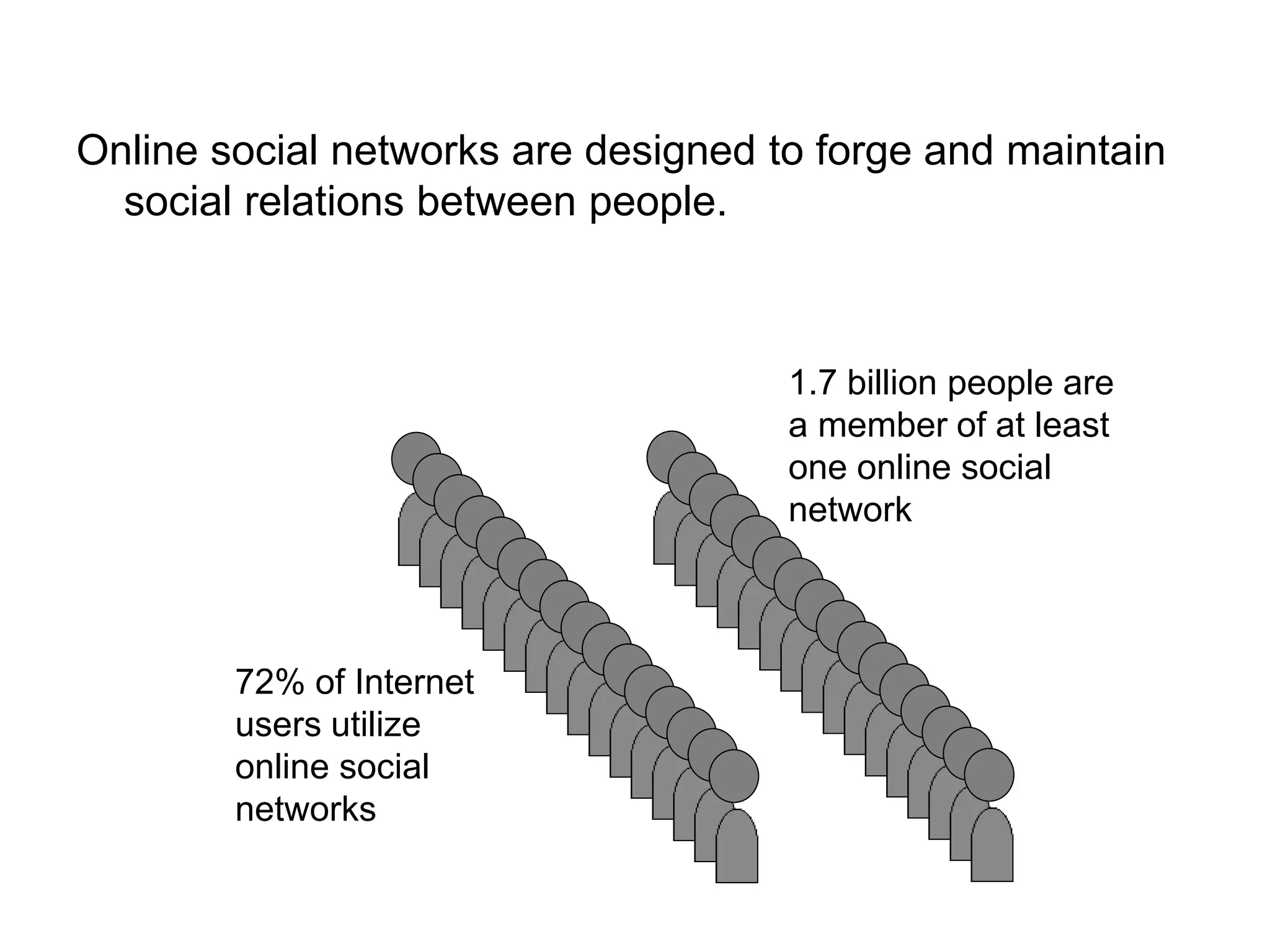
Online social networks are designed to forge and maintain
social relations between people.
72% of Internet
users utilize
online social
networks
1.7 billion people are
a member of at least
one online social
network
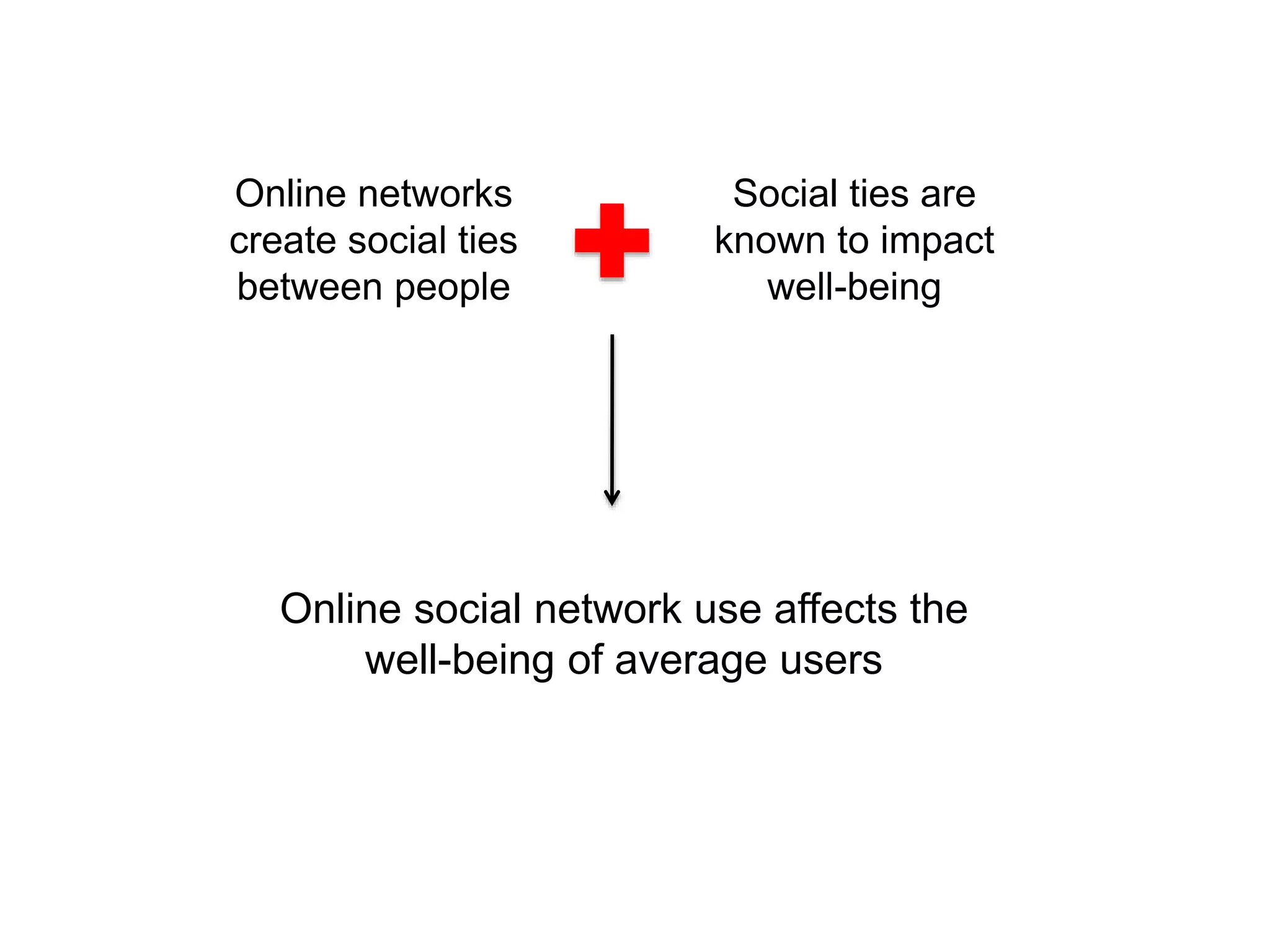
Online networks
create social ties
between people
Social ties are
known to impact
well-being
Online social network use affects the
well-being of average users
Why should we care about the
health of the “healthy”?
“Transient happy moods lead people to seek
out others and engage with the
environment, to be more venturesome,
more open, and more sensitive to their
individuals.”
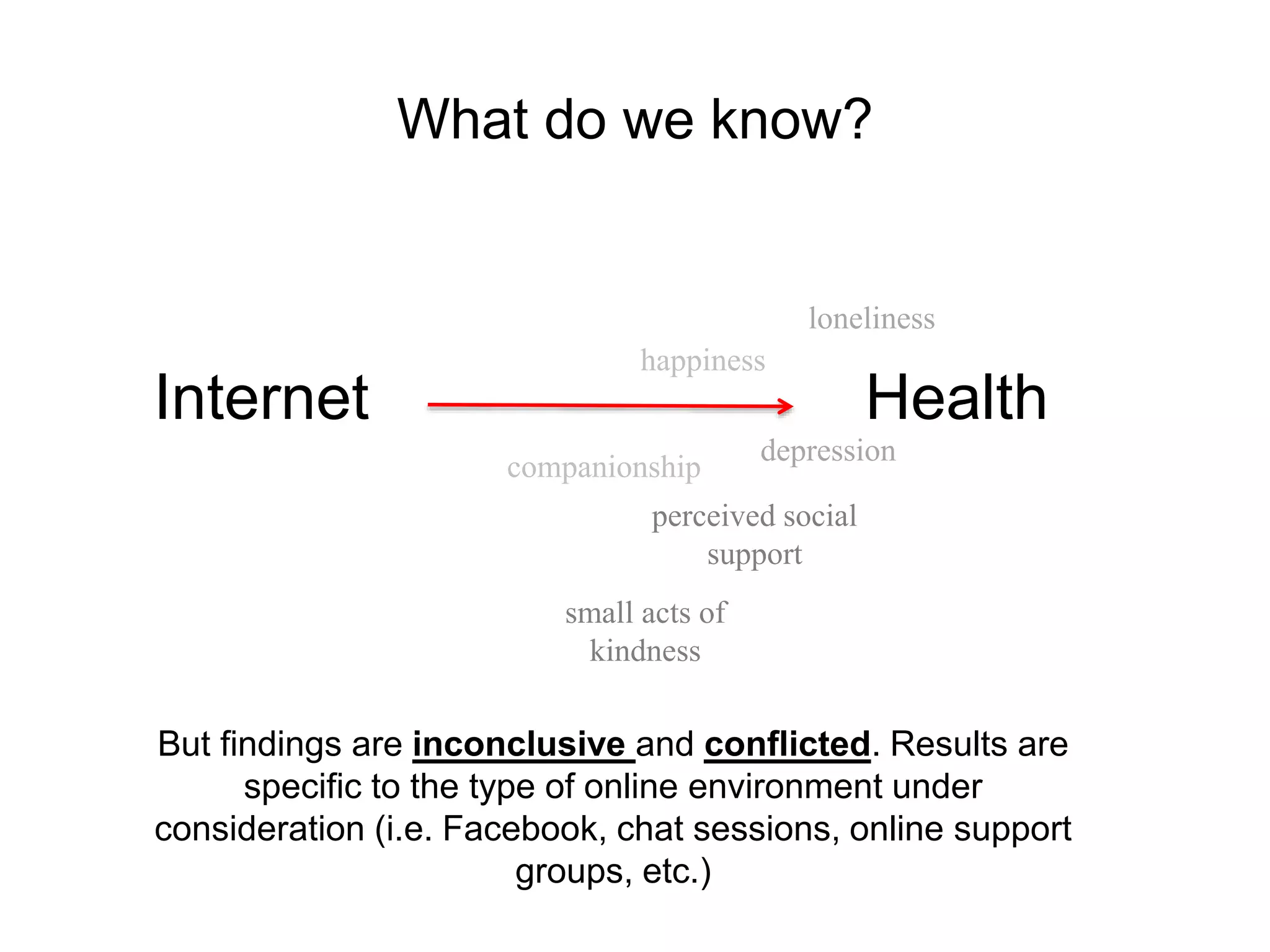
What do we know?
Internet Health
happiness
loneliness
perceived social
support
companionship
depression
small acts of
kindness
But findings are inconclusive and conflicted. Results are
specific to the type of online environment under
consideration (i.e. Facebook, chat sessions, online support
groups, etc.)
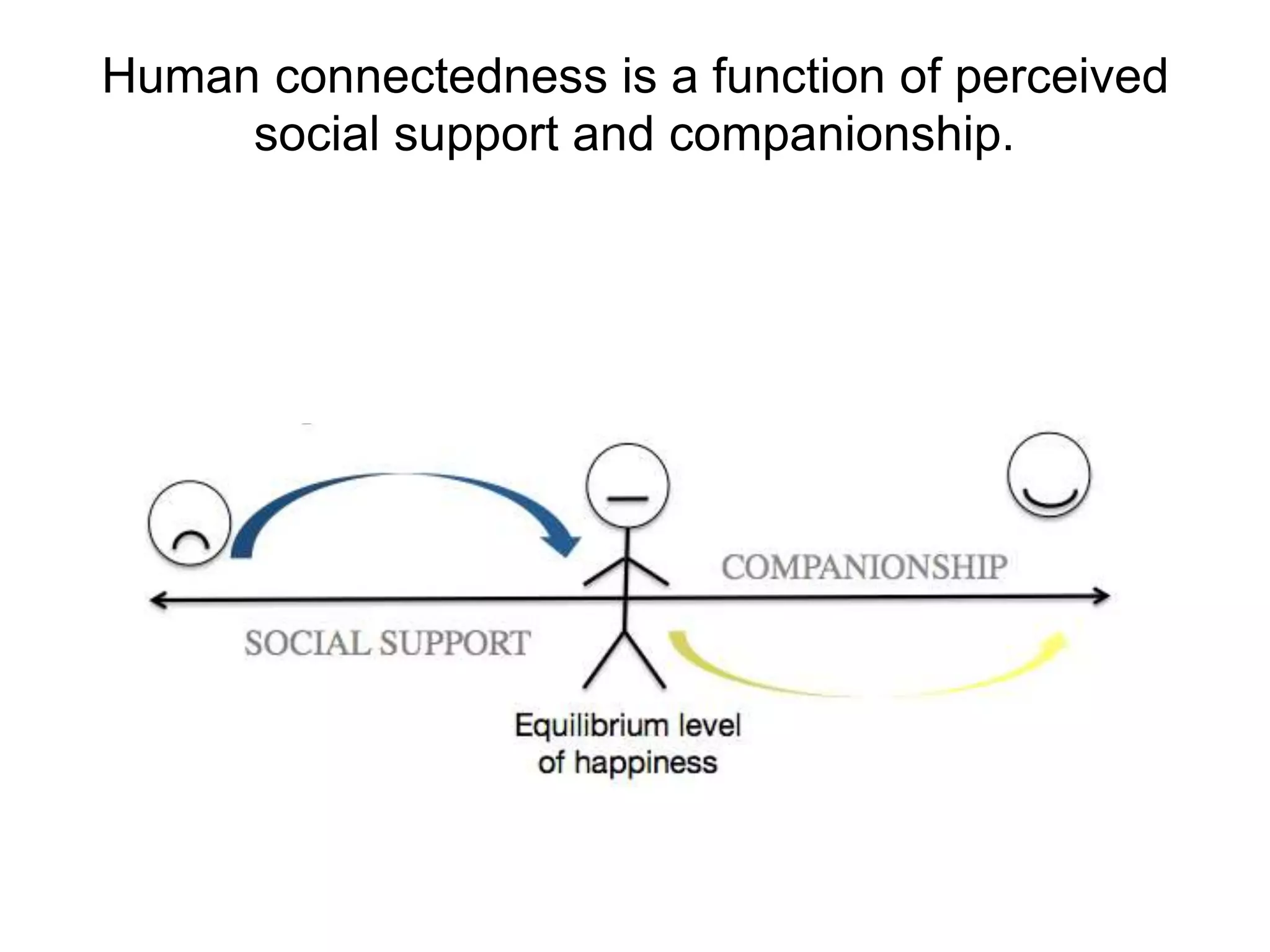
Human connectedness is a function of perceived
social support and companionship.
The power of perception.
“Humans are such meaning-making
creatures that we perceive social
relationships where no objectifiable
relationship exists (e.g., between author
and reader, between an individual and God)
or where no reciprocity is possible (e.g., in
parasocial relationships with television
characters).”
“Conversely, we perceive social
isolation when social
opportunities and relationships
do exist but we lack the capacity
to harness the power of social
connectedness in everyday life.”
theory of
perceived
companionship
Hypotheses
1. A reciprocal online interaction has the potential to
improve user well-being
1. A potentially reciprocal online interaction has the ability
to improve user well-being
Subject
tweets
Another user
acknowledges
tweet
Subject
experiences a
boost in well-
being
Individual perceives
that they are
supported
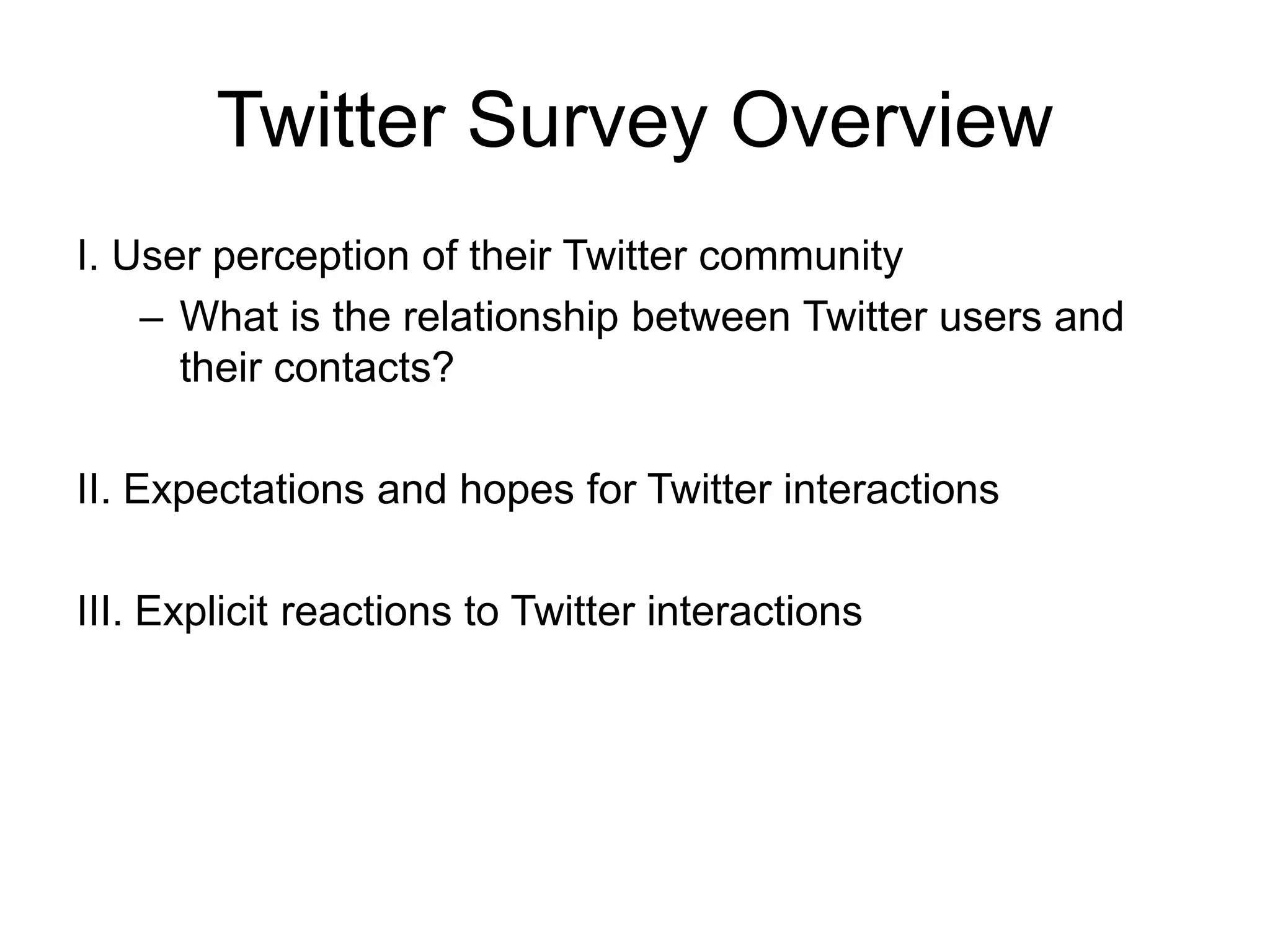
Twitter Survey Overview
I. User perception of their Twitter community
– What is the relationship between Twitter users and
their contacts?
II. Expectations and hopes for Twitter interactions
III. Explicit reactions to Twitter interactions
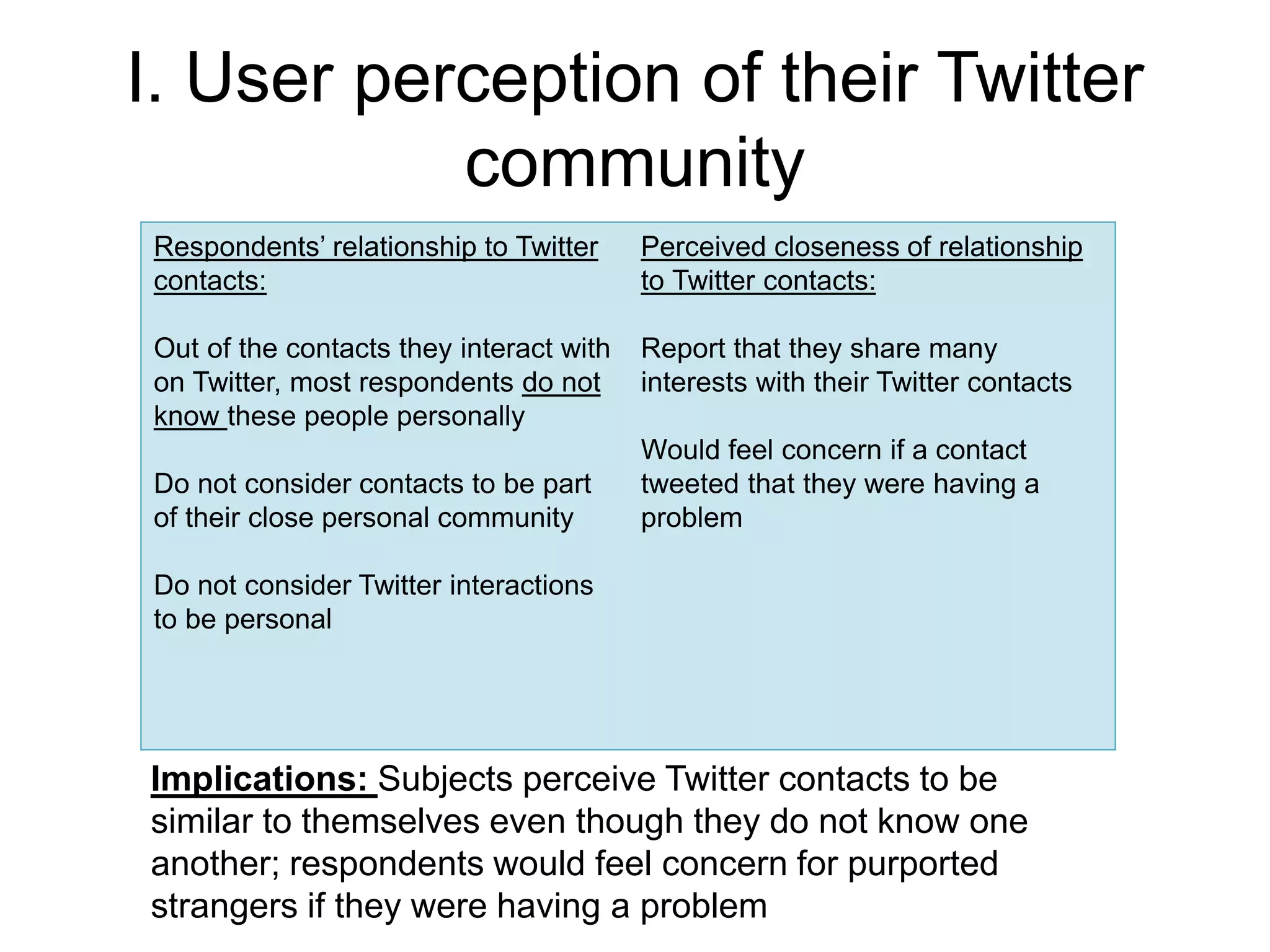
I. User perception of their Twitter
community
Respondents’ relationship to Twitter
contacts:
Out of the contacts they interact with
on Twitter, most respondents do not
know these people personally
Do not consider contacts to be part
of their close personal community
Do not consider Twitter interactions
to be personal
Perceived closeness of relationship
to Twitter contacts:
Report that they share many
interests with their Twitter contacts
Would feel concern if a contact
tweeted that they were having a
problem
Implications: Subjects perceive Twitter contacts to be
similar to themselves even though they do not know one
another; respondents would feel concern for purported
strangers if they were having a problem
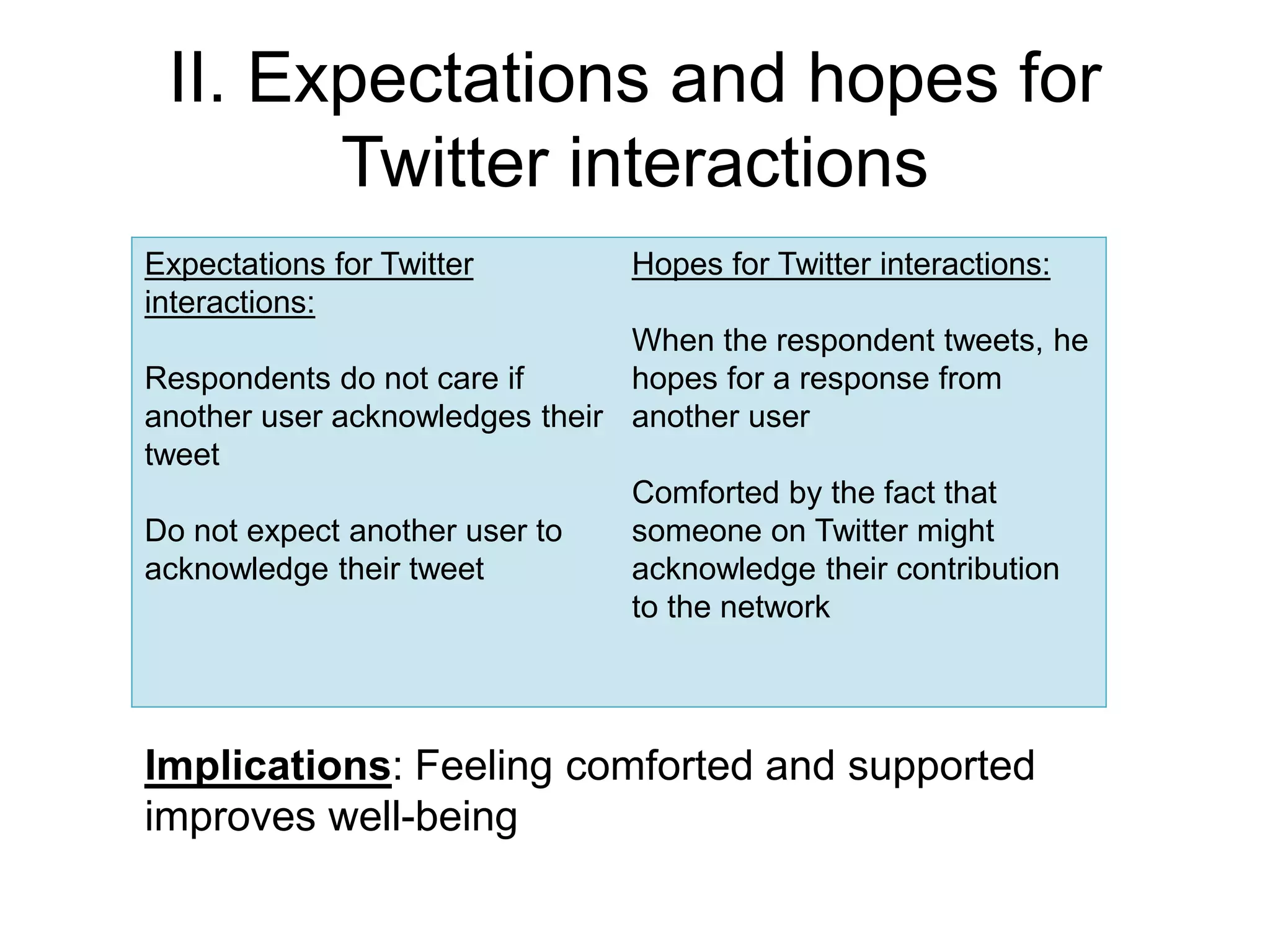
II. Expectations and hopes for
Twitter interactions
Expectations for Twitter
interactions:
Respondents do not care if
another user acknowledges their
tweet
Do not expect another user to
acknowledge their tweet
Hopes for Twitter interactions:
When the respondent tweets, he
hopes for a response from
another user
Comforted by the fact that
someone on Twitter might
acknowledge their contribution
to the network
Implications: Feeling comforted and supported
improves well-being
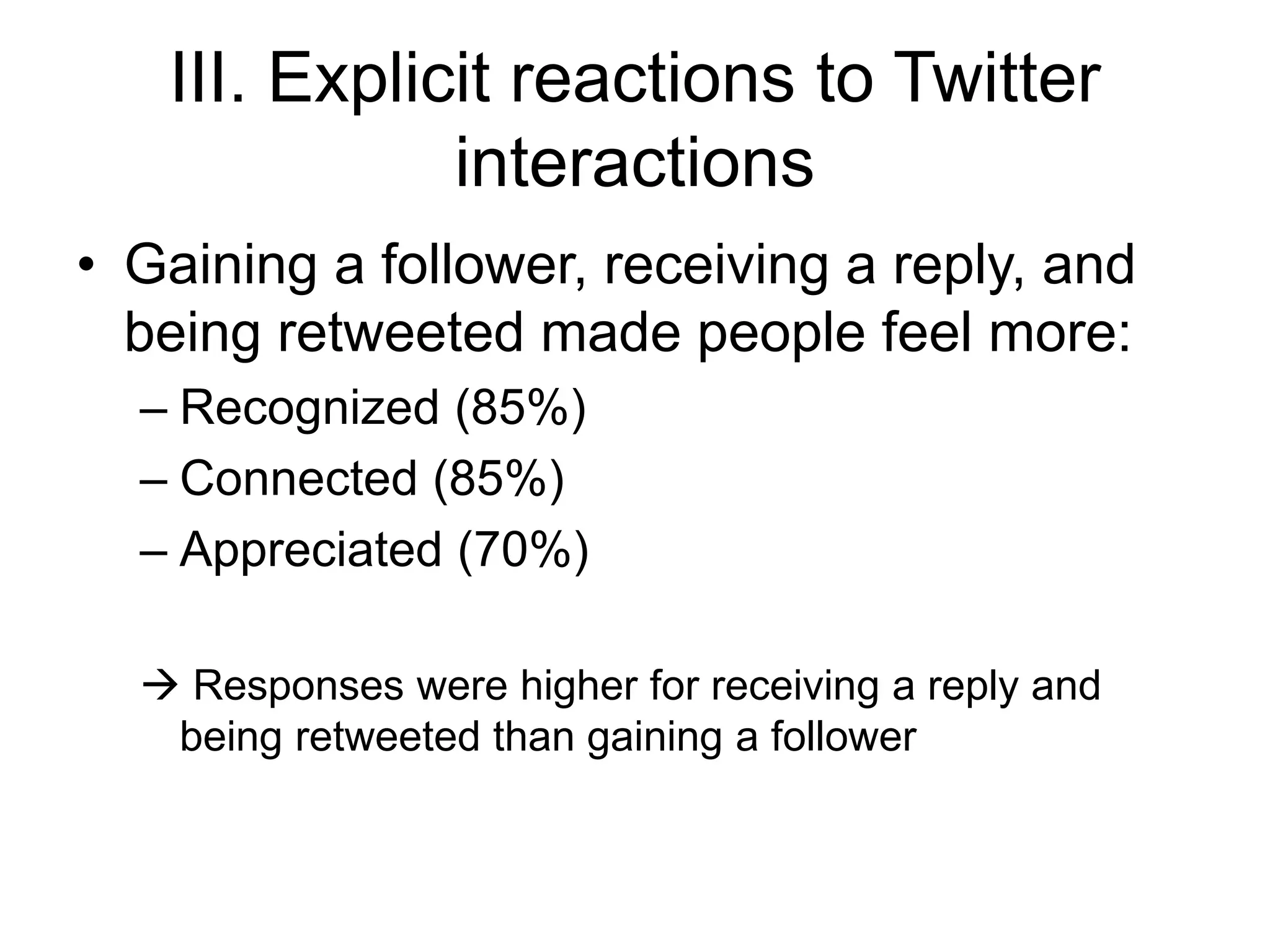
III. Explicit reactions to Twitter
interactions
• Gaining a follower, receiving a reply, and
being retweeted made people feel more:
– Recognized (85%)
– Connected (85%)
– Appreciated (70%)
 Responses were higher for receiving a reply and
being retweeted than gaining a follower
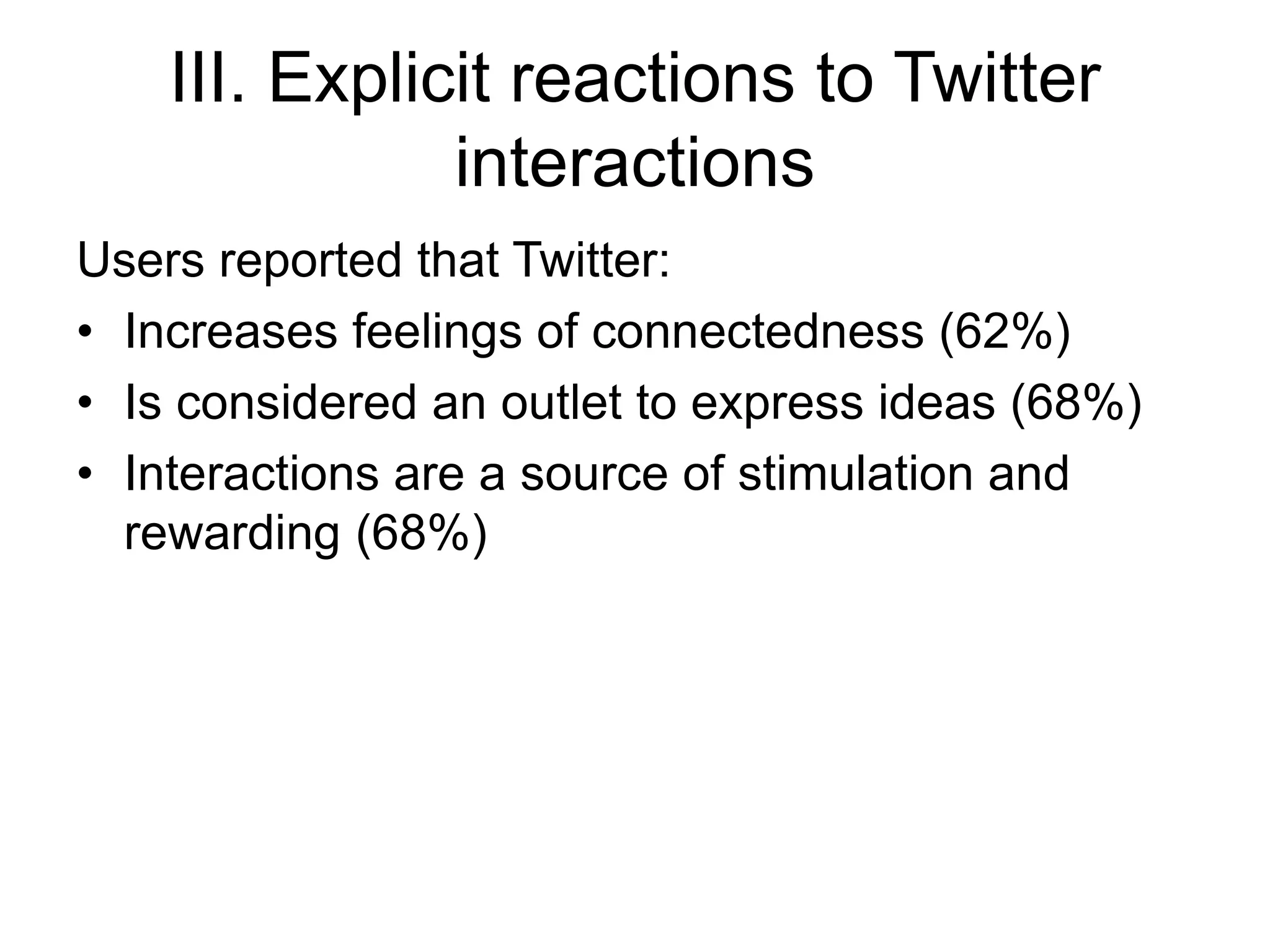
III. Explicit reactions to Twitter
interactions
Users reported that Twitter:
• Increases feelings of connectedness (62%)
• Is considered an outlet to express ideas (68%)
• Interactions are a source of stimulation and
rewarding (68%)
III. Explicit reactions to Twitter
interactions
Boosts in well-being:
- Most users do not feel a boost in well-being when they
tweet
- When a tweet is acknowledged by another user, 64%
report a boost in well-being
Implications: It is the interaction between strangers
that boosts well-being
Exploring the Theory of Perceived
Companionship
• Health benefits resulting from interactions with
one’s Twitter network are based off of individual
perception
– Subject believes another user has deciphered their tweet and
deemed it relevant, which may or may not be accurate
– Subject perceives Twitter network to be similar to themselves,
which may or may not be accurate
– A lack of contextual cues forces users to “fill in the spaces”;
research shows that online, people are inclined to create positive
views of one another and develop exaggerated impressions of
conversation partners
The online environment may be manipulated so that average users
perceive activities to be supportive or companionate even if they
are not intended as such
Social Media // Force for Good
“Our biggest problems have no
technological solution. We have come
through the industrial age, the information
age. Now we need to prepare ourselves
for what I call the human engineering age
and address the relationships which
enable societies to work” (Herbert, 2011)
Thank you.
@typewriters

Twitter presentation (data science team)

  • 1.
    SOCIAL MEDIA ISTHE PROBLEM (AND THE SOLUTION) Lauren Wagner < September 22 2011 >
  • 2.
    Social relationships areone of the most well-documented factors influencing physical and mental health - Lowered levels of distress - Increased feelings of security and self worth - Heightened sense of belonging - Source of regulation for maintaining healthy behaviors - Enhanced social participation and commitment to community
  • 3.
    Online social networksare designed to forge and maintain social relations between people. 72% of Internet users utilize online social networks 1.7 billion people are a member of at least one online social network
  • 4.
    Online networks create socialties between people Social ties are known to impact well-being Online social network use affects the well-being of average users
  • 5.
    Why should wecare about the health of the “healthy”? “Transient happy moods lead people to seek out others and engage with the environment, to be more venturesome, more open, and more sensitive to their individuals.”
  • 6.
    What do weknow? Internet Health happiness loneliness perceived social support companionship depression small acts of kindness But findings are inconclusive and conflicted. Results are specific to the type of online environment under consideration (i.e. Facebook, chat sessions, online support groups, etc.)
  • 7.
    Human connectedness isa function of perceived social support and companionship.
  • 8.
    The power ofperception. “Humans are such meaning-making creatures that we perceive social relationships where no objectifiable relationship exists (e.g., between author and reader, between an individual and God) or where no reciprocity is possible (e.g., in parasocial relationships with television characters).”
  • 9.
    “Conversely, we perceivesocial isolation when social opportunities and relationships do exist but we lack the capacity to harness the power of social connectedness in everyday life.”
  • 10.
  • 12.
    Hypotheses 1. A reciprocalonline interaction has the potential to improve user well-being 1. A potentially reciprocal online interaction has the ability to improve user well-being Subject tweets Another user acknowledges tweet Subject experiences a boost in well- being Individual perceives that they are supported
  • 13.
    Twitter Survey Overview I.User perception of their Twitter community – What is the relationship between Twitter users and their contacts? II. Expectations and hopes for Twitter interactions III. Explicit reactions to Twitter interactions
  • 14.
    I. User perceptionof their Twitter community Respondents’ relationship to Twitter contacts: Out of the contacts they interact with on Twitter, most respondents do not know these people personally Do not consider contacts to be part of their close personal community Do not consider Twitter interactions to be personal Perceived closeness of relationship to Twitter contacts: Report that they share many interests with their Twitter contacts Would feel concern if a contact tweeted that they were having a problem Implications: Subjects perceive Twitter contacts to be similar to themselves even though they do not know one another; respondents would feel concern for purported strangers if they were having a problem
  • 15.
    II. Expectations andhopes for Twitter interactions Expectations for Twitter interactions: Respondents do not care if another user acknowledges their tweet Do not expect another user to acknowledge their tweet Hopes for Twitter interactions: When the respondent tweets, he hopes for a response from another user Comforted by the fact that someone on Twitter might acknowledge their contribution to the network Implications: Feeling comforted and supported improves well-being
  • 16.
    III. Explicit reactionsto Twitter interactions • Gaining a follower, receiving a reply, and being retweeted made people feel more: – Recognized (85%) – Connected (85%) – Appreciated (70%)  Responses were higher for receiving a reply and being retweeted than gaining a follower
  • 17.
    III. Explicit reactionsto Twitter interactions Users reported that Twitter: • Increases feelings of connectedness (62%) • Is considered an outlet to express ideas (68%) • Interactions are a source of stimulation and rewarding (68%)
  • 18.
    III. Explicit reactionsto Twitter interactions Boosts in well-being: - Most users do not feel a boost in well-being when they tweet - When a tweet is acknowledged by another user, 64% report a boost in well-being Implications: It is the interaction between strangers that boosts well-being
  • 19.
    Exploring the Theoryof Perceived Companionship • Health benefits resulting from interactions with one’s Twitter network are based off of individual perception – Subject believes another user has deciphered their tweet and deemed it relevant, which may or may not be accurate – Subject perceives Twitter network to be similar to themselves, which may or may not be accurate – A lack of contextual cues forces users to “fill in the spaces”; research shows that online, people are inclined to create positive views of one another and develop exaggerated impressions of conversation partners The online environment may be manipulated so that average users perceive activities to be supportive or companionate even if they are not intended as such
  • 20.
    Social Media //Force for Good “Our biggest problems have no technological solution. We have come through the industrial age, the information age. Now we need to prepare ourselves for what I call the human engineering age and address the relationships which enable societies to work” (Herbert, 2011)
  • 21.

Editor's Notes

  • #2 BACKGROUND- recent facebook study 2010 Lancet published a study about whether mobile phone communication between health care patients and providers in Kenya would improve adherence to drug regimens and result in suppressed viral loads Received a simple text message every Monday that said how are you feeling- responded sawa that they were doing well, or shida that they were having a problem. Most said that they were fine yet intervention group displayed greater adherence to drug regimens and increased viral suppressions compared with the control “felt like someone cares”– didn’t know health worker and messages were impersonal. Said they felt like someone cares, resulting in positive health benefits
  • #3 Yes there’s mediated communication but I chose to focus on online social networks; FOUND THE IDEA OF PERCEPTION PARTICULARLY INTERESTING
  • #5 Healthy might think of sick. Mental health, think of crazy. Here to challenge your conception of health and mental health. Actual definition is that health is an optimum state and something we should all strive to achieve. Since we know that social relationships impact health and online networks are designed to forge these ties, how do we configure interactions to advance positive outcomes. My focus is on average people doing average things and how that influences mental health.
  • #6 Good news and the bad news: Depression statistics By 2030, depression will be the biggest sociological and economic burden on societies worldwide (WHO) However Government: For example, according to the cabinet secretary, improving the mental health and well-being of the unemployed could motivate them to find work (Ramesh, 2007), which would benefit society at-large.
  • #7 In an attempt to improve the lives of users, it is unhelpful to draw conclusions about interactions specific to a type of online social network or interaction (i.e. Looking at Facebook photos decreases self- esteem) The Internet has been lauded for its ability to foster feelings of perceived social support across a multitude of online environments Instead, we must create new generalizable theories that can be used to inform the design of websites and networks
  • #8 Traditional focus on the sick. 1 billion people using these networks, how do we benefit them. Existing studies look back instead of look forward. Focus on perceived social support- HOW ITS INTERPRETED MORE IMPORTANT THAN WHAT IS HAPPENING Although it might seem insignificant, companionship is integral to our well-being: Known to be the strongest predictor of loneliness Small regular boosts in happiness have been shown to maintain users’ self-esteem over an extended period of time Contributes to greater resilience and optimism, thus shaping how we perceive the world Lack of pleasurable activities have been implicated in the inception of some psychological disorders
  • #9 Online and offline!!!
  • #10 Happiness and well-being are perceived experiences. When you move to a new location it negatively impacts your well-being. Your happiness in the new location is based on how many friends you think you have rather the the number of friends you actually have
  • #11 “Imagined” friendships are facilitated by the Internet and mediated communication, which produce boosts in well-being; SAME HEALTH BENEFITS Specifically, can a reciprocal interaction online provide a boost in well-being. Also, once someone has gained some sort of benefit through these interactions, can the mere potential for that interaction to occur in the future create some sort of enduring feeling of support that improves wellbeing
  • #12 Can online reciprocal interactions boost wellbeing? Can the potential for these interactions improve happiness? Results: perceived closeness to other contacts; outlet to express ideas; makes people feel more connected to the world When you tweet don’t feel a boost in wellbeing but when tweet is retweeted or replied to you feel a boost