UNIT 42-UK TV
BROADCASTING
P1
http://www.mediastudentsbook.com/content/case-study-outline-history-tv-uk
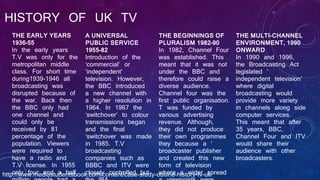
THE EARLY YEARS
1936–55
In the early years
T.V was only for the
metropolitan middle
class. For short time
during1939-1946 all
broadcasting was
disrupted because of
the war. Back then
the BBC only had
one channel and
could only be
received by 81
percentage of the
population. Viewers
were required to
have a radio and
T.V license. In 1955
only four and a half
A UNIVERSAL
PUBLIC SERVICE
1955–82
Introduction of the
‘commercial’ or
‘independent’
television. However,
the BBC introduced
a new channel with
a higher resolution in
1964. In 1967 the
‘switchover’ to colour
transmissions began
and the final
‘switchover was made
in 1985. T.V
broadcasting
companies such as
BBBC and ITV were
closely controlled but
THE BEGINNINGS OF
PLURALISM 1982–90
In 1982, Channel Four
was established. This
meant that it was not
under the BBC and
therefore could raise a
diverse audience.
Channel four was the
first public organisation.
T was funded by
various advertising
revenue. Although,
they did not produce
their own programmes
they because a ‘
broadcaster publisher
and created this new
form of television
where a wider spread
THE MULTI-CHANNEL
ENVIRONMENT, 1990
ONWARD
In 1990 and 1996,
the Broadcasting Act
legislated ‘
independent television’
where digital
broadcasting would
provide more variety
in channels along side
computer services.
This meant that after
35 years, BBC,
Channel Four and ITV
would share their
audience with other
broadcasters.
HISTORY OF UK TV
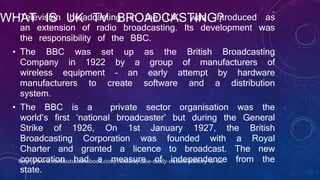
WHAT IS UK TV BROADCASTING?• Television broadcasting in the UK, was introduced as
an extension of radio broadcasting. Its development was
the responsibility of the BBC.
• The BBC was set up as the British Broadcasting
Company in 1922 by a group of manufacturers of
wireless equipment – an early attempt by hardware
manufacturers to create software and a distribution
system.
• The BBC is a private sector organisation was the
world’s first ‘national broadcaster’ but during the General
Strike of 1926, On 1st January 1927, the British
Broadcasting Corporation was founded with a Royal
Charter and granted a licence to broadcast. The new
corporation had a measure of independence from the
state.
http://www.mediastudentsbook.com/content/case-study-outline-history-tv-uk
P1 A-OWNERSHIPMedia regulators
The Department for Culture,
Media and Sport (DCMS).
Government is responsible for
broadcasting and creative
industries in the UK .
The UK communications
industries, with responsibilities
across television, radio,
telecommunications and wireless
communications services is
controlled by Ofcom an
independent regulator
competition authority
Website address
http://www.bbc.co.uk/aboutthebbc/insidethebbc/manageme
ntstructure/bbcstructure
P1 A-OWNERSHIP
Website address
http://www.bbc.co.uk/aboutthebbc/insidethebbc/managementstructure/b
bcstructure
Royal Charter
The BBC is
established under
a Royal Charter.
The charter that
is in place now
has been going
since 2007 and
end this year.
This means that it
will be reviewed
and the Royal
Charter will decide
if they will
continue to
support the BBC.
BBC Trust
The strategy and direction
of the BBC is set through
the BBC Trust which is
governed by the Royal
Charter. The BBC Trust
has a clear duty to
represent the interests of
the licence fee payers. The
Trust sets purpose remits,
issues service licences and
holds the Executive Board
to account for its
performance in delivering
BBC services. The Trust
works closely with national
Audience Councils in order
to understand the needs
and concerns of audiences.
Executive
The Executive Board
is responsible for the
operational
management of the
BBC in controlled by
The Executive Board.
Directors from across
the BBC contribute
to the leadership of
the organisation as
part of the Executive
Team.
P1- A-
OPERATING MODEL- EXECUTIVE
STRUCTURE
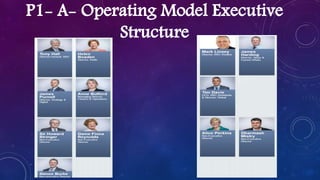
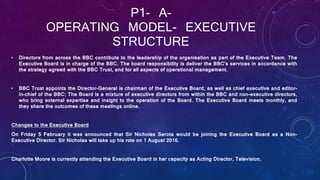
• Directors from across the BBC contribute to the leadership of the organisation as part of the Executive Team. The
Executive Board is in charge of the BBC. The board responsibility is deliver the BBC’s services in accordance with
the strategy agreed with the BBC Trust, and for all aspects of operational management.
• BBC Trust appoints the Director-General is chairman of the Executive Board, as well as chief executive and editor-
in-chief of the BBC; The Board is a mixture of executive directors from within the BBC and non-executive directors,
who bring external expertise and insight to the operation of the Board. The Executive Board meets monthly, and
they share the outcomes of these meetings online.
Changes to the Executive Board
On Friday 5 February it was announced that Sir Nicholas Serota would be joining the Executive Board as a Non-
Executive Director. Sir Nicholas will take up his role on 1 August 2016.
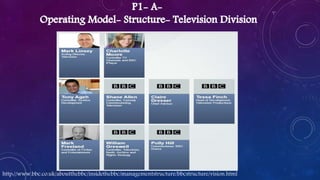
Charlotte Moore is currently attending the Executive Board in her capacity as Acting Director, Television.
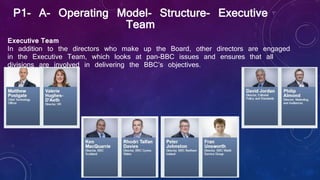
Executive Team
In addition to the directors who make up the Board, other directors are engaged
in the Executive Team, which looks at pan-BBC issues and ensures that all
divisions are involved in delivering the BBC’s objectives.
http://www.bbc.co.uk/aboutthebbc/insidethebbc/managementstructure/bbcstructure/vision.html
P1- A-
Operation Model- Partnerships
Partnership through Make It Digital
• ‘Micro Bit’ coding device to all year 7 children across the UK for free to inspire a future generation - 1 million
devices in total.
• Programmes and online activity involving the BBC’s biggest and best-loved brands, including Doctor Who,
EastEnders, Radio 1, The One Show, Children in Need, BBC Weather and many more.
• The Make it Digital Traineeship to up to 5,000 young unemployed people.
• Partnerships with around 50 major organisations across the UK, including Apps for Good, ARM, Barclays,
British Computing Society, BT, Code Club, DWP, Google, iDEA, Microsoft, Nesta, Samsung, Skills Funding
Agency, Tech City UK, the Tech Partnership, TeenTech, Young Rewired State.
• In Get Creative we'll be working closely with a huge number of external organisations including Culture at
King’s, Voluntary Arts, 64 Million Artists, Fun Palaces, Cultural Learning Alliance, and Arts Council England, as
well as Culture 24, The Royal Shakespeare Company, the BFI, The Roundhouse, Sadler’s Wells, The Young Vic,
National Theatre Wales, Arts Council Wales and many more. It’s the first time amateur and professional arts
organisations have come together on a national project of this scale.
Information: http://www.bbc.co.uk/aboutthebbc/insidethebbc/howwework/partnerships
The BBC does not carry out any advertising or sponsorship on its public services. They
do this because they want to remain independent of commercial interests and ensure
they can be run purely to serve the general public interest.
If airtime was sold either wholly or partially, advertisers and other commercial pressures
would be able to have their say on when the programme is filmed and schedule
priorities. Which deceases the There revenue for broadcasters.
To guarantee a wide range of unrestricted programmes, each households pays for a T.V
license. This guarantees that a wide range of high-quality programmes can be made
available, unrestricted, to everyone. The licence fee also helps support production skills,
training, local
The BBC runs additional commercial services around the world. These are not financed
by the licence fee but are kept quite separate from the BBC's public services.
P1- A-
Operating Model- Relationship with Advertisers
http://www.bbc.co.uk/aboutthebbc/insidethebbc/howwework/policiesandguidelines/advertising.html
Information: http://www.bbc.co.uk/annualreport/2014/executive/finances/licence_fee.html
P1- A-
Operation Model- Revenue
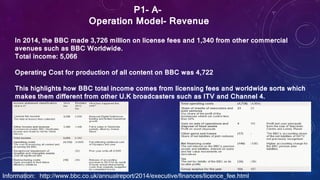
In 2014, the BBC made 3,726 million on license fees and 1,340 from other commercial
avenues such as BBC Worldwide.
Total income: 5,066
Operating Cost for production of all content on BBC was 4,722
This highlights how BBC total income comes from licensing fees and worldwide sorts which
makes them different from other U.K broadcasters such as ITV and Channel 4.

P1 a uk tv

  • 1.
  • 2.
    http://www.mediastudentsbook.com/content/case-study-outline-history-tv-uk THE EARLY YEARS 1936–55 Inthe early years T.V was only for the metropolitan middle class. For short time during1939-1946 all broadcasting was disrupted because of the war. Back then the BBC only had one channel and could only be received by 81 percentage of the population. Viewers were required to have a radio and T.V license. In 1955 only four and a half A UNIVERSAL PUBLIC SERVICE 1955–82 Introduction of the ‘commercial’ or ‘independent’ television. However, the BBC introduced a new channel with a higher resolution in 1964. In 1967 the ‘switchover’ to colour transmissions began and the final ‘switchover was made in 1985. T.V broadcasting companies such as BBBC and ITV were closely controlled but THE BEGINNINGS OF PLURALISM 1982–90 In 1982, Channel Four was established. This meant that it was not under the BBC and therefore could raise a diverse audience. Channel four was the first public organisation. T was funded by various advertising revenue. Although, they did not produce their own programmes they because a ‘ broadcaster publisher and created this new form of television where a wider spread THE MULTI-CHANNEL ENVIRONMENT, 1990 ONWARD In 1990 and 1996, the Broadcasting Act legislated ‘ independent television’ where digital broadcasting would provide more variety in channels along side computer services. This meant that after 35 years, BBC, Channel Four and ITV would share their audience with other broadcasters. HISTORY OF UK TV
  • 3.
    WHAT IS UKTV BROADCASTING?• Television broadcasting in the UK, was introduced as an extension of radio broadcasting. Its development was the responsibility of the BBC. • The BBC was set up as the British Broadcasting Company in 1922 by a group of manufacturers of wireless equipment – an early attempt by hardware manufacturers to create software and a distribution system. • The BBC is a private sector organisation was the world’s first ‘national broadcaster’ but during the General Strike of 1926, On 1st January 1927, the British Broadcasting Corporation was founded with a Royal Charter and granted a licence to broadcast. The new corporation had a measure of independence from the state. http://www.mediastudentsbook.com/content/case-study-outline-history-tv-uk
  • 4.
    P1 A-OWNERSHIPMedia regulators TheDepartment for Culture, Media and Sport (DCMS). Government is responsible for broadcasting and creative industries in the UK . The UK communications industries, with responsibilities across television, radio, telecommunications and wireless communications services is controlled by Ofcom an independent regulator competition authority Website address http://www.bbc.co.uk/aboutthebbc/insidethebbc/manageme ntstructure/bbcstructure
  • 5.
    P1 A-OWNERSHIP Website address http://www.bbc.co.uk/aboutthebbc/insidethebbc/managementstructure/b bcstructure RoyalCharter The BBC is established under a Royal Charter. The charter that is in place now has been going since 2007 and end this year. This means that it will be reviewed and the Royal Charter will decide if they will continue to support the BBC. BBC Trust The strategy and direction of the BBC is set through the BBC Trust which is governed by the Royal Charter. The BBC Trust has a clear duty to represent the interests of the licence fee payers. The Trust sets purpose remits, issues service licences and holds the Executive Board to account for its performance in delivering BBC services. The Trust works closely with national Audience Councils in order to understand the needs and concerns of audiences. Executive The Executive Board is responsible for the operational management of the BBC in controlled by The Executive Board. Directors from across the BBC contribute to the leadership of the organisation as part of the Executive Team.
  • 7.
    P1- A- OPERATING MODEL-EXECUTIVE STRUCTURE • Directors from across the BBC contribute to the leadership of the organisation as part of the Executive Team. The Executive Board is in charge of the BBC. The board responsibility is deliver the BBC’s services in accordance with the strategy agreed with the BBC Trust, and for all aspects of operational management. • BBC Trust appoints the Director-General is chairman of the Executive Board, as well as chief executive and editor- in-chief of the BBC; The Board is a mixture of executive directors from within the BBC and non-executive directors, who bring external expertise and insight to the operation of the Board. The Executive Board meets monthly, and they share the outcomes of these meetings online. Changes to the Executive Board On Friday 5 February it was announced that Sir Nicholas Serota would be joining the Executive Board as a Non- Executive Director. Sir Nicholas will take up his role on 1 August 2016. Charlotte Moore is currently attending the Executive Board in her capacity as Acting Director, Television.
  • 8.
    Executive Team In additionto the directors who make up the Board, other directors are engaged in the Executive Team, which looks at pan-BBC issues and ensures that all divisions are involved in delivering the BBC’s objectives.
  • 9.
  • 10.
  • 11.
    P1- A- Operation Model-Partnerships Partnership through Make It Digital • ‘Micro Bit’ coding device to all year 7 children across the UK for free to inspire a future generation - 1 million devices in total. • Programmes and online activity involving the BBC’s biggest and best-loved brands, including Doctor Who, EastEnders, Radio 1, The One Show, Children in Need, BBC Weather and many more. • The Make it Digital Traineeship to up to 5,000 young unemployed people. • Partnerships with around 50 major organisations across the UK, including Apps for Good, ARM, Barclays, British Computing Society, BT, Code Club, DWP, Google, iDEA, Microsoft, Nesta, Samsung, Skills Funding Agency, Tech City UK, the Tech Partnership, TeenTech, Young Rewired State. • In Get Creative we'll be working closely with a huge number of external organisations including Culture at King’s, Voluntary Arts, 64 Million Artists, Fun Palaces, Cultural Learning Alliance, and Arts Council England, as well as Culture 24, The Royal Shakespeare Company, the BFI, The Roundhouse, Sadler’s Wells, The Young Vic, National Theatre Wales, Arts Council Wales and many more. It’s the first time amateur and professional arts organisations have come together on a national project of this scale. Information: http://www.bbc.co.uk/aboutthebbc/insidethebbc/howwework/partnerships
  • 12.
    The BBC doesnot carry out any advertising or sponsorship on its public services. They do this because they want to remain independent of commercial interests and ensure they can be run purely to serve the general public interest. If airtime was sold either wholly or partially, advertisers and other commercial pressures would be able to have their say on when the programme is filmed and schedule priorities. Which deceases the There revenue for broadcasters. To guarantee a wide range of unrestricted programmes, each households pays for a T.V license. This guarantees that a wide range of high-quality programmes can be made available, unrestricted, to everyone. The licence fee also helps support production skills, training, local The BBC runs additional commercial services around the world. These are not financed by the licence fee but are kept quite separate from the BBC's public services. P1- A- Operating Model- Relationship with Advertisers http://www.bbc.co.uk/aboutthebbc/insidethebbc/howwework/policiesandguidelines/advertising.html
  • 13.
    Information: http://www.bbc.co.uk/annualreport/2014/executive/finances/licence_fee.html P1- A- OperationModel- Revenue In 2014, the BBC made 3,726 million on license fees and 1,340 from other commercial avenues such as BBC Worldwide. Total income: 5,066 Operating Cost for production of all content on BBC was 4,722 This highlights how BBC total income comes from licensing fees and worldwide sorts which makes them different from other U.K broadcasters such as ITV and Channel 4.