Seminar On
Role of FBG Sensors In Health Mointoring bridges
Railway
NARESH KUMAR
Enroll. No. 11593057
Introduction
In- Fibre Bragg grating (FBG) sensors have been subject to continuous and rapid
development since they were first demonstrated for strain and temperature
measurement.
1. The main reasons for this is because FBG sensors have a number of
distinguishing advantages over other implementations of fibre optic sensors,
including potentially low cost and unique wavelength-multiplexing capacity. The
transduction mechanism is the modulation at the reflection wavelength of the
sensing element.
2. The general aspects of the FBG sensors technology, including sensing
principle, properties fabrication, interrogation and multiplexing technique, have
been systematically reviewed by the author.
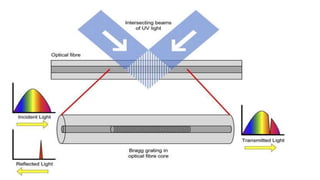
➔ Fiber Bragg Grating (FBG) is a periodic variation of the index of refraction in
the core of an optical fiber.
● The reflection from the periodic structure will add up in phase when
which is the Bragg condition.
● Fabrication
➔ When fiber is exposed to a pair of interfering UV beams then we would obtain
an interference pattern.
➔ In region of constructive interference the refractive index increases.
➔ The period (width) of grating can be controlled by angle between interfering
beams.
➔ Exposing a germanium doped silica fiber to the interference pattern formed
between two UV beams leads to formation of periodic refractive index
variation in the core of the fiber.
● Technology Advantages
➔ Multiplexing
➔ Multifunctionality
➔ Long transmission distance
➔ Electric isolation
➔ Signal integrity
➔ Long term stability
Disadvantages
1.High cost of maintenance
2.Skiilled labor
3. reduction of motion artefacts
Applications
1. Weight measurement
2. Strength of bridges
3. To avoid derailment
4. Wheel balancing
5. Health monitoring`
6. Taking care of bridges and buildings
LITERATURE REVIEW
Year Author(s) Area of Study Conclusion(s)
2005 Berardis et al. Use of FBG sensors for
weight in motion
Development of a WIM technique based on use
of FBG sensors and with high weight resolution
was demonstrated by
use of a small sized
to solve problems related to
constrains imposed by high speed traffic that
could affect the performance of the system,
such as installation beneath
asphalt layer.
2005 TAM et al. Fiber Bragg Grating
Sensors for Structural and
Railway Applications
Two field trials using FBG sensor arrays for
train speed measurement and for strain
measurements on different locations
(suspension cable, rocker and truss girders) of
the TsingMa Bridge were performed
successfully
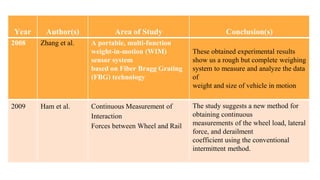
2008 Zhang et al. A portable, multi-function
weight-in-motion (WIM)
sensor system
based on Fiber Bragg Grating
(FBG) technology
These obtained experimental results
show us a rough but complete weighing
system to measure and analyze the data
of
weight and size of vehicle in motion
2009 Ham et al. Continuous Measurement of
Interaction
Forces between Wheel and Rail
The study suggests a new method for
obtaining continuous
measurements of the wheel load, lateral
force, and derailment
coefficient using the conventional
intermittent method.
Year Author(s) Area of Study Conclusion(s)
2011 Kolakowski
et al.
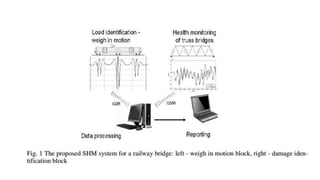
Weighing of trains in motion
as a part of health monitoring
system for a raiway bridge.
This paper presents numerical and
experimental results of a WIM
procedure, which is meant to
be a part of an integrated SHM system
dedicated to railway truss bridges
2012 Sekua and
akowski
Piezo-based weigh-in-motion
system for the railway transport
This paper presents numerical and
experimental results of a WIM
procedure, which is meant to
be a part of an integrated SHM system
dedicated to railway truss bridges
Year Author(s) Area of Study Conclusion(s)
2014 Yuen Novel application
of a fibre optic-
based train
weigh-in-motion
system in railway
Installation architecture and
data interpretation for train
vibration measurement and
wheel loading
measurement
have been developed. The
findings can serve as
reference
for future FBG railway
usage
REFERENCES
1. S. Berardis, M. A. Caponerob, F. Fellia, F. Roccoa ‘Use of FBG sensors for weigh in motion’
(2005) Vol.5855
2. H.Y. TAM, S.Y. Liu, B.O. Guan, W.H. Chung, T.H.T Chan and L.K. Cheng“Fiber Bragg Grating
Sensors for Structural and Railway Applications” (2005) Vol.5634
3. Hongtao Zhang, Zhanxiong Wei, Qiming Zhao, Liang Guan, Jilin Zou, Lingling Fan, Shangming
Yang, Dongcao Song, Gregory Recine, Hong-Liang Cui “A portable, multi-function weight-in-
motion (WIM) sensor system based on Fiber Bragg Grating (FBG) technology”
(2008)Vol.7004
REFERENCES (contd.)
4. Young-Sam Ham, Dong-Hyong Lee, Seok-Jin Kwon, Won-Hee You and Taek-Yul Oh
“Continuous Measurement of Interaction Forces between Wheel and Rail”(2009) Vol.10
5. P. Kołakowski, K. Sekuła, D. Sala, A. Świercz & A. Orłowska “ Weighing of trains in motion as a
part of health monitoring system for a railway bridge”(2011)
6. Krzysztof Seku and Przemys Ko akowski “Piezo-based weigh-in-motion system for the railway
transport”(2012) Vol.19
7. Ken K. Yuen “Novel application of a fibre optic-based train weigh-in-motion system in
railway”(2014) vol.21

TUSHAR SAINI

  • 1.
    Seminar On Role ofFBG Sensors In Health Mointoring bridges Railway NARESH KUMAR Enroll. No. 11593057
  • 2.
    Introduction In- Fibre Bragggrating (FBG) sensors have been subject to continuous and rapid development since they were first demonstrated for strain and temperature measurement. 1. The main reasons for this is because FBG sensors have a number of distinguishing advantages over other implementations of fibre optic sensors, including potentially low cost and unique wavelength-multiplexing capacity. The transduction mechanism is the modulation at the reflection wavelength of the sensing element. 2. The general aspects of the FBG sensors technology, including sensing principle, properties fabrication, interrogation and multiplexing technique, have been systematically reviewed by the author.
  • 3.
    ➔ Fiber BraggGrating (FBG) is a periodic variation of the index of refraction in the core of an optical fiber.
  • 6.
    ● The reflectionfrom the periodic structure will add up in phase when which is the Bragg condition.
  • 7.
    ● Fabrication ➔ Whenfiber is exposed to a pair of interfering UV beams then we would obtain an interference pattern. ➔ In region of constructive interference the refractive index increases. ➔ The period (width) of grating can be controlled by angle between interfering beams. ➔ Exposing a germanium doped silica fiber to the interference pattern formed between two UV beams leads to formation of periodic refractive index variation in the core of the fiber.
  • 9.
    ● Technology Advantages ➔Multiplexing ➔ Multifunctionality ➔ Long transmission distance ➔ Electric isolation ➔ Signal integrity ➔ Long term stability
  • 10.
    Disadvantages 1.High cost ofmaintenance 2.Skiilled labor 3. reduction of motion artefacts
  • 11.
    Applications 1. Weight measurement 2.Strength of bridges 3. To avoid derailment 4. Wheel balancing 5. Health monitoring` 6. Taking care of bridges and buildings
  • 12.
    LITERATURE REVIEW Year Author(s)Area of Study Conclusion(s) 2005 Berardis et al. Use of FBG sensors for weight in motion Development of a WIM technique based on use of FBG sensors and with high weight resolution was demonstrated by use of a small sized to solve problems related to constrains imposed by high speed traffic that could affect the performance of the system, such as installation beneath asphalt layer. 2005 TAM et al. Fiber Bragg Grating Sensors for Structural and Railway Applications Two field trials using FBG sensor arrays for train speed measurement and for strain measurements on different locations (suspension cable, rocker and truss girders) of the TsingMa Bridge were performed successfully
  • 13.
    2008 Zhang etal. A portable, multi-function weight-in-motion (WIM) sensor system based on Fiber Bragg Grating (FBG) technology These obtained experimental results show us a rough but complete weighing system to measure and analyze the data of weight and size of vehicle in motion 2009 Ham et al. Continuous Measurement of Interaction Forces between Wheel and Rail The study suggests a new method for obtaining continuous measurements of the wheel load, lateral force, and derailment coefficient using the conventional intermittent method. Year Author(s) Area of Study Conclusion(s)
  • 14.
    2011 Kolakowski et al. Weighingof trains in motion as a part of health monitoring system for a raiway bridge. This paper presents numerical and experimental results of a WIM procedure, which is meant to be a part of an integrated SHM system dedicated to railway truss bridges 2012 Sekua and akowski Piezo-based weigh-in-motion system for the railway transport This paper presents numerical and experimental results of a WIM procedure, which is meant to be a part of an integrated SHM system dedicated to railway truss bridges Year Author(s) Area of Study Conclusion(s)
  • 15.
    Year Author(s) Areaof Study Conclusion(s) 2014 Yuen Novel application of a fibre optic- based train weigh-in-motion system in railway Installation architecture and data interpretation for train vibration measurement and wheel loading measurement have been developed. The findings can serve as reference for future FBG railway usage
  • 16.
    REFERENCES 1. S. Berardis,M. A. Caponerob, F. Fellia, F. Roccoa ‘Use of FBG sensors for weigh in motion’ (2005) Vol.5855 2. H.Y. TAM, S.Y. Liu, B.O. Guan, W.H. Chung, T.H.T Chan and L.K. Cheng“Fiber Bragg Grating Sensors for Structural and Railway Applications” (2005) Vol.5634 3. Hongtao Zhang, Zhanxiong Wei, Qiming Zhao, Liang Guan, Jilin Zou, Lingling Fan, Shangming Yang, Dongcao Song, Gregory Recine, Hong-Liang Cui “A portable, multi-function weight-in- motion (WIM) sensor system based on Fiber Bragg Grating (FBG) technology” (2008)Vol.7004
  • 17.
    REFERENCES (contd.) 4. Young-SamHam, Dong-Hyong Lee, Seok-Jin Kwon, Won-Hee You and Taek-Yul Oh “Continuous Measurement of Interaction Forces between Wheel and Rail”(2009) Vol.10 5. P. Kołakowski, K. Sekuła, D. Sala, A. Świercz & A. Orłowska “ Weighing of trains in motion as a part of health monitoring system for a railway bridge”(2011) 6. Krzysztof Seku and Przemys Ko akowski “Piezo-based weigh-in-motion system for the railway transport”(2012) Vol.19 7. Ken K. Yuen “Novel application of a fibre optic-based train weigh-in-motion system in railway”(2014) vol.21