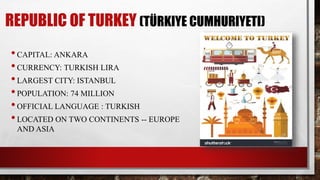
REPUBLIC OF TURKEY (TÜRKIYE CUMHURIYETI)
•CAPITAL: ANKARA
•CURRENCY: TURKISH LIRA
•LARGEST CITY: ISTANBUL
•POPULATION: 74 MILLION
•OFFICIAL LANGUAGE : TURKISH
•LOCATED ON TWO CONTINENTS -- EUROPE
AND ASIA
HISTORY
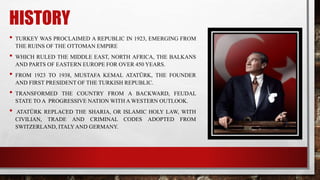
• TURKEY WAS PROCLAIMED A REPUBLIC IN 1923, EMERGING FROM
THE RUINS OF THE OTTOMAN EMPIRE
• WHICH RULED THE MIDDLE EAST, NORTH AFRICA, THE BALKANS
AND PARTS OF EASTERN EUROPE FOR OVER 450 YEARS.
• FROM 1923 TO 1938, MUSTAFA KEMAL ATATÜRK, THE FOUNDER
AND FIRST PRESIDENT OF THE TURKISH REPUBLIC.
• TRANSFORMED THE COUNTRY FROM A BACKWARD, FEUDAL
STATE TO A PROGRESSIVE NATION WITH A WESTERN OUTLOOK.
• ATATÜRK REPLACED THE SHARIA, OR ISLAMIC HOLY LAW, WITH
CIVILIAN, TRADE AND CRIMINAL CODES ADOPTED FROM
SWITZERLAND, ITALYAND GERMANY.
PEST ANALYSIS
P E
S T
POLITICAL
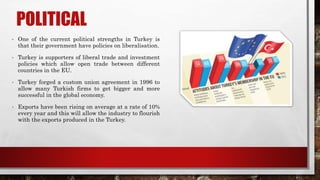
• One of the current political strengths in Turkey is
that their government have policies on liberalisation.
• Turkey is supporters of liberal trade and investment
policies which allow open trade between different
countries in the EU.
• Turkey forged a custom union agreement in 1996 to
allow many Turkish firms to get bigger and more
successful in the global economy.
• Exports have been rising on average at a rate of 10%
every year and this will allow the industry to flourish
with the exports produced in the Turkey.
ECONOMICAL
• One of the current economic strengths in Turkey is that
there is a high flow of foreign investment coming from
abroad. The investment plays apart in Turkey's speedy
expansion and this has been driving the country's economic
growth.
• The money generated from foreign investment will be used
for expanding the infrastructure of the country.
• The economy of Turkey is defined as an emerging market
economy by the IMF.
• Turkey is also defined by economists and political scientists
as one of the world's newly industrialized countries.
• The country is among the world's leading producers of
agricultural products; textiles; motor vehicles, ships and
other transportation equipment; construction materials;
consumer electronics and home appliances.
SOCIAL
• One of the social system strengths in Turkey is that they have growing proportion of young
population as they have more than half the population being aged below 30.
• This will allow Turkey to increase their employment rate by getting the most out of the young
labour force.
• This is an advantage for the business and Industry being brought into Turkey as shows there is a
healthy supply of young population willing to work so the company could create jobs for these
people.
• Turkish culture is influenced by the ancient history of Anatolia, the Mediterranean, the
Middle east, the Caucasus, eastern Europe, and certainly by the Aegean culture.
TECHNOLOGY
• The Republic of Turkey has long been and continues to be an advocate of raising science and
technology to new heights.
• One of the technological strength's in Turkey is the significant development in the ICT sector.
• Launched in 2004, one of the subsequent triggers in the Turkish model is the conceptualization of
the Turkish Research Area (TARAL).
• TARAL set into motion a mobilization with which the private and public sectors, together with
NGOs, strategically focus and collaborate on R&D and innovation.
• The TARAL objectives that are to be achieved are to (a) enhance the quality of life, (b) find
innovative solutions to societal needs, (c) increase the competitiveness of the country, and (d)
foster and diffuse S&T awareness in society.
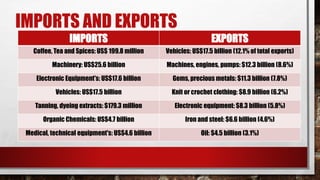
IMPORTS AND EXPORTS
IMPORTS EXPORTS
Coffee, Tea and Spices: US$ 199.8 million Vehicles: US$17.5 billion (12.1% of total exports)
Machinery: US$25.6 billion Machines, engines, pumps: $12.3 billion (8.6%)
Electronic Equipment's: US$17.6 billion Gems, precious metals: $11.3 billion (7.8%)
Vehicles: US$17.5 billion Knit or crochet clothing: $8.9 billion (6.2%)
Tanning, dyeing extracts: $179.3 million Electronic equipment: $8.3 billion (5.8%)
Organic Chemicals: US$4.7 billion Iron and steel: $6.6 billion (4.6%)
Medical, technical equipment's: US$4.6 billion Oil: $4.5 billion (3.1%)
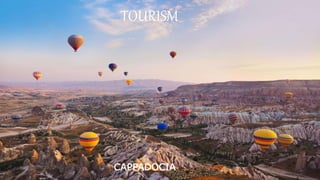
TOURISM
CAPPADOCIA
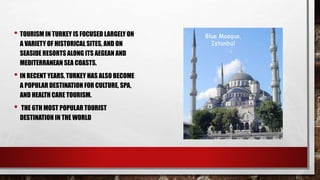
• TOURISM IN TURKEY IS FOCUSED LARGELY ON
A VARIETY OF HISTORICAL SITES, AND ON
SEASIDE RESORTS ALONG ITS AEGEAN AND
MEDITERRANEAN SEA COASTS.
• IN RECENT YEARS, TURKEY HAS ALSO BECOME
A POPULAR DESTINATION FOR CULTURE, SPA,
AND HEALTH CARE TOURISM.
• THE 6TH MOST POPULAR TOURIST
DESTINATION IN THE WORLD
Blue Mosque,
Istanbul
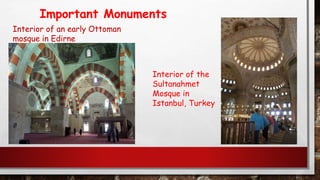
Important Monuments
Interior of an early Ottoman
mosque in Edirne
Interior of the
Sultanahmet
Mosque in
Istanbul, Turkey
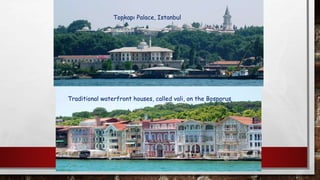
Topkapı Palace, Istanbul
Traditional waterfront houses, called vali, on the Bosporus
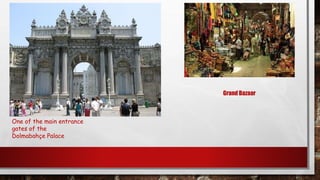
One of the main entrance
gates of the
Dolmabahçe Palace
Grand Bazaar
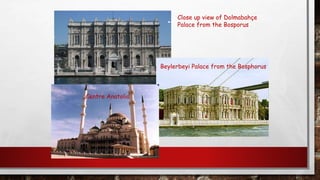
Close up view of Dolmabahçe
Palace from the Bosporus
Beylerbeyi Palace from the Bosphorus
Centre Anatolia
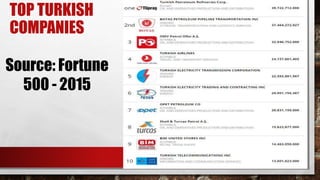
TOP TURKISH
COMPANIES
Source: Fortune
500 - 2015
TURKISH
AIRLINES
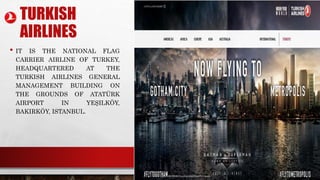
• IT IS THE NATIONAL FLAG
CARRIER AIRLINE OF TURKEY,
HEADQUARTERED AT THE
TURKISH AIRLINES GENERAL
MANAGEMENT BUILDING ON
THE GROUNDS OF ATATÜRK
AIRPORT IN YEŞILKÖY,
BAKIRKÖY, ISTANBUL.
TÜPRAŞ
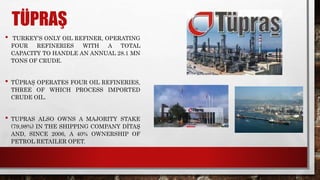
• TURKEY’S ONLY OIL REFINER, OPERATING
FOUR REFINERIES WITH A TOTAL
CAPACITY TO HANDLE AN ANNUAL 28.1 MN
TONS OF CRUDE.
• TÜPRAŞ OPERATES FOUR OIL REFINERIES,
THREE OF WHICH PROCESS IMPORTED
CRUDE OIL.
• TUPRAS ALSO OWNS A MAJORITY STAKE
(79,98%) IN THE SHIPPING COMPANY DİTAŞ
AND, SINCE 2006, A 40% OWNERSHIP OF
PETROL RETAILER OPET.
INDIAN COMPANIES
• MORE THAN 150 COMPANIES WITH INDIAN CAPITAL HAVE REGISTERED
BUSINESSES IN TURKEY IN THE FORM OF JOINT VENTURES, TRADE AND
REPRESENTATIVE OFFICES.
• THESE INCLUDE M/S POLYPLEX, GMR INFRASTRUCTURE, TATA MOTORS,
MAHINDRA & MAHINDRA , RELIANCE, ISPAT, ADITYA BIRLA GROUP,
TRACTORS AND FARM EQUIPMENT LTD., JAIN IRRIGATION, WIPRO AND
DABUR.
THANK YOU
Benoy Abraham

Turkey

  • 2.
    REPUBLIC OF TURKEY(TÜRKIYE CUMHURIYETI) •CAPITAL: ANKARA •CURRENCY: TURKISH LIRA •LARGEST CITY: ISTANBUL •POPULATION: 74 MILLION •OFFICIAL LANGUAGE : TURKISH •LOCATED ON TWO CONTINENTS -- EUROPE AND ASIA
  • 3.
    HISTORY • TURKEY WASPROCLAIMED A REPUBLIC IN 1923, EMERGING FROM THE RUINS OF THE OTTOMAN EMPIRE • WHICH RULED THE MIDDLE EAST, NORTH AFRICA, THE BALKANS AND PARTS OF EASTERN EUROPE FOR OVER 450 YEARS. • FROM 1923 TO 1938, MUSTAFA KEMAL ATATÜRK, THE FOUNDER AND FIRST PRESIDENT OF THE TURKISH REPUBLIC. • TRANSFORMED THE COUNTRY FROM A BACKWARD, FEUDAL STATE TO A PROGRESSIVE NATION WITH A WESTERN OUTLOOK. • ATATÜRK REPLACED THE SHARIA, OR ISLAMIC HOLY LAW, WITH CIVILIAN, TRADE AND CRIMINAL CODES ADOPTED FROM SWITZERLAND, ITALYAND GERMANY.
  • 4.
  • 5.
    POLITICAL • One ofthe current political strengths in Turkey is that their government have policies on liberalisation. • Turkey is supporters of liberal trade and investment policies which allow open trade between different countries in the EU. • Turkey forged a custom union agreement in 1996 to allow many Turkish firms to get bigger and more successful in the global economy. • Exports have been rising on average at a rate of 10% every year and this will allow the industry to flourish with the exports produced in the Turkey.
  • 6.
    ECONOMICAL • One ofthe current economic strengths in Turkey is that there is a high flow of foreign investment coming from abroad. The investment plays apart in Turkey's speedy expansion and this has been driving the country's economic growth. • The money generated from foreign investment will be used for expanding the infrastructure of the country. • The economy of Turkey is defined as an emerging market economy by the IMF. • Turkey is also defined by economists and political scientists as one of the world's newly industrialized countries. • The country is among the world's leading producers of agricultural products; textiles; motor vehicles, ships and other transportation equipment; construction materials; consumer electronics and home appliances.
  • 7.
    SOCIAL • One ofthe social system strengths in Turkey is that they have growing proportion of young population as they have more than half the population being aged below 30. • This will allow Turkey to increase their employment rate by getting the most out of the young labour force. • This is an advantage for the business and Industry being brought into Turkey as shows there is a healthy supply of young population willing to work so the company could create jobs for these people. • Turkish culture is influenced by the ancient history of Anatolia, the Mediterranean, the Middle east, the Caucasus, eastern Europe, and certainly by the Aegean culture.
  • 8.
    TECHNOLOGY • The Republicof Turkey has long been and continues to be an advocate of raising science and technology to new heights. • One of the technological strength's in Turkey is the significant development in the ICT sector. • Launched in 2004, one of the subsequent triggers in the Turkish model is the conceptualization of the Turkish Research Area (TARAL). • TARAL set into motion a mobilization with which the private and public sectors, together with NGOs, strategically focus and collaborate on R&D and innovation. • The TARAL objectives that are to be achieved are to (a) enhance the quality of life, (b) find innovative solutions to societal needs, (c) increase the competitiveness of the country, and (d) foster and diffuse S&T awareness in society.
  • 9.
    IMPORTS AND EXPORTS IMPORTSEXPORTS Coffee, Tea and Spices: US$ 199.8 million Vehicles: US$17.5 billion (12.1% of total exports) Machinery: US$25.6 billion Machines, engines, pumps: $12.3 billion (8.6%) Electronic Equipment's: US$17.6 billion Gems, precious metals: $11.3 billion (7.8%) Vehicles: US$17.5 billion Knit or crochet clothing: $8.9 billion (6.2%) Tanning, dyeing extracts: $179.3 million Electronic equipment: $8.3 billion (5.8%) Organic Chemicals: US$4.7 billion Iron and steel: $6.6 billion (4.6%) Medical, technical equipment's: US$4.6 billion Oil: $4.5 billion (3.1%)
  • 10.
  • 11.
    • TOURISM INTURKEY IS FOCUSED LARGELY ON A VARIETY OF HISTORICAL SITES, AND ON SEASIDE RESORTS ALONG ITS AEGEAN AND MEDITERRANEAN SEA COASTS. • IN RECENT YEARS, TURKEY HAS ALSO BECOME A POPULAR DESTINATION FOR CULTURE, SPA, AND HEALTH CARE TOURISM. • THE 6TH MOST POPULAR TOURIST DESTINATION IN THE WORLD Blue Mosque, Istanbul
  • 12.
    Important Monuments Interior ofan early Ottoman mosque in Edirne Interior of the Sultanahmet Mosque in Istanbul, Turkey
  • 13.
    Topkapı Palace, Istanbul Traditionalwaterfront houses, called vali, on the Bosporus
  • 14.
    One of themain entrance gates of the Dolmabahçe Palace Grand Bazaar
  • 15.
    Close up viewof Dolmabahçe Palace from the Bosporus Beylerbeyi Palace from the Bosphorus Centre Anatolia
  • 16.
  • 17.
    TURKISH AIRLINES • IT ISTHE NATIONAL FLAG CARRIER AIRLINE OF TURKEY, HEADQUARTERED AT THE TURKISH AIRLINES GENERAL MANAGEMENT BUILDING ON THE GROUNDS OF ATATÜRK AIRPORT IN YEŞILKÖY, BAKIRKÖY, ISTANBUL.
  • 18.
    TÜPRAŞ • TURKEY’S ONLYOIL REFINER, OPERATING FOUR REFINERIES WITH A TOTAL CAPACITY TO HANDLE AN ANNUAL 28.1 MN TONS OF CRUDE. • TÜPRAŞ OPERATES FOUR OIL REFINERIES, THREE OF WHICH PROCESS IMPORTED CRUDE OIL. • TUPRAS ALSO OWNS A MAJORITY STAKE (79,98%) IN THE SHIPPING COMPANY DİTAŞ AND, SINCE 2006, A 40% OWNERSHIP OF PETROL RETAILER OPET.
  • 19.
    INDIAN COMPANIES • MORETHAN 150 COMPANIES WITH INDIAN CAPITAL HAVE REGISTERED BUSINESSES IN TURKEY IN THE FORM OF JOINT VENTURES, TRADE AND REPRESENTATIVE OFFICES. • THESE INCLUDE M/S POLYPLEX, GMR INFRASTRUCTURE, TATA MOTORS, MAHINDRA & MAHINDRA , RELIANCE, ISPAT, ADITYA BIRLA GROUP, TRACTORS AND FARM EQUIPMENT LTD., JAIN IRRIGATION, WIPRO AND DABUR.
  • 20.