Turabian, 8th Edition
Contents of this presentation come either from
http://www.press.uchicago.edu/books/turabian/
turabian_citationguide.html
or from the Turabian Manual, 8th ed. (2003)
Turabian
Turabian's Manual for Writers of Research Papers,
Theses, and Dissertations is an abbreviated guide to
the Chicago Manual of Style.
Books One Author
Footnote
1. Wendy Doniger, Splitting the Difference
(Chicago: University of Chicago Press, 1999), 65.
Bibliography
Doniger, Wendy. Splitting the Difference. Chicago:
University of Chicago Press, 1999.
When the publisher city is a major, well-known city,
no state identification is needed, but if it is a lesser
known city, such as Cleveland, TN, then the two
letter (both capitalized) state abbreviation is used
followed by a colon (no period) and then the
publisher name.
Book Two Authors
Footnote:
6. Guy Cowlishaw and Robin Dunbar, Primate
Conservation Biology (Chicago: University of
Chicago Press, 2000), 104–7.
Bibliography:
Cowlishaw, Guy, and Robin Dunbar. Primate
Conservation Biology. Chicago: University of
Chicago Press, 2000.
Book Four or More Authors
Footnote:
13. Edward O. Laumann et al., The Social
Organization of Sexuality: Sexual Practices in the
United States (Chicago: University of Chicago Press,
1994), 262.
Bibliography:
Laumann, Edward O., John H. Gagnon, Robert T.
Michael, and Stuart Michaels. The Social
Organization of Sexuality: Sexual Practices in the
United States. Chicago: University of Chicago
Press, 1994.
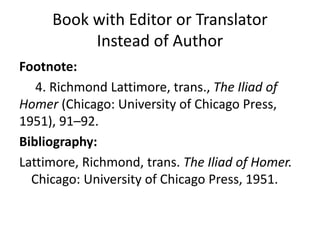
Book with Editor or Translator
Instead of Author
Footnote:
4. Richmond Lattimore, trans., The Iliad of
Homer (Chicago: University of Chicago Press,
1951), 91–92.
Bibliography:
Lattimore, Richmond, trans. The Iliad of Homer.
Chicago: University of Chicago Press, 1951.
Editor, translator, or compiler in
addition to author
Footnote:
16. Yves Bonnefoy, New and Selected Poems,
ed. John Naughton and Anthony Rudolf
(Chicago: University of Chicago Press, 1995), 22.
Bibliography:
Bonnefoy, Yves. New and Selected Poems. Edited
by John Naughton and Anthony Rudolf.
Chicago: University of Chicago Press, 1995.
Chapter or other part of a book
Footnote:
5. Andrew Wiese, “‘The House I Live In’: Race, Class,
and African American Suburban Dreams in the Postwar
United States,” in The New Suburban History, ed. Kevin M.
Kruse and Thomas J. Sugrue (Chicago: University of
Chicago Press, 2006), 101–2.
Bibliography:
Wiese, Andrew. “‘The House I Live In’: Race, Class, and
African American Suburban Dreams in the Postwar
United States.” In The New Suburban History, edited by
Kevin M. Kruse and Thomas J. Sugrue, 99–119. Chicago:
University of Chicago Press, 2006.
Book published electronically
Footnote:
2. Philip B. Kurland and Ralph Lerner, eds., The
Founders’ Constitution (Chicago: University of
Chicago Press, 1987), accessed June 27, 2006,
http://press-pubs.uchicago.edu/founders/.
Bibliography:
Kurland, Philip B., and Ralph Lerner, eds. The
Founders’ Constitution. Chicago: University of
Chicago Press, 1987. Accessed June 27, 2006.
http://press-pubs.uchicago.edu/founders/).
Article in a print journal
Footnote:
8. John Maynard Smith, “The Origin of
Altruism,” Nature 393 (1998): 639.
Bibliography:
Smith, John Maynard. “The Origin of Altruism.”
Nature 393 (1998): 639–40.
Article in an online journal
Footnote:
33. Mark A. Hlatky et al., "Quality-of-Life and Depressive
Symptoms in Postmenopausal Women after Receiving Hormone
Therapy: Results from the Heart and Estrogen/Progestin Replacement
Study (HERS) Trial," Journal of the American Medical Association 287,
no. 5 (2002), accessed January 7, 2004, http://jama.ama-
assn.org/issues/v287n5/rfull/joc10108.html#aainfo.
Bibliography:
Hlatky, Mark A., Derek Boothroyd, Eric Vittinghoff, Penny Sharp, and
Mary A. Whooley. "Quality-of-Life and Depressive Symptoms in
Postmenopausal Women after Receiving Hormone Therapy: Results
from the Heart and Estrogen/Progestin Replacement Study (HERS)
Trial." Journal of the American Medical Association 287, no. 5
(February 6, 2002), Accessed January 7, 2004. http://jama.ama-
assn.org/issues/v287n5/rfull/joc10108.html#aainfo.
Popular magazine article
Footnote:
29. Steve Martin, “Sports-Interview Shocker,”
New Yorker, May 6, 2002, 84.
Bibliography:
Martin, Steve. “Sports-Interview Shocker.” New
Yorker, May 6, 2002.
Newspaper article
Newspaper articles may be cited in running text (“As
William Niederkorn noted in a New York Times article on
June 20, 2002, . . . ”) instead of in a note or a
parenthetical citation, and they are commonly omitted
from a bibliography or reference list as well. The following
examples show the more formal versions of the citations.
Footnote:
10. William S. Niederkorn, “A Scholar Recants on His
‘Shakespeare’ Discovery,” New York Times, June 20, 2002,
Arts section, Midwest edition.
Bibliography:
Niederkorn, William S. “A Scholar Recants on His
‘Shakespeare’ Discovery.” New York Times, June 20,
2002, Arts section, Midwest edition.
Web site
Web sites may be cited in running text (“On its Web site, the
Evanston Public Library Board of Trustees states . . .”) instead
of in a parenthetical citation, and they are commonly omitted
from a bibliography or reference list as well. The following
examples show the more formal versions of the citations.
Footnote:
11. Evanston Public Library Board of Trustees, “Evanston
Public Library Strategic Plan, 2000–2010: A Decade of
Outreach,” Evanston Public Library, accessed June 1, 2005,
http://www.epl.org/library/strategic-plan-00.html.
Bibliography:
Evanston Public Library Board of Trustees. “Evanston Public
Library Strategic Plan, 2000–2010: A Decade of Outreach.”
Evanston Public Library. Accessed June 1, 2005.
http://www.epl.org/library/strategic-plan-00.html
Weblog entry or comment
Weblog entries or comments may be cited in running text (“In
a comment posted to the Becker-Posner Blog on March 6,
2006, Peter Pearson noted . . .”) instead of in a note or a
parenthetical citation, and they are commonly omitted from a
bibliography or reference list as well. The following examples
show the more formal versions of the citations.
Footnote:
8. Peter Pearson, comment on “The New American
Dilemma: Illegal Immigration,” The Becker-Posner Blog,
comment posted March 6, 2006, accessed March 28, 2006,
http://www.becker-posner-
blog.com/archives/2006/03/the_new_america.html#c080052.
Bibliography:
Becker-Posner Blog, The. Accessed March 28, 2006.
http://www.becker-posner-blog.com/.
The Bible and Other Sacred Scripture
Cite the Bible in the footnotes. You do not need to
include these works in your bibliography.
For citations from the Bible, include the abbreviated
name of the book, the chapter number, and the verse
number—never a page number.
Footnote:
4. 1 Thess. 4:11 (KJV).
Identify the version you are using in your first
citation, either spelled out or accepted abbreviation.
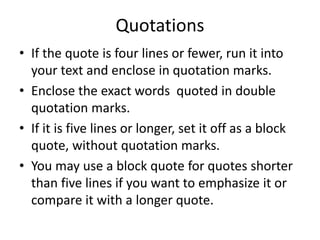
Quotations
• If the quote is four lines or fewer, run it into
your text and enclose in quotation marks.
• Enclose the exact words quoted in double
quotation marks.
• If it is five lines or longer, set it off as a block
quote, without quotation marks.
• You may use a block quote for quotes shorter
than five lines if you want to emphasize it or
compare it with a longer quote.
Block Quotations
• If you introduce the quotation with a complete
sentence, end the sentence with a colon.
• If you use an attribution phrase such as notes,
claims, argues, states, or according to along with
the author’s name, end the phrase with a
comma.
• If you weave the quotation into the syntaxt of the
your sentence, do not use any punctuation
before the quotation if none would normally
appear there.
Block Quote
• Single-space a block quote and leave a blank
line before and after it.
• Do not add quotation marks at the beginning
or end, but preserve any quotation marks in
the original.
• Indent the entire quote as far as you indent
the first line of a paragraph.
Sections and Subsections
• If your paper has only a few sections, you may
signal the division between sections informally
by leaving an extra blank line between
paragraphs.
• Do not add an extra space between every
paragraph.
• If you create formal sections in a paper, you
may give each one its own title.

Turabian lesson

  • 1.
    Turabian, 8th Edition Contentsof this presentation come either from http://www.press.uchicago.edu/books/turabian/ turabian_citationguide.html or from the Turabian Manual, 8th ed. (2003)
  • 2.
    Turabian Turabian's Manual forWriters of Research Papers, Theses, and Dissertations is an abbreviated guide to the Chicago Manual of Style.
  • 3.
    Books One Author Footnote 1.Wendy Doniger, Splitting the Difference (Chicago: University of Chicago Press, 1999), 65. Bibliography Doniger, Wendy. Splitting the Difference. Chicago: University of Chicago Press, 1999. When the publisher city is a major, well-known city, no state identification is needed, but if it is a lesser known city, such as Cleveland, TN, then the two letter (both capitalized) state abbreviation is used followed by a colon (no period) and then the publisher name.
  • 4.
    Book Two Authors Footnote: 6.Guy Cowlishaw and Robin Dunbar, Primate Conservation Biology (Chicago: University of Chicago Press, 2000), 104–7. Bibliography: Cowlishaw, Guy, and Robin Dunbar. Primate Conservation Biology. Chicago: University of Chicago Press, 2000.
  • 5.
    Book Four orMore Authors Footnote: 13. Edward O. Laumann et al., The Social Organization of Sexuality: Sexual Practices in the United States (Chicago: University of Chicago Press, 1994), 262. Bibliography: Laumann, Edward O., John H. Gagnon, Robert T. Michael, and Stuart Michaels. The Social Organization of Sexuality: Sexual Practices in the United States. Chicago: University of Chicago Press, 1994.
  • 6.
    Book with Editoror Translator Instead of Author Footnote: 4. Richmond Lattimore, trans., The Iliad of Homer (Chicago: University of Chicago Press, 1951), 91–92. Bibliography: Lattimore, Richmond, trans. The Iliad of Homer. Chicago: University of Chicago Press, 1951.
  • 7.
    Editor, translator, orcompiler in addition to author Footnote: 16. Yves Bonnefoy, New and Selected Poems, ed. John Naughton and Anthony Rudolf (Chicago: University of Chicago Press, 1995), 22. Bibliography: Bonnefoy, Yves. New and Selected Poems. Edited by John Naughton and Anthony Rudolf. Chicago: University of Chicago Press, 1995.
  • 8.
    Chapter or otherpart of a book Footnote: 5. Andrew Wiese, “‘The House I Live In’: Race, Class, and African American Suburban Dreams in the Postwar United States,” in The New Suburban History, ed. Kevin M. Kruse and Thomas J. Sugrue (Chicago: University of Chicago Press, 2006), 101–2. Bibliography: Wiese, Andrew. “‘The House I Live In’: Race, Class, and African American Suburban Dreams in the Postwar United States.” In The New Suburban History, edited by Kevin M. Kruse and Thomas J. Sugrue, 99–119. Chicago: University of Chicago Press, 2006.
  • 9.
    Book published electronically Footnote: 2.Philip B. Kurland and Ralph Lerner, eds., The Founders’ Constitution (Chicago: University of Chicago Press, 1987), accessed June 27, 2006, http://press-pubs.uchicago.edu/founders/. Bibliography: Kurland, Philip B., and Ralph Lerner, eds. The Founders’ Constitution. Chicago: University of Chicago Press, 1987. Accessed June 27, 2006. http://press-pubs.uchicago.edu/founders/).
  • 10.
    Article in aprint journal Footnote: 8. John Maynard Smith, “The Origin of Altruism,” Nature 393 (1998): 639. Bibliography: Smith, John Maynard. “The Origin of Altruism.” Nature 393 (1998): 639–40.
  • 11.
    Article in anonline journal Footnote: 33. Mark A. Hlatky et al., "Quality-of-Life and Depressive Symptoms in Postmenopausal Women after Receiving Hormone Therapy: Results from the Heart and Estrogen/Progestin Replacement Study (HERS) Trial," Journal of the American Medical Association 287, no. 5 (2002), accessed January 7, 2004, http://jama.ama- assn.org/issues/v287n5/rfull/joc10108.html#aainfo. Bibliography: Hlatky, Mark A., Derek Boothroyd, Eric Vittinghoff, Penny Sharp, and Mary A. Whooley. "Quality-of-Life and Depressive Symptoms in Postmenopausal Women after Receiving Hormone Therapy: Results from the Heart and Estrogen/Progestin Replacement Study (HERS) Trial." Journal of the American Medical Association 287, no. 5 (February 6, 2002), Accessed January 7, 2004. http://jama.ama- assn.org/issues/v287n5/rfull/joc10108.html#aainfo.
  • 12.
    Popular magazine article Footnote: 29.Steve Martin, “Sports-Interview Shocker,” New Yorker, May 6, 2002, 84. Bibliography: Martin, Steve. “Sports-Interview Shocker.” New Yorker, May 6, 2002.
  • 13.
    Newspaper article Newspaper articlesmay be cited in running text (“As William Niederkorn noted in a New York Times article on June 20, 2002, . . . ”) instead of in a note or a parenthetical citation, and they are commonly omitted from a bibliography or reference list as well. The following examples show the more formal versions of the citations. Footnote: 10. William S. Niederkorn, “A Scholar Recants on His ‘Shakespeare’ Discovery,” New York Times, June 20, 2002, Arts section, Midwest edition. Bibliography: Niederkorn, William S. “A Scholar Recants on His ‘Shakespeare’ Discovery.” New York Times, June 20, 2002, Arts section, Midwest edition.
  • 14.
    Web site Web sitesmay be cited in running text (“On its Web site, the Evanston Public Library Board of Trustees states . . .”) instead of in a parenthetical citation, and they are commonly omitted from a bibliography or reference list as well. The following examples show the more formal versions of the citations. Footnote: 11. Evanston Public Library Board of Trustees, “Evanston Public Library Strategic Plan, 2000–2010: A Decade of Outreach,” Evanston Public Library, accessed June 1, 2005, http://www.epl.org/library/strategic-plan-00.html. Bibliography: Evanston Public Library Board of Trustees. “Evanston Public Library Strategic Plan, 2000–2010: A Decade of Outreach.” Evanston Public Library. Accessed June 1, 2005. http://www.epl.org/library/strategic-plan-00.html
  • 15.
    Weblog entry orcomment Weblog entries or comments may be cited in running text (“In a comment posted to the Becker-Posner Blog on March 6, 2006, Peter Pearson noted . . .”) instead of in a note or a parenthetical citation, and they are commonly omitted from a bibliography or reference list as well. The following examples show the more formal versions of the citations. Footnote: 8. Peter Pearson, comment on “The New American Dilemma: Illegal Immigration,” The Becker-Posner Blog, comment posted March 6, 2006, accessed March 28, 2006, http://www.becker-posner- blog.com/archives/2006/03/the_new_america.html#c080052. Bibliography: Becker-Posner Blog, The. Accessed March 28, 2006. http://www.becker-posner-blog.com/.
  • 16.
    The Bible andOther Sacred Scripture Cite the Bible in the footnotes. You do not need to include these works in your bibliography. For citations from the Bible, include the abbreviated name of the book, the chapter number, and the verse number—never a page number. Footnote: 4. 1 Thess. 4:11 (KJV). Identify the version you are using in your first citation, either spelled out or accepted abbreviation.
  • 17.
    Quotations • If thequote is four lines or fewer, run it into your text and enclose in quotation marks. • Enclose the exact words quoted in double quotation marks. • If it is five lines or longer, set it off as a block quote, without quotation marks. • You may use a block quote for quotes shorter than five lines if you want to emphasize it or compare it with a longer quote.
  • 18.
    Block Quotations • Ifyou introduce the quotation with a complete sentence, end the sentence with a colon. • If you use an attribution phrase such as notes, claims, argues, states, or according to along with the author’s name, end the phrase with a comma. • If you weave the quotation into the syntaxt of the your sentence, do not use any punctuation before the quotation if none would normally appear there.
  • 19.
    Block Quote • Single-spacea block quote and leave a blank line before and after it. • Do not add quotation marks at the beginning or end, but preserve any quotation marks in the original. • Indent the entire quote as far as you indent the first line of a paragraph.
  • 20.
    Sections and Subsections •If your paper has only a few sections, you may signal the division between sections informally by leaving an extra blank line between paragraphs. • Do not add an extra space between every paragraph. • If you create formal sections in a paper, you may give each one its own title.