TUBERCULOSIS AND
INFERTILITY
Shreya Susan Koshy
 Prevalence:
 Global Prevalence of Genital TB is about 8-10 million cases
 Incidence:
 5 to 10% of the patients with infertility have Genital TB.
 Rising incidence due to increasing prevalence of HIV infection.
 10% of the women with pelvic tuberculosis have a concurrent urinary Tuberculosis
Although genital TB can occur in any age group, the
majority of patients are in the reproductive age
group
 75% being in the 20–45 years age bracket.
Female Genital TB
 Female Genital TB used to be the commonest cause of tubal infertility in women
in TB endemic areas.
 Symptomatic only after 10-15 years of primary infection.
 25% of the cases have a history of TB.
 In most cases it developed secondary to Pulmonary TB (50%)
 Rarely, the primary site of infection is the Cervix
Mode of Spread
 Haematogenous: From a primary site, 90% of the spread occurs in this route. If this
coincides with the growth spurt of pelvic vasculature the reproductive organs (mostly
the Fallopian Tubes) get affected.
 Lymphatic/ Direct: Direct involvement of Pelvic Organs or through the
lymphatics from the infected organs (peritoneum, bowel and mesenteric nodes)
 Ascending: Sexual transmission from a male with urogenital tuberculosis causes
vulval, vaginal or cervical lesion
Pathology
 The frequency of lesions found in the genital tract are as follows
 Fallopian Tubes-100% (bilaterally)
 Endometrium-50%
 Ovaries-20%
 Cervix-5%
 Vagina and Vulva<1%
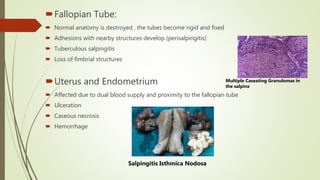
Fallopian Tube:
 Normal anatomy is destroyed , the tubes become rigid and fixed
 Adhesions with nearby structures develop (perisalpingitis)
 Tuberculous salpingitis
 Loss of fimbrial structures
Uterus and Endometrium
 Affected due to dual blood supply and proximity to the fallopian tube
 Ulceration
 Caseous necrosis
 Hemorrhage
Multiple Caseating Granulomas in
the salpinx
Salpingitis Isthmica Nodosa
Ovarian Tuberculosis
 Surface tubercles
 adhesions
 thickening of capsules
 caseating abscess on the ovarian surface
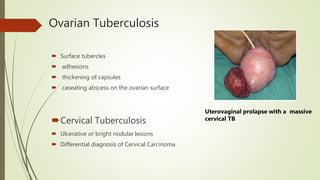
Cervical Tuberculosis
 Ulcerative or bright nodular lesions
 Differential diagnosis of Cervical Carcinoma
Uterovaginal prolapse with a massive
cervical TB
INFERTILITY IN GENITAL
TUBERCULOSIS
Due to loss of normal tube anatomy and
endometrial tissue
Difficult to treat both surgically and medically
CLINICAL FEATURES
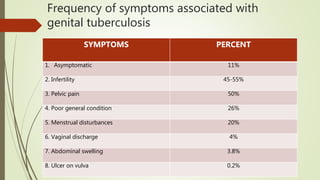
Frequency of symptoms associated with
genital tuberculosis
SYMPTOMS PERCENT
1. Asymptomatic 11%
2. Infertility 45-55%
3. Pelvic pain 50%
4. Poor general condition 26%
5. Menstrual disturbances 20%
6. Vaginal discharge 4%
7. Abdominal swelling 3.8%
8. Ulcer on vulva 0.2%
In the acute phase, the picture may resemble
classical acute pelvic inflammatory disease (PID)
with pelvic pain, fever and vaginal discharge
Genital TB may be asymptomatic and diagnosis
requires a high index of suspicion
Subtle signs that could indicate a problem,
especially if a woman has suffered from
pulmonary TB in the past or has had close
contact with a TB patient – menstrual
abnormalities, pain in pelvic area, infertility
DIAGNOSTIC APPROACH
Family History of tuberculosis
Any member of the family
Any close contact suffering from TB or having taken
ATT for 9-12 months or any duration
PAST MEDICAL HISTORY OF
TUBERCULOSIS
Right from childhood
Especially important as there has been case
reports of tuberculous tubo ovarian masses being
opened up, which were preoperatively diagnosed
as malignancies because patients were reluctant
to reveal past TB history in front of relatives
PHYSICAL EXAMINATION
General Examination :
 Usually unremarkable
 May be anemic due to chronic infection
 Presence of cervical lymphadenopathy may point to tuberculous pathology
CHEST EXAMINATION
 May be normal
 Show signs of active TB
PER ABDOMEN
Usually normal
Rarely find irregular tender mass in lower
abdomen rising out from pelvis
Abdomen may feel doughy due to matted
intestines
Evidence of free peritoneal fluid is rare
Tuberculous ascites when encysted mimics an
ovarian cyst
PER VAGINUM
May be negative upto 50% of cases
Restricted mobility and adnexal mass
Thickening of tubes felt through lateral fornices
Nodules felt through posterior fornix
At times, bilateral pelvic mass of varying sizes quite
indistinguishable from that due to pyogenic infection
may be felt
Presence of adnexal tubo
ovarian mass in unmarried
girls is generally TB if
ovarian neoplasms are ruled
out.
INVESTIGATIONS
AIMS:
To identify the primary lesion if possible
To confirm the genital lesion
BLOOD
 Leucocyte count and ESR values may be raised
 Periodic evaluation is of value to evaluate the progress
MANTOUX TEST
CHEST XRAY- For evidence of active or healed
lesion
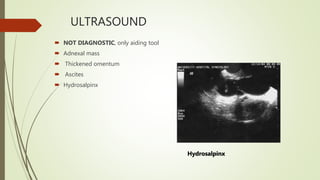
ULTRASOUND
 NOT DIAGNOSTIC, only aiding tool
 Adnexal mass
 Thickened omentum
 Ascites
 Hydrosalpinx
Hydrosalpinx
DIAGNOSTIC UTERINE CURETTAGE
 To be done on the week preceding menstruation, because tubercles surface
premenstrually.
 Material should be sent to the lab in two portions :
One part – in formol saline to detect giant cell system
NOTE: Histology could detect TB in about 10% cases only.
False positive due to presence of chronic lesions like talc or catgut
granuloma or sarcoidosis
False negative due to improper timing or less incidence of uterine infection
Jetley S, Rana S, Jairajpuri ZS. Morphological spectrum of endometrial pathology in middle-aged women with
atypical uterine bleeding: A study of 219 cases. J Mid-life Health [serial online] 2013 [cited 2015 Aug 19];4:216-20.
Available from: http://www.jmidlifehealth.org/text.asp?2013/4/4/216/122242
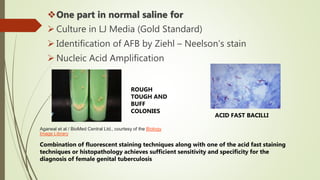
One part in normal saline for
 Culture in LJ Media (Gold Standard)
 Identification of AFB by Ziehl – Neelson’s stain
 Nucleic Acid Amplification
Agarwal et al / BioMed Central Ltd., courtesy of the Biology
Image Library
Combination of fluorescent staining techniques along with one of the acid fast staining
techniques or histopathology achieves sufficient sensitivity and specificity for the
diagnosis of female genital tuberculosis
ROUGH
TOUGH AND
BUFF
COLONIES
ACID FAST BACILLI
NUCLEIC ACID AMPLIFICATION
SAMPLE- Endometrial tissue or menstrual blood collected
on first day of discharge
Can detect fewer than 10 organisms in clinical specimens,
and is of importance as genital TB is usually paucibacillary.
First day Menstrual Discharge – Collected in a pipette and
subjected to nucleic acid amplification, and culture.
NOTE : Positive report on AFB
microscopy, PCR, culture and
histology gives the diagnosis,
BUT a negative report does
not rule out tuberculosis
Sputum and Urine
Lymph node biopsy
Biopsy from lesion in cervix, vagina or vulva if
present.
HYSTEROSALPINGOGRAPHY
(HSG)
 In a proved case, HSG is contraindicated for risk of reactivation
 HSG done as a routine work up for investigation of infertility may
reveal the following suggestive features.
HSG FINDINGS IN GENITAL TB
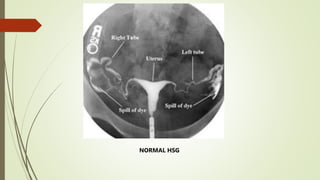
NORMAL HSG
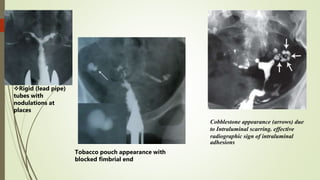
Rigid (lead pipe)
tubes with
nodulations at
places
Tobacco pouch appearance with
blocked fimbrial end
Cobblestone appearance (arrows) due
to Intraluminal scarring. effective
radiographic sign of intraluminal
adhesions
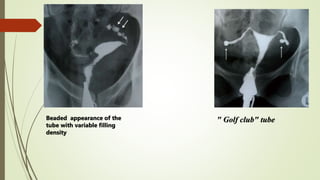
Beaded appearance of the
tube with variable filling
density
" Golf club" tube
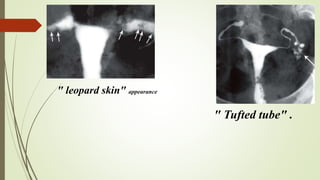
" leopard skin" appearance
" Tufted tube" .
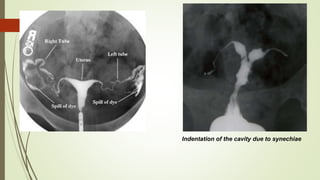
Indentation of the cavity due to synechiae
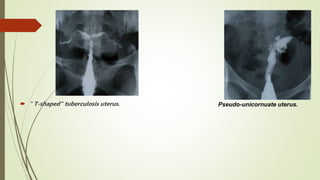
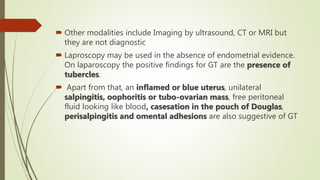
 " T-shaped" tuberculosis uterus. Pseudo-unicornuate uterus.
 Other modalities include Imaging by ultrasound, CT or MRI but
they are not diagnostic
 Laproscopy may be used in the absence of endometrial evidence.
On laparoscopy the positive findings for GT are the presence of
tubercles.
 Apart from that, an inflamed or blue uterus, unilateral
salpingitis, oophoritis or tubo-ovarian mass, free peritoneal
fluid looking like blood, casesation in the pouch of Douglas,
perisalpingitis and omental adhesions are also suggestive of GT
A WORD
 Even though sensitivity is extremely low, culture in LJ medium is the gold standard for genital
TB
 Due to it higher pick up rate, PCR is emerging as the investigation of choice for genital TB
 In clinically suspected cases, in the presence of positive PCR results, an infertile woman should be
considered as having GTB and should be treated.
 High false negative result in PCR may result in missing diagnosis. Therefore, when GTB is
suspected clinically, but the PCR results are negative, it indicates the need for further evaluation
using other diagnostic tests and repeat testing to confirm/exclude diagnosis.
 Studies show that the sensitivity of PCR can be improved by using more than one set of
primers in the detection of genital tuberculosis (R.B.P. Thangappah, C.N. Paramasivan, and
Sujatha Narayanan)
GENITAL TUBERCULOSIS – EVADING
DETECTION
 As a general rule, genital tuberculosis evades diagnosis mainly because
1. Paucibacillary nature of genital TB
2. low sensitivity of detection techniques.
3. Secondary nature of lesions – infecting organisms are sparse and the lesions are usually
bacteriologically mute
 Importance of detecting genital TB :
1. So that treatment can be started before irreversible damage sets in
2. Important cause of infertility
TREATMENT
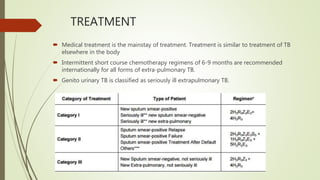
 Medical treatment is the mainstay of treatment. Treatment is similar to treatment of TB
elsewhere in the body
 Intermittent short course chemotherapy regimens of 6-9 months are recommended
internationally for all forms of extra-pulmonary TB.
 Genito urinary TB is classified as seriously ill extrapulmonary TB.
SURGERY INDICATIONS:
 Unresponsiveness of active disease in spite of adequate anti TB chemotherapy
 Tubercular pyosalpinx
 Ovarian abscess
 Pyometra
 Persistent menorrhagia and/ chronic pelvic pain causing deteriorating health status
CONTRAINDICATIONS
 Presence of active TB at the extragenital site
 Favorable response to chemotherapy
Precautions:
ATT should have been administered in full dosage at least 6 weeks before surgery
TREATMENT OF INFERTILITY
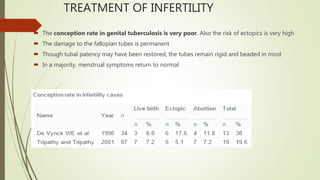
 The conception rate in genital tuberculosis is very poor. Also the risk of ectopics is very high
 The damage to the fallopian tubes is permanent
 Though tubal patency may have been restored, the tubes remain rigid and beaded in most
 In a majority, menstrual symptoms return to normal
In Vitro Fertilisation
 The role of IVF in patients with genital TB is now highlighted
 Many recommend direct IVF without attempting tubal surgery
 The success of in vitro fertilization depends on the extent of
endometrial damage. Lesser the damage to the endometrium,
higher is the chance of success.
 However, overall pregnancy rates per cycle in these patients is
reported to be lower than those with tubal infertility due to
nontuberculous pathology
References
 Lakshmi Sheshadri, Textbook of Gynecology
 DC Dutta Textbook of Gynecology
 Jassawalla MJ. Genital tuberculosis-A diagnostic dilemma. J Obstet Gynecol India 2006;
56 : 203-4.
 Manjunath N, Shankar P, Rajan L, Bhargava A, Saluja S,Shriniwas. Evaluation of a
polymerase chain reaction for the diagnosis of tuberculosis. Tubercle 1991; 72 : 21-7.
 Schaefer G. Female genital tuberculosis. Clin Obstet Gynecol 1976;19:223-39.
 Tripathy SN. Tuberculosis and pregnancy. Int J Gynaecol Obstet 2003;80:247-53
 Ghosh K, Ghosh K, Chowdhury JR. Tuberculosis and female reproductive health. J
Postgrad Med 2011;57:307-13.
 Tripathy SN, Tripathy SN. Infertility and pregnancy outcome in female genital
tuberculosis Int J Gynaecol Obstet 2002;76:59-63.

Tuberculosis and infertility

  • 1.
  • 2.
     Prevalence:  GlobalPrevalence of Genital TB is about 8-10 million cases  Incidence:  5 to 10% of the patients with infertility have Genital TB.  Rising incidence due to increasing prevalence of HIV infection.  10% of the women with pelvic tuberculosis have a concurrent urinary Tuberculosis
  • 3.
    Although genital TBcan occur in any age group, the majority of patients are in the reproductive age group  75% being in the 20–45 years age bracket.
  • 4.
    Female Genital TB Female Genital TB used to be the commonest cause of tubal infertility in women in TB endemic areas.  Symptomatic only after 10-15 years of primary infection.  25% of the cases have a history of TB.  In most cases it developed secondary to Pulmonary TB (50%)  Rarely, the primary site of infection is the Cervix
  • 5.
    Mode of Spread Haematogenous: From a primary site, 90% of the spread occurs in this route. If this coincides with the growth spurt of pelvic vasculature the reproductive organs (mostly the Fallopian Tubes) get affected.  Lymphatic/ Direct: Direct involvement of Pelvic Organs or through the lymphatics from the infected organs (peritoneum, bowel and mesenteric nodes)  Ascending: Sexual transmission from a male with urogenital tuberculosis causes vulval, vaginal or cervical lesion
  • 6.
    Pathology  The frequencyof lesions found in the genital tract are as follows  Fallopian Tubes-100% (bilaterally)  Endometrium-50%  Ovaries-20%  Cervix-5%  Vagina and Vulva<1%
  • 7.
    Fallopian Tube:  Normalanatomy is destroyed , the tubes become rigid and fixed  Adhesions with nearby structures develop (perisalpingitis)  Tuberculous salpingitis  Loss of fimbrial structures Uterus and Endometrium  Affected due to dual blood supply and proximity to the fallopian tube  Ulceration  Caseous necrosis  Hemorrhage Multiple Caseating Granulomas in the salpinx Salpingitis Isthmica Nodosa
  • 8.
    Ovarian Tuberculosis  Surfacetubercles  adhesions  thickening of capsules  caseating abscess on the ovarian surface Cervical Tuberculosis  Ulcerative or bright nodular lesions  Differential diagnosis of Cervical Carcinoma Uterovaginal prolapse with a massive cervical TB
  • 9.
    INFERTILITY IN GENITAL TUBERCULOSIS Dueto loss of normal tube anatomy and endometrial tissue Difficult to treat both surgically and medically
  • 10.
  • 11.
    Frequency of symptomsassociated with genital tuberculosis SYMPTOMS PERCENT 1. Asymptomatic 11% 2. Infertility 45-55% 3. Pelvic pain 50% 4. Poor general condition 26% 5. Menstrual disturbances 20% 6. Vaginal discharge 4% 7. Abdominal swelling 3.8% 8. Ulcer on vulva 0.2%
  • 12.
    In the acutephase, the picture may resemble classical acute pelvic inflammatory disease (PID) with pelvic pain, fever and vaginal discharge
  • 13.
    Genital TB maybe asymptomatic and diagnosis requires a high index of suspicion Subtle signs that could indicate a problem, especially if a woman has suffered from pulmonary TB in the past or has had close contact with a TB patient – menstrual abnormalities, pain in pelvic area, infertility
  • 14.
  • 15.
    Family History oftuberculosis Any member of the family Any close contact suffering from TB or having taken ATT for 9-12 months or any duration
  • 16.
    PAST MEDICAL HISTORYOF TUBERCULOSIS Right from childhood Especially important as there has been case reports of tuberculous tubo ovarian masses being opened up, which were preoperatively diagnosed as malignancies because patients were reluctant to reveal past TB history in front of relatives
  • 17.
    PHYSICAL EXAMINATION General Examination:  Usually unremarkable  May be anemic due to chronic infection  Presence of cervical lymphadenopathy may point to tuberculous pathology CHEST EXAMINATION  May be normal  Show signs of active TB
  • 18.
    PER ABDOMEN Usually normal Rarelyfind irregular tender mass in lower abdomen rising out from pelvis Abdomen may feel doughy due to matted intestines Evidence of free peritoneal fluid is rare Tuberculous ascites when encysted mimics an ovarian cyst
  • 19.
    PER VAGINUM May benegative upto 50% of cases Restricted mobility and adnexal mass Thickening of tubes felt through lateral fornices Nodules felt through posterior fornix At times, bilateral pelvic mass of varying sizes quite indistinguishable from that due to pyogenic infection may be felt
  • 20.
    Presence of adnexaltubo ovarian mass in unmarried girls is generally TB if ovarian neoplasms are ruled out.
  • 21.
    INVESTIGATIONS AIMS: To identify theprimary lesion if possible To confirm the genital lesion
  • 22.
    BLOOD  Leucocyte countand ESR values may be raised  Periodic evaluation is of value to evaluate the progress MANTOUX TEST CHEST XRAY- For evidence of active or healed lesion
  • 23.
    ULTRASOUND  NOT DIAGNOSTIC,only aiding tool  Adnexal mass  Thickened omentum  Ascites  Hydrosalpinx Hydrosalpinx
  • 24.
    DIAGNOSTIC UTERINE CURETTAGE To be done on the week preceding menstruation, because tubercles surface premenstrually.  Material should be sent to the lab in two portions : One part – in formol saline to detect giant cell system NOTE: Histology could detect TB in about 10% cases only. False positive due to presence of chronic lesions like talc or catgut granuloma or sarcoidosis False negative due to improper timing or less incidence of uterine infection
  • 25.
    Jetley S, RanaS, Jairajpuri ZS. Morphological spectrum of endometrial pathology in middle-aged women with atypical uterine bleeding: A study of 219 cases. J Mid-life Health [serial online] 2013 [cited 2015 Aug 19];4:216-20. Available from: http://www.jmidlifehealth.org/text.asp?2013/4/4/216/122242
  • 26.
    One part innormal saline for  Culture in LJ Media (Gold Standard)  Identification of AFB by Ziehl – Neelson’s stain  Nucleic Acid Amplification Agarwal et al / BioMed Central Ltd., courtesy of the Biology Image Library Combination of fluorescent staining techniques along with one of the acid fast staining techniques or histopathology achieves sufficient sensitivity and specificity for the diagnosis of female genital tuberculosis ROUGH TOUGH AND BUFF COLONIES ACID FAST BACILLI
  • 27.
    NUCLEIC ACID AMPLIFICATION SAMPLE-Endometrial tissue or menstrual blood collected on first day of discharge Can detect fewer than 10 organisms in clinical specimens, and is of importance as genital TB is usually paucibacillary. First day Menstrual Discharge – Collected in a pipette and subjected to nucleic acid amplification, and culture.
  • 28.
    NOTE : Positivereport on AFB microscopy, PCR, culture and histology gives the diagnosis, BUT a negative report does not rule out tuberculosis
  • 29.
    Sputum and Urine Lymphnode biopsy Biopsy from lesion in cervix, vagina or vulva if present.
  • 30.
    HYSTEROSALPINGOGRAPHY (HSG)  In aproved case, HSG is contraindicated for risk of reactivation  HSG done as a routine work up for investigation of infertility may reveal the following suggestive features.
  • 31.
    HSG FINDINGS INGENITAL TB
  • 32.
  • 33.
    Rigid (lead pipe) tubeswith nodulations at places Tobacco pouch appearance with blocked fimbrial end Cobblestone appearance (arrows) due to Intraluminal scarring. effective radiographic sign of intraluminal adhesions
  • 34.
    Beaded appearance ofthe tube with variable filling density " Golf club" tube
  • 35.
    " leopard skin"appearance " Tufted tube" .
  • 36.
    Indentation of thecavity due to synechiae
  • 37.
     " T-shaped"tuberculosis uterus. Pseudo-unicornuate uterus.
  • 38.
     Other modalitiesinclude Imaging by ultrasound, CT or MRI but they are not diagnostic  Laproscopy may be used in the absence of endometrial evidence. On laparoscopy the positive findings for GT are the presence of tubercles.  Apart from that, an inflamed or blue uterus, unilateral salpingitis, oophoritis or tubo-ovarian mass, free peritoneal fluid looking like blood, casesation in the pouch of Douglas, perisalpingitis and omental adhesions are also suggestive of GT
  • 39.
    A WORD  Eventhough sensitivity is extremely low, culture in LJ medium is the gold standard for genital TB  Due to it higher pick up rate, PCR is emerging as the investigation of choice for genital TB  In clinically suspected cases, in the presence of positive PCR results, an infertile woman should be considered as having GTB and should be treated.  High false negative result in PCR may result in missing diagnosis. Therefore, when GTB is suspected clinically, but the PCR results are negative, it indicates the need for further evaluation using other diagnostic tests and repeat testing to confirm/exclude diagnosis.  Studies show that the sensitivity of PCR can be improved by using more than one set of primers in the detection of genital tuberculosis (R.B.P. Thangappah, C.N. Paramasivan, and Sujatha Narayanan)
  • 40.
    GENITAL TUBERCULOSIS –EVADING DETECTION  As a general rule, genital tuberculosis evades diagnosis mainly because 1. Paucibacillary nature of genital TB 2. low sensitivity of detection techniques. 3. Secondary nature of lesions – infecting organisms are sparse and the lesions are usually bacteriologically mute  Importance of detecting genital TB : 1. So that treatment can be started before irreversible damage sets in 2. Important cause of infertility
  • 41.
    TREATMENT  Medical treatmentis the mainstay of treatment. Treatment is similar to treatment of TB elsewhere in the body  Intermittent short course chemotherapy regimens of 6-9 months are recommended internationally for all forms of extra-pulmonary TB.  Genito urinary TB is classified as seriously ill extrapulmonary TB.
  • 42.
    SURGERY INDICATIONS:  Unresponsivenessof active disease in spite of adequate anti TB chemotherapy  Tubercular pyosalpinx  Ovarian abscess  Pyometra  Persistent menorrhagia and/ chronic pelvic pain causing deteriorating health status
  • 43.
    CONTRAINDICATIONS  Presence ofactive TB at the extragenital site  Favorable response to chemotherapy Precautions: ATT should have been administered in full dosage at least 6 weeks before surgery
  • 44.
    TREATMENT OF INFERTILITY The conception rate in genital tuberculosis is very poor. Also the risk of ectopics is very high  The damage to the fallopian tubes is permanent  Though tubal patency may have been restored, the tubes remain rigid and beaded in most  In a majority, menstrual symptoms return to normal
  • 45.
    In Vitro Fertilisation The role of IVF in patients with genital TB is now highlighted  Many recommend direct IVF without attempting tubal surgery  The success of in vitro fertilization depends on the extent of endometrial damage. Lesser the damage to the endometrium, higher is the chance of success.  However, overall pregnancy rates per cycle in these patients is reported to be lower than those with tubal infertility due to nontuberculous pathology
  • 46.
    References  Lakshmi Sheshadri,Textbook of Gynecology  DC Dutta Textbook of Gynecology  Jassawalla MJ. Genital tuberculosis-A diagnostic dilemma. J Obstet Gynecol India 2006; 56 : 203-4.  Manjunath N, Shankar P, Rajan L, Bhargava A, Saluja S,Shriniwas. Evaluation of a polymerase chain reaction for the diagnosis of tuberculosis. Tubercle 1991; 72 : 21-7.  Schaefer G. Female genital tuberculosis. Clin Obstet Gynecol 1976;19:223-39.  Tripathy SN. Tuberculosis and pregnancy. Int J Gynaecol Obstet 2003;80:247-53  Ghosh K, Ghosh K, Chowdhury JR. Tuberculosis and female reproductive health. J Postgrad Med 2011;57:307-13.  Tripathy SN, Tripathy SN. Infertility and pregnancy outcome in female genital tuberculosis Int J Gynaecol Obstet 2002;76:59-63.