Deterministic Networking for Real-Time Systems
(Using TSN and DetNet)
Henrik Austad
haustad@cisco.com
Cisco Systems
Prague, Oct 25, 2017
about:henrik
Cisco Collaboration, Audio group at
Lysaker, Norway
All things Linux
Real-time tweaking and tuning
Staring at traces
AVB/TSN and DetNet
“I have a script for that somewhere..”
https://projectworkplace.cisco.com
SX80 Codec backplane
Henrik Austad (Cisco) TSN and Linux Prague, Oct 25, 2017 1 / 23
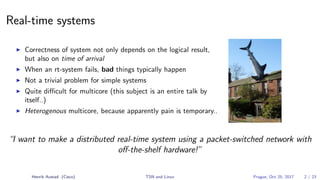
Real-time systems
Correctness of system not only depends on the logical result,
but also on time of arrival
When an rt-system fails, bad things typically happen
Not a trivial problem for simple systems
Quite difficult for multicore (this subject is an entire talk by
itself..)
Heterogenous multicore, because apparently pain is temporary..
“I want to make a distributed real-time system using a packet-switched network with
off-the-shelf hardware!”
Henrik Austad (Cisco) TSN and Linux Prague, Oct 25, 2017 2 / 23
Challenge 1 - Time
Real-time systems have very strict requirements. Adding distributed to the mix;
No 2 clocks ever run at the same rate
Complex SW introduces latencies, giving rise to more uncertainties
Unpredictable network delays add insult to injury
NTP can du sub-ms accuracy if LAN, low traffic, full moon, Saturn and Venus in phase etc
PTP has already fixed this, enabling sub µs accuracy
HW Support in both the network and in the end-stations is strongly preferred
We are not going to cover PTP in more detail in this talk.
Henrik Austad (Cisco) TSN and Linux Prague, Oct 25, 2017 3 / 23
Challenge 2 - Reliable1
Packet Switched Networks (PSN)
Acceptable for a PSN to drop a frame on collision
Bridges have finite buffers (can lead to framedrops)
Next frame out on a port is probably FIFO, perhaps it supports vlan pcp
Jumboframes will block all others until tx completes
Cannot express “arrive no later than” to the network
... nor indicate “send frame at time X” to the NIC
And not “give me Y kbps of bandwidth and never, ever drop a frame”
1
“Reliable” as in “real-time systems”-reliable
Henrik Austad (Cisco) TSN and Linux Prague, Oct 25, 2017 4 / 23
Challenge 3+n (where n ∈ N0
)
Your application will probably have
some other application-specific issues
that are amplified by being distributed.
These are left as an exercise for the reader ;)
Henrik Austad (Cisco) TSN and Linux Prague, Oct 25, 2017 5 / 23
AVB/TSN
Source: https://goo.gl/images/l3846A
Audio/Video Bridging - AVB
This started out as a set of open standards that aimed to solve the network
challenge for media over PSN.
Idea: AD/DAs are cheap. Ethernet MACs are cheap...
Why not handle A/V digitally as early as possible?
⇒ Started out as Pro Audio/Video only.
Media must have guaranteed delivery, best-effort not
acceptable
Allows for very flexible setups (can easily reroute and
duplicate streams)
High (audio-)capacity in a single cable
As units grow smaller with more processing power,
being restricted by the physical dimensions of the
backplane is not otimal
Can co-exist with BE traffic
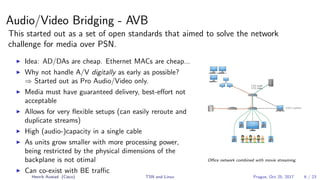
Office network combined with movie streaming
Henrik Austad (Cisco) TSN and Linux Prague, Oct 25, 2017 6 / 23
AVB
Initial target was simple systems (mic, speakers, DSPs)
Started out with etherframes (L2) only
Specified PTPv2 profile (gPTP)
Uses Stream Reservation Protocol (SRP) to express requirements to the network
An easy way to connect end-stations (IEEE 1722.1)
Security not that important (subnet only)
Reliable, low-jitter streams with guaranteed BW most important
Henrik Austad (Cisco) TSN and Linux Prague, Oct 25, 2017 7 / 23
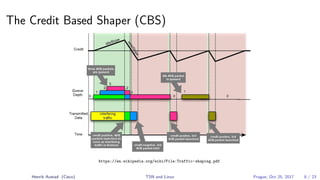
The Credit Based Shaper (CBS)
https://en.wikipedia.org/wiki/File:Traffic-shaping.pdf
Henrik Austad (Cisco) TSN and Linux Prague, Oct 25, 2017 8 / 23
TSN: Time Sensitive Networking
People started to use AVB for all sorts of crazy things, so “AVB” proved to be a
misnomer. Renamed to TSN in Nov. 2012
Pro-AV
Consumer AV
Infotainment systems (cars, messaging boards, theme-parks, ...)
Automotive (ABS breaks, control systems, monitoring, etc)
Industrial applications (e.g. Control systems/Robotics, IIoT - “Industry 4.0”)
Combine Operation Technology (OT) networks with IT networks
Focus no longer on just to provide reliabe, jitter-free streams, but also on time of
transmission, frame preemption, larger networks, path redundancy.
Henrik Austad (Cisco) TSN and Linux Prague, Oct 25, 2017 9 / 23
IETF and Deterministic Networking (DetNet) WG
(https://datatracker.ietf.org/wg/detnet/about/)
Large network oriented (WAN support important)
Pseudo-wire encapsulation (invisible to the end-station)
Set of guidelines to achieve deterministic behavior (rather than hard requirements)
Multipath routing (replication and elimination)
Requires Central controller (not like 1722.1 where ’anyone’ can configure)
Brings a somewhat larger security concern to the table
Henrik Austad (Cisco) TSN and Linux Prague, Oct 25, 2017 10 / 23
DetNet motivation
Broadcasting (digital TV, PA at large venues)
Blockchain (to accelerate the consensus process)
Building Automation Systems (sensors, HVAC)
Electrical utilities (SmartGrid, coordinate producers, grid frequency)
Extremely low packet loss ratio (10−9
− 10−12
)
When end-to-end latency is important
Replacing proprietary deterministic networks
Same network for both critical and Best-Effort traffic
Henrik Austad (Cisco) TSN and Linux Prague, Oct 25, 2017 11 / 23
TSN in the Linux kernel
Previous approach was media centric
A lot of central pieces missing (hacked into network and media)
Mostly done via SW inside kernel (timing and best-effort tx of frames)
Made it possible to use whatever media-app to play audio over the network,
which was fun.
TSN is more than stream reservation.
Currently, only Intel’s i210 is available in a PCI-e formfactor, so this is the NIC
used for kernel testing.
But things are happening!
Henrik Austad (Cisco) TSN and Linux Prague, Oct 25, 2017 12 / 23
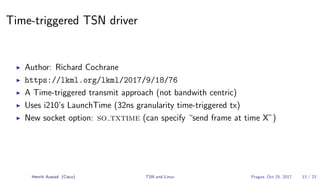
Time-triggered TSN driver
Author: Richard Cochrane
https://lkml.org/lkml/2017/9/18/76
A Time-triggered transmit approach (not bandwith centric)
Uses i210’s LaunchTime (32ns granularity time-triggered tx)
New socket option: so txtime (can specify “send frame at time X”)
Henrik Austad (Cisco) TSN and Linux Prague, Oct 25, 2017 13 / 23
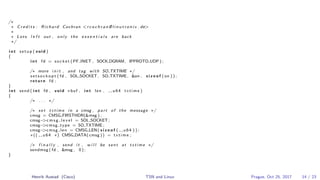
/∗
∗ C r e d i t s : Richard Cochran <r c o c h r a n @ l i n u t r o n i x . de>
∗
∗ Lots l e f t out , only the e s s e n t i a l s are back
∗/
i n t setup ( void )
{
i n t fd = socket ( PF INET , SOCK DGRAM, IPPROTO UDP ) ;
/∗ more i n i t , and tag with SO TXTIME ∗/
s e t s o c k o p t ( fd , SOL SOCKET , SO TXTIME , &on , s i z e o f ( on ) ) ;
return fd ;
}
i n t send ( i n t fd , void ∗buf , i n t len , u64 txtime )
{
/∗ . . . ∗/
/∗ s e t txtime i n a cmsg , part of the message ∗/
cmsg = CMSG FIRSTHDR(&msg ) ;
cmsg−>c m s g l e v e l = SOL SOCKET ;
cmsg−>cmsg type = SO TXTIME ;
cmsg−>cmsg len = CMSG LEN( s i z e o f ( u64 ) ) ;
∗(( u64 ∗) CMSG DATA( cmsg )) = txtime ;
/∗ f i n a l l y , send i t , w i l l be sent at txtime ∗/
sendmsg ( fd , &msg , 0 ) ;
}
Henrik Austad (Cisco) TSN and Linux Prague, Oct 25, 2017 14 / 23
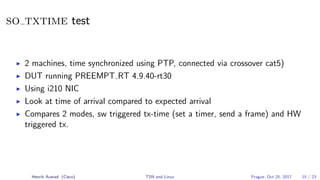
so txtime test
2 machines, time synchronized using PTP, connected via crossover cat5)
DUT running PREEMPT RT 4.9.40-rt30
Using i210 NIC
Look at time of arrival compared to expected arrival
Compares 2 modes, sw triggered tx-time (set a timer, send a frame) and HW
triggered tx.
Henrik Austad (Cisco) TSN and Linux Prague, Oct 25, 2017 15 / 23
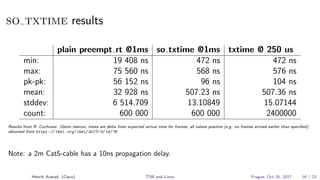
so txtime results
plain preempt rt @1ms so txtime @1ms txtime @ 250 us
min: 19 408 ns 472 ns 472 ns
max: 75 560 ns 568 ns 576 ns
pk-pk: 56 152 ns 96 ns 104 ns
mean: 32 928 ns 507.23 ns 507.36 ns
stddev: 6 514.709 13.10849 15.07144
count: 600 000 600 000 2400000
Results from R. Cochrane. 10min testrun, times are delta from expected arrival time for frames, all values positive (e.g. no frames arrived earlier than specified)
obtained from https: // lkml. org/ lkml/ 2017/ 9/ 18/ 76
Note: a 2m Cat5-cable has a 10ns propagation delay.
Henrik Austad (Cisco) TSN and Linux Prague, Oct 25, 2017 16 / 23
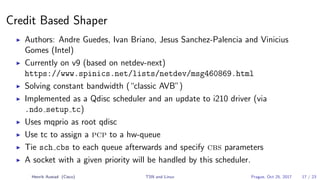
Credit Based Shaper
Authors: Andre Guedes, Ivan Briano, Jesus Sanchez-Palencia and Vinicius
Gomes (Intel)
Currently on v9 (based on netdev-next)
https://www.spinics.net/lists/netdev/msg460869.html
Solving constant bandwidth (“classic AVB”)
Implemented as a Qdisc scheduler and an update to i210 driver (via
.ndo setup tc)
Uses mqprio as root qdisc
Use tc to assign a pcp to a hw-queue
Tie sch cbs to each queue afterwards and specify cbs parameters
A socket with a given priority will be handled by this scheduler.
Henrik Austad (Cisco) TSN and Linux Prague, Oct 25, 2017 17 / 23
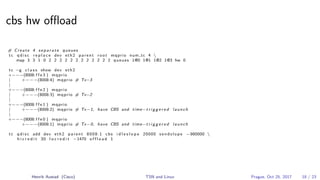
cbs hw offload
# Create 4 s e p a r a t e queues
tc q d i s c r e p l a c e dev eth2 parent root mqprio num tc 4 
map 3 3 1 0 2 2 2 2 2 2 2 2 2 2 2 2 queues 1@0 1@1 1@2 1@3 hw 0
tc −g c l a s s show dev eth2
+−−−(8008: f f e 3 ) mqprio
| +−−−(8008:4) mqprio # Tx−3
|
+−−−(8008: f f e 2 ) mqprio
| +−−−(8008:3) mqprio # Tx−2
|
+−−−(8008: f f e 1 ) mqprio
| +−−−(8008:2) mqprio # Tx−1, have CBS and time−t r i g g e r e d launch
|
+−−−(8008: f f e 0 ) mqprio
+−−−(8008:1) mqprio # Tx−0, have CBS and time−t r i g g e r e d launch
tc q d i s c add dev eth2 parent 8008:1 cbs i d l e s l o p e 20000 s e n d s l o p e −980000 
h i c r e d i t 30 l o c r e d i t −1470 o f f l o a d 1
Henrik Austad (Cisco) TSN and Linux Prague, Oct 25, 2017 18 / 23
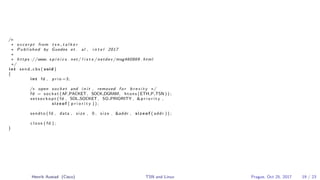
/∗
∗ e x c e r p t from t s n t a l k e r
∗ Published by Guedes et . al , i n t e l 2017
∗
∗ h t t p s ://www. s p i n i c s . net / l i s t s / netdev /msg460869 . html
∗/
i n t send cbs ( void )
{
i n t fd , p r i o =3;
/∗ open socket and i n i t , removed f o r b r e v i t y ∗/
fd = socket (AF PACKET, SOCK DGRAM, htons (ETH P TSN ) ) ;
s e t s o c k o p t ( fd , SOL SOCKET , SO PRIORITY , &p r i o r i t y ,
s i z e o f ( p r i o r i t y ) ) ;
sendto ( fd , data , s i z e , 0 , s i z e , &addr , s i z e o f ( addr ) ) ;
c l o s e ( fd ) ;
}
Henrik Austad (Cisco) TSN and Linux Prague, Oct 25, 2017 19 / 23
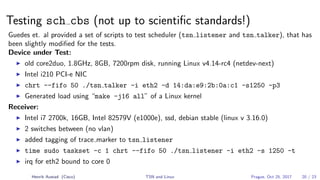
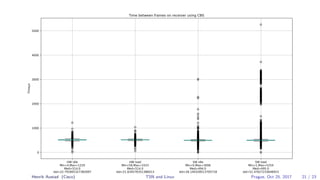
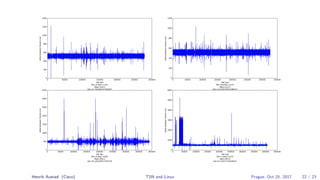
Testing sch cbs (not up to scientific standards!)
Guedes et. al provided a set of scripts to test scheduler (tsn listener and tsn talker), that has
been slightly modified for the tests.
Device under Test:
old core2duo, 1.8GHz, 8GB, 7200rpm disk, running Linux v4.14-rc4 (netdev-next)
Intel i210 PCI-e NIC
chrt --fifo 50 ./tsn talker -i eth2 -d 14:da:e9:2b:0a:c1 -s1250 -p3
Generated load using “make -j16 all” of a Linux kernel
Receiver:
Intel i7 2700k, 16GB, Intel 82579V (e1000e), ssd, debian stable (linux v 3.16.0)
2 switches between (no vlan)
added tagging of trace marker to tsn listener
time sudo taskset -c 1 chrt --fifo 50 ./tsn listener -i eth2 -s 1250 -t
irq for eth2 bound to core 0
Henrik Austad (Cisco) TSN and Linux Prague, Oct 25, 2017 20 / 23
Henrik Austad (Cisco) TSN and Linux Prague, Oct 25, 2017 21 / 23
Henrik Austad (Cisco) TSN and Linux Prague, Oct 25, 2017 22 / 23
Future work
Better evaluation of sch cbs (my test was horrible)
Doing a “CBS-like” qdisc based on so txtime
Get merged into the kernel, they both serve a purpose
Accurate load measurements
Adapting the old tsn-driver to connect alsa to this
Henrik Austad (Cisco) TSN and Linux Prague, Oct 25, 2017 23 / 23
Thank you!
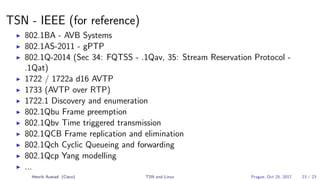
TSN - IEEE (for reference)
802.1BA - AVB Systems
802.1AS-2011 - gPTP
802.1Q-2014 (Sec 34: FQTSS - .1Qav, 35: Stream Reservation Protocol -
.1Qat)
1722 / 1722a d16 AVTP
1733 (AVTP over RTP)
1722.1 Discovery and enumeration
802.1Qbu Frame preemption
802.1Qbv Time triggered transmission
802.1QCB Frame replication and elimination
802.1Qch Cyclic Queueing and forwarding
802.1Qcp Yang modelling
...
Henrik Austad (Cisco) TSN and Linux Prague, Oct 25, 2017 23 / 23

Tsn linux elce17

  • 1.
    Deterministic Networking forReal-Time Systems (Using TSN and DetNet) Henrik Austad haustad@cisco.com Cisco Systems Prague, Oct 25, 2017
  • 2.
    about:henrik Cisco Collaboration, Audiogroup at Lysaker, Norway All things Linux Real-time tweaking and tuning Staring at traces AVB/TSN and DetNet “I have a script for that somewhere..” https://projectworkplace.cisco.com SX80 Codec backplane Henrik Austad (Cisco) TSN and Linux Prague, Oct 25, 2017 1 / 23
  • 3.
    Real-time systems Correctness ofsystem not only depends on the logical result, but also on time of arrival When an rt-system fails, bad things typically happen Not a trivial problem for simple systems Quite difficult for multicore (this subject is an entire talk by itself..) Heterogenous multicore, because apparently pain is temporary.. “I want to make a distributed real-time system using a packet-switched network with off-the-shelf hardware!” Henrik Austad (Cisco) TSN and Linux Prague, Oct 25, 2017 2 / 23
  • 4.
    Challenge 1 -Time Real-time systems have very strict requirements. Adding distributed to the mix; No 2 clocks ever run at the same rate Complex SW introduces latencies, giving rise to more uncertainties Unpredictable network delays add insult to injury NTP can du sub-ms accuracy if LAN, low traffic, full moon, Saturn and Venus in phase etc PTP has already fixed this, enabling sub µs accuracy HW Support in both the network and in the end-stations is strongly preferred We are not going to cover PTP in more detail in this talk. Henrik Austad (Cisco) TSN and Linux Prague, Oct 25, 2017 3 / 23
  • 5.
    Challenge 2 -Reliable1 Packet Switched Networks (PSN) Acceptable for a PSN to drop a frame on collision Bridges have finite buffers (can lead to framedrops) Next frame out on a port is probably FIFO, perhaps it supports vlan pcp Jumboframes will block all others until tx completes Cannot express “arrive no later than” to the network ... nor indicate “send frame at time X” to the NIC And not “give me Y kbps of bandwidth and never, ever drop a frame” 1 “Reliable” as in “real-time systems”-reliable Henrik Austad (Cisco) TSN and Linux Prague, Oct 25, 2017 4 / 23
  • 6.
    Challenge 3+n (wheren ∈ N0 ) Your application will probably have some other application-specific issues that are amplified by being distributed. These are left as an exercise for the reader ;) Henrik Austad (Cisco) TSN and Linux Prague, Oct 25, 2017 5 / 23
  • 7.
  • 8.
    Audio/Video Bridging -AVB This started out as a set of open standards that aimed to solve the network challenge for media over PSN. Idea: AD/DAs are cheap. Ethernet MACs are cheap... Why not handle A/V digitally as early as possible? ⇒ Started out as Pro Audio/Video only. Media must have guaranteed delivery, best-effort not acceptable Allows for very flexible setups (can easily reroute and duplicate streams) High (audio-)capacity in a single cable As units grow smaller with more processing power, being restricted by the physical dimensions of the backplane is not otimal Can co-exist with BE traffic Office network combined with movie streaming Henrik Austad (Cisco) TSN and Linux Prague, Oct 25, 2017 6 / 23
  • 9.
    AVB Initial target wassimple systems (mic, speakers, DSPs) Started out with etherframes (L2) only Specified PTPv2 profile (gPTP) Uses Stream Reservation Protocol (SRP) to express requirements to the network An easy way to connect end-stations (IEEE 1722.1) Security not that important (subnet only) Reliable, low-jitter streams with guaranteed BW most important Henrik Austad (Cisco) TSN and Linux Prague, Oct 25, 2017 7 / 23
  • 10.
    The Credit BasedShaper (CBS) https://en.wikipedia.org/wiki/File:Traffic-shaping.pdf Henrik Austad (Cisco) TSN and Linux Prague, Oct 25, 2017 8 / 23
  • 11.
    TSN: Time SensitiveNetworking People started to use AVB for all sorts of crazy things, so “AVB” proved to be a misnomer. Renamed to TSN in Nov. 2012 Pro-AV Consumer AV Infotainment systems (cars, messaging boards, theme-parks, ...) Automotive (ABS breaks, control systems, monitoring, etc) Industrial applications (e.g. Control systems/Robotics, IIoT - “Industry 4.0”) Combine Operation Technology (OT) networks with IT networks Focus no longer on just to provide reliabe, jitter-free streams, but also on time of transmission, frame preemption, larger networks, path redundancy. Henrik Austad (Cisco) TSN and Linux Prague, Oct 25, 2017 9 / 23
  • 12.
    IETF and DeterministicNetworking (DetNet) WG (https://datatracker.ietf.org/wg/detnet/about/) Large network oriented (WAN support important) Pseudo-wire encapsulation (invisible to the end-station) Set of guidelines to achieve deterministic behavior (rather than hard requirements) Multipath routing (replication and elimination) Requires Central controller (not like 1722.1 where ’anyone’ can configure) Brings a somewhat larger security concern to the table Henrik Austad (Cisco) TSN and Linux Prague, Oct 25, 2017 10 / 23
  • 13.
    DetNet motivation Broadcasting (digitalTV, PA at large venues) Blockchain (to accelerate the consensus process) Building Automation Systems (sensors, HVAC) Electrical utilities (SmartGrid, coordinate producers, grid frequency) Extremely low packet loss ratio (10−9 − 10−12 ) When end-to-end latency is important Replacing proprietary deterministic networks Same network for both critical and Best-Effort traffic Henrik Austad (Cisco) TSN and Linux Prague, Oct 25, 2017 11 / 23
  • 15.
    TSN in theLinux kernel Previous approach was media centric A lot of central pieces missing (hacked into network and media) Mostly done via SW inside kernel (timing and best-effort tx of frames) Made it possible to use whatever media-app to play audio over the network, which was fun. TSN is more than stream reservation. Currently, only Intel’s i210 is available in a PCI-e formfactor, so this is the NIC used for kernel testing. But things are happening! Henrik Austad (Cisco) TSN and Linux Prague, Oct 25, 2017 12 / 23
  • 16.
    Time-triggered TSN driver Author:Richard Cochrane https://lkml.org/lkml/2017/9/18/76 A Time-triggered transmit approach (not bandwith centric) Uses i210’s LaunchTime (32ns granularity time-triggered tx) New socket option: so txtime (can specify “send frame at time X”) Henrik Austad (Cisco) TSN and Linux Prague, Oct 25, 2017 13 / 23
  • 17.
    /∗ ∗ C re d i t s : Richard Cochran <r c o c h r a n @ l i n u t r o n i x . de> ∗ ∗ Lots l e f t out , only the e s s e n t i a l s are back ∗/ i n t setup ( void ) { i n t fd = socket ( PF INET , SOCK DGRAM, IPPROTO UDP ) ; /∗ more i n i t , and tag with SO TXTIME ∗/ s e t s o c k o p t ( fd , SOL SOCKET , SO TXTIME , &on , s i z e o f ( on ) ) ; return fd ; } i n t send ( i n t fd , void ∗buf , i n t len , u64 txtime ) { /∗ . . . ∗/ /∗ s e t txtime i n a cmsg , part of the message ∗/ cmsg = CMSG FIRSTHDR(&msg ) ; cmsg−>c m s g l e v e l = SOL SOCKET ; cmsg−>cmsg type = SO TXTIME ; cmsg−>cmsg len = CMSG LEN( s i z e o f ( u64 ) ) ; ∗(( u64 ∗) CMSG DATA( cmsg )) = txtime ; /∗ f i n a l l y , send i t , w i l l be sent at txtime ∗/ sendmsg ( fd , &msg , 0 ) ; } Henrik Austad (Cisco) TSN and Linux Prague, Oct 25, 2017 14 / 23
  • 18.
    so txtime test 2machines, time synchronized using PTP, connected via crossover cat5) DUT running PREEMPT RT 4.9.40-rt30 Using i210 NIC Look at time of arrival compared to expected arrival Compares 2 modes, sw triggered tx-time (set a timer, send a frame) and HW triggered tx. Henrik Austad (Cisco) TSN and Linux Prague, Oct 25, 2017 15 / 23
  • 19.
    so txtime results plainpreempt rt @1ms so txtime @1ms txtime @ 250 us min: 19 408 ns 472 ns 472 ns max: 75 560 ns 568 ns 576 ns pk-pk: 56 152 ns 96 ns 104 ns mean: 32 928 ns 507.23 ns 507.36 ns stddev: 6 514.709 13.10849 15.07144 count: 600 000 600 000 2400000 Results from R. Cochrane. 10min testrun, times are delta from expected arrival time for frames, all values positive (e.g. no frames arrived earlier than specified) obtained from https: // lkml. org/ lkml/ 2017/ 9/ 18/ 76 Note: a 2m Cat5-cable has a 10ns propagation delay. Henrik Austad (Cisco) TSN and Linux Prague, Oct 25, 2017 16 / 23
  • 20.
    Credit Based Shaper Authors:Andre Guedes, Ivan Briano, Jesus Sanchez-Palencia and Vinicius Gomes (Intel) Currently on v9 (based on netdev-next) https://www.spinics.net/lists/netdev/msg460869.html Solving constant bandwidth (“classic AVB”) Implemented as a Qdisc scheduler and an update to i210 driver (via .ndo setup tc) Uses mqprio as root qdisc Use tc to assign a pcp to a hw-queue Tie sch cbs to each queue afterwards and specify cbs parameters A socket with a given priority will be handled by this scheduler. Henrik Austad (Cisco) TSN and Linux Prague, Oct 25, 2017 17 / 23
  • 21.
    cbs hw offload #Create 4 s e p a r a t e queues tc q d i s c r e p l a c e dev eth2 parent root mqprio num tc 4 map 3 3 1 0 2 2 2 2 2 2 2 2 2 2 2 2 queues 1@0 1@1 1@2 1@3 hw 0 tc −g c l a s s show dev eth2 +−−−(8008: f f e 3 ) mqprio | +−−−(8008:4) mqprio # Tx−3 | +−−−(8008: f f e 2 ) mqprio | +−−−(8008:3) mqprio # Tx−2 | +−−−(8008: f f e 1 ) mqprio | +−−−(8008:2) mqprio # Tx−1, have CBS and time−t r i g g e r e d launch | +−−−(8008: f f e 0 ) mqprio +−−−(8008:1) mqprio # Tx−0, have CBS and time−t r i g g e r e d launch tc q d i s c add dev eth2 parent 8008:1 cbs i d l e s l o p e 20000 s e n d s l o p e −980000 h i c r e d i t 30 l o c r e d i t −1470 o f f l o a d 1 Henrik Austad (Cisco) TSN and Linux Prague, Oct 25, 2017 18 / 23
  • 22.
    /∗ ∗ e xc e r p t from t s n t a l k e r ∗ Published by Guedes et . al , i n t e l 2017 ∗ ∗ h t t p s ://www. s p i n i c s . net / l i s t s / netdev /msg460869 . html ∗/ i n t send cbs ( void ) { i n t fd , p r i o =3; /∗ open socket and i n i t , removed f o r b r e v i t y ∗/ fd = socket (AF PACKET, SOCK DGRAM, htons (ETH P TSN ) ) ; s e t s o c k o p t ( fd , SOL SOCKET , SO PRIORITY , &p r i o r i t y , s i z e o f ( p r i o r i t y ) ) ; sendto ( fd , data , s i z e , 0 , s i z e , &addr , s i z e o f ( addr ) ) ; c l o s e ( fd ) ; } Henrik Austad (Cisco) TSN and Linux Prague, Oct 25, 2017 19 / 23
  • 23.
    Testing sch cbs(not up to scientific standards!) Guedes et. al provided a set of scripts to test scheduler (tsn listener and tsn talker), that has been slightly modified for the tests. Device under Test: old core2duo, 1.8GHz, 8GB, 7200rpm disk, running Linux v4.14-rc4 (netdev-next) Intel i210 PCI-e NIC chrt --fifo 50 ./tsn talker -i eth2 -d 14:da:e9:2b:0a:c1 -s1250 -p3 Generated load using “make -j16 all” of a Linux kernel Receiver: Intel i7 2700k, 16GB, Intel 82579V (e1000e), ssd, debian stable (linux v 3.16.0) 2 switches between (no vlan) added tagging of trace marker to tsn listener time sudo taskset -c 1 chrt --fifo 50 ./tsn listener -i eth2 -s 1250 -t irq for eth2 bound to core 0 Henrik Austad (Cisco) TSN and Linux Prague, Oct 25, 2017 20 / 23
  • 24.
    Henrik Austad (Cisco)TSN and Linux Prague, Oct 25, 2017 21 / 23
  • 25.
    Henrik Austad (Cisco)TSN and Linux Prague, Oct 25, 2017 22 / 23
  • 26.
    Future work Better evaluationof sch cbs (my test was horrible) Doing a “CBS-like” qdisc based on so txtime Get merged into the kernel, they both serve a purpose Accurate load measurements Adapting the old tsn-driver to connect alsa to this Henrik Austad (Cisco) TSN and Linux Prague, Oct 25, 2017 23 / 23
  • 27.
  • 28.
    TSN - IEEE(for reference) 802.1BA - AVB Systems 802.1AS-2011 - gPTP 802.1Q-2014 (Sec 34: FQTSS - .1Qav, 35: Stream Reservation Protocol - .1Qat) 1722 / 1722a d16 AVTP 1733 (AVTP over RTP) 1722.1 Discovery and enumeration 802.1Qbu Frame preemption 802.1Qbv Time triggered transmission 802.1QCB Frame replication and elimination 802.1Qch Cyclic Queueing and forwarding 802.1Qcp Yang modelling ... Henrik Austad (Cisco) TSN and Linux Prague, Oct 25, 2017 23 / 23