The Iliad -
A Tale of Ancient Greece
The Iliad is the story of Achilles, or, as
it is often called, “The tragedy of
Achilles,” and how he brings disaster
upon himself through his anger.
Although parts of the Iliad have nothing
to do with Achilles, he is the central
figure, the medium through which
Homer conveys the poem's theme. As
Homer shows, coming face to face with
his own humanity, he takes his
audience on a moral journey. This is
perhaps the main reason the Iliad
transcends the limits of time, place, and
ACHILLES
Achilles was the son of the mortal
Peleus and the goddess Thetis.
He was the mightiest of the
Greeks who fought in the Trojan
War, and was the hero of
Homer's Iliad.
Achilles was very brave and
undefeatable in battle – almost
immortal, in fact. There are two
stories that explain why Achilles
was so resistant to death:
Story 1:
Thetis, Achilles’ goddess-mother, wanted to
burn away the human part of her son; so she
placed him upon a fiery altar. Peleus,
Achilles’ father, intervened just in time, but
an angry Thetis abandoned her son and
husband.
Story 2:
Thetis, Achilles’ goddess-mother, wanted to
make her son immune to death. So she held
him by the heel and dipped him into the River
Styx to make him immortal. Thus, the only
vulnerable (weak) spot on Achilles’ body was
his tendon where his mother held him as she
dipped him into the waters of death.
There was a prophecy given about
Achilles’ destiny while he was still a boy.
A prophet named Calchas prophesied
that the city of Troy could not be taken
without Achilles’ help. Thetis knew that, if
her son went to Troy, Achilles would die
an early death, so she sent him to the
court of Lycomedes, in Scyros where he
was hidden, disguised as a young girl.
Achilles' disguise was finally discovered
by Odysseus. Achilles went willingly with
Odysseus to Troy, leading a host of his
father's Myrmidons and accompanied by
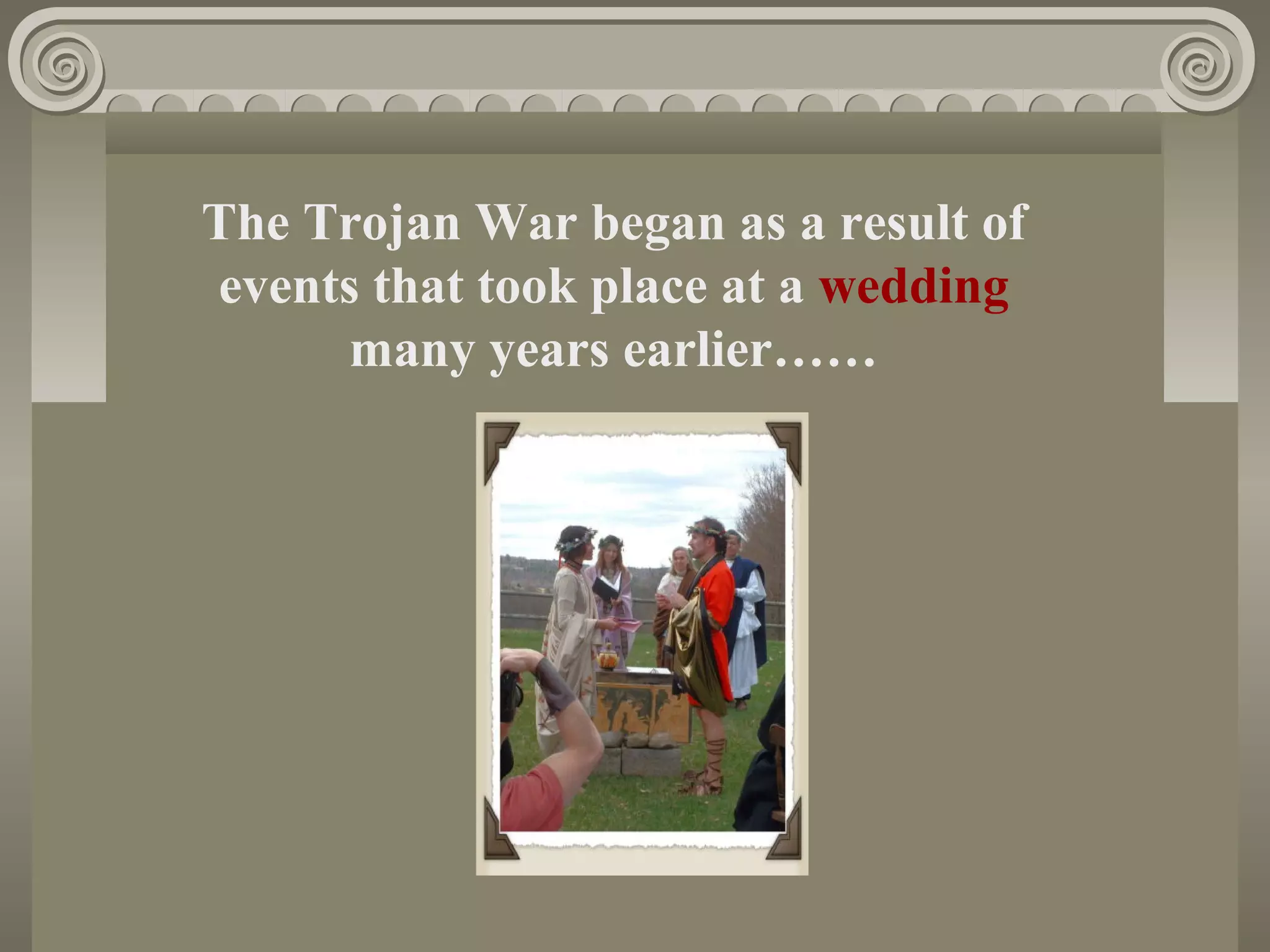
The Trojan War began as a result of
events that took place at a wedding
many years earlier……
Paris, the handsomest man in all of
the known world, was asked by Zeus
to judge a divine “beauty contest” of
sorts. A golden apple would be given
to the most beautiful goddess present
– Hera, Athena, or Aphrodite.
0Hera offered Paris ultimate power
if he picked her; Athena promised
to make him the wealthiest man
alive, and Aphrodite promised to
give Paris Helen – the most
beautiful woman alive.
{Nevermind that she was already
married to Menelaus of
Sparta……}
Paris, of course, picked Aphrodite,
and she helped him to steal Helen
from her husband’s home and
whisk her away to Troy, his
boyhood home. Needless to say,
Menelaus launched 1,000 ships –
commanded by Greek kings and
their armies – to get Helen back.
Thus, the Trojan War began.
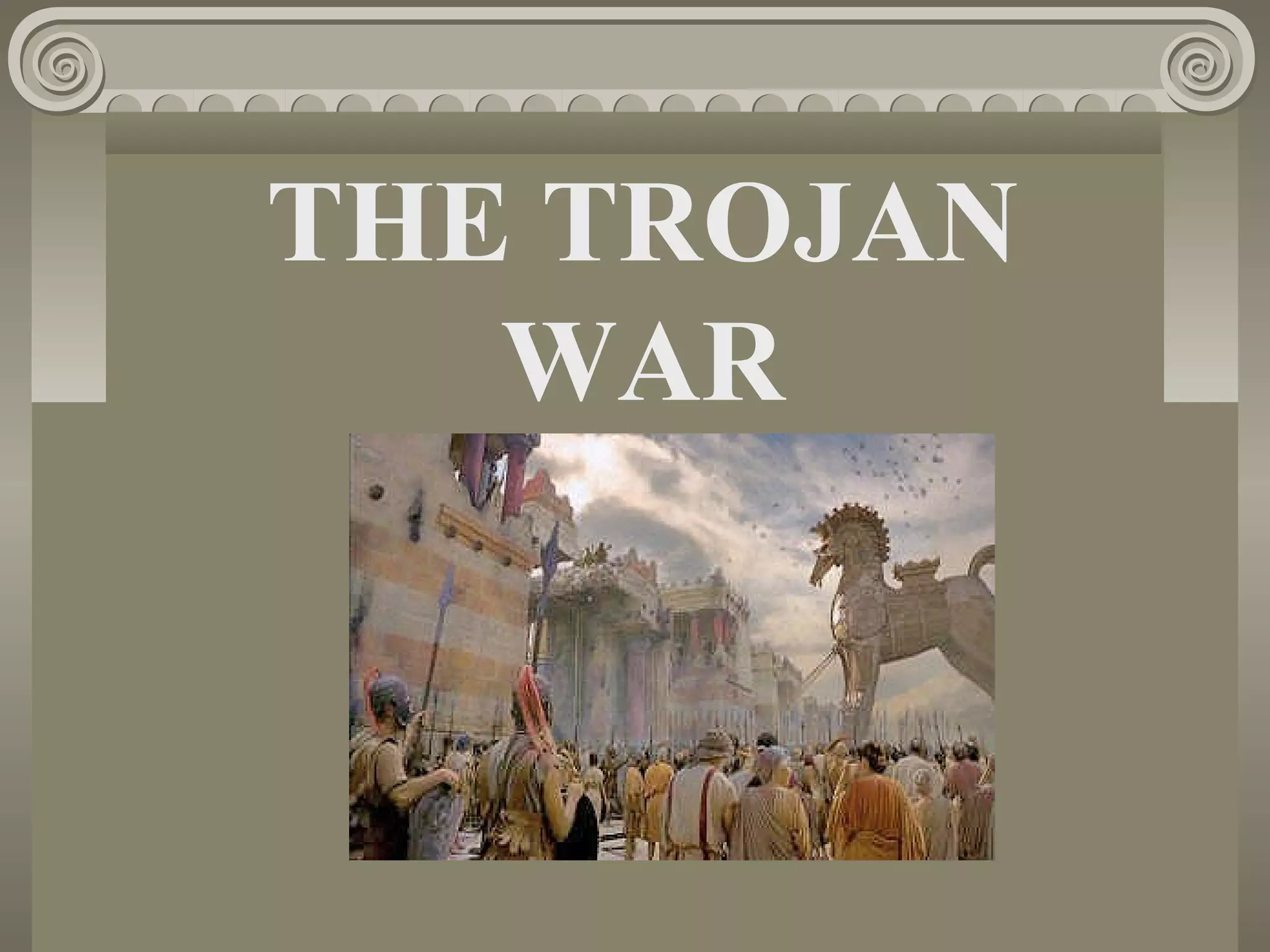
THE TROJAN
WAR
Just after Menelaus, Achilles, and
Agamemnon (three Greek kings)
had found Troy and began to
engage the Trojan army in a fight,
Achilles became very angry at
Agamemnon over a girl (you’ll
just have to wait to read the story
to find out the juicy details!)
Achilles refused to fight, and
returned home in a pout. All of
the rewards the Greeks had to
offer could not entice him to
return to battle; however, he
allowed his best friend – Patroclus
– to fight in his place.
When Achilles received word that
his friend Patroclus was killed by
Hector – the Trojan hero – he
returned to battle, swearing
revenge on Hector. He killed
Hector and dragged his body
behind a chariot to further
dishonor him.
Only after Hector’s father –
Priam, king of Troy – came to
Achilles and begged for the body
of his son did Achilles release his
anger and give up Hector’s body
for a proper / honorable burial.
HOMERHOMER –
BARD of THE ILIAD
The ancient Greeks ascribed the Iliad
and the Odyssey, their two oldest,
monumental epic poems, to Homer,
whom they called simply "The Poet."
Nothing certain is known about
Homer's life. His name, which means
"hostage," gives no clue to his origins,
since small wars and raids between
neighboring city-states and towns were
frequent in ancient Greece, and
prisoners were routinely held for
ransom of sold into slavery. Homer is
commonly referred to as the "Ionian
Legend has it that Homer was blind.
This legend may have some basis in
fact; if he lived to be an old man, he
may simply have become blind.
However, the idea of Homer's
blindness may have arisen because of
its symbolic implications. The Greeks
contrasted inner vision with physical
vision, that a “second sight” was a gift
from the gods to make up for a loss of
physical sight. Also, Homer's image -
the blind bard singing the myths of his
people - is a striking symbol for the
Although it is not known for certain
when Homer lived, the Iliad was almost
certainly composed late in the 8th
century B.C. Historically, however, both
the Iliad and the Odyssey take place in
a long-past heroic age known as the
Late Bronze Age. Homer did not create
the plot of characters of the epics he is
credited with writing; rather, he
inherited the stories of those epics.
Generations of Greeks had preserved
orally the subject matter of the Iliad and
the Odyssey - the story of the Trojan
The Epic FormThe Epic Form
The Iliad was, in fact, considered
historical fact: children in the fifth
century B.C. memorized large sections of
the poem and practiced the ethical codes
that Homer presents. Athenians even
claimed the Homeric gods and heroes as
founders or champions of Athens and its
people. Homer's epics also had a
tremendous influence on later
generations of Greek writers. Greek lyric
poets, dramatists, and philosophers
considered themselves Homer's heirs,
drawing on his work either to imitate it or
Just as the oral tradition supplied
Homer with a vast body of legend, it
also provided him with the form and
structure in which to express the
legend. Although Homer was free to
choose and shape the elements of the
story according to his own vision, his
language, meter, and style were
formulaic. Over time, bards had
developed a common fund of
expressions, phrases, and descriptions
that fit the rhythms of the epic verse
line. These conventions became the
Homer begins the Iliad powerfully
by stating the epic's theme and
invoking one of the Muses. The
Muses are nine goddesses in Greek
mythology who were believed to
preside over all forms of art and
science. The poet calls on the
Muse to inspire him with the
material he needs to tell the story.
This type of opening is one of the
defining features of a Homeric epic.
Homer observes another epic convention
by beginning the story "in medias res,"
which is Latin for "in the middle of
things." Reading a Greek epic from the
beginning is like tuning in to a story
already in progress, in that many of the
story's events have already taken place.
Information about those events is
revealed later in the poem through
flashbacks and other narrative devices.
Homer could begin his poems in medias
res because the general outline of the
plot and the main characters would have
The particular demands of composing and
listening to oral poetry gave rise to the
use of stock descriptive words of
phrases, such as "brilliant Achilles," or
"Hector breaker of horses." These
epithets, often compound adjectives like
"blazing-eyed Athena," allowed the poet
to describe an object or a character
quickly and economically, in terms his
audience would recognize. Homeric
epithets and other formulaic language
may have helped the poet shape his story
and compose while reciting, and the
Cultural InfluencesCultural Influences
in The Iliadin The Iliad
The gods and goddesses of
Homer's epics often would take
contradictory sides in human
affairs and would interfere with
mortals in ways that sometimes
seemed helpful while at other
times seemed unfair. Humans
were constantly at the gods'
mercy, and many Greeks would
blame misfortunes upon an angry
god or goddess who had been
displeased by the actions of some
To protect themselves from the
vengeance of angry gods, Greeks
practiced ritual sacrifices. The ritual
sacrifice of animals was a common
practice. Normally, only certain parts
of the slaughtered animals were
burned. Among these were the fatty
parts that make aromatic smoke
sacrificers hoped would reach the
gods; the remaining meat was shared
among the people. When the entire
animals was burned, the sacrifice was
Sometimes larger, more substantial
sacrifices were necessary. A
hecatomb is the sacrifice of one
hundred animals (usually oxen, sheep,
or goats), although the term may be
used to refer to any large sacrifice.
Other times, a human sacrifice was
required, as in the case of
Agamemnon's daughter who was slain
in order to appease the goddess
Artemis and ensure a safe voyage to
Troy. Agamemnon himself was said
Throughout the Iliad, reciprocity,
hospitality, and exchange are the
glue that holds a society together,
mending the cracks that would
split it apart. Exchanging gifts and
services is the way "xenia" works,
the guest-host relationship in
ancient Greece that binds together
people not related by blood or
clan.
Early in the sixth book of the Iliad,
the heroes Glaucus and Diomedes
come together to fight. Before
engaging in battle, each ascertain
the other's identity. The two men
discover that their ancestors had
established a bond of xenia.
Realizing that they are bound to
uphold the ancestral bond, the two
warriors vow not to fight each other
and exchange armor as a gesture of
friendship.
Refusing to take part in the system
threatens to shake the foundations
of civilized community. Likewise,
Greeks who would withhold
hospitality to other Greeks or
traveling strangers risked angering
the gods and goddesses, who often
traveled in disguise and would be
offended if hospitality were not
given.
In ancient Greece, oaths were
sworn to solemnize promises or
threats and to formalize official
relationships between individuals,
clans, or states. The gods were
called on to witness the intentions
of the speaker; if the speaker
violated his oath, the gods would
punish him.
As warfare is presented in the Iliad,
there are several options in dealing
with a dead opponent. The winner
might strip the armor of the
vanquished warrior and then return
the body. The returning of the
vanquished hero to his homeland
was important to the ancient
Greeks, and warriors would often
go to great lengths to retrieve the
bodies of their fallen comrades.
The Greeks placed such importance
upon burying the dead that they
believed departed souls would
return to haunt the living if, in
death, they did not receive a proper
burial. In the context of formal
mourning, only women sang funeral
dirges (songs). The men would
play "funeral games" - games of
skill and chance to honor the fallen
warrior.
All of these cultural influences can
be seen in Homer’s rendition of
“The Iliad.”

The iliad -_background_information

  • 1.
    The Iliad - ATale of Ancient Greece
  • 2.
    The Iliad isthe story of Achilles, or, as it is often called, “The tragedy of Achilles,” and how he brings disaster upon himself through his anger. Although parts of the Iliad have nothing to do with Achilles, he is the central figure, the medium through which Homer conveys the poem's theme. As Homer shows, coming face to face with his own humanity, he takes his audience on a moral journey. This is perhaps the main reason the Iliad transcends the limits of time, place, and
  • 3.
  • 4.
    Achilles was theson of the mortal Peleus and the goddess Thetis. He was the mightiest of the Greeks who fought in the Trojan War, and was the hero of Homer's Iliad.
  • 5.
    Achilles was verybrave and undefeatable in battle – almost immortal, in fact. There are two stories that explain why Achilles was so resistant to death:
  • 6.
    Story 1: Thetis, Achilles’goddess-mother, wanted to burn away the human part of her son; so she placed him upon a fiery altar. Peleus, Achilles’ father, intervened just in time, but an angry Thetis abandoned her son and husband.
  • 7.
    Story 2: Thetis, Achilles’goddess-mother, wanted to make her son immune to death. So she held him by the heel and dipped him into the River Styx to make him immortal. Thus, the only vulnerable (weak) spot on Achilles’ body was his tendon where his mother held him as she dipped him into the waters of death.
  • 8.
    There was aprophecy given about Achilles’ destiny while he was still a boy. A prophet named Calchas prophesied that the city of Troy could not be taken without Achilles’ help. Thetis knew that, if her son went to Troy, Achilles would die an early death, so she sent him to the court of Lycomedes, in Scyros where he was hidden, disguised as a young girl. Achilles' disguise was finally discovered by Odysseus. Achilles went willingly with Odysseus to Troy, leading a host of his father's Myrmidons and accompanied by
  • 9.
    The Trojan Warbegan as a result of events that took place at a wedding many years earlier……
  • 10.
    Paris, the handsomestman in all of the known world, was asked by Zeus to judge a divine “beauty contest” of sorts. A golden apple would be given to the most beautiful goddess present – Hera, Athena, or Aphrodite.
  • 11.
    0Hera offered Parisultimate power if he picked her; Athena promised to make him the wealthiest man alive, and Aphrodite promised to give Paris Helen – the most beautiful woman alive. {Nevermind that she was already married to Menelaus of Sparta……}
  • 12.
    Paris, of course,picked Aphrodite, and she helped him to steal Helen from her husband’s home and whisk her away to Troy, his boyhood home. Needless to say, Menelaus launched 1,000 ships – commanded by Greek kings and their armies – to get Helen back. Thus, the Trojan War began.
  • 13.
  • 14.
    Just after Menelaus,Achilles, and Agamemnon (three Greek kings) had found Troy and began to engage the Trojan army in a fight, Achilles became very angry at Agamemnon over a girl (you’ll just have to wait to read the story to find out the juicy details!)
  • 15.
    Achilles refused tofight, and returned home in a pout. All of the rewards the Greeks had to offer could not entice him to return to battle; however, he allowed his best friend – Patroclus – to fight in his place.
  • 16.
    When Achilles receivedword that his friend Patroclus was killed by Hector – the Trojan hero – he returned to battle, swearing revenge on Hector. He killed Hector and dragged his body behind a chariot to further dishonor him.
  • 17.
    Only after Hector’sfather – Priam, king of Troy – came to Achilles and begged for the body of his son did Achilles release his anger and give up Hector’s body for a proper / honorable burial.
  • 18.
  • 19.
    The ancient Greeksascribed the Iliad and the Odyssey, their two oldest, monumental epic poems, to Homer, whom they called simply "The Poet." Nothing certain is known about Homer's life. His name, which means "hostage," gives no clue to his origins, since small wars and raids between neighboring city-states and towns were frequent in ancient Greece, and prisoners were routinely held for ransom of sold into slavery. Homer is commonly referred to as the "Ionian
  • 20.
    Legend has itthat Homer was blind. This legend may have some basis in fact; if he lived to be an old man, he may simply have become blind. However, the idea of Homer's blindness may have arisen because of its symbolic implications. The Greeks contrasted inner vision with physical vision, that a “second sight” was a gift from the gods to make up for a loss of physical sight. Also, Homer's image - the blind bard singing the myths of his people - is a striking symbol for the
  • 21.
    Although it isnot known for certain when Homer lived, the Iliad was almost certainly composed late in the 8th century B.C. Historically, however, both the Iliad and the Odyssey take place in a long-past heroic age known as the Late Bronze Age. Homer did not create the plot of characters of the epics he is credited with writing; rather, he inherited the stories of those epics. Generations of Greeks had preserved orally the subject matter of the Iliad and the Odyssey - the story of the Trojan
  • 22.
  • 23.
    The Iliad was,in fact, considered historical fact: children in the fifth century B.C. memorized large sections of the poem and practiced the ethical codes that Homer presents. Athenians even claimed the Homeric gods and heroes as founders or champions of Athens and its people. Homer's epics also had a tremendous influence on later generations of Greek writers. Greek lyric poets, dramatists, and philosophers considered themselves Homer's heirs, drawing on his work either to imitate it or
  • 24.
    Just as theoral tradition supplied Homer with a vast body of legend, it also provided him with the form and structure in which to express the legend. Although Homer was free to choose and shape the elements of the story according to his own vision, his language, meter, and style were formulaic. Over time, bards had developed a common fund of expressions, phrases, and descriptions that fit the rhythms of the epic verse line. These conventions became the
  • 25.
    Homer begins theIliad powerfully by stating the epic's theme and invoking one of the Muses. The Muses are nine goddesses in Greek mythology who were believed to preside over all forms of art and science. The poet calls on the Muse to inspire him with the material he needs to tell the story. This type of opening is one of the defining features of a Homeric epic.
  • 26.
    Homer observes anotherepic convention by beginning the story "in medias res," which is Latin for "in the middle of things." Reading a Greek epic from the beginning is like tuning in to a story already in progress, in that many of the story's events have already taken place. Information about those events is revealed later in the poem through flashbacks and other narrative devices. Homer could begin his poems in medias res because the general outline of the plot and the main characters would have
  • 27.
    The particular demandsof composing and listening to oral poetry gave rise to the use of stock descriptive words of phrases, such as "brilliant Achilles," or "Hector breaker of horses." These epithets, often compound adjectives like "blazing-eyed Athena," allowed the poet to describe an object or a character quickly and economically, in terms his audience would recognize. Homeric epithets and other formulaic language may have helped the poet shape his story and compose while reciting, and the
  • 28.
  • 29.
    The gods andgoddesses of Homer's epics often would take contradictory sides in human affairs and would interfere with mortals in ways that sometimes seemed helpful while at other times seemed unfair. Humans were constantly at the gods' mercy, and many Greeks would blame misfortunes upon an angry god or goddess who had been displeased by the actions of some
  • 30.
    To protect themselvesfrom the vengeance of angry gods, Greeks practiced ritual sacrifices. The ritual sacrifice of animals was a common practice. Normally, only certain parts of the slaughtered animals were burned. Among these were the fatty parts that make aromatic smoke sacrificers hoped would reach the gods; the remaining meat was shared among the people. When the entire animals was burned, the sacrifice was
  • 31.
    Sometimes larger, moresubstantial sacrifices were necessary. A hecatomb is the sacrifice of one hundred animals (usually oxen, sheep, or goats), although the term may be used to refer to any large sacrifice. Other times, a human sacrifice was required, as in the case of Agamemnon's daughter who was slain in order to appease the goddess Artemis and ensure a safe voyage to Troy. Agamemnon himself was said
  • 32.
    Throughout the Iliad,reciprocity, hospitality, and exchange are the glue that holds a society together, mending the cracks that would split it apart. Exchanging gifts and services is the way "xenia" works, the guest-host relationship in ancient Greece that binds together people not related by blood or clan.
  • 33.
    Early in thesixth book of the Iliad, the heroes Glaucus and Diomedes come together to fight. Before engaging in battle, each ascertain the other's identity. The two men discover that their ancestors had established a bond of xenia. Realizing that they are bound to uphold the ancestral bond, the two warriors vow not to fight each other and exchange armor as a gesture of friendship.
  • 34.
    Refusing to takepart in the system threatens to shake the foundations of civilized community. Likewise, Greeks who would withhold hospitality to other Greeks or traveling strangers risked angering the gods and goddesses, who often traveled in disguise and would be offended if hospitality were not given.
  • 35.
    In ancient Greece,oaths were sworn to solemnize promises or threats and to formalize official relationships between individuals, clans, or states. The gods were called on to witness the intentions of the speaker; if the speaker violated his oath, the gods would punish him.
  • 36.
    As warfare ispresented in the Iliad, there are several options in dealing with a dead opponent. The winner might strip the armor of the vanquished warrior and then return the body. The returning of the vanquished hero to his homeland was important to the ancient Greeks, and warriors would often go to great lengths to retrieve the bodies of their fallen comrades.
  • 37.
    The Greeks placedsuch importance upon burying the dead that they believed departed souls would return to haunt the living if, in death, they did not receive a proper burial. In the context of formal mourning, only women sang funeral dirges (songs). The men would play "funeral games" - games of skill and chance to honor the fallen warrior.
  • 38.
    All of thesecultural influences can be seen in Homer’s rendition of “The Iliad.”