Preservation Planning An Overview Hans Hofman Planets project, Training Vilnius, 3 October 2007
Overview What is the problem? Defining the issues The scope and role of Preservation Planning The Planets approach The organisational/ business context Usage requirements and collection profiles Preservation plans and preservation actions
Why Preservation Planning? Who are the stakeholders? What is the issue? Why important? What are the objectives?
Stakeholders Memory institutions (‘content holders’) (Scientific) data centres  Government organisations Business companies Individuals
The issue / challenge The enormous and rapidly increasing amount of digital information Fragile resources The rapid evolution in technology The risk of obsolescence and therefore corruption and/or loss of valuable information (Pro-)active  and ongoing attention / maintenance required Potential solutions: still fragmented infrastructure not comprehensive
Objectives of Preservation Planning To identify and analyse the organisational context including a risk assessment define a framework for preservation (?) To support decision-making about digital preservation including  Identifying criteria for preservation within that context Defining workflow for evaluating/ defining preservation plans Developing methodologies for assessing the risks of applying different preservation strategies for different types of digital objects To enable formulation, evaluation and execution of high-quality and cost-effective preservation plans that suit the organisational (e.g. repository) needs
What is Preservation Planning? Defining criteria for preservation of specific digital objects (in the collection) based on risk analysis in a defined (business) context Following a systematic and structured workflow/ procedure in making decisions about the best possible approaches given the organisational context and the content of the repository Defining one or more appropriate preservation plan(s) depending on the types of objects and available strategies Execute those plans when needed, and Be able to assess the quality of the results Document all these steps in order to be accountable Issue: scope includes preservation policy?
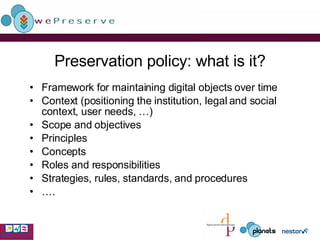
Preservation policy: what is it? Framework for maintaining digital objects over time Context (positioning the institution, legal and social context, user needs, …) Scope and objectives Principles Concepts Roles and responsibilities Strategies, rules, standards, and procedures … .
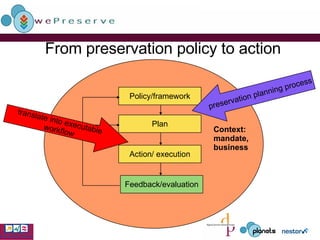
From preservation policy to action Policy/framework preservation planning process translate into executable workflow Context: mandate,  business Plan Action/ execution Feedback/evaluation
Exercise
Groups A: Collection of scanned newspapers in a library Egle, Renata, Grazina, Edvardas, Filip/Tomasz, Libor B: Sound archive (Archive of Dialects) Thomas, Violeta, Hamid, Tomasz/Filip, Aiste C: Collection of electronic publications: Library Journal publications, Theses and dissertations Jurate, Jelena, Laima, Edgars, Elona D: Collection of electronic publications: Archive Piret, Aadi, Raimonda, Marija, Bjorn Ragnolf
Exercise Determine what (external/internal) factors will influence a preservation policy for your context  Identify what would be the main issues that have to be addressed or included for preserving the objects involved
Terminology Preservation vs. curation recordkeeping, archiving Framework, policy, strategy Plan, action, method
The Planets approach Understanding the parameters of successful preservation strategy in different contexts, i.e archives, libraries and data centres, e-government, … Understanding organisational policies What is happening in practice? What would a policy encompass? Policies may exist, but are hardly implemented Understanding usage of digital objects Carrying out probes and interviews with selected researchers in different institutions Collect information and experiences from researchers in several iterations Let users talk as much as possible Analysis and structuring of results (‘affinity analysis’) Identification of areas of user interests Interviews with futurologists
Planets approach (2) Collection profile What types of objects (both technical and intellectual aspects)? Technical: file formats registries (e.g. PRONOM, …) Intellectual: for instance documentary form, look and feel, ‘behaviour’  objective tree ‘templates’ an (intellectual) object may consist of different computer files what strategy then?
Planets Approach (3) Usage requirements  Performance Usability, presentation Authenticity Understanding Rights Costs
Planets approach (4) Providing a decision-support workflow and mechanism capable of translating those parameters into best available strategy  Conducting case studies to identify sets of essential characteristics for different digital objects (objective trees) Developing a decision support tool (software) 1st version, end of November 2007 (not public) 2d version publicly available, second half of 2008 Systematic procedure for evaluating preservation strategies Based on evaluation of strategies create preservation plan
From policy to action: Preservation Plan Preservation context legal and regulatory environment mandate Roles and responsibilities Selected preservation strategy based on evaluation evaluation result (which alternatives have been compared, the outcome) Costs of applying the preservation plan Trigger(s) to initiate the execution of the plan more…?
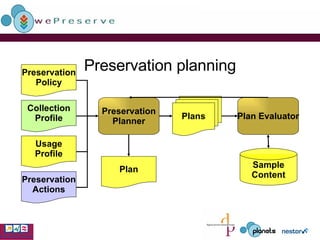
Preservation planning Preservation Policy Collection Profile Usage Profile Preservation Planner Plans Plan Evaluator Plan Sample Content Preservation Actions
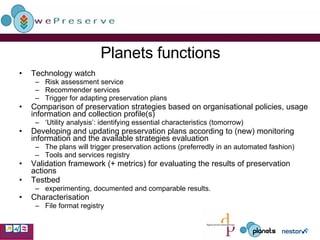
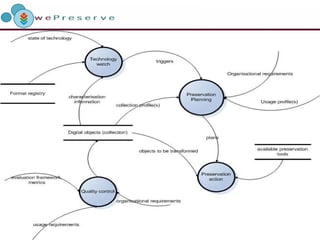
Planets functions Technology watch Risk assessment service Recommender services Trigger for adapting preservation plans Comparison of preservation strategies based on organisational policies, usage information and collection profile(s)  ‘ Utility analysis’: identifying essential characteristics (tomorrow) Developing and updating preservation plans according to (new) monitoring information and the available strategies evaluation The plans will trigger preservation actions (preferredly in an automated fashion) Tools and services registry Validation framework (+ metrics) for evaluating the results of preservation actions Testbed experimenting, documented and comparable results. Characterisation File format registry
 
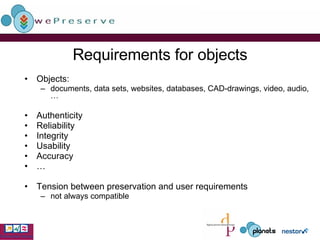
Requirements for objects Objects:  documents, data sets, websites, databases, CAD-drawings, video, audio, … Authenticity Reliability Integrity Usability Accuracy … Tension between preservation and user requirements  not always compatible
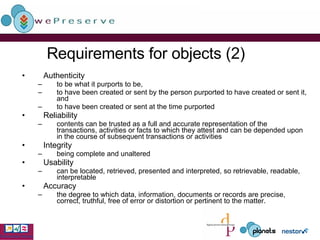
Requirements for objects (2)  Authenticity to be what it purports to be, to have been created or sent by the person purported to have created or sent it, and  to have been created or sent at the time purported   Reliability contents can be trusted as a full and accurate representation of the transactions, activities or facts to which they attest and can be depended upon in the course of subsequent transactions or activities   Integrity being complete and unaltered   Usability can be located, retrieved, presented and interpreted, so retrievable, readable, interpretable Accuracy the degree to which data, information, documents or records are precise, correct, truthful, free of error or distortion or pertinent to the matter.
Relationship to OAIS model
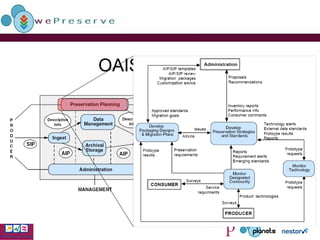
OAIS   Model
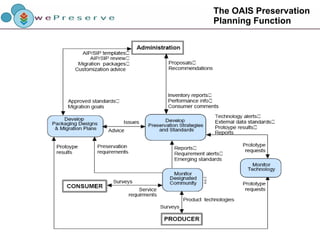
The OAIS Preservation  Planning Function
OAIS Functions Develop preservation strategies and standards Develop Packaging designs and migration plans Monitor designated community/-ies Monitor technology
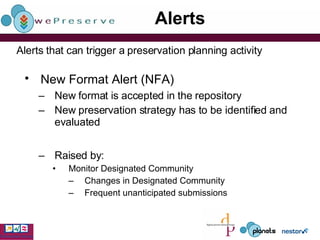
Alerts New Format Alert (NFA)   New format is accepted in the repository  New preservation strategy has to be identified and evaluated Raised by: Monitor Designated Community Changes in Designated Community Frequent unanticipated submissions Alerts that can trigger a preservation planning activity
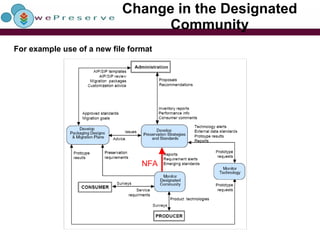
Change in the Designated Community For example use of a new file format NFA
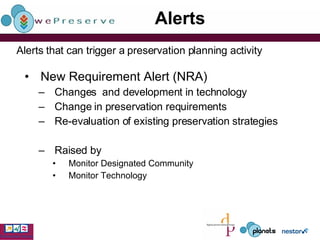
Alerts New Requirement Alert (NRA) Changes  and development in technology  Change in preservation requirements Re-evaluation of existing preservation strategies Raised by Monitor Designated Community  Monitor Technology Alerts that can trigger a preservation planning activity
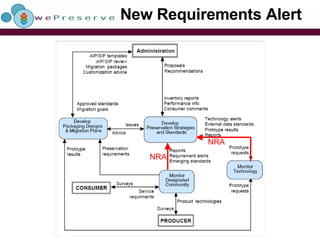
New Requirements Alert NRA NRA
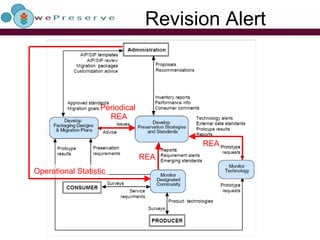
Alerts Revision Alert (REA) Periodical reviews help to improve and further develop existing preservation strategies 3 kinds: Periodical review Review depending on operational statistics Review for new developments  Alerts that can trigger a preservation planning activity
Revision Alert Periodical   REA Operational Statistic REA REA
Preservation Planning:  an overview
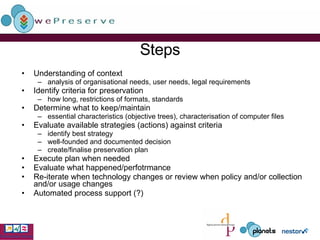
Steps Understanding of context analysis of organisational needs, user needs, legal requirements Identify criteria for preservation how long, restrictions of formats, standards  Determine what to keep/maintain essential characteristics (objective trees), characterisation of computer files Evaluate available strategies (actions) against criteria  identify best strategy well-founded and documented decision create/finalise preservation plan Execute plan when needed Evaluate what happened/perfotrmance Re-iterate when technology changes or review when policy and/or collection and/or usage changes Automated process support (?)
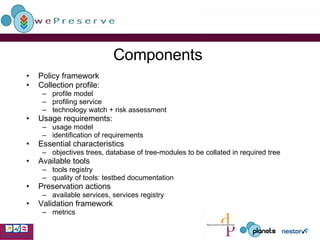
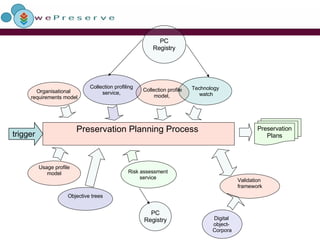
Components Policy framework Collection profile:  profile model profiling service technology watch + risk assessment Usage requirements:  usage model identification of requirements Essential characteristics objectives trees, database of tree-modules to be collated in required tree Available tools tools registry quality of tools: testbed documentation Preservation actions available services, services registry Validation framework metrics
Preservation Planning Process  trigger Preservation Plans Usage profile model Collection profile model,  Organisational  requirements model Technology watch Collection profiling  service,  Objective trees Risk assessment  service  PC Registry Validation  framework PC Registry Digital  object-  Corpora
This work is licenced under the Creative Commons Attribution-Non-Commercial-No Derivative Works 3.0 Netherlands License. To view a copy of this licence, visit  http:// creativecommons . org / licenses /by- nc - nd /3.0/ nl /  or send a letter to Creative Commons, 171 Second Street, Suite 300, San Francisco, California 94105, USA.

Trm Planets Training Pp Module

  • 1.
    Preservation Planning AnOverview Hans Hofman Planets project, Training Vilnius, 3 October 2007
  • 2.
    Overview What isthe problem? Defining the issues The scope and role of Preservation Planning The Planets approach The organisational/ business context Usage requirements and collection profiles Preservation plans and preservation actions
  • 3.
    Why Preservation Planning?Who are the stakeholders? What is the issue? Why important? What are the objectives?
  • 4.
    Stakeholders Memory institutions(‘content holders’) (Scientific) data centres Government organisations Business companies Individuals
  • 5.
    The issue /challenge The enormous and rapidly increasing amount of digital information Fragile resources The rapid evolution in technology The risk of obsolescence and therefore corruption and/or loss of valuable information (Pro-)active and ongoing attention / maintenance required Potential solutions: still fragmented infrastructure not comprehensive
  • 6.
    Objectives of PreservationPlanning To identify and analyse the organisational context including a risk assessment define a framework for preservation (?) To support decision-making about digital preservation including Identifying criteria for preservation within that context Defining workflow for evaluating/ defining preservation plans Developing methodologies for assessing the risks of applying different preservation strategies for different types of digital objects To enable formulation, evaluation and execution of high-quality and cost-effective preservation plans that suit the organisational (e.g. repository) needs
  • 7.
    What is PreservationPlanning? Defining criteria for preservation of specific digital objects (in the collection) based on risk analysis in a defined (business) context Following a systematic and structured workflow/ procedure in making decisions about the best possible approaches given the organisational context and the content of the repository Defining one or more appropriate preservation plan(s) depending on the types of objects and available strategies Execute those plans when needed, and Be able to assess the quality of the results Document all these steps in order to be accountable Issue: scope includes preservation policy?
  • 8.
    Preservation policy: whatis it? Framework for maintaining digital objects over time Context (positioning the institution, legal and social context, user needs, …) Scope and objectives Principles Concepts Roles and responsibilities Strategies, rules, standards, and procedures … .
  • 9.
    From preservation policyto action Policy/framework preservation planning process translate into executable workflow Context: mandate, business Plan Action/ execution Feedback/evaluation
  • 10.
  • 11.
    Groups A: Collectionof scanned newspapers in a library Egle, Renata, Grazina, Edvardas, Filip/Tomasz, Libor B: Sound archive (Archive of Dialects) Thomas, Violeta, Hamid, Tomasz/Filip, Aiste C: Collection of electronic publications: Library Journal publications, Theses and dissertations Jurate, Jelena, Laima, Edgars, Elona D: Collection of electronic publications: Archive Piret, Aadi, Raimonda, Marija, Bjorn Ragnolf
  • 12.
    Exercise Determine what(external/internal) factors will influence a preservation policy for your context Identify what would be the main issues that have to be addressed or included for preserving the objects involved
  • 13.
    Terminology Preservation vs.curation recordkeeping, archiving Framework, policy, strategy Plan, action, method
  • 14.
    The Planets approachUnderstanding the parameters of successful preservation strategy in different contexts, i.e archives, libraries and data centres, e-government, … Understanding organisational policies What is happening in practice? What would a policy encompass? Policies may exist, but are hardly implemented Understanding usage of digital objects Carrying out probes and interviews with selected researchers in different institutions Collect information and experiences from researchers in several iterations Let users talk as much as possible Analysis and structuring of results (‘affinity analysis’) Identification of areas of user interests Interviews with futurologists
  • 15.
    Planets approach (2)Collection profile What types of objects (both technical and intellectual aspects)? Technical: file formats registries (e.g. PRONOM, …) Intellectual: for instance documentary form, look and feel, ‘behaviour’ objective tree ‘templates’ an (intellectual) object may consist of different computer files what strategy then?
  • 16.
    Planets Approach (3)Usage requirements Performance Usability, presentation Authenticity Understanding Rights Costs
  • 17.
    Planets approach (4)Providing a decision-support workflow and mechanism capable of translating those parameters into best available strategy Conducting case studies to identify sets of essential characteristics for different digital objects (objective trees) Developing a decision support tool (software) 1st version, end of November 2007 (not public) 2d version publicly available, second half of 2008 Systematic procedure for evaluating preservation strategies Based on evaluation of strategies create preservation plan
  • 18.
    From policy toaction: Preservation Plan Preservation context legal and regulatory environment mandate Roles and responsibilities Selected preservation strategy based on evaluation evaluation result (which alternatives have been compared, the outcome) Costs of applying the preservation plan Trigger(s) to initiate the execution of the plan more…?
  • 19.
    Preservation planning PreservationPolicy Collection Profile Usage Profile Preservation Planner Plans Plan Evaluator Plan Sample Content Preservation Actions
  • 20.
    Planets functions Technologywatch Risk assessment service Recommender services Trigger for adapting preservation plans Comparison of preservation strategies based on organisational policies, usage information and collection profile(s) ‘ Utility analysis’: identifying essential characteristics (tomorrow) Developing and updating preservation plans according to (new) monitoring information and the available strategies evaluation The plans will trigger preservation actions (preferredly in an automated fashion) Tools and services registry Validation framework (+ metrics) for evaluating the results of preservation actions Testbed experimenting, documented and comparable results. Characterisation File format registry
  • 21.
  • 22.
    Requirements for objectsObjects: documents, data sets, websites, databases, CAD-drawings, video, audio, … Authenticity Reliability Integrity Usability Accuracy … Tension between preservation and user requirements not always compatible
  • 23.
    Requirements for objects(2) Authenticity to be what it purports to be, to have been created or sent by the person purported to have created or sent it, and to have been created or sent at the time purported Reliability contents can be trusted as a full and accurate representation of the transactions, activities or facts to which they attest and can be depended upon in the course of subsequent transactions or activities Integrity being complete and unaltered Usability can be located, retrieved, presented and interpreted, so retrievable, readable, interpretable Accuracy the degree to which data, information, documents or records are precise, correct, truthful, free of error or distortion or pertinent to the matter.
  • 24.
  • 25.
    OAIS Model
  • 26.
    The OAIS Preservation Planning Function
  • 27.
    OAIS Functions Developpreservation strategies and standards Develop Packaging designs and migration plans Monitor designated community/-ies Monitor technology
  • 28.
    Alerts New FormatAlert (NFA) New format is accepted in the repository New preservation strategy has to be identified and evaluated Raised by: Monitor Designated Community Changes in Designated Community Frequent unanticipated submissions Alerts that can trigger a preservation planning activity
  • 29.
    Change in theDesignated Community For example use of a new file format NFA
  • 30.
    Alerts New RequirementAlert (NRA) Changes and development in technology Change in preservation requirements Re-evaluation of existing preservation strategies Raised by Monitor Designated Community Monitor Technology Alerts that can trigger a preservation planning activity
  • 31.
  • 32.
    Alerts Revision Alert(REA) Periodical reviews help to improve and further develop existing preservation strategies 3 kinds: Periodical review Review depending on operational statistics Review for new developments Alerts that can trigger a preservation planning activity
  • 33.
    Revision Alert Periodical REA Operational Statistic REA REA
  • 34.
  • 35.
    Steps Understanding ofcontext analysis of organisational needs, user needs, legal requirements Identify criteria for preservation how long, restrictions of formats, standards Determine what to keep/maintain essential characteristics (objective trees), characterisation of computer files Evaluate available strategies (actions) against criteria identify best strategy well-founded and documented decision create/finalise preservation plan Execute plan when needed Evaluate what happened/perfotrmance Re-iterate when technology changes or review when policy and/or collection and/or usage changes Automated process support (?)
  • 36.
    Components Policy frameworkCollection profile: profile model profiling service technology watch + risk assessment Usage requirements: usage model identification of requirements Essential characteristics objectives trees, database of tree-modules to be collated in required tree Available tools tools registry quality of tools: testbed documentation Preservation actions available services, services registry Validation framework metrics
  • 37.
    Preservation Planning Process trigger Preservation Plans Usage profile model Collection profile model, Organisational requirements model Technology watch Collection profiling service, Objective trees Risk assessment service PC Registry Validation framework PC Registry Digital object- Corpora
  • 38.
    This work islicenced under the Creative Commons Attribution-Non-Commercial-No Derivative Works 3.0 Netherlands License. To view a copy of this licence, visit http:// creativecommons . org / licenses /by- nc - nd /3.0/ nl / or send a letter to Creative Commons, 171 Second Street, Suite 300, San Francisco, California 94105, USA.