Trusted Repositories DPE/Planets/CASPAR/nestor  Joint Training Event: The Preservation challenge: basic concepts and practical applications March, 23th- 27th 2008 Barcelona, Spain Christian Keitel Landesarchiv Baden-Württemberg and nestor Special thanks to Susanne Dobratz, Astrid Schoger and Stefan Strathmann from the  nestor-WG „Trusted Repositories – Certification“
Session Outline The problem Trustworthy objects and trustworthy repositories Initiatives and activities: TRAC and DRAMBORA Example: nestor Catalogue of Criteria for Trusted Digital Repositories
Authenticity There is a conformity/identity of… the author according to the document and the real author. the date of origin according to the document and the date in fact written by the author. the content according to the document and the content in fact written by the real author. The object actually contains what it claims to contain.
After 800 years: The same content?
Two browsers: The same content?
Jpg and png: The same content?
Intermediate result Authenticity = The object actually contains what it claims to contain. Absolute authenticity isn‘t feasible. Authenticity depends from the point of view.
Trustworthiness of Paper and Parchment:  Look at the material! Marriage contract between Karl, Prince of  Württemberg, and  Olga, Princess of Russia, 1849, HStAS G 314 U 494
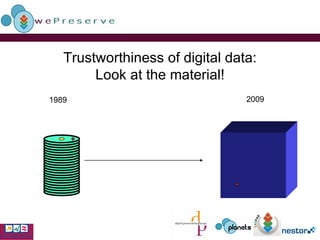
Trustworthiness of digital data: Look at the material! 1989 2009
Trustworthiness of traditional records: Look at the writing! Archive Production
Trustworthiness of digital records:  Look at the writing! Archive Production 011001011100101 100110010011000 1011001111110010 010010010101010 1101011011010010 1011001111110010 010010010101010 1101011011010010011001011100101 100110010011000 1101011011010010 011001011100101 100110010011000 1011001111110010 010010010101010
Intermediate result Authenticity = The object actually contains what it claims to contain. Absolute authenticity isn‘t feasible. Authenticity depends from the point of view. The traditionell ways of proving authenticity can’t be transferred easily into the digital world.
Trustworthiness of Formats?   For example Tiff Carriers?   For example CD Processes? For example Ingest
Intermediate result Authenticity = The object actually contains what it claims to contain. Absolute authenticity isn‘t feasible. Authenticity depends from the point of view. The traditionell ways of proving authenticity can’t be transferred easily into the digital world. There is no  overall accepted concrete criterion for digital archiving .
Intermediate result Authenticity = The object actually contains what it claims to contain. Absolute authenticity isn‘t feasible. Authenticity depends from the point of view. The traditionell ways of proving authenticity can’t be transferred easily into the digital world. There is no  overall accepted concrete criterion for digital archiving . A trustworthy repository allows the user to trust in the authenticity of the digital objects
Trustworthy Digital Archives “…  repositories claiming to serve an archival function must be able to prove that they are who they say they are by meeting or exceeding the standards and criteria of an independently-administered program for archival certification ..” Task Force on Archiving Digital Information (1996): Preserving Digital Information, Commission on Preservation and Access, Washington D.C.
Some Questions When is a digital repository trustworthy? What should be the criteria for a formal process of certification? Who verifies the trustworthiness of a digital repository: A group of experts, the archive by itself or each user on his own?
Who is interested in Trusted Repositories? General public, end user Information producer Archival Institutions: management, staff, responsible bodies Partner in a cooperative digital preservation (trusted repositories are the basis for cooperative digital preservation)
Challenges Broad variety of archives Different  designated communities Variety of object types Different standards in use Authenticity of the objects Integrity of the objects
International Efforts – A  Chronology 2002: RLG/OCLC Report: Trusted Repositories Attributes & Responsibilities 2002: Reference Model for an Open Archival Information System (OAIS) 2005: RLG/NARA: Audit Check-list for Repository Certification 2006: nestor: Catalogue of Criteria for Trusted Digital Repositories  2007: nestor/CLR/RLG/DPE/DCC: Core Requirements for Digital Archives  2007: DCC/DPE: Digital Repository Audit Method Based on Risk Assessment (DRAMBORA) 2007: CRL/OCLC: Trustworthy Repositories Audit & Certification (TRAC): Criteria and Check-list
Trustworthy Repositories Audit & Certification (TRAC): Criteria and Check-list Revised and expanded version of “The Audit Checklist for the Certification of Trusted Digital Repositories”, originally developed by RLG-NARA Test audits conducted 2006/2007 Provides Tools for the audit/assessment of digital repositories. Compiles documentation requirements. Drafts a certification process. Establishes methodologies for the determination of the sustainability of digital repositories. http://www.crl.edu/content.asp?l1=13&l2=58&l3=162
Digital Repository Audit Method Based on Risk Assessment (DRAMBORA) Based on risk-analysis Test audits in 2007 seq. Discussions in ISO Group TC46 http://www.repositoryaudit.eu/
10 Common Principles I In January 2007 DCC, DPE, nestor and CRL agreed on 10 basic characteristics of digital preservation repositories: The repository: Commits to continuing maintenance of digital objects for identified community/communities. Demonstrates organizational fitness (including financial, staffing structure, and processes) to fulfill its commitment. Acquires and maintains requisite contractual and legal rights and fulfills responsibilities.
10 Common Principles II Has an effective and efficient policy framework. Acquires and ingests digital objects based upon stated criteria that correspond to its commitments and capabilities. Maintains/ensures the integrity, authenticity and usability of digital objects it holds over time. Creates and maintains requisite metadata about actions taken on digital objects during preservation as well as about the relevant production, access support, and usage process contexts before preservation. Fulfills requisite dissemination requirements.
10 Common Principles III Has a strategic program for preservation planning and action. Has technical infrastructure adequate to continuing maintenance and security of its digital objects. The key premise underlying the core requirements is that for repositories of all types and sizes preservation activities must be scaled to the needs and means of the defined community or communities.
nestor nestor - Network of Expertise in Long-Term Storage of Digital Resources Duration: May 2003 – June 2006 and July 2006 – June 2009; continuation expected Funded by the German Ministry of Research and Education  Partner: cultural heritage sector (libraries, archives, museums) Aim: coordination, information and communication - not archiving
nestor WG on Trusted Repositories Certification   Broader group of members than nestor ( + World Data Center, Computer Scientists, Certification Specialists, …) Start in Dec. 2004 Aim: a net of trustworthiness in which long-term digital archives can function in various environments (libraries, archives, museums…)
nestor WG on Trusted Repositories Certification Provide a coaching instrument to force a certain level for digital archives, ensure acknowledgements of recent standards Tight cooperation and permanent involvement of the communities Don’t reinvent the wheel, but fit criteria into Germany’s conditions nestor WG is transferred into the DIN NABD15 / mirror group to ISO TC46
Catalogue of Criteria nestor Catalogue of Criteria  2006  At the moment: Preparation of second edition Self-assessment tool Target group: cultural heritage organizations, software developers, third party vendors, … Work will be continued in the DIN NABD15 / mirror group to ISO TC46 http://www.nbn-resolving.de?urn:nbn:de:0008-2006060703
Catalogue of Criteria Formulates abstract criteria, enhanced with examples and explanations Focused on application in Germany, but orientated on international discussions and standards
Digital Long-term Archive …  is defined as an  organisation (consisting of both people and technical systems)  that has assumed  responsibility  for the long-term preservation and long-term accessibility of digital objects, ensuring their usability by a specified target group, or ‘ designated community’ . " Long-term"  in this context means  beyond technological changes  (to hardware and software) and also any changes to this designated community. Once more, this definition of digital archive is based on the OAIS Reference Model.
Central Concepts of the Catalogue - Thrustworthiness Trustworthiness is the capacity of a system to  operate in accordance with its objectives and specifications   (that is, to do exactly what it claims to do).  From an IT security perspective, the fundamental considerations are  integrity, authenticity, confidentiality and availability.   IT security is therefore an important prerequisite for trusted digital repositories.
Central Concepts of the Catalogue - Implementation Implementation (of the long-term archive and of single criteria)  as a multi step process 1. Conception 2. Planning and Specification 3. Realization and Implementation 4. Evaluation Because of permanent changes, these steps must be repeated if necessary (quality management)
Basic principles for application of criteria -   Documentation The objectives, basic concept, specifications and implementation of the digital long-term repository should be well documented. The documentation can be used to evaluate the status of development both internally and externally. Early evaluation can serve to avoid errors caused by inappropriate implementation. Correct documentation of workflow also allows verification of any evaluatory conclusions.  All quality and security standards must also be suitably documented.
Basic principles for application of criteria -  Transparency Transparency is achieved by publishing appropriate parts of the documentation. It relates closely to trust as it permits interested parties to make a direct assessment of the quality of a digital repository. External transparency (users, partners, funders etc.) enables to gauge the degree of trustworthiness. Transparency afforded to producers and suppliers enables these groups to determine to whom they wish to entrust their digital objects.  Internal transparency facilitates reflective self-assessment by the operators, managers and all other employees.
Basic principles for application of criteria - Adequacy The principle of adequacy derives from the fact that the conception of absolute standards is somewhat unfeasible; rather that evaluation is always based on the objectives and tasks of the individual digital repository concerned.  The criteria have to be related to the context of each individual archiving task. Individual criteria may therefore prove irrelevant. Depending on the objectives and tasks of the digital repository, the required degree of compliance for a particular criterion may differ.
Basic principles for application of criteria -  Measureability In some cases - especially with regard to long-term issues - there are no objectively measurable characteristics.  In such cases we must rely on other indirect indicators that demonstrate the degree of trustworthiness. Again, transparency makes the indicators accessible for evaluation.
Composition of the Criteria The main criteria are on a very abstract level (because of the broad scope) They are enriched by subcriteria, detailed explanations, examples and references As basis for a common terminology the OAIS reference model was taken, where possible An audit checklist is provided together with the catalogue of criteria
Internal References 4.4 The digital repository engages in  long-term planning . 8  The digital repository has a  strategic plan for its technical  preservation measures. 10.4  The digital repository implements  strategies for the long-term  preservation of the AIPs.
Overview of Main Criteria I A Organizational Framework Goals are defined Adequate usage is guaranteed Legal  rules are observed Adequate organization is chosen Adequate quality management is conducted
Overview of Main Criteria II B Object Management Integrity of digital objects is ensured Authenticity of digital objects is ensured A preservation planning is implemented Transfers from producers are defined Archival storage is well defined Usage is well defined Data management guarantees the functionality of the repository
Overview of Main Criteria III C Infrastructure and Security The IT infrastructure is adequate The infrastructure ensures the protections of the repository and its digital objects
Structure of the criteria catalogue Criterion  General explanation of the criterion  Examples, comments, notes from different application areas, with no claim to exhaustiveness  Literature related to this criterion
Example A Organisational Framework 1 The repository has defined its goals. 1.1 Selection criteria 1.2 Responsibility for the long-term preservation of the information represented by the digital objects 1.3 Repository has defined its designated community 2 The repository allows its designated community an adequate usage of the information represented by the digital objects. 2.1 Access for the designated community 2.2 Guarantees interpretability of the digital objects by the designated community
Example Criterion A 1.1 1.1 The digital repository has developed criteria for the selection of its digital objects.  (   Criterion ) The DR should have laid down which digital objects fall within its scope. This is often determined by the institution's overall task area, or stipulated by laws. The DR has developed collection guidelines, selection criteria, evaluation criteria or heritage generation criteria. The criteria may be content-based, formal or qualitative in nature.  (   General explanation of the criterion )
Example Criterion A 1.1 In the case of both state-owned and non-state-owned archives, the formal responsibility is generally derived from the relevant laws or the entity behind the archive (a state-owned archive accepts the documents of the state government, a corporate archive the documents of the company, a university archive, the documents of the university). German National Library law - draft law approved by Bundesrat, Article 2 Tasks and authorisation: The Library is tasked with: 1. collecting, making an inventory of, analysing and bibliographically recording a) originals of all media works published since 1913 and b) originals of all foreign media works published in German since 1913, and ensuring the long-term preservation of these works, rendering them accessible to the general public, and providing central library and national library services. Supported by the state libraries, the Baden-Württemberg online archive (BOA - http://www.boa-bw.de/ ) collects net publications …"which originate in Baden-Württemberg, or the content of which is related to the state, its towns and villages or inhabitants." The Oxford Text Archive http://ota.ahds.ac.uk/ collects "high-quality scholarly electronic texts and linguistic corpora (and any related resources) of long-term interest and use across the range of humanities disciplines". The website contains a detailed "collections policy". The document and publication server of the Humboldt University in Berlin collects "electronic academic documents published by employees of the  Humboldt University" http://edoc.hu-berlin.de/e_info/leitlinien.php.   (   Examples, comments, notes from different application areas, with no claim to exhaustiveness)
Example Criterion A 1.1 [Erpanet: Erpanet "Appraisal of Scientific Data" conference, 2003]  [Interpares Appraisal Task Force: Appraisal of Electronic Records: A Review of the Literature in English, 2006]  [Wiesenmüller, Heidrun et al.: Auswahlkriterien für das Sammeln von Netzpublikationen im Rahmen des elektronischen Pflichtexemplars: Empfehlungen der Arbeitsgemeinschaft der Regionalbibliotheken, 2004]  (   Literature related to this criterion)
Further Work General 2ed edition of the catalogue Continuation of the work in a DIN WG Conducting interviews / test audits WS in January  Standardization Coaching, self-audit Approach DIN / ISO Certification Criteria must meet requirements of formal certification processes Define an audit process Internationalization Continuation of cooperation
The catalogue German Version nestor–Arbeitsgruppe Vertrauenswürdige Archive – Zertifizierung: Kriterienkatalog vertrauenswürdige digitale Langzeitarchive, Version 2 (Entwurf zur öffentlichen Kommentierung), nestor Materialien 8, Juni 2006, Frankfurt am Main : nestor c/o Die Deutsche Bibliothek, http://www.langzeitarchivierung.de/downloads/mat/nestor_mat_08.pdf English Version  nestor - Network of Expertise in Long-Term Storage of Digital Resources / Trusted Repository Certification Working Group: Criteria for Trusted Digital Long-Term Preservation Repositories, version 1 (Request for Public Comment), http://nbn-resolving.de/urn:nbn:de:0008-2006060703 Information about the trusted repositories group at: http://nestor.cms.hu-berlin.de/moinwiki/WG_Trusted_Repositories_-_Certification?action=show&redirect=WG+Trusted+Repositories
Thank you very much for your attention! Comments? Questions? Dr. Christian Keitel Landesarchiv Baden-Württemberg [email_address] 0049 - (0)711 212 4276
Dieses Werk ist unter einem Creative Commons Namensnennung-Keine kommerzielle Nutzung-Weitergabe unter gleichen Bedingungen 3.0 Deutschland Lizenzvertrag lizenziert. Um die Lizenz anzusehen, gehen Sie bitte zu  http:// creativecommons . org / licenses /by- nc - sa /3.0/de/  oder schicken Sie einen Brief an Creative Commons, 171 Second Street, Suite 300, San Francisco, California 94105, USA.

Trusted Repositories

  • 1.
    Trusted Repositories DPE/Planets/CASPAR/nestor Joint Training Event: The Preservation challenge: basic concepts and practical applications March, 23th- 27th 2008 Barcelona, Spain Christian Keitel Landesarchiv Baden-Württemberg and nestor Special thanks to Susanne Dobratz, Astrid Schoger and Stefan Strathmann from the nestor-WG „Trusted Repositories – Certification“
  • 2.
    Session Outline Theproblem Trustworthy objects and trustworthy repositories Initiatives and activities: TRAC and DRAMBORA Example: nestor Catalogue of Criteria for Trusted Digital Repositories
  • 3.
    Authenticity There isa conformity/identity of… the author according to the document and the real author. the date of origin according to the document and the date in fact written by the author. the content according to the document and the content in fact written by the real author. The object actually contains what it claims to contain.
  • 4.
    After 800 years:The same content?
  • 5.
    Two browsers: Thesame content?
  • 6.
    Jpg and png:The same content?
  • 7.
    Intermediate result Authenticity= The object actually contains what it claims to contain. Absolute authenticity isn‘t feasible. Authenticity depends from the point of view.
  • 8.
    Trustworthiness of Paperand Parchment: Look at the material! Marriage contract between Karl, Prince of Württemberg, and Olga, Princess of Russia, 1849, HStAS G 314 U 494
  • 9.
    Trustworthiness of digitaldata: Look at the material! 1989 2009
  • 10.
    Trustworthiness of traditionalrecords: Look at the writing! Archive Production
  • 11.
    Trustworthiness of digitalrecords: Look at the writing! Archive Production 011001011100101 100110010011000 1011001111110010 010010010101010 1101011011010010 1011001111110010 010010010101010 1101011011010010011001011100101 100110010011000 1101011011010010 011001011100101 100110010011000 1011001111110010 010010010101010
  • 12.
    Intermediate result Authenticity= The object actually contains what it claims to contain. Absolute authenticity isn‘t feasible. Authenticity depends from the point of view. The traditionell ways of proving authenticity can’t be transferred easily into the digital world.
  • 13.
    Trustworthiness of Formats? For example Tiff Carriers? For example CD Processes? For example Ingest
  • 14.
    Intermediate result Authenticity= The object actually contains what it claims to contain. Absolute authenticity isn‘t feasible. Authenticity depends from the point of view. The traditionell ways of proving authenticity can’t be transferred easily into the digital world. There is no overall accepted concrete criterion for digital archiving .
  • 15.
    Intermediate result Authenticity= The object actually contains what it claims to contain. Absolute authenticity isn‘t feasible. Authenticity depends from the point of view. The traditionell ways of proving authenticity can’t be transferred easily into the digital world. There is no overall accepted concrete criterion for digital archiving . A trustworthy repository allows the user to trust in the authenticity of the digital objects
  • 16.
    Trustworthy Digital Archives“… repositories claiming to serve an archival function must be able to prove that they are who they say they are by meeting or exceeding the standards and criteria of an independently-administered program for archival certification ..” Task Force on Archiving Digital Information (1996): Preserving Digital Information, Commission on Preservation and Access, Washington D.C.
  • 17.
    Some Questions Whenis a digital repository trustworthy? What should be the criteria for a formal process of certification? Who verifies the trustworthiness of a digital repository: A group of experts, the archive by itself or each user on his own?
  • 18.
    Who is interestedin Trusted Repositories? General public, end user Information producer Archival Institutions: management, staff, responsible bodies Partner in a cooperative digital preservation (trusted repositories are the basis for cooperative digital preservation)
  • 19.
    Challenges Broad varietyof archives Different designated communities Variety of object types Different standards in use Authenticity of the objects Integrity of the objects
  • 20.
    International Efforts –A Chronology 2002: RLG/OCLC Report: Trusted Repositories Attributes & Responsibilities 2002: Reference Model for an Open Archival Information System (OAIS) 2005: RLG/NARA: Audit Check-list for Repository Certification 2006: nestor: Catalogue of Criteria for Trusted Digital Repositories 2007: nestor/CLR/RLG/DPE/DCC: Core Requirements for Digital Archives 2007: DCC/DPE: Digital Repository Audit Method Based on Risk Assessment (DRAMBORA) 2007: CRL/OCLC: Trustworthy Repositories Audit & Certification (TRAC): Criteria and Check-list
  • 21.
    Trustworthy Repositories Audit& Certification (TRAC): Criteria and Check-list Revised and expanded version of “The Audit Checklist for the Certification of Trusted Digital Repositories”, originally developed by RLG-NARA Test audits conducted 2006/2007 Provides Tools for the audit/assessment of digital repositories. Compiles documentation requirements. Drafts a certification process. Establishes methodologies for the determination of the sustainability of digital repositories. http://www.crl.edu/content.asp?l1=13&l2=58&l3=162
  • 22.
    Digital Repository AuditMethod Based on Risk Assessment (DRAMBORA) Based on risk-analysis Test audits in 2007 seq. Discussions in ISO Group TC46 http://www.repositoryaudit.eu/
  • 23.
    10 Common PrinciplesI In January 2007 DCC, DPE, nestor and CRL agreed on 10 basic characteristics of digital preservation repositories: The repository: Commits to continuing maintenance of digital objects for identified community/communities. Demonstrates organizational fitness (including financial, staffing structure, and processes) to fulfill its commitment. Acquires and maintains requisite contractual and legal rights and fulfills responsibilities.
  • 24.
    10 Common PrinciplesII Has an effective and efficient policy framework. Acquires and ingests digital objects based upon stated criteria that correspond to its commitments and capabilities. Maintains/ensures the integrity, authenticity and usability of digital objects it holds over time. Creates and maintains requisite metadata about actions taken on digital objects during preservation as well as about the relevant production, access support, and usage process contexts before preservation. Fulfills requisite dissemination requirements.
  • 25.
    10 Common PrinciplesIII Has a strategic program for preservation planning and action. Has technical infrastructure adequate to continuing maintenance and security of its digital objects. The key premise underlying the core requirements is that for repositories of all types and sizes preservation activities must be scaled to the needs and means of the defined community or communities.
  • 26.
    nestor nestor -Network of Expertise in Long-Term Storage of Digital Resources Duration: May 2003 – June 2006 and July 2006 – June 2009; continuation expected Funded by the German Ministry of Research and Education Partner: cultural heritage sector (libraries, archives, museums) Aim: coordination, information and communication - not archiving
  • 27.
    nestor WG onTrusted Repositories Certification Broader group of members than nestor ( + World Data Center, Computer Scientists, Certification Specialists, …) Start in Dec. 2004 Aim: a net of trustworthiness in which long-term digital archives can function in various environments (libraries, archives, museums…)
  • 28.
    nestor WG onTrusted Repositories Certification Provide a coaching instrument to force a certain level for digital archives, ensure acknowledgements of recent standards Tight cooperation and permanent involvement of the communities Don’t reinvent the wheel, but fit criteria into Germany’s conditions nestor WG is transferred into the DIN NABD15 / mirror group to ISO TC46
  • 29.
    Catalogue of Criterianestor Catalogue of Criteria 2006 At the moment: Preparation of second edition Self-assessment tool Target group: cultural heritage organizations, software developers, third party vendors, … Work will be continued in the DIN NABD15 / mirror group to ISO TC46 http://www.nbn-resolving.de?urn:nbn:de:0008-2006060703
  • 30.
    Catalogue of CriteriaFormulates abstract criteria, enhanced with examples and explanations Focused on application in Germany, but orientated on international discussions and standards
  • 31.
    Digital Long-term Archive… is defined as an organisation (consisting of both people and technical systems) that has assumed responsibility for the long-term preservation and long-term accessibility of digital objects, ensuring their usability by a specified target group, or ‘ designated community’ . " Long-term" in this context means beyond technological changes (to hardware and software) and also any changes to this designated community. Once more, this definition of digital archive is based on the OAIS Reference Model.
  • 32.
    Central Concepts ofthe Catalogue - Thrustworthiness Trustworthiness is the capacity of a system to operate in accordance with its objectives and specifications (that is, to do exactly what it claims to do). From an IT security perspective, the fundamental considerations are integrity, authenticity, confidentiality and availability. IT security is therefore an important prerequisite for trusted digital repositories.
  • 33.
    Central Concepts ofthe Catalogue - Implementation Implementation (of the long-term archive and of single criteria) as a multi step process 1. Conception 2. Planning and Specification 3. Realization and Implementation 4. Evaluation Because of permanent changes, these steps must be repeated if necessary (quality management)
  • 34.
    Basic principles forapplication of criteria - Documentation The objectives, basic concept, specifications and implementation of the digital long-term repository should be well documented. The documentation can be used to evaluate the status of development both internally and externally. Early evaluation can serve to avoid errors caused by inappropriate implementation. Correct documentation of workflow also allows verification of any evaluatory conclusions. All quality and security standards must also be suitably documented.
  • 35.
    Basic principles forapplication of criteria - Transparency Transparency is achieved by publishing appropriate parts of the documentation. It relates closely to trust as it permits interested parties to make a direct assessment of the quality of a digital repository. External transparency (users, partners, funders etc.) enables to gauge the degree of trustworthiness. Transparency afforded to producers and suppliers enables these groups to determine to whom they wish to entrust their digital objects. Internal transparency facilitates reflective self-assessment by the operators, managers and all other employees.
  • 36.
    Basic principles forapplication of criteria - Adequacy The principle of adequacy derives from the fact that the conception of absolute standards is somewhat unfeasible; rather that evaluation is always based on the objectives and tasks of the individual digital repository concerned. The criteria have to be related to the context of each individual archiving task. Individual criteria may therefore prove irrelevant. Depending on the objectives and tasks of the digital repository, the required degree of compliance for a particular criterion may differ.
  • 37.
    Basic principles forapplication of criteria - Measureability In some cases - especially with regard to long-term issues - there are no objectively measurable characteristics. In such cases we must rely on other indirect indicators that demonstrate the degree of trustworthiness. Again, transparency makes the indicators accessible for evaluation.
  • 38.
    Composition of theCriteria The main criteria are on a very abstract level (because of the broad scope) They are enriched by subcriteria, detailed explanations, examples and references As basis for a common terminology the OAIS reference model was taken, where possible An audit checklist is provided together with the catalogue of criteria
  • 39.
    Internal References 4.4The digital repository engages in long-term planning . 8 The digital repository has a strategic plan for its technical preservation measures. 10.4 The digital repository implements strategies for the long-term preservation of the AIPs.
  • 40.
    Overview of MainCriteria I A Organizational Framework Goals are defined Adequate usage is guaranteed Legal rules are observed Adequate organization is chosen Adequate quality management is conducted
  • 41.
    Overview of MainCriteria II B Object Management Integrity of digital objects is ensured Authenticity of digital objects is ensured A preservation planning is implemented Transfers from producers are defined Archival storage is well defined Usage is well defined Data management guarantees the functionality of the repository
  • 42.
    Overview of MainCriteria III C Infrastructure and Security The IT infrastructure is adequate The infrastructure ensures the protections of the repository and its digital objects
  • 43.
    Structure of thecriteria catalogue Criterion General explanation of the criterion Examples, comments, notes from different application areas, with no claim to exhaustiveness Literature related to this criterion
  • 44.
    Example A OrganisationalFramework 1 The repository has defined its goals. 1.1 Selection criteria 1.2 Responsibility for the long-term preservation of the information represented by the digital objects 1.3 Repository has defined its designated community 2 The repository allows its designated community an adequate usage of the information represented by the digital objects. 2.1 Access for the designated community 2.2 Guarantees interpretability of the digital objects by the designated community
  • 45.
    Example Criterion A1.1 1.1 The digital repository has developed criteria for the selection of its digital objects. (  Criterion ) The DR should have laid down which digital objects fall within its scope. This is often determined by the institution's overall task area, or stipulated by laws. The DR has developed collection guidelines, selection criteria, evaluation criteria or heritage generation criteria. The criteria may be content-based, formal or qualitative in nature. (  General explanation of the criterion )
  • 46.
    Example Criterion A1.1 In the case of both state-owned and non-state-owned archives, the formal responsibility is generally derived from the relevant laws or the entity behind the archive (a state-owned archive accepts the documents of the state government, a corporate archive the documents of the company, a university archive, the documents of the university). German National Library law - draft law approved by Bundesrat, Article 2 Tasks and authorisation: The Library is tasked with: 1. collecting, making an inventory of, analysing and bibliographically recording a) originals of all media works published since 1913 and b) originals of all foreign media works published in German since 1913, and ensuring the long-term preservation of these works, rendering them accessible to the general public, and providing central library and national library services. Supported by the state libraries, the Baden-Württemberg online archive (BOA - http://www.boa-bw.de/ ) collects net publications …"which originate in Baden-Württemberg, or the content of which is related to the state, its towns and villages or inhabitants." The Oxford Text Archive http://ota.ahds.ac.uk/ collects "high-quality scholarly electronic texts and linguistic corpora (and any related resources) of long-term interest and use across the range of humanities disciplines". The website contains a detailed "collections policy". The document and publication server of the Humboldt University in Berlin collects "electronic academic documents published by employees of the Humboldt University" http://edoc.hu-berlin.de/e_info/leitlinien.php. (  Examples, comments, notes from different application areas, with no claim to exhaustiveness)
  • 47.
    Example Criterion A1.1 [Erpanet: Erpanet "Appraisal of Scientific Data" conference, 2003] [Interpares Appraisal Task Force: Appraisal of Electronic Records: A Review of the Literature in English, 2006] [Wiesenmüller, Heidrun et al.: Auswahlkriterien für das Sammeln von Netzpublikationen im Rahmen des elektronischen Pflichtexemplars: Empfehlungen der Arbeitsgemeinschaft der Regionalbibliotheken, 2004] (  Literature related to this criterion)
  • 48.
    Further Work General2ed edition of the catalogue Continuation of the work in a DIN WG Conducting interviews / test audits WS in January Standardization Coaching, self-audit Approach DIN / ISO Certification Criteria must meet requirements of formal certification processes Define an audit process Internationalization Continuation of cooperation
  • 49.
    The catalogue GermanVersion nestor–Arbeitsgruppe Vertrauenswürdige Archive – Zertifizierung: Kriterienkatalog vertrauenswürdige digitale Langzeitarchive, Version 2 (Entwurf zur öffentlichen Kommentierung), nestor Materialien 8, Juni 2006, Frankfurt am Main : nestor c/o Die Deutsche Bibliothek, http://www.langzeitarchivierung.de/downloads/mat/nestor_mat_08.pdf English Version nestor - Network of Expertise in Long-Term Storage of Digital Resources / Trusted Repository Certification Working Group: Criteria for Trusted Digital Long-Term Preservation Repositories, version 1 (Request for Public Comment), http://nbn-resolving.de/urn:nbn:de:0008-2006060703 Information about the trusted repositories group at: http://nestor.cms.hu-berlin.de/moinwiki/WG_Trusted_Repositories_-_Certification?action=show&redirect=WG+Trusted+Repositories
  • 50.
    Thank you verymuch for your attention! Comments? Questions? Dr. Christian Keitel Landesarchiv Baden-Württemberg [email_address] 0049 - (0)711 212 4276
  • 51.
    Dieses Werk istunter einem Creative Commons Namensnennung-Keine kommerzielle Nutzung-Weitergabe unter gleichen Bedingungen 3.0 Deutschland Lizenzvertrag lizenziert. Um die Lizenz anzusehen, gehen Sie bitte zu  http:// creativecommons . org / licenses /by- nc - sa /3.0/de/  oder schicken Sie einen Brief an Creative Commons, 171 Second Street, Suite 300, San Francisco, California 94105, USA.