Digital Preservation Process: Preparation and Requirements   Hans Hofman  Nationaal Archief Netherlands  Training session, 13 October 2008, Prague
Overview What is the problem? Defining the issues Preservation Planning Process: scope and role, preservation plan  What’s needed? How to identify requirements? The organisational/ business context Usage requirements, and  Collection profile
The issue / challenge The enormous and rapidly increasing amount of digital information Fragile resources The rapid evolution in technology The risk of obsolescence and therefore corruption and/or loss of valuable information (Pro-)active  and ongoing attention / maintenance required Potential solutions still fragmented infrastructure not comprehensive
Stakeholders Memory institutions (‘content holders’) archives, libraries (Scientific) data centres  Government organisations (record creators) Business companies (record creators, intellectual capital) Individuals (e.g. family pictures)
Terminology Preservation vs. curation recordkeeping,  archiving Framework, policy, strategy Integrity, fixity Plan, action, method Object, deliverable unit, record, collection
How to prepare? Understanding the organisational context mandate/ legislation the organisational policy user community Understanding the objects (collection of) digital objects: characteristics Understanding the infrastructure technology (past, present, future), infrastructure people, knowledge, skills Available options potential methods/ strategies Decision making process: preservation planning
Objectives of Preservation Planning Identify and analyse the organisational context including a risk assessment define a framework for preservation / policy Support decision-making about digital preservation including  Identifying criteria for preservation within that context Defining workflow for evaluating/ defining preservation plans Developing methodologies for assessing the risks of applying different preservation strategies for different types of digital objects Enable formulation, evaluation and execution of high-quality and cost-effective preservation plans that suit the organisational (e.g. repository) needs Support the on-going evaluation of the results of executing preservation plans and provide a feedback mechanism Document the planning process carefully
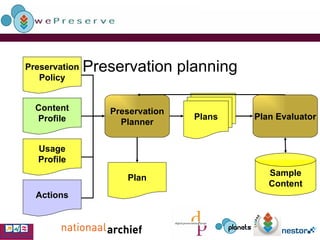
Preservation planning Preservation Policy Content Profile Usage Profile Preservation Planner Plans Plan Evaluator Plan Sample Content Actions
 
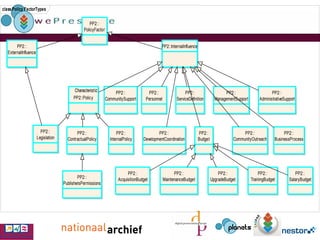
Model for organisational requirements Approach: Literature study and interviews with decision makers Extraction of requirements and building of conceptual model Create model from first principles First version of model  describes and positions policy requirements in wider context of Planets data model indicates potential policy requirements on different levels and in relation to various types of preservation objects (e.g. collection, deliverable unit, manifestation, byte stream, etc.) (thus) is able to cover policy requirements that are relevant for all types of preservation actions  in different organisational settings Translate organisational constraints and requirements into a machine interpretable model an organisation can choose from them according to its needs  Policy model
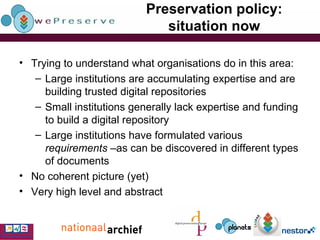
Preservation policy: situation now Trying to understand what organisations do in this area: Large institutions are accumulating expertise and are building trusted digital repositories Small institutions generally lack expertise and funding to build a digital repository Large institutions have formulated various  requirements  –as can be discovered in different types of documents No coherent picture (yet) Very high level and abstract
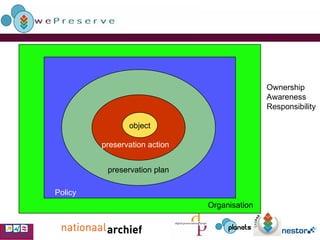
object Ownership Awareness Responsibility Organisation Policy preservation plan preservation action
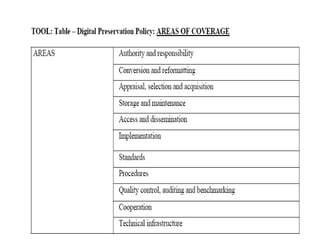
Preservation policy: examples Example policy statements of institutions with a digital preservation programme UK Data Archive State Library of Victoria National Archives of Australia
UK Data Archive < UK Data Archive Preservation Policy http://www.data-archive.ac.uk/news/publications/UKDAPreservationPolicy0308.pdf p. 11: “The UKDA has chosen to implement a preservation strategy based upon open and available file formats, data migration and media refreshment.” What does this choice mean in practice? Two examples: Emulation is –apparently– not a preservation strategy that will be chosen; all obsolete files will be migrated. Migration to open file formats will be preferred.
State Library of Victoria (Australia) < Digital Preservation Policy, State Library of Victoria http://www.slv.vic.gov.au/about/information/policies/digitalpreservation.html “ Storage.  Born-digital objects published on disk (CD-R or DVD) are considered the archival copy and will be stored appropriately. When needed and authority granted, the physical format data may be copied to another storage carrier in order to preserve its contents. The master TIFF files shall be stored appropriately in a secure location on the Library's LAN, and back-ups made in accordance with TSD policy.” What does this choice mean in practice? Three examples: CD-R and DVD should be stored in appropriate places (with appropriate temperatures and relative humidity). It is allowed –if needed– to make copies to ensure long-term preservation. For files stored on the Local Network, back-ups are made.
National Archives of Australia < An Approach to the Preservation of Digital Records http://www.naa.gov.au/images/an-approach-green-paper_tcm2-888.pdf p. 14: “The digital preservation program must be able to preserve any digital record that is brought into National Archives’ custody regardless of the application or system it is from or data format it is stored in.” What does this choice mean in practice? One example: all records that are accepted, should be preserved, regardless file format, medium, application, etc. transform to open standard + keep ‘original’ format
Policies: issues The framework developed in Planets allows that various (sets of) requirements are identified Framework (requirements) are identified at a high level However, on this high level, it is possible and feasible that some requirements are already made explicit. Examples: choice for one strategy (e.g. migration to open document format) choice that some types of records/documents can be denied because e.g. an  exotic  file format is used Some decisions/choices may prove to be difficult to implement At this moment, lack of information about some strategies -> possibility to miss interesting new solutions … Some strategies are excluded as viable solutions: no investments have to be made
 
Potential resources Mandate/ vision / mission statements Policy documents (if they exist) Project plans Guidelines Procedures/ rules
 
Preliminary conclusion The variety of requirements in institutional policy documents is very large Some of these requirements are very general, others are a bit more specific. Questions How does one make these requirements operational for preservation planning purposes? What are ‘valuable’ requirements in a process of preservation planning? …
Requirements What are they? requirements, rules, constraints (e.g. budget, use of standards) How to express them, so they can be used? How to structure them? hierarchical, ‘objective trees’, formal language, machine-readable
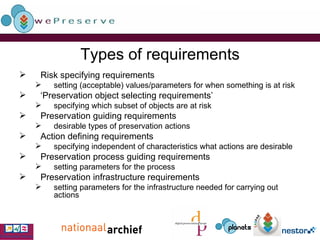
Types of requirements Risk specifying requirements setting (acceptable) values/parameters for when something is at risk ‘ Preservation object selecting requirements’ specifying which subset of objects are at risk Preservation guiding requirements desirable types of preservation actions Action defining requirements specifying independent of characteristics what actions are desirable Preservation process guiding requirements setting parameters for the process Preservation infrastructure requirements setting parameters for the infrastructure needed for carrying out actions
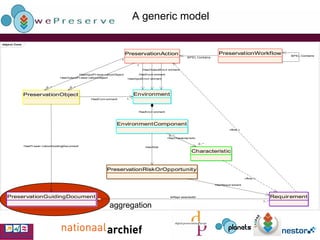
A generic model aggregation
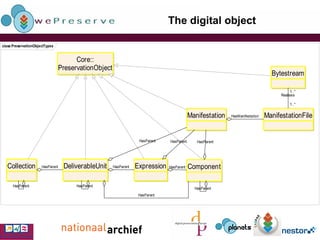
The digital object
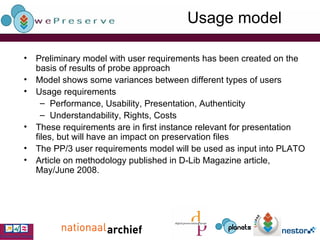
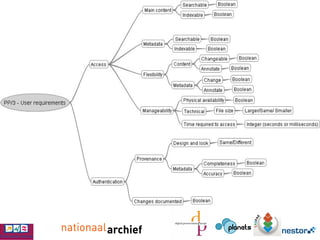
Usage model Preliminary model with user requirements has been created on the basis of results of probe approach  Model shows some variances between different types of users  Usage requirements Performance, Usability, Presentation, Authenticity Understandability, Rights, Costs   These requirements are in first instance relevant for presentation files, but will have an impact on preservation files The PP/3 user requirements model will be used as input into PLATO Article on methodology published in D-Lib Magazine article, May/June 2008.
Planets Approach Usage requirements for digital objects Performance Usability, presentation Authenticity Understandability Rights Costs To what extent relevant for digital preservation?
User perspective Goal of digital preservation is to serve (future) users in providing usable and authentic information What are needs/requirements of users? easy access knowledge about origin of documents/  to be able to interpret them to use them for their own convenience Example requirements some users prefer that all information is presented in a uniform way some users prefer that they can search full-text in documents consequence: don’t migrate texts to image files …
User perspective (2) Some user requirements will affect decisions for preservation actions Different manifestations of ‘deliverable units’? However, difference between preservation and presentation copy Not necessarily the same ‘object’/ format... Should it be the same, in order to reduce costs for preservation strategies/ actions? Providing presentation copy ‘on the fly’/ on demand? Not all users necessarily have the same requirements requirements may be based on user segmentation
User perspective (3) Difficult to assess what users want in the digital era because they are (often) not used to work with digital information/documents because they are possibly not aware of the possibilities of different ways of presentation Compilation of requirements is based on user studies in which the participants combine the use of paper and digital documents Predict what users in the future want, is impossible….!
 
‘ Technical’ requirements These could be based on requirements as identified by users or the institution Is it –from a user’s point of view- necessary that the page layout is as close as possible to the ‘original’? Yes -> page layout, fonts, links, headers & footers, titles & subtitles should be preserved migrate emulate No -> only the textual content is important don’t bother about emulation migrate to an ‘easy’ format
Collection profile What types of objects (both technical and intellectual aspects)? Technical: file formats registries (e.g. PRONOM, …) Intellectual: for instance documentary form, structure, look and feel, ‘behaviour ’   objective tree ‘templates’ an (intellectual) object may consist of different computer files what strategy then?
Requirements for objects  Authenticity to be what it purports to be, to have been created or sent by the person purported to have created or sent it, and  to have been created or sent at the time purported   Reliability contents can be trusted as a full and accurate representation of the transactions, activities or facts to which they attest and can be depended upon in the course of subsequent transactions or activities   Integrity being complete and unaltered   Usability can be located, retrieved, presented and interpreted, so retrievable, readable, interpretable Accuracy the degree to which data, information, documents or records are precise, correct, truthful, free of error or distortion or pertinent to the matter.
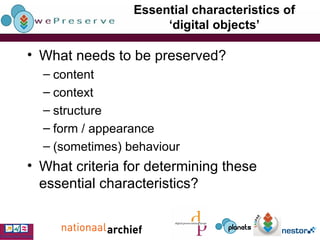
Essential characteristics of ‘digital objects’ What needs to be preserved? content context structure form / appearance (sometimes) behaviour What criteria for determining these essential characteristics?
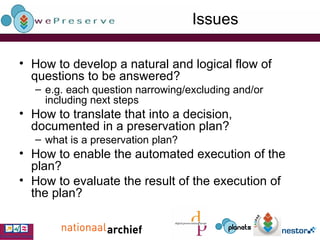
Issues How to develop a natural and logical flow of questions to be answered? e.g. each question narrowing/excluding and/or including next steps How to translate that into a decision, documented in a preservation plan? what is a preservation plan? How to enable the automated execution of the plan? How to evaluate the result of the execution of the plan?
 
Preservation Planning and OAIS
Definition of a Preservation Plan ‘ A  preservation plan   defines a series of preservation actions to be taken by a responsible institution to address an identified risk for a given set of digital objects or records (called collection). ‘ The Preservation Plan takes into account the preservation policies, legal obligations, organisational and technical constraints, user requirements and preservation goal. It also describes the preservation context, the evaluated alternative preservation strategies and the resulting decision for one strategy, including the rationale of the decision
Characteristics  of a preservation plan It is a concrete translation of a preservation policy how to handle/treat a certain type of digital objects in a given institutional setting New plans will be needed over time due to   changes in technology changes in organisational setting changes in user requirements changes in available tools changes in preservation methods It also specifies a series of steps or actions along with responsibilities and rules and conditions for execution This is called  preservation action plan.  It is in the form of an executable workflow definition, detailing the actions and the required technical environment   Relationship with a specific action The preservation plan provides the context/ background of the preservation action plan
The content of a preservation plan Identification Status What was the immediate reason for this plan? Has it been approved and if so, when and by whom How does it relate to other P-plans related to a specific type of objects? Description of institutional setting Description of the collection (digital objects) Purpose and requirements Evidence of decision for a specific preservation action what is the foundation of the decision description of evaluation of possible actions Costs considerations Trigger for re-evaluation Roles and responsibilities Preservation action plan executable program draft
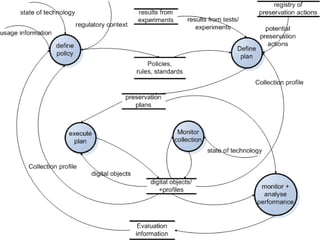
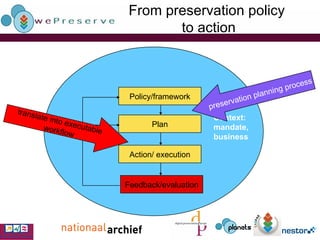
From preservation policy  to action Policy/framework preservation planning process translate into executable workflow Context: mandate,  business Plan Action/ execution Feedback/evaluation
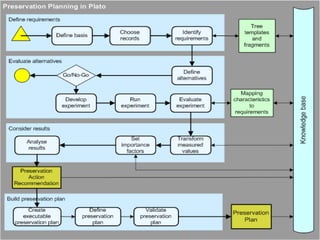
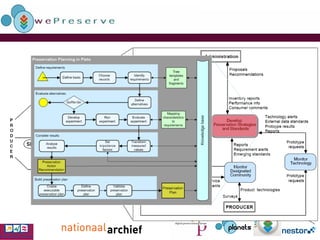
Models and tools in PP Conceptual model of potential preservation requirements (characteristics), both organisational and object-oriented Conceptual model of PP-process Validation framework (how to measure whether a preservation action has been successful?) Definiton of preservation (action) plan Tools: Machine interpretable models for usage, collection profile, policy requirements/constraints Plato tool for decision making: v.2 (November 2008) Validation Framework -  comparator - metrics Technology watch service Recommender service Collection profiling service technical (related to PRONOM) and intellectual aspects Risk assessment service technical aspects (related to PRONOM registry)
Summary Understanding of context analysis of organisational needs, user needs, legal requirements Identify criteria for preservation how long, restrictions of formats, standards, …  Risk analysis ! Determine what to keep/maintain essential characteristics (objective trees), characterisation of computer files Evaluate available strategies (actions) against criteria  identify best strategy well-founded and documented decision create/finalise preservation plan Execute plan when needed Evaluate what happened/performance Re-iterate when technology changes or review when policy and/or collection and/or usage changes Automated decision process support (?)
Thank you for your attention! Questions? www.planets-project.eu [email_address]
This work is licenced under the Creative Commons Attribution-Non-Commercial-No Derivative Works 3.0 Netherlands License. To view a copy of this licence, visit  http:// creativecommons . org / licenses /by- nc - nd /3.0/ nl /  or send a letter to Creative Commons, 171 Second Street, Suite 300, San Francisco, California 94105, USA.

Digital Preservation Process: Preparation and Requirements

  • 1.
    Digital Preservation Process:Preparation and Requirements Hans Hofman Nationaal Archief Netherlands Training session, 13 October 2008, Prague
  • 2.
    Overview What isthe problem? Defining the issues Preservation Planning Process: scope and role, preservation plan What’s needed? How to identify requirements? The organisational/ business context Usage requirements, and Collection profile
  • 3.
    The issue /challenge The enormous and rapidly increasing amount of digital information Fragile resources The rapid evolution in technology The risk of obsolescence and therefore corruption and/or loss of valuable information (Pro-)active and ongoing attention / maintenance required Potential solutions still fragmented infrastructure not comprehensive
  • 4.
    Stakeholders Memory institutions(‘content holders’) archives, libraries (Scientific) data centres Government organisations (record creators) Business companies (record creators, intellectual capital) Individuals (e.g. family pictures)
  • 5.
    Terminology Preservation vs.curation recordkeeping, archiving Framework, policy, strategy Integrity, fixity Plan, action, method Object, deliverable unit, record, collection
  • 6.
    How to prepare?Understanding the organisational context mandate/ legislation the organisational policy user community Understanding the objects (collection of) digital objects: characteristics Understanding the infrastructure technology (past, present, future), infrastructure people, knowledge, skills Available options potential methods/ strategies Decision making process: preservation planning
  • 7.
    Objectives of PreservationPlanning Identify and analyse the organisational context including a risk assessment define a framework for preservation / policy Support decision-making about digital preservation including Identifying criteria for preservation within that context Defining workflow for evaluating/ defining preservation plans Developing methodologies for assessing the risks of applying different preservation strategies for different types of digital objects Enable formulation, evaluation and execution of high-quality and cost-effective preservation plans that suit the organisational (e.g. repository) needs Support the on-going evaluation of the results of executing preservation plans and provide a feedback mechanism Document the planning process carefully
  • 8.
    Preservation planning PreservationPolicy Content Profile Usage Profile Preservation Planner Plans Plan Evaluator Plan Sample Content Actions
  • 9.
  • 10.
    Model for organisationalrequirements Approach: Literature study and interviews with decision makers Extraction of requirements and building of conceptual model Create model from first principles First version of model describes and positions policy requirements in wider context of Planets data model indicates potential policy requirements on different levels and in relation to various types of preservation objects (e.g. collection, deliverable unit, manifestation, byte stream, etc.) (thus) is able to cover policy requirements that are relevant for all types of preservation actions in different organisational settings Translate organisational constraints and requirements into a machine interpretable model an organisation can choose from them according to its needs Policy model
  • 11.
    Preservation policy: situationnow Trying to understand what organisations do in this area: Large institutions are accumulating expertise and are building trusted digital repositories Small institutions generally lack expertise and funding to build a digital repository Large institutions have formulated various requirements –as can be discovered in different types of documents No coherent picture (yet) Very high level and abstract
  • 12.
    object Ownership AwarenessResponsibility Organisation Policy preservation plan preservation action
  • 13.
    Preservation policy: examplesExample policy statements of institutions with a digital preservation programme UK Data Archive State Library of Victoria National Archives of Australia
  • 14.
    UK Data Archive< UK Data Archive Preservation Policy http://www.data-archive.ac.uk/news/publications/UKDAPreservationPolicy0308.pdf p. 11: “The UKDA has chosen to implement a preservation strategy based upon open and available file formats, data migration and media refreshment.” What does this choice mean in practice? Two examples: Emulation is –apparently– not a preservation strategy that will be chosen; all obsolete files will be migrated. Migration to open file formats will be preferred.
  • 15.
    State Library ofVictoria (Australia) < Digital Preservation Policy, State Library of Victoria http://www.slv.vic.gov.au/about/information/policies/digitalpreservation.html “ Storage. Born-digital objects published on disk (CD-R or DVD) are considered the archival copy and will be stored appropriately. When needed and authority granted, the physical format data may be copied to another storage carrier in order to preserve its contents. The master TIFF files shall be stored appropriately in a secure location on the Library's LAN, and back-ups made in accordance with TSD policy.” What does this choice mean in practice? Three examples: CD-R and DVD should be stored in appropriate places (with appropriate temperatures and relative humidity). It is allowed –if needed– to make copies to ensure long-term preservation. For files stored on the Local Network, back-ups are made.
  • 16.
    National Archives ofAustralia < An Approach to the Preservation of Digital Records http://www.naa.gov.au/images/an-approach-green-paper_tcm2-888.pdf p. 14: “The digital preservation program must be able to preserve any digital record that is brought into National Archives’ custody regardless of the application or system it is from or data format it is stored in.” What does this choice mean in practice? One example: all records that are accepted, should be preserved, regardless file format, medium, application, etc. transform to open standard + keep ‘original’ format
  • 17.
    Policies: issues Theframework developed in Planets allows that various (sets of) requirements are identified Framework (requirements) are identified at a high level However, on this high level, it is possible and feasible that some requirements are already made explicit. Examples: choice for one strategy (e.g. migration to open document format) choice that some types of records/documents can be denied because e.g. an exotic file format is used Some decisions/choices may prove to be difficult to implement At this moment, lack of information about some strategies -> possibility to miss interesting new solutions … Some strategies are excluded as viable solutions: no investments have to be made
  • 18.
  • 19.
    Potential resources Mandate/vision / mission statements Policy documents (if they exist) Project plans Guidelines Procedures/ rules
  • 20.
  • 21.
    Preliminary conclusion Thevariety of requirements in institutional policy documents is very large Some of these requirements are very general, others are a bit more specific. Questions How does one make these requirements operational for preservation planning purposes? What are ‘valuable’ requirements in a process of preservation planning? …
  • 22.
    Requirements What arethey? requirements, rules, constraints (e.g. budget, use of standards) How to express them, so they can be used? How to structure them? hierarchical, ‘objective trees’, formal language, machine-readable
  • 23.
    Types of requirementsRisk specifying requirements setting (acceptable) values/parameters for when something is at risk ‘ Preservation object selecting requirements’ specifying which subset of objects are at risk Preservation guiding requirements desirable types of preservation actions Action defining requirements specifying independent of characteristics what actions are desirable Preservation process guiding requirements setting parameters for the process Preservation infrastructure requirements setting parameters for the infrastructure needed for carrying out actions
  • 24.
    A generic modelaggregation
  • 25.
  • 26.
    Usage model Preliminarymodel with user requirements has been created on the basis of results of probe approach Model shows some variances between different types of users Usage requirements Performance, Usability, Presentation, Authenticity Understandability, Rights, Costs These requirements are in first instance relevant for presentation files, but will have an impact on preservation files The PP/3 user requirements model will be used as input into PLATO Article on methodology published in D-Lib Magazine article, May/June 2008.
  • 27.
    Planets Approach Usagerequirements for digital objects Performance Usability, presentation Authenticity Understandability Rights Costs To what extent relevant for digital preservation?
  • 28.
    User perspective Goalof digital preservation is to serve (future) users in providing usable and authentic information What are needs/requirements of users? easy access knowledge about origin of documents/ to be able to interpret them to use them for their own convenience Example requirements some users prefer that all information is presented in a uniform way some users prefer that they can search full-text in documents consequence: don’t migrate texts to image files …
  • 29.
    User perspective (2)Some user requirements will affect decisions for preservation actions Different manifestations of ‘deliverable units’? However, difference between preservation and presentation copy Not necessarily the same ‘object’/ format... Should it be the same, in order to reduce costs for preservation strategies/ actions? Providing presentation copy ‘on the fly’/ on demand? Not all users necessarily have the same requirements requirements may be based on user segmentation
  • 30.
    User perspective (3)Difficult to assess what users want in the digital era because they are (often) not used to work with digital information/documents because they are possibly not aware of the possibilities of different ways of presentation Compilation of requirements is based on user studies in which the participants combine the use of paper and digital documents Predict what users in the future want, is impossible….!
  • 31.
  • 32.
    ‘ Technical’ requirementsThese could be based on requirements as identified by users or the institution Is it –from a user’s point of view- necessary that the page layout is as close as possible to the ‘original’? Yes -> page layout, fonts, links, headers & footers, titles & subtitles should be preserved migrate emulate No -> only the textual content is important don’t bother about emulation migrate to an ‘easy’ format
  • 33.
    Collection profile Whattypes of objects (both technical and intellectual aspects)? Technical: file formats registries (e.g. PRONOM, …) Intellectual: for instance documentary form, structure, look and feel, ‘behaviour ’ objective tree ‘templates’ an (intellectual) object may consist of different computer files what strategy then?
  • 34.
    Requirements for objects Authenticity to be what it purports to be, to have been created or sent by the person purported to have created or sent it, and to have been created or sent at the time purported Reliability contents can be trusted as a full and accurate representation of the transactions, activities or facts to which they attest and can be depended upon in the course of subsequent transactions or activities Integrity being complete and unaltered Usability can be located, retrieved, presented and interpreted, so retrievable, readable, interpretable Accuracy the degree to which data, information, documents or records are precise, correct, truthful, free of error or distortion or pertinent to the matter.
  • 35.
    Essential characteristics of‘digital objects’ What needs to be preserved? content context structure form / appearance (sometimes) behaviour What criteria for determining these essential characteristics?
  • 36.
    Issues How todevelop a natural and logical flow of questions to be answered? e.g. each question narrowing/excluding and/or including next steps How to translate that into a decision, documented in a preservation plan? what is a preservation plan? How to enable the automated execution of the plan? How to evaluate the result of the execution of the plan?
  • 37.
  • 38.
  • 39.
    Definition of aPreservation Plan ‘ A preservation plan defines a series of preservation actions to be taken by a responsible institution to address an identified risk for a given set of digital objects or records (called collection). ‘ The Preservation Plan takes into account the preservation policies, legal obligations, organisational and technical constraints, user requirements and preservation goal. It also describes the preservation context, the evaluated alternative preservation strategies and the resulting decision for one strategy, including the rationale of the decision
  • 40.
    Characteristics ofa preservation plan It is a concrete translation of a preservation policy how to handle/treat a certain type of digital objects in a given institutional setting New plans will be needed over time due to changes in technology changes in organisational setting changes in user requirements changes in available tools changes in preservation methods It also specifies a series of steps or actions along with responsibilities and rules and conditions for execution This is called preservation action plan. It is in the form of an executable workflow definition, detailing the actions and the required technical environment Relationship with a specific action The preservation plan provides the context/ background of the preservation action plan
  • 41.
    The content ofa preservation plan Identification Status What was the immediate reason for this plan? Has it been approved and if so, when and by whom How does it relate to other P-plans related to a specific type of objects? Description of institutional setting Description of the collection (digital objects) Purpose and requirements Evidence of decision for a specific preservation action what is the foundation of the decision description of evaluation of possible actions Costs considerations Trigger for re-evaluation Roles and responsibilities Preservation action plan executable program draft
  • 42.
    From preservation policy to action Policy/framework preservation planning process translate into executable workflow Context: mandate, business Plan Action/ execution Feedback/evaluation
  • 43.
    Models and toolsin PP Conceptual model of potential preservation requirements (characteristics), both organisational and object-oriented Conceptual model of PP-process Validation framework (how to measure whether a preservation action has been successful?) Definiton of preservation (action) plan Tools: Machine interpretable models for usage, collection profile, policy requirements/constraints Plato tool for decision making: v.2 (November 2008) Validation Framework - comparator - metrics Technology watch service Recommender service Collection profiling service technical (related to PRONOM) and intellectual aspects Risk assessment service technical aspects (related to PRONOM registry)
  • 44.
    Summary Understanding ofcontext analysis of organisational needs, user needs, legal requirements Identify criteria for preservation how long, restrictions of formats, standards, … Risk analysis ! Determine what to keep/maintain essential characteristics (objective trees), characterisation of computer files Evaluate available strategies (actions) against criteria identify best strategy well-founded and documented decision create/finalise preservation plan Execute plan when needed Evaluate what happened/performance Re-iterate when technology changes or review when policy and/or collection and/or usage changes Automated decision process support (?)
  • 45.
    Thank you foryour attention! Questions? www.planets-project.eu [email_address]
  • 46.
    This work islicenced under the Creative Commons Attribution-Non-Commercial-No Derivative Works 3.0 Netherlands License. To view a copy of this licence, visit http:// creativecommons . org / licenses /by- nc - nd /3.0/ nl / or send a letter to Creative Commons, 171 Second Street, Suite 300, San Francisco, California 94105, USA.