Timberwork Case Studies
     MSc. Building Conservation
         22 February 2013
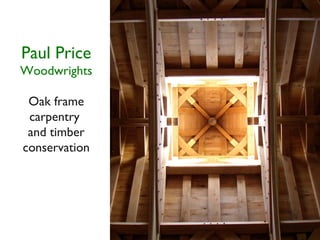
Paul Price
Woodwrights

 Oak frame
 carpentry
 and timber
conservation
An overview of historic
carpentry and timber repair

   Topics:
   1.Recognising historic carpentry
   2.Repairs: surveys and methods
   3.Case histories
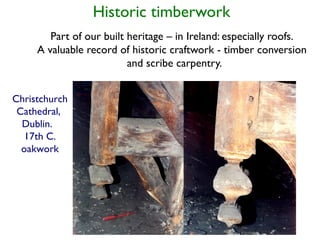
Historic timberwork
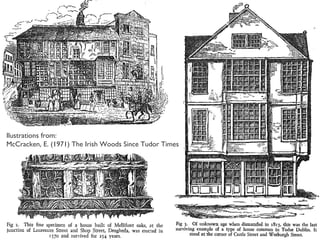
        Part of our built heritage – in Ireland: especially roofs.
     A valuable record of historic craftwork - timber conversion
                          and scribe carpentry.


Christchurch
 Cathedral,
  Dublin.
   17th C.
  oakwork
Ilustrations from:
McCracken, E. (1971) The Irish Woods Since Tudor Times
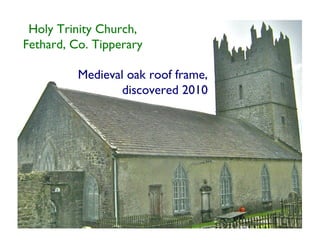
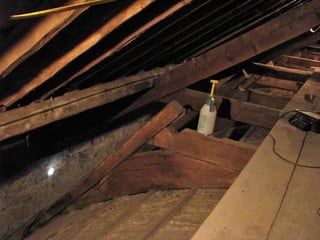
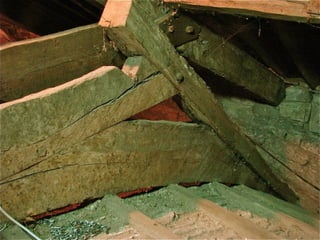
Holy Trinity Church,
Fethard, Co. Tipperary

          Medieval oak roof frame,
                  discovered 2010
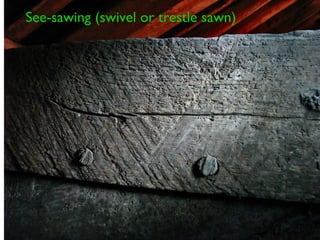
See-sawing (swivel or trestle sawn)
Timber Conservation Aims
  Conserve the overall aesthetic form of the structural frame
                   while repairing the structure.
          Preserve original timber as much as possible.
      Timber surfaces, which preserve marks recording the
        original timber conversion and framing methods.


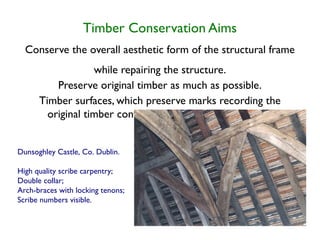
Dunsoghley Castle, Co. Dublin.

High quality scribe carpentry;
Double collar;
Arch-braces with locking tenons;
Scribe numbers visible.
Timber Conservation Process
      Survey: historical value, condition, and structure.
         Repairs: minimal, unobtrusive, reversible.
              Outlook: maintenance check-list


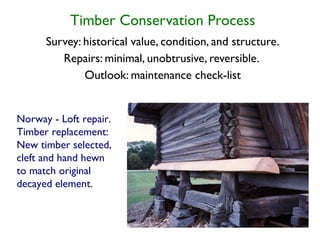
Norway - Loft repair.
Timber replacement:
New timber selected,
cleft and hand hewn
to match original
decayed element.
Recognising historic carpentry
Conversion: logs into timber
Carpentry: scribing, jointing and raising frames
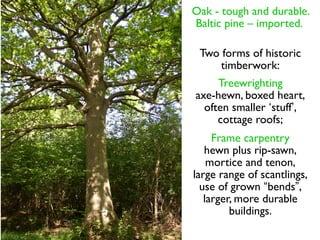
Oak - tough and durable.
Baltic pine – imported.

 Two forms of historic
     timberwork:
     Treewrighting
axe-hewn, boxed heart,
  often smaller ‘stuff’,
     cottage roofs;
     Frame carpentry
   hewn plus rip-sawn,
    mortice and tenon,
large range of scantlings,
  use of grown “bends”,
   larger, more durable
         buildings.
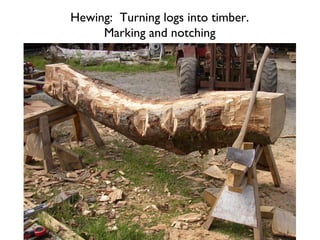
Hewing: Turning logs into timber.
     Marking and notching
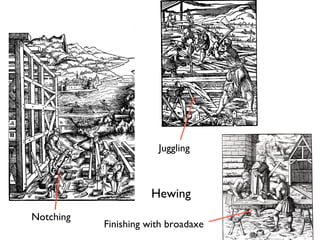
Juggling


                     Hewing
Notching
           Finishing with broadaxe
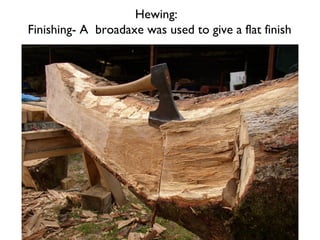
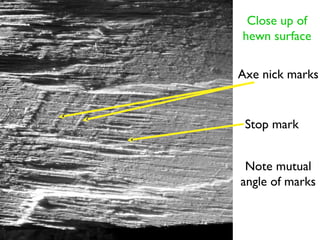
Hewing:
Finishing- A broadaxe was used to give a flat finish
Close up of
hewn surface

Axe nick marks


 Stop mark


 Note mutual
angle of marks
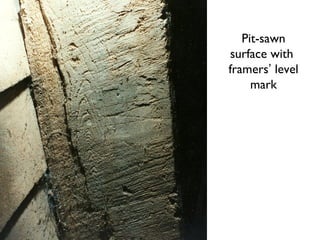
Pit-sawn
surface with
framers’ level
     mark
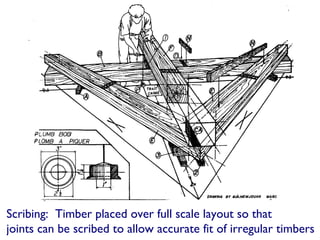
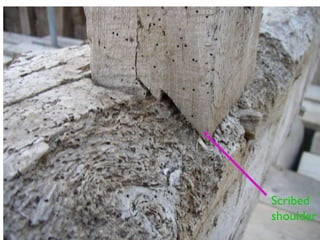
Scribing: Timber placed over full scale layout so that
joints can be scribed to allow accurate fit of irregular timbers
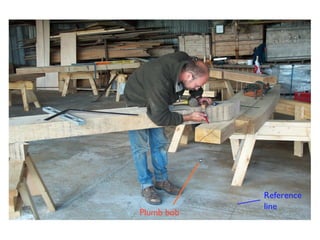
Reference
            line
Plumb bob
Scribed
shoulder
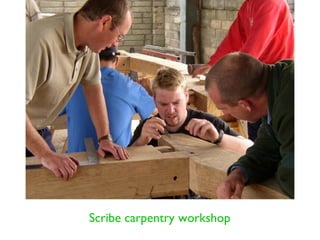
Scribe carpentry workshop
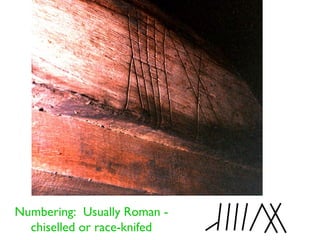
Numbering: Usually Roman -
  chiselled or race-knifed
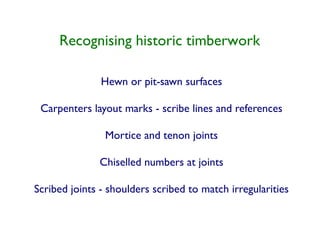
Recognising historic timberwork

               Hewn or pit-sawn surfaces

 Carpenters layout marks - scribe lines and references

                Mortice and tenon joints

              Chiselled numbers at joints

Scribed joints - shoulders scribed to match irregularities
Repairs:
surveys and methods
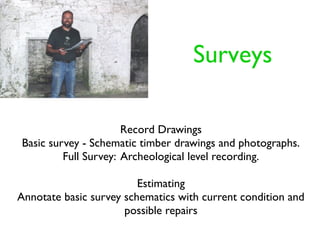
Surveys

                      Record Drawings
Basic survey - Schematic timber drawings and photographs.
         Full Survey: Archeological level recording.

                         Estimating
Annotate basic survey schematics with current condition and
                      possible repairs
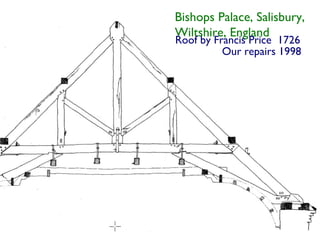
Bishops Palace, Salisbury,
Wiltshire, England
Roof by Francis Price 1726
          Our repairs 1998
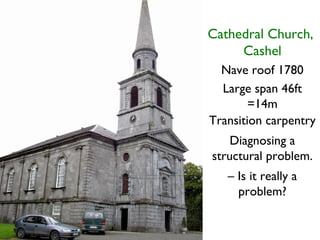
Cathedral Church,
     Cashel
  Nave roof 1780
  Large span 46ft
        =14m
Transition carpentry
    Diagnosing a
structural problem.
   – Is it really a
     problem?
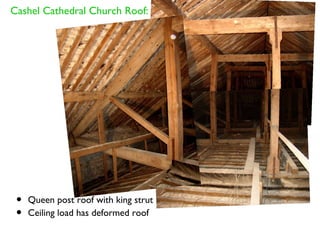
Cashel Cathedral Church Roof:


 •   Queen post roof with king strut
 •   Ceiling load has deformed roof
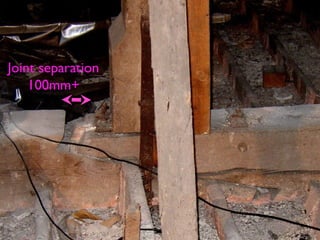
Joint separation
    100mm+
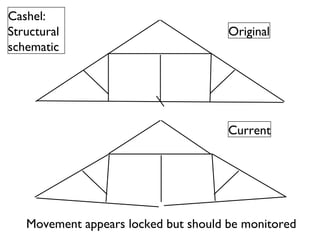
Cashel:
Structural                            Original
schematic


                                      Current


   Movement appears locked but should be monitored
Repair Methods
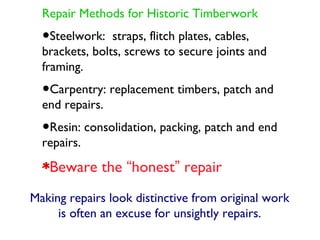
Repair Methods for Historic Timberwork
  •Steelwork:   straps, flitch plates, cables,
  brackets, bolts, screws to secure joints and
  framing.
  •Carpentry: replacement timbers, patch and
  end repairs.
  •Resin: consolidation, packing, patch and end
  repairs.
   Beware the “honest” repair
Making repairs look distinctive from original work
     is often an excuse for unsightly repairs.
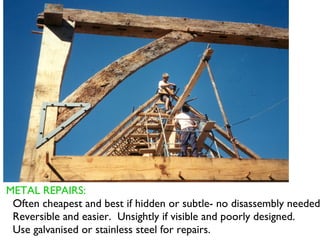
METAL REPAIRS:
•Often cheapest and best if hidden or subtle- no disassembly needed
•Reversible and easier. Unsightly if visible and poorly designed.
•Use galvanised or stainless steel for repairs.
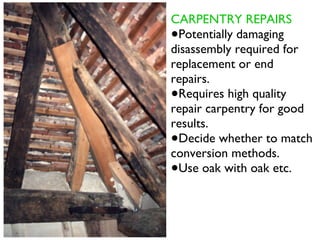
CARPENTRY REPAIRS
•Potentially damaging
disassembly required for
replacement or end
repairs.
•Requires high quality
repair carpentry for good
results.
•Decide whether to match
conversion methods.
•Use oak with oak etc.
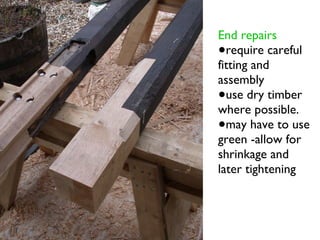
End repairs
• require careful
fitting and
assembly
• use dry timber
where possible.
• may have to use
green -allow for
shrinkage and
later tightening
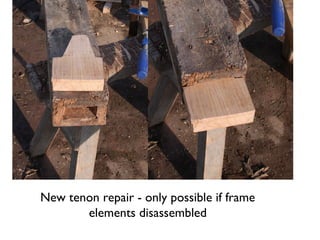
New tenon repair - only possible if frame
       elements disassembled
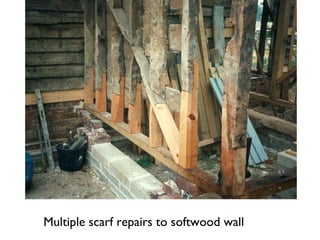
Multiple scarf repairs to softwood wall
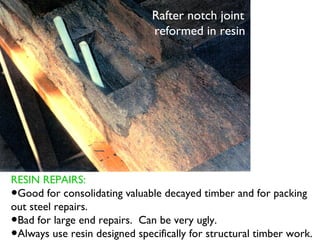
Rafter notch joint
                               reformed in resin


RESIN REPAIRS:
•Good for consolidating valuable decayed timber and for packing
out steel repairs.
•Bad for large end repairs. Can be very ugly.
•Always use resin designed specifically for structural timber work.
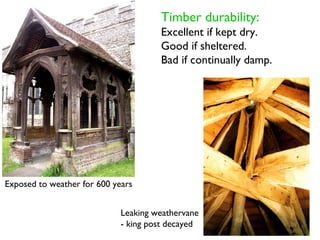
Timber durability:
                                      Excellent if kept dry.
                                      Good if sheltered.
                                      Bad if continually damp.


Exposed to weather for 600 years


                             Leaking weathervane
                             - king post decayed
Case Histories
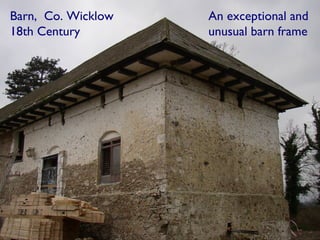
Barn, Co. Wicklow   An exceptional and
18th Century        unusual barn frame
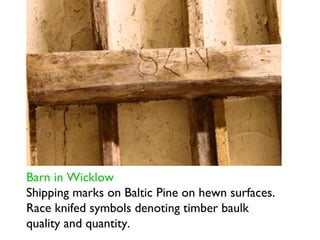
Barn in Wicklow
Shipping marks on Baltic Pine on hewn surfaces.
Race knifed symbols denoting timber baulk
quality and quantity.
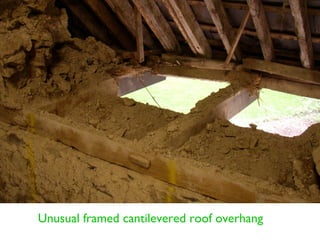
Unusual framed cantilevered roof overhang
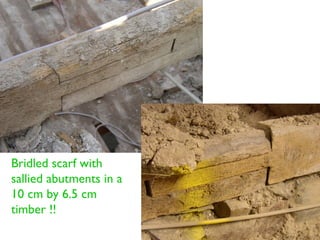
Bridled scarf with
sallied abutments in a
10 cm by 6.5 cm
timber !!
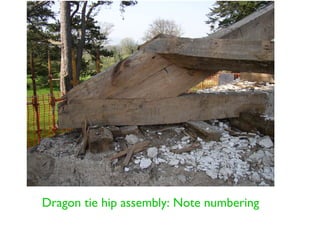
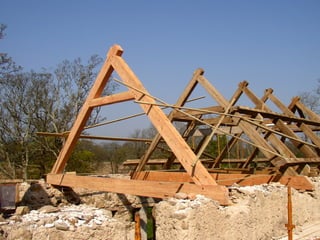
Dragon tie hip assembly: Note numbering
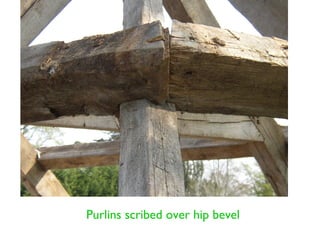
Purlins scribed over hip bevel
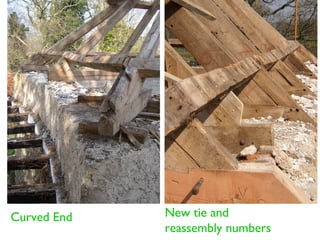
Curved End   New tie and
             reassembly numbers
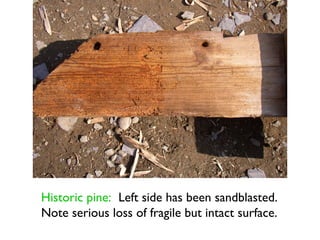
Historic pine: Left side has been sandblasted.
Note serious loss of fragile but intact surface.
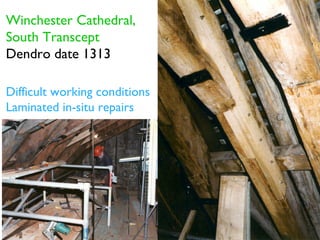
Winchester Cathedral,
South Transcept
Dendro date 1313

Difficult working conditions
Laminated in-situ repairs
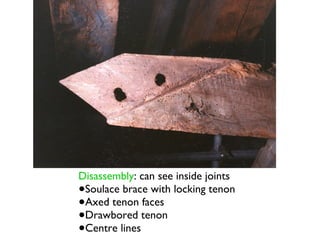
Disassembly: can see inside joints
•Soulace brace with locking tenon
•Axed tenon faces
•Drawbored tenon
•Centre lines
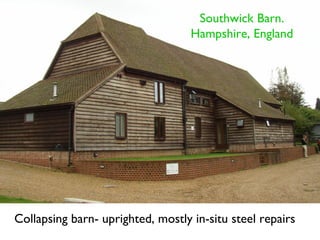
Southwick Barn.
                                   Hampshire, England


Collapsing barn- uprighted, mostly in-situ steel repairs
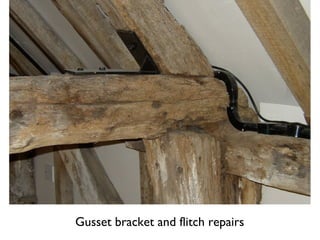
Gusset bracket and flitch repairs
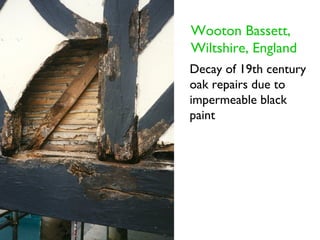
Wooton Bassett,
Wiltshire, England
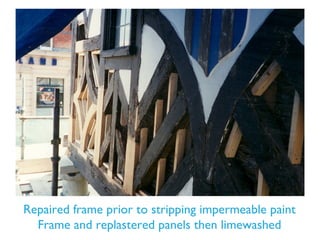
Decay of 19th century
oak repairs due to
impermeable black
paint
Repaired frame prior to stripping impermeable paint
  Frame and replastered panels then limewashed
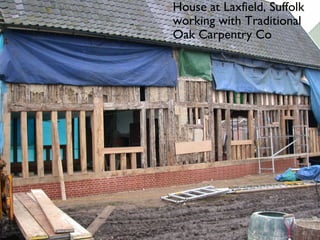
House at Laxfield, Suffolk
working with Traditional
Oak Carpentry Co
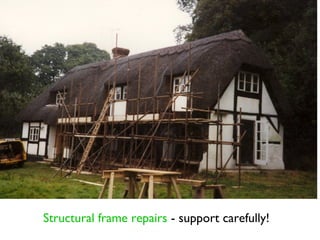
Structural frame repairs - support carefully!
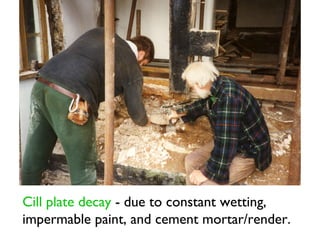
Cill plate decay - due to constant wetting,
impermable paint, and cement mortar/render.
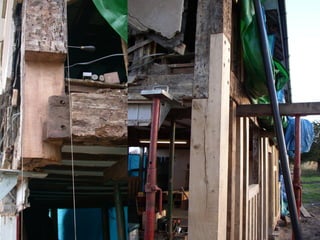
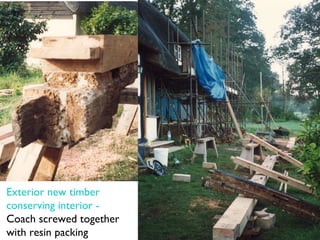
Exterior new timber
conserving interior -
Coach screwed together
with resin packing
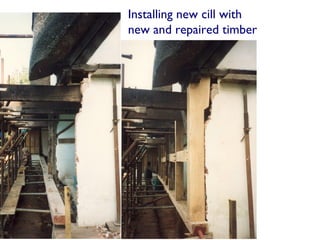
Installing new cill with
new and repaired timber
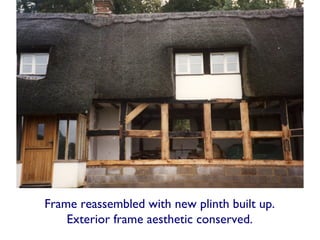
Frame reassembled with new plinth built up.
    Exterior frame aesthetic conserved.
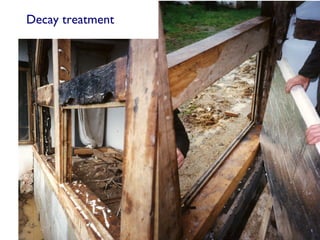
Decay treatment
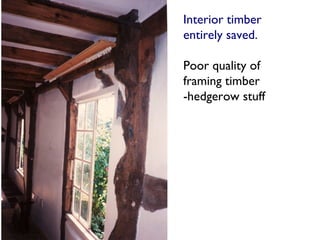
Interior timber
entirely saved.

Poor quality of
framing timber
-hedgerow stuff
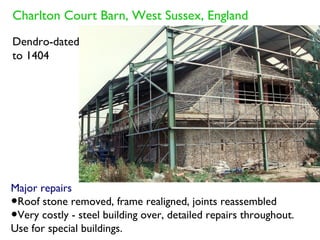
Charlton Court Barn, West Sussex, England
Dendro-dated
to 1404


Major repairs
•Roof stone removed, frame realigned, joints reassembled
•Very costly - steel building over, detailed repairs throughout.
Use for special buildings.
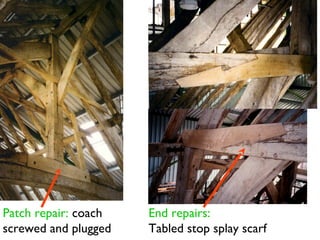
Patch repair: coach   End repairs:
screwed and plugged   Tabled stop splay scarf
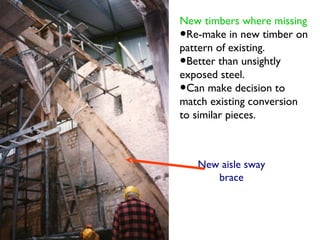
New timbers where missing
•Re-make in new timber on
pattern of existing.
•Better than unsightly
exposed steel.
•Can make decision to
match existing conversion
to similar pieces.


    New aisle sway
       brace
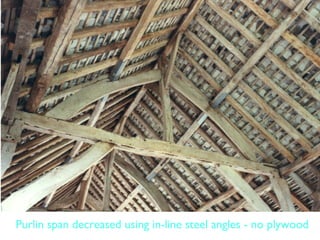
Purlin span decreased using in-line steel angles - no plywood
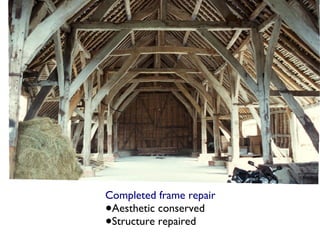
Completed frame repair
•Aesthetic conserved
•Structure repaired
An overview of historic
carpentry and timber repair
    Topics:
    •Recognising historic carpentry
    •Repair surveys and methods
    •Case histories
Thank-you

  Paul Price
woodwrights.ie

Trinity Timber Case Studies slideshare

Editor's Notes

  • #15 Oak: Tree to carpentry connection
  • #18 Hewing marks on surfaces
  • #22 Scribing
  • #24 Marking joints
  • #29 Surveys
  • #30 Transition roof True truss Problems
  • #54 Dated 1313. Messy work 100ft up. DRY timber for repairs. Special flush washered nuts to look better.
  • #58 Bad paint. late 1800s repairs rotted
  • #59 Breathable lime render and lime paint