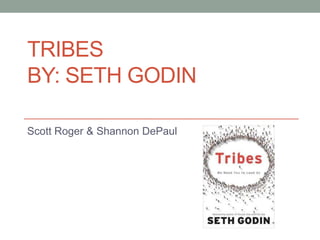
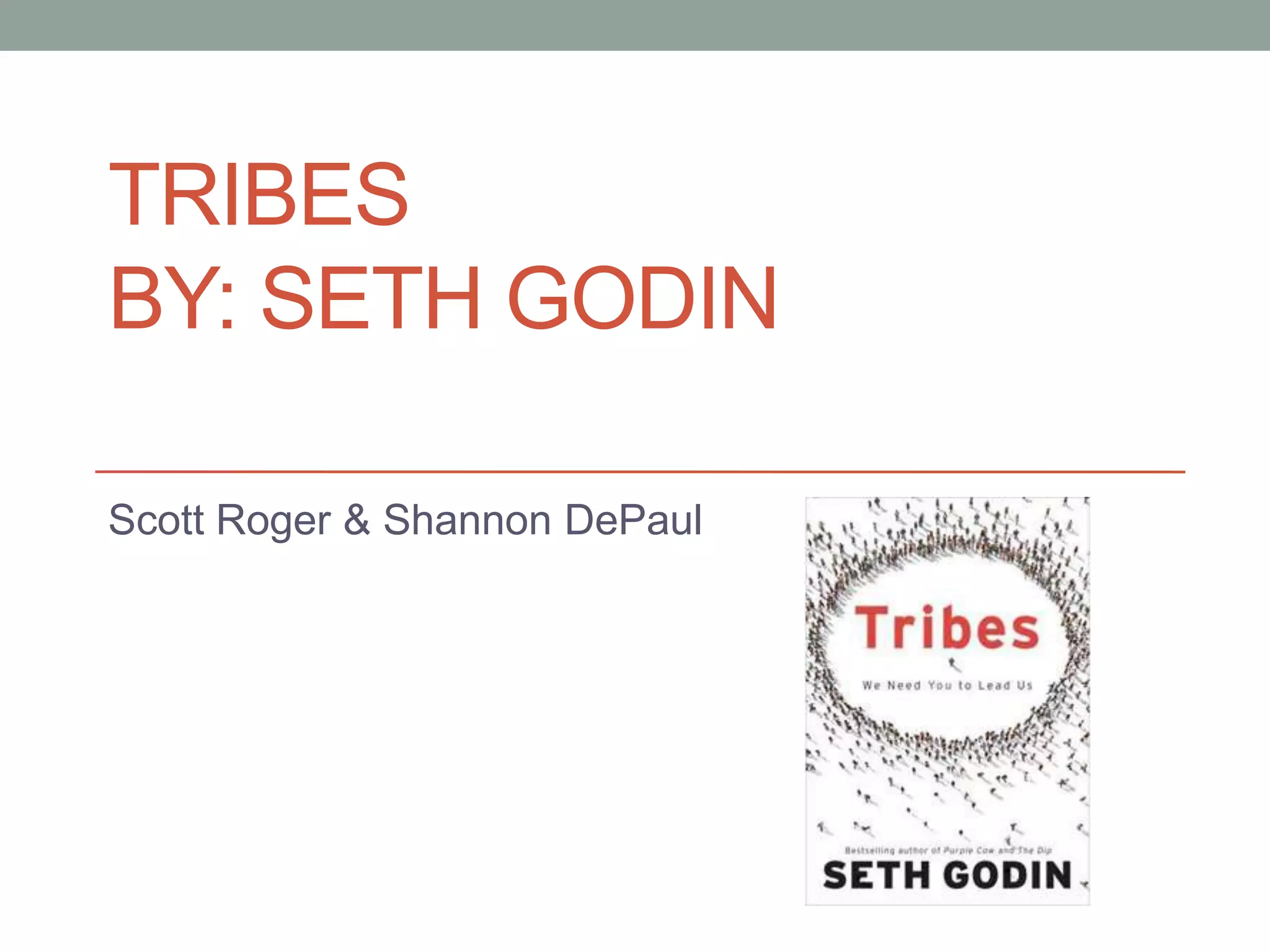
TRIBES
BY: SETH GODIN

Scott Roger & Shannon DePaul
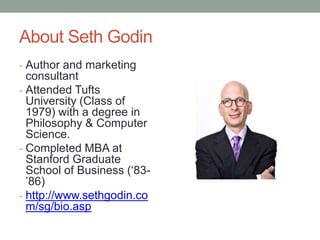
About Seth Godin
- Author and marketing
  consultant
- Attended Tufts
  University (Class of
  1979) with a degree in
  Philosophy & Computer
  Science.
- Completed MBA at
  Stanford Graduate
  School of Business („83-
  ‟86)
- http://www.sethgodin.co
  m/sg/bio.asp
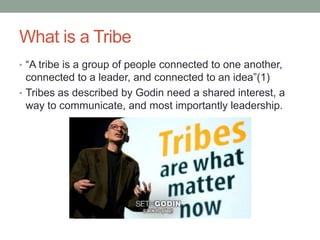
What is a Tribe
• “A tribe is a group of people connected to one another,
  connected to a leader, and connected to an idea”(1)
• Tribes as described by Godin need a shared interest, a
  way to communicate, and most importantly leadership.
Leadership
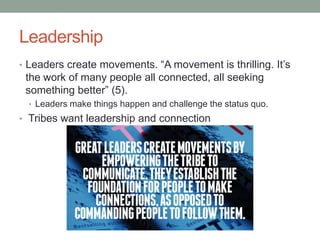
• Leaders create movements. “A movement is thrilling. It‟s
 the work of many people all connected, all seeking
 something better” (5).
  • Leaders make things happen and challenge the status quo.
• Tribes want leadership and connection
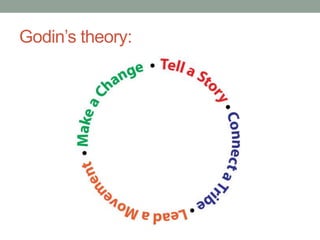
Godin‟s theory:
Leadership is not Management
• Managers are not necessarily leaders
• http://www.youtube.com/watch?v=8NPzLBSBzPI
• The distinction between managers and leaders is that
  leaders create new processes and create change while
  challenging the status quo.
• “Management is about manipulating resources to get a
  known job done…Managers manage a process they‟ve
  seen before”(15)
The Balloon Factory and Unicorn
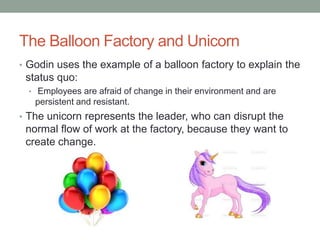
• Godin uses the example of a balloon factory to explain the
 status quo:
  • Employees are afraid of change in their environment and are
   persistent and resistant.
• The unicorn represents the leader, who can disrupt the
 normal flow of work at the factory, because they want to
 create change.
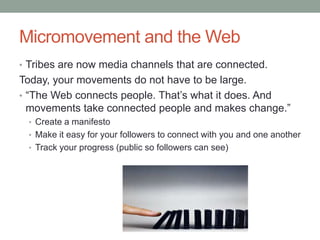
Micromovement and the Web
• Tribes are now media channels that are connected.
Today, your movements do not have to be large.
• “The Web connects people. That‟s what it does. And
  movements take connected people and makes change.”
 • Create a manifesto
 • Make it easy for your followers to connect with you and one another
 • Track your progress (public so followers can see)
Core Fears
• Godin challenges reasons why we don‟t lead.
  • Fear of failure
  • Fear of criticism
  • Fears of apathy
  • Fears of discontent
  • Fear of the status quo
    http://www.youtube.com/watch?v=Ot1Ahvjo8vI

   “The only thing holding you back from being the kind of person who
   changes things is this: lack of faith. Faith that you can do it. Faith
   that it‟s work doing. Faith that failure won‟t destroy you” (71).

Tribes: We Need You to Lead Us

  • 1.
    TRIBES BY: SETH GODIN ScottRoger & Shannon DePaul
  • 2.
    About Seth Godin -Author and marketing consultant - Attended Tufts University (Class of 1979) with a degree in Philosophy & Computer Science. - Completed MBA at Stanford Graduate School of Business („83- ‟86) - http://www.sethgodin.co m/sg/bio.asp
  • 3.
    What is aTribe • “A tribe is a group of people connected to one another, connected to a leader, and connected to an idea”(1) • Tribes as described by Godin need a shared interest, a way to communicate, and most importantly leadership.
  • 4.
    Leadership • Leaders createmovements. “A movement is thrilling. It‟s the work of many people all connected, all seeking something better” (5). • Leaders make things happen and challenge the status quo. • Tribes want leadership and connection
  • 5.
  • 6.
    Leadership is notManagement • Managers are not necessarily leaders • http://www.youtube.com/watch?v=8NPzLBSBzPI • The distinction between managers and leaders is that leaders create new processes and create change while challenging the status quo. • “Management is about manipulating resources to get a known job done…Managers manage a process they‟ve seen before”(15)
  • 7.
    The Balloon Factoryand Unicorn • Godin uses the example of a balloon factory to explain the status quo: • Employees are afraid of change in their environment and are persistent and resistant. • The unicorn represents the leader, who can disrupt the normal flow of work at the factory, because they want to create change.
  • 8.
    Micromovement and theWeb • Tribes are now media channels that are connected. Today, your movements do not have to be large. • “The Web connects people. That‟s what it does. And movements take connected people and makes change.” • Create a manifesto • Make it easy for your followers to connect with you and one another • Track your progress (public so followers can see)
  • 9.
    Core Fears • Godinchallenges reasons why we don‟t lead. • Fear of failure • Fear of criticism • Fears of apathy • Fears of discontent • Fear of the status quo http://www.youtube.com/watch?v=Ot1Ahvjo8vI “The only thing holding you back from being the kind of person who changes things is this: lack of faith. Faith that you can do it. Faith that it‟s work doing. Faith that failure won‟t destroy you” (71).