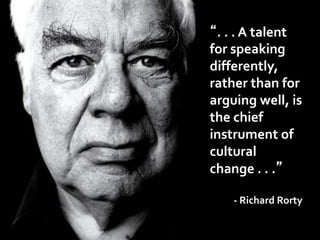
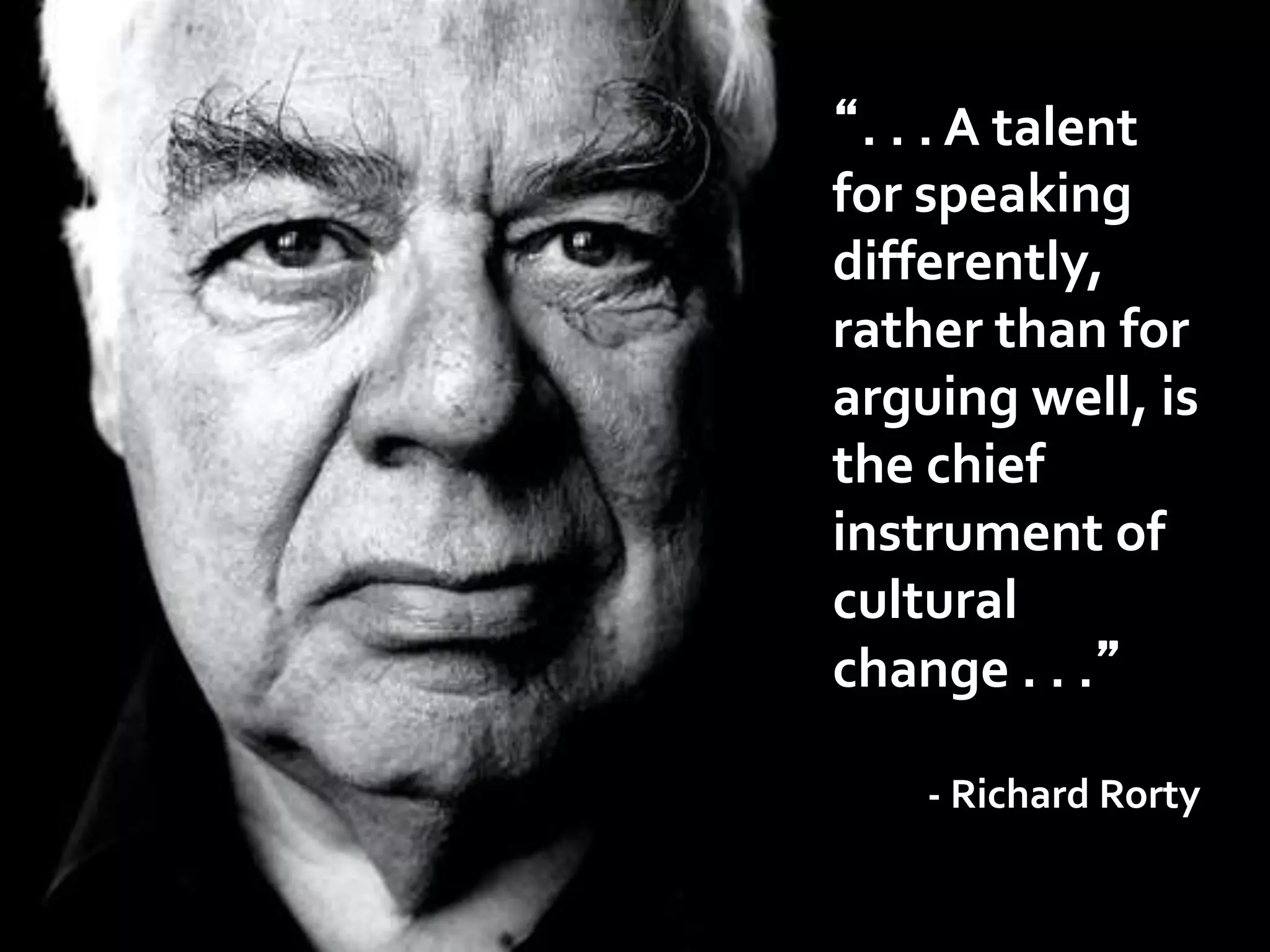
“. . . A talent
for speaking
differently,
rather than for
arguing well, is
the chief
instrument of
cultural
change . . .”
- Richard Rorty
Neighborhood Partnerships
Janet Byrd, Executive Director
Matt Kinshella, Communications Director
Your
Picture
Here
Speaking
Differently
Who are we?
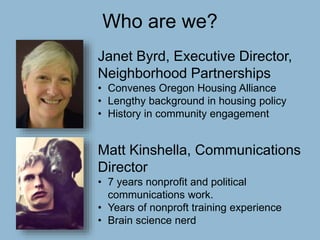
Janet Byrd, Executive Director,
Neighborhood Partnerships
• Convenes Oregon Housing Alliance
• Lengthy background in housing policy
• History in community engagement
Matt Kinshella, Communications
Director
• 7 years nonprofit and political
communications work.
• Years of nonproft training experience
• Brain science nerd
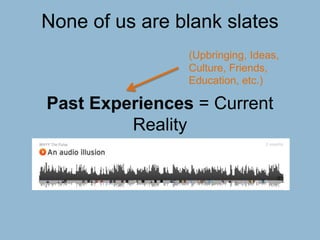
None of us are blank slates
Past Experiences = Current
Reality
(Upbringing, Ideas,
Culture, Friends,
Education, etc.)
10 scientifically proven ways
advocates can speak differently
and get results
• 2 golden rules
• Recipe for a truly effective story
• Supercharge your message
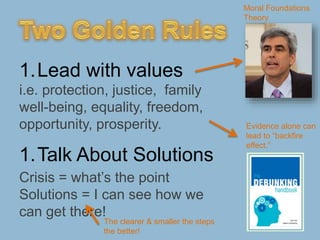
1.Lead with values
1.Talk About Solutions
i.e. protection, justice, family
well-being, equality, freedom,
opportunity, prosperity. Evidence alone can
lead to “backfire
effect.”
Moral Foundations
Theory
Crisis = what’s the point
Solutions = I can see how we
can get there!
The clearer & smaller the steps
the better!
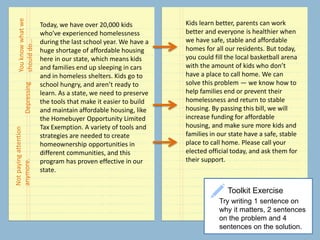
Toolkit Exercise
Try writing 1 sentence on
why it matters, 2 sentences
on the problem and 4
sentences on the solution.
Today, we have over 20,000 kids
who’ve experienced homelessness
during the last school year. We have a
huge shortage of affordable housing
here in our state, which means kids
and families end up sleeping in cars
and in homeless shelters. Kids go to
school hungry, and aren’t ready to
learn. As a state, we need to preserve
the tools that make it easier to build
and maintain affordable housing, like
the Homebuyer Opportunity Limited
Tax Exemption. A variety of tools and
strategies are needed to create
homeownership opportunities in
different communities, and this
program has proven effective in our
state.
Depressing
Notpayingattention
anymore.
Youknowwhatwe
shoulddo…
Kids learn better, parents can work
better and everyone is healthier when
we have safe, stable and affordable
homes for all our residents. But today,
you could fill the local basketball arena
with the amount of kids who don’t
have a place to call home. We can
solve this problem — we know how to
help families end or prevent their
homelessness and return to stable
housing. By passing this bill, we will
increase funding for affordable
housing, and make sure more kids and
families in our state have a safe, stable
place to call home. Please call your
elected official today, and ask them for
their support.
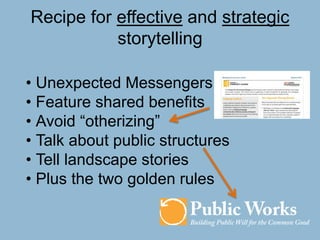
Recipe for effective and strategic
storytelling
• Unexpected Messengers
• Feature shared benefits
• Avoid “otherizing”
• Talk about public structures
• Tell landscape stories
• Plus the two golden rules
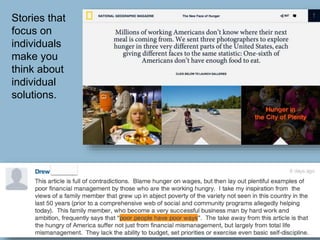
Stories that
focus on
individuals
make you
think about
individual
solutions.
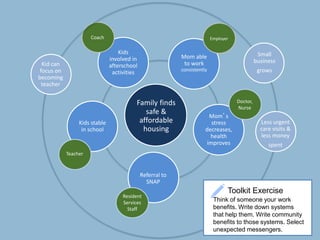
Family finds
safe &
affordable
housing
Kids
involved in
afterschool
activities
Coach
Mom able
to work
consistently
Employer
Mom’s
stress
decreases,
health
improves
Doctor,
Nurse
Referral to
SNAP
Resident
Services
Staff
Kids stable
in school
Teacher
Kid can
focus on
becoming
teacher
Small
business
grows
Less urgent
care visits &
less money
spent
Toolkit Exercise
Think of someone your work
benefits. Write down systems
that help them. Write community
benefits to those systems. Select
unexpected messengers.
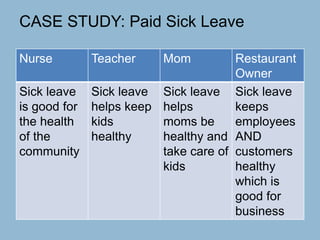
CASE STUDY: Paid Sick Leave
Nurse Teacher Mom Restaurant
Owner
Sick leave
is good for
the health
of the
community
Sick leave
helps keep
kids
healthy
Sick leave
helps
moms be
healthy and
take care of
kids
Sick leave
keeps
employees
AND
customers
healthy
which is
good for
business
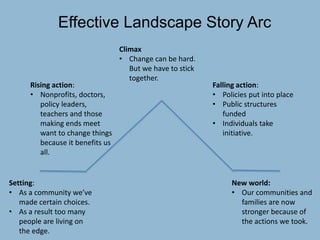
Effective Landscape Story Arc
Setting:
• As a community we’ve
made certain choices.
• As a result too many
people are living on
the edge.
Rising action:
• Nonprofits, doctors,
policy leaders,
teachers and those
making ends meet
want to change things
because it benefits us
all.
Climax
• Change can be hard.
But we have to stick
together.
Falling action:
• Policies put into place
• Public structures
funded
• Individuals take
initiative.
New world:
• Our communities and
families are now
stronger because of
the actions we took.
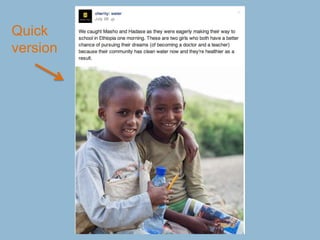
Quick
version
Supercharge your message!
• Metaphors
• Social math
• Local narratives
Play for an awesome 1970s
Super Chargers fight song!
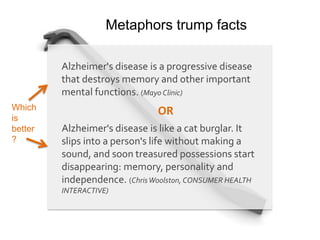
Alzheimer's disease is a progressive disease
that destroys memory and other important
mental functions. (Mayo Clinic)
Metaphors trump facts
Alzheimer's disease is like a cat burglar. It
slips into a person's life without making a
sound, and soon treasured possessions start
disappearing: memory, personality and
independence. (ChrisWoolston, CONSUMER HEALTH
INTERACTIVE)
ORWhich
is
better
?
“Volunteers spent more than
2,376 hours on the phone
[doing Get-Out-The-Vote
calls]. That’s like starting a
conversation with a voter on
Halloween, and not hanging
up until Valentines day.”
 Simplify
fractions
 Find a
comparison
(city, sports
stadiums)
 Break
number
down by
time (how
many times
does X
happen in X
time?)
 Make a
comparison
(ironic or
relevant)
Use social math
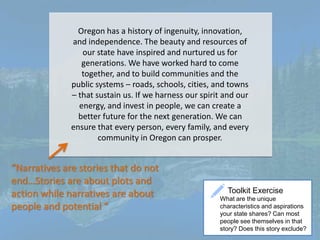
Oregon has a history of ingenuity, innovation,
and independence. The beauty and resources of
our state have inspired and nurtured us for
generations. We have worked hard to come
together, and to build communities and the
public systems – roads, schools, cities, and towns
– that sustain us. If we harness our spirit and our
energy, and invest in people, we can create a
better future for the next generation. We can
ensure that every person, every family, and every
community in Oregon can prosper.
“Narratives are stories that do not
end…Stories are about plots and
action while narratives are about
people and potential “
Toolkit Exercise
What are the unique
characteristics and aspirations
your state shares? Can most
people see themselves in that
story? Does this story exclude?
Learn More
http://hub.nhc.org/toolkit/messaging-framing
Where to Find Us
http://NeighborhoodPartnerships.org
http://advocatescollege.tumblr.com/
How to Contact Us
jbyrd@neighborhoodpartnerships.org
mkinshella@neighborhoodpartnerships.org
@NPartnerships
@mkinshella
@byrdjanet

How to Speak Differently About the Issues You Care About

  • 1.
    “. . .A talent for speaking differently, rather than for arguing well, is the chief instrument of cultural change . . .” - Richard Rorty
  • 2.
    Neighborhood Partnerships Janet Byrd,Executive Director Matt Kinshella, Communications Director Your Picture Here Speaking Differently
  • 3.
    Who are we? JanetByrd, Executive Director, Neighborhood Partnerships • Convenes Oregon Housing Alliance • Lengthy background in housing policy • History in community engagement Matt Kinshella, Communications Director • 7 years nonprofit and political communications work. • Years of nonproft training experience • Brain science nerd
  • 4.
    None of usare blank slates Past Experiences = Current Reality (Upbringing, Ideas, Culture, Friends, Education, etc.)
  • 5.
    10 scientifically provenways advocates can speak differently and get results • 2 golden rules • Recipe for a truly effective story • Supercharge your message
  • 6.
    1.Lead with values 1.TalkAbout Solutions i.e. protection, justice, family well-being, equality, freedom, opportunity, prosperity. Evidence alone can lead to “backfire effect.” Moral Foundations Theory Crisis = what’s the point Solutions = I can see how we can get there! The clearer & smaller the steps the better!
  • 7.
    Toolkit Exercise Try writing1 sentence on why it matters, 2 sentences on the problem and 4 sentences on the solution. Today, we have over 20,000 kids who’ve experienced homelessness during the last school year. We have a huge shortage of affordable housing here in our state, which means kids and families end up sleeping in cars and in homeless shelters. Kids go to school hungry, and aren’t ready to learn. As a state, we need to preserve the tools that make it easier to build and maintain affordable housing, like the Homebuyer Opportunity Limited Tax Exemption. A variety of tools and strategies are needed to create homeownership opportunities in different communities, and this program has proven effective in our state. Depressing Notpayingattention anymore. Youknowwhatwe shoulddo… Kids learn better, parents can work better and everyone is healthier when we have safe, stable and affordable homes for all our residents. But today, you could fill the local basketball arena with the amount of kids who don’t have a place to call home. We can solve this problem — we know how to help families end or prevent their homelessness and return to stable housing. By passing this bill, we will increase funding for affordable housing, and make sure more kids and families in our state have a safe, stable place to call home. Please call your elected official today, and ask them for their support.
  • 8.
    Recipe for effectiveand strategic storytelling • Unexpected Messengers • Feature shared benefits • Avoid “otherizing” • Talk about public structures • Tell landscape stories • Plus the two golden rules
  • 9.
    Stories that focus on individuals makeyou think about individual solutions.
  • 10.
    Family finds safe & affordable housing Kids involvedin afterschool activities Coach Mom able to work consistently Employer Mom’s stress decreases, health improves Doctor, Nurse Referral to SNAP Resident Services Staff Kids stable in school Teacher Kid can focus on becoming teacher Small business grows Less urgent care visits & less money spent Toolkit Exercise Think of someone your work benefits. Write down systems that help them. Write community benefits to those systems. Select unexpected messengers.
  • 11.
    CASE STUDY: PaidSick Leave Nurse Teacher Mom Restaurant Owner Sick leave is good for the health of the community Sick leave helps keep kids healthy Sick leave helps moms be healthy and take care of kids Sick leave keeps employees AND customers healthy which is good for business
  • 12.
    Effective Landscape StoryArc Setting: • As a community we’ve made certain choices. • As a result too many people are living on the edge. Rising action: • Nonprofits, doctors, policy leaders, teachers and those making ends meet want to change things because it benefits us all. Climax • Change can be hard. But we have to stick together. Falling action: • Policies put into place • Public structures funded • Individuals take initiative. New world: • Our communities and families are now stronger because of the actions we took.
  • 13.
  • 14.
    Supercharge your message! •Metaphors • Social math • Local narratives Play for an awesome 1970s Super Chargers fight song!
  • 15.
    Alzheimer's disease isa progressive disease that destroys memory and other important mental functions. (Mayo Clinic) Metaphors trump facts Alzheimer's disease is like a cat burglar. It slips into a person's life without making a sound, and soon treasured possessions start disappearing: memory, personality and independence. (ChrisWoolston, CONSUMER HEALTH INTERACTIVE) ORWhich is better ?
  • 16.
    “Volunteers spent morethan 2,376 hours on the phone [doing Get-Out-The-Vote calls]. That’s like starting a conversation with a voter on Halloween, and not hanging up until Valentines day.”  Simplify fractions  Find a comparison (city, sports stadiums)  Break number down by time (how many times does X happen in X time?)  Make a comparison (ironic or relevant) Use social math
  • 17.
    Oregon has ahistory of ingenuity, innovation, and independence. The beauty and resources of our state have inspired and nurtured us for generations. We have worked hard to come together, and to build communities and the public systems – roads, schools, cities, and towns – that sustain us. If we harness our spirit and our energy, and invest in people, we can create a better future for the next generation. We can ensure that every person, every family, and every community in Oregon can prosper. “Narratives are stories that do not end…Stories are about plots and action while narratives are about people and potential “ Toolkit Exercise What are the unique characteristics and aspirations your state shares? Can most people see themselves in that story? Does this story exclude?
  • 18.
    Learn More http://hub.nhc.org/toolkit/messaging-framing Where toFind Us http://NeighborhoodPartnerships.org http://advocatescollege.tumblr.com/ How to Contact Us jbyrd@neighborhoodpartnerships.org mkinshella@neighborhoodpartnerships.org @NPartnerships @mkinshella @byrdjanet

Editor's Notes

  • #2 Janet – values statement about the importance of changing the way we speak
  • #3 Janet -Intro and brief history of AC
  • #4 Introduce ourselves
  • #5 https://soundcloud.com/whyy-the-pulse/an-audio-illusion Matt Goal is to keep in mind this seemingly obvious fact. But it can be tough not to just speak from our own frames and wants and experiences.
  • #6 Matt
  • #7 Matt Values are a foundation for commonality - Haidt. Evidence alone won’t work- debunking myths Solutions. People want to make the world a better place but things seem overwhelming.
  • #8 Matt The Homeless? I know what we should do with them… trigger preconceived notions. “We can solve this problem” pivot Provide action, make it clear who is responsible
  • #9 Matt
  • #10 Matt On the flip side – people who were moved by this only think about individual charity.
  • #11 Janet Think about someone your organization is currently helping. Put them at the center of a piece of paper, and think about all the systems that are in place that might help that family stabilize. Write down all the systems or kinds of assistance you can think of. › Next, write down all the good things that happen because this person is now stable in housing — i.e., their kids do better in school, they are able to work, etc. › Now, think about who can help you tell this story — is it a case manager? One of the children’s teache
  • #12 Janet - Paid sick leave
  • #13 Matt - Drawn story arch
  • #14 Matt
  • #15 Matt
  • #16 Matt
  • #17 Matt
  • #18 Janet
  • #19 END – LINK FOR HANDOUT