H.R.Ghalyanchi
MS fellow
Sina MS Research Center,TUMS
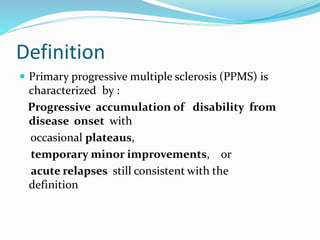
Definition
 Primary progressive multiple sclerosis (PPMS) is
characterized by :
Progressive accumulation of disability from
disease onset with
occasional plateaus,
temporary minor improvements, or
acute relapses still consistent with the
definition
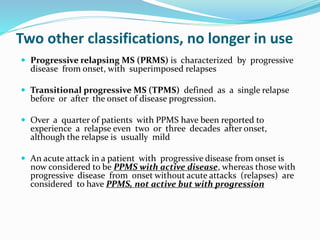
Two other classifications, no longer in use
 Progressive relapsing MS (PRMS) is characterized by progressive
disease from onset, with superimposed relapses
 Transitional progressive MS (TPMS) defined as a single relapse
before or after the onset of disease progression.
 Over a quarter of patients with PPMS have been reported to
experience a relapse even two or three decades after onset,
although the relapse is usually mild
 An acute attack in a patient with progressive disease from onset is
now considered to be PPMS with active disease, whereas those with
progressive disease from onset without acute attacks (relapses) are
considered to have PPMS, not active but with progression
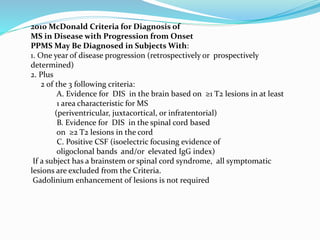
2010 McDonald Criteria for Diagnosis of
MS in Disease with Progression from Onset
PPMS May Be Diagnosed in Subjects With:
1. One year of disease progression (retrospectively or prospectively
determined)
2. Plus
2 of the 3 following criteria:
A. Evidence for DIS in the brain based on ≥1 T2 lesions in at least
1 area characteristic for MS
(periventricular, juxtacortical, or infratentorial)
B. Evidence for DIS in the spinal cord based
on ≥2 T2 lesions in the cord
C. Positive CSF (isoelectric focusing evidence of
oligoclonal bands and/or elevated IgG index)
If a subject has a brainstem or spinal cord syndrome, all symptomatic
lesions are excluded from the Criteria.
Gadolinium enhancement of lesions is not required
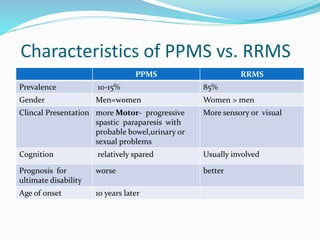
Characteristics of PPMS vs. RRMS
PPMS RRMS
Prevalence 10-15% 85%
Gender Men=women Women > men
Clincal Presentation more Motor- progressive
spastic paraparesis with
probable bowel,urinary or
sexual problems
More sensory or visual
Cognition relatively spared Usually involved
Prognosis for
ultimate disability
worse better
Age of onset 10 years later
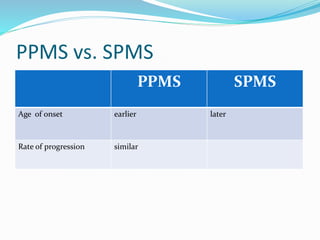
PPMS vs. SPMS
PPMS SPMS
Age of onset earlier later
Rate of progression similar
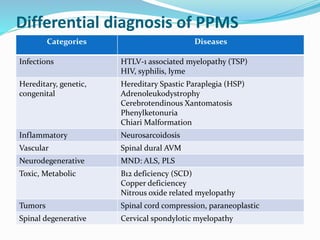
Differential diagnosis of PPMS
Categories Diseases
Infections HTLV-1 associated myelopathy (TSP)
HIV, syphilis, lyme
Hereditary, genetic,
congenital
Hereditary Spastic Paraplegia (HSP)
Adrenoleukodystrophy
Cerebrotendinous Xantomatosis
Phenylketonuria
Chiari Malformation
Inflammatory Neurosarcoidosis
Vascular Spinal dural AVM
Neurodegenerative MND: ALS, PLS
Toxic, Metabolic B12 deficiency (SCD)
Copper deficiencey
Nitrous oxide related myelopathy
Tumors Spinal cord compression, paraneoplastic
Spinal degenerative Cervical spondylotic myelopathy
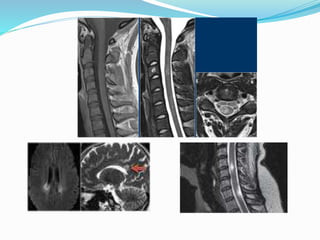
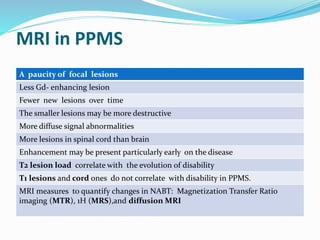
MRI in PPMS
A paucity of focal lesions
Less Gd- enhancing lesion
Fewer new lesions over time
The smaller lesions may be more destructive
More diffuse signal abnormalities
More lesions in spinal cord than brain
Enhancement may be present particularly early on the disease
T2 lesion load correlate with the evolution of disability
T1 lesions and cord ones do not correlate with disability in PPMS.
MRI measures to quantify changes in NABT: Magnetization Transfer Ratio
imaging (MTR), 1H (MRS),and diffusion MRI
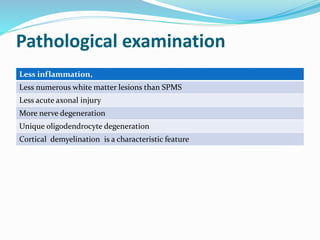
Pathological examination
Less inflammation,
Less numerous white matter lesions than SPMS
Less acute axonal injury
More nerve degeneration
Unique oligodendrocyte degeneration
Cortical demyelination is a characteristic feature
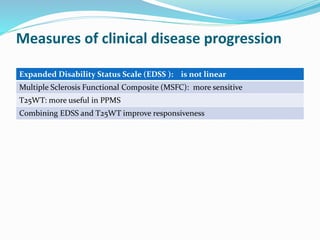
Measures of clinical disease progression
Expanded Disability Status Scale (EDSS ): is not linear
Multiple Sclerosis Functional Composite (MSFC): more sensitive
T25WT: more useful in PPMS
Combining EDSS and T25WT improve responsiveness
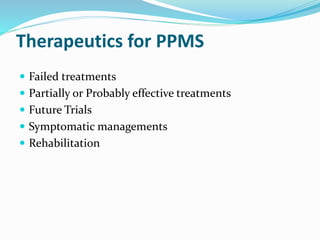
Therapeutics for PPMS
 Failed treatments
 Partially or Probably effective treatments
 Future Trials
 Symptomatic managements
 Rehabilitation
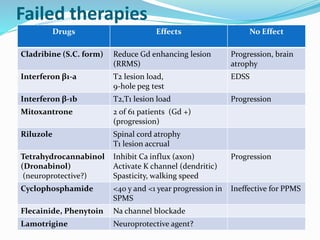
Failed therapies
Drugs Effects No Effect
Cladribine (S.C. form) Reduce Gd enhancing lesion
(RRMS)
Progression, brain
atrophy
Interferon β1-a T2 lesion load,
9-hole peg test
EDSS
Interferon β-1b T2,T1 lesion load Progression
Mitoxantrone 2 of 61 patients (Gd +)
(progression)
Riluzole Spinal cord atrophy
T1 lesion accrual
Tetrahydrocannabinol
(Dronabinol)
(neuroprotective?)
Inhibit Ca influx (axon)
Activate K channel (dendritic)
Spasticity, walking speed
Progression
Cyclophosphamide <40 y and <1 year progression in
SPMS
Ineffective for PPMS
Flecainide, Phenytoin Na channel blockade
Lamotrigine Neuroprotective agent?
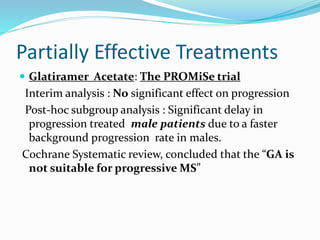
Partially Effective Treatments
 Glatiramer Acetate: The PROMiSe trial
Interim analysis : No significant effect on progression
Post-hoc subgroup analysis : Significant delay in
progression treated male patients due to a faster
background progression rate in males.
Cochrane Systematic review, concluded that the “GA is
not suitable for progressive MS”
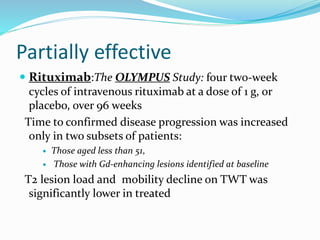
Partially effective
 Rituximab:The OLYMPUS Study: four two-week
cycles of intravenous rituximab at a dose of 1 g, or
placebo, over 96 weeks
Time to confirmed disease progression was increased
only in two subsets of patients:
 Those aged less than 51,
 Those with Gd-enhancing lesions identified at baseline
T2 lesion load and mobility decline on TWT was
significantly lower in treated
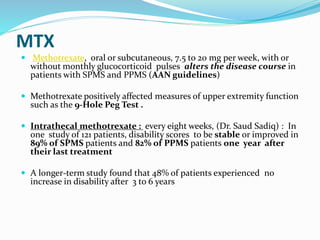
MTX
 Methotrexate, oral or subcutaneous, 7.5 to 20 mg per week, with or
without monthly glucocorticoid pulses alters the disease course in
patients with SPMS and PPMS (AAN guidelines)
 Methotrexate positively affected measures of upper extremity function
such as the 9-Hole Peg Test .
 Intrathecal methotrexate : every eight weeks, (Dr. Saud Sadiq) : In
one study of 121 patients, disability scores to be stable or improved in
89% of SPMS patients and 82% of PPMS patients one year after
their last treatment
 A longer-term study found that 48% of patients experienced no
increase in disability after 3 to 6 years
Stem cell therapy
 Autologous hematopoietic stem cell transplantation :
 In a meta-analysis, the estimated rate of progression-free
survival for 102 patients receiving intermediate-intensity
conditioning regimens (five studies with a median follow
up of 39 months) was 79 percent .
 In contrast, the estimated rate of progression-free survival
for 61 patients receiving high-intensity regimens (three
studies with a median follow up of 24 months) was 45
percent .
 Among 15 studies that reported adverse events, the most
frequent complications occurring within six months of
autologous HSCT were fever, engraftment syndrome,
enteritis, and transient neurologic deterioration.
Stem cell therapy
 Among 13 case series with post-treatment follow-up,
seven patients died from treatment-related causes,
mainly infection, and six patients died from
nontreatment-related causes, mainly disease
progression. Overall mortality was approximately 3
percent.
Partially effective
 Azathioprine: 51 patients PPMS - demonstrated a
small therapeutic effect overall
 Intermittent (on and off) intravenous (IV) steroids
have been tried in patients with PPMS (monthly
pulses) (typically 1000 mg of methylprednisolone)
 IVIG: Beneficial effects were seen in the PPMS
subgroup in a double blind, placebo-controlled trial
of IVIG in progressive MS.
Probable effective
 Pirfenidone: TNF-α synthesis inhibitor and TNF-
alpha receptor blocker
A small open-label study: clinical stabilization in
progressive MS over one year
 Amiloride : A few PPMS patients seem to have
responded to the potassium sparing diuretic
amiloride.
Targeting acid-sensing ion channel 1 (encoded by the
ASIC1 gene), contributes to the excessive intracellular
accumulation of injurious Na(+) and Ca(2+) that is
over-expressed in acute multiple sclerosis lesions
Probable effective
 LDN (Low dose naltrexone) :
stops progression of multiple sclerosis disability,
prevents relapses, and
reduces MS symptoms, such as fatigue, spasticity,
weakness , cognitive dysfunction, urinary
incontinence, depression and even heat
intolerance
Increases the body’s sensitivity to its own endorphins, or
helps the body make more endorphins
LDN administration
 Interferons should NOT take with LDN ( interact
with it).However, it is OK to be used in conjunction
with GA.
 LDN should NEVER be combined with any opiate-
based drugs (narcotics).
 For people with multiple sclerosis, the dosage of LDN ranges from
1.5 to 4.5 mg per day
 LDN is taken at night, between 9:00 pm and 12:00 midnight, to
work with the body’s natural peak release of endorphins, which
occurs sometime between 2:00 and 4:00 am. It can be taken with or
without food.
Future Trials
 Fingolimod (FTY720): Primarily anti-inflammatory agent
in vitro influence CNS remyelination
a double-blind placebo-controlled trial in PPMS is currently recruiting
(INFORMS; NCT00731692)
 Natalizumab in PPMS and SPMS
 Oral methylprednisolone, 500 mg monthly in SPMS and PPMS
 Ocrelizumab in PPMS 2017
 Lithium in Progressive Multiple Sclerosis Dec 2016
 Hydroxyurea (as an antiviral agent vs. EBV) in PPMS Jul2013
 Oral Cladribine; for PPMS
 Mastinib: improved MSFC- continue 2015
 Idebenone, a synthetic form of coenzyme Q10 which is thought to
promote remyelination
 Minocycline
Future treatments
 A Phosphodiesterase inhibitor Ibudilast (PDE-4 subtype
inhibitor):
Anti inflammatory and neuroprotective and antiplatelet
agent, in a trial MS-SMART in the United kingdom
SPRINT MS ibudilast vs placebo in the United States.
 Mesenchymal stem cell therapy for MS is being explored
 NSCs - neural stem cells : ‘allogenic’ stem cells
NSCs injected intrathecally in a clinical trial (phase I).
 Simvastatin 80 mg : in SPMS affect on whole-brain
atrophy and some measures of disability
No effect on new and enlarging brain lesions or in the
relapse rate. On PPMS ???
Symptomatic managements
 Multidisciplinary approach: medical, psychological and
social
 Maintain comfort and productivity, and enhancing
quality of life
 Treat fatigue, urinary incontinence, spasticity,
seizures and paroxysmal symptoms, pain, depression,
 Dalfampridine: (4-aminopyridine; fampridine), a
potassium channel blocker, may improve walking speed in
some patients with MS
 REHABILITATION: enhancing mobility and promoting
safety and independence
 Emotional well-being , can be achieved even in the
presence of a chronic illness or disability.
Conclusions:
 No treatment is yet proven to be effective for PPMS
 It is still ethical to carry out placebo-controlled trials
 Therapeutic agents directed at axonal protection or
repair may be particularly useful in PPMS, although
inflammation clearly occurs and hence trials of anti-
inflammatory agents are also justified
 Most trials did not last longer than two or three years and
give only hints about long-term results of treatment
 Too Big, Too Long, Too Expensive
 As its relative rarity, we need the involvement of multiple
centers in definitive trials using a combination of MRI
parameters to assess outcome
Conclusions
 Therapeutics in PPMS can no longer be considered a
neglected area
 Several randomized controlled trials, including Phase
3 trials of glatiramer acetate and rituximab, have now
been completed.
 A better understanding of the pathophysiology of
PPMS is required to guide the development of
therapeutic agents to target specific pathogenic
mechanisms.
Treatment for patients with primary progressive2

Treatment for patients with primary progressive2

  • 1.
  • 2.
    Definition  Primary progressivemultiple sclerosis (PPMS) is characterized by : Progressive accumulation of disability from disease onset with occasional plateaus, temporary minor improvements, or acute relapses still consistent with the definition
  • 3.
    Two other classifications,no longer in use  Progressive relapsing MS (PRMS) is characterized by progressive disease from onset, with superimposed relapses  Transitional progressive MS (TPMS) defined as a single relapse before or after the onset of disease progression.  Over a quarter of patients with PPMS have been reported to experience a relapse even two or three decades after onset, although the relapse is usually mild  An acute attack in a patient with progressive disease from onset is now considered to be PPMS with active disease, whereas those with progressive disease from onset without acute attacks (relapses) are considered to have PPMS, not active but with progression
  • 4.
    2010 McDonald Criteriafor Diagnosis of MS in Disease with Progression from Onset PPMS May Be Diagnosed in Subjects With: 1. One year of disease progression (retrospectively or prospectively determined) 2. Plus 2 of the 3 following criteria: A. Evidence for DIS in the brain based on ≥1 T2 lesions in at least 1 area characteristic for MS (periventricular, juxtacortical, or infratentorial) B. Evidence for DIS in the spinal cord based on ≥2 T2 lesions in the cord C. Positive CSF (isoelectric focusing evidence of oligoclonal bands and/or elevated IgG index) If a subject has a brainstem or spinal cord syndrome, all symptomatic lesions are excluded from the Criteria. Gadolinium enhancement of lesions is not required
  • 6.
    Characteristics of PPMSvs. RRMS PPMS RRMS Prevalence 10-15% 85% Gender Men=women Women > men Clincal Presentation more Motor- progressive spastic paraparesis with probable bowel,urinary or sexual problems More sensory or visual Cognition relatively spared Usually involved Prognosis for ultimate disability worse better Age of onset 10 years later
  • 7.
    PPMS vs. SPMS PPMSSPMS Age of onset earlier later Rate of progression similar
  • 8.
    Differential diagnosis ofPPMS Categories Diseases Infections HTLV-1 associated myelopathy (TSP) HIV, syphilis, lyme Hereditary, genetic, congenital Hereditary Spastic Paraplegia (HSP) Adrenoleukodystrophy Cerebrotendinous Xantomatosis Phenylketonuria Chiari Malformation Inflammatory Neurosarcoidosis Vascular Spinal dural AVM Neurodegenerative MND: ALS, PLS Toxic, Metabolic B12 deficiency (SCD) Copper deficiencey Nitrous oxide related myelopathy Tumors Spinal cord compression, paraneoplastic Spinal degenerative Cervical spondylotic myelopathy
  • 9.
    MRI in PPMS Apaucity of focal lesions Less Gd- enhancing lesion Fewer new lesions over time The smaller lesions may be more destructive More diffuse signal abnormalities More lesions in spinal cord than brain Enhancement may be present particularly early on the disease T2 lesion load correlate with the evolution of disability T1 lesions and cord ones do not correlate with disability in PPMS. MRI measures to quantify changes in NABT: Magnetization Transfer Ratio imaging (MTR), 1H (MRS),and diffusion MRI
  • 10.
    Pathological examination Less inflammation, Lessnumerous white matter lesions than SPMS Less acute axonal injury More nerve degeneration Unique oligodendrocyte degeneration Cortical demyelination is a characteristic feature
  • 11.
    Measures of clinicaldisease progression Expanded Disability Status Scale (EDSS ): is not linear Multiple Sclerosis Functional Composite (MSFC): more sensitive T25WT: more useful in PPMS Combining EDSS and T25WT improve responsiveness
  • 12.
    Therapeutics for PPMS Failed treatments  Partially or Probably effective treatments  Future Trials  Symptomatic managements  Rehabilitation
  • 13.
    Failed therapies Drugs EffectsNo Effect Cladribine (S.C. form) Reduce Gd enhancing lesion (RRMS) Progression, brain atrophy Interferon β1-a T2 lesion load, 9-hole peg test EDSS Interferon β-1b T2,T1 lesion load Progression Mitoxantrone 2 of 61 patients (Gd +) (progression) Riluzole Spinal cord atrophy T1 lesion accrual Tetrahydrocannabinol (Dronabinol) (neuroprotective?) Inhibit Ca influx (axon) Activate K channel (dendritic) Spasticity, walking speed Progression Cyclophosphamide <40 y and <1 year progression in SPMS Ineffective for PPMS Flecainide, Phenytoin Na channel blockade Lamotrigine Neuroprotective agent?
  • 14.
    Partially Effective Treatments Glatiramer Acetate: The PROMiSe trial Interim analysis : No significant effect on progression Post-hoc subgroup analysis : Significant delay in progression treated male patients due to a faster background progression rate in males. Cochrane Systematic review, concluded that the “GA is not suitable for progressive MS”
  • 15.
    Partially effective  Rituximab:TheOLYMPUS Study: four two-week cycles of intravenous rituximab at a dose of 1 g, or placebo, over 96 weeks Time to confirmed disease progression was increased only in two subsets of patients:  Those aged less than 51,  Those with Gd-enhancing lesions identified at baseline T2 lesion load and mobility decline on TWT was significantly lower in treated
  • 16.
    MTX  Methotrexate, oralor subcutaneous, 7.5 to 20 mg per week, with or without monthly glucocorticoid pulses alters the disease course in patients with SPMS and PPMS (AAN guidelines)  Methotrexate positively affected measures of upper extremity function such as the 9-Hole Peg Test .  Intrathecal methotrexate : every eight weeks, (Dr. Saud Sadiq) : In one study of 121 patients, disability scores to be stable or improved in 89% of SPMS patients and 82% of PPMS patients one year after their last treatment  A longer-term study found that 48% of patients experienced no increase in disability after 3 to 6 years
  • 17.
    Stem cell therapy Autologous hematopoietic stem cell transplantation :  In a meta-analysis, the estimated rate of progression-free survival for 102 patients receiving intermediate-intensity conditioning regimens (five studies with a median follow up of 39 months) was 79 percent .  In contrast, the estimated rate of progression-free survival for 61 patients receiving high-intensity regimens (three studies with a median follow up of 24 months) was 45 percent .  Among 15 studies that reported adverse events, the most frequent complications occurring within six months of autologous HSCT were fever, engraftment syndrome, enteritis, and transient neurologic deterioration.
  • 18.
    Stem cell therapy Among 13 case series with post-treatment follow-up, seven patients died from treatment-related causes, mainly infection, and six patients died from nontreatment-related causes, mainly disease progression. Overall mortality was approximately 3 percent.
  • 19.
    Partially effective  Azathioprine:51 patients PPMS - demonstrated a small therapeutic effect overall  Intermittent (on and off) intravenous (IV) steroids have been tried in patients with PPMS (monthly pulses) (typically 1000 mg of methylprednisolone)  IVIG: Beneficial effects were seen in the PPMS subgroup in a double blind, placebo-controlled trial of IVIG in progressive MS.
  • 20.
    Probable effective  Pirfenidone:TNF-α synthesis inhibitor and TNF- alpha receptor blocker A small open-label study: clinical stabilization in progressive MS over one year  Amiloride : A few PPMS patients seem to have responded to the potassium sparing diuretic amiloride. Targeting acid-sensing ion channel 1 (encoded by the ASIC1 gene), contributes to the excessive intracellular accumulation of injurious Na(+) and Ca(2+) that is over-expressed in acute multiple sclerosis lesions
  • 21.
    Probable effective  LDN(Low dose naltrexone) : stops progression of multiple sclerosis disability, prevents relapses, and reduces MS symptoms, such as fatigue, spasticity, weakness , cognitive dysfunction, urinary incontinence, depression and even heat intolerance Increases the body’s sensitivity to its own endorphins, or helps the body make more endorphins
  • 22.
    LDN administration  Interferonsshould NOT take with LDN ( interact with it).However, it is OK to be used in conjunction with GA.  LDN should NEVER be combined with any opiate- based drugs (narcotics).  For people with multiple sclerosis, the dosage of LDN ranges from 1.5 to 4.5 mg per day  LDN is taken at night, between 9:00 pm and 12:00 midnight, to work with the body’s natural peak release of endorphins, which occurs sometime between 2:00 and 4:00 am. It can be taken with or without food.
  • 23.
    Future Trials  Fingolimod(FTY720): Primarily anti-inflammatory agent in vitro influence CNS remyelination a double-blind placebo-controlled trial in PPMS is currently recruiting (INFORMS; NCT00731692)  Natalizumab in PPMS and SPMS  Oral methylprednisolone, 500 mg monthly in SPMS and PPMS  Ocrelizumab in PPMS 2017  Lithium in Progressive Multiple Sclerosis Dec 2016  Hydroxyurea (as an antiviral agent vs. EBV) in PPMS Jul2013  Oral Cladribine; for PPMS  Mastinib: improved MSFC- continue 2015  Idebenone, a synthetic form of coenzyme Q10 which is thought to promote remyelination  Minocycline
  • 24.
    Future treatments  APhosphodiesterase inhibitor Ibudilast (PDE-4 subtype inhibitor): Anti inflammatory and neuroprotective and antiplatelet agent, in a trial MS-SMART in the United kingdom SPRINT MS ibudilast vs placebo in the United States.  Mesenchymal stem cell therapy for MS is being explored  NSCs - neural stem cells : ‘allogenic’ stem cells NSCs injected intrathecally in a clinical trial (phase I).  Simvastatin 80 mg : in SPMS affect on whole-brain atrophy and some measures of disability No effect on new and enlarging brain lesions or in the relapse rate. On PPMS ???
  • 25.
    Symptomatic managements  Multidisciplinaryapproach: medical, psychological and social  Maintain comfort and productivity, and enhancing quality of life  Treat fatigue, urinary incontinence, spasticity, seizures and paroxysmal symptoms, pain, depression,  Dalfampridine: (4-aminopyridine; fampridine), a potassium channel blocker, may improve walking speed in some patients with MS  REHABILITATION: enhancing mobility and promoting safety and independence  Emotional well-being , can be achieved even in the presence of a chronic illness or disability.
  • 26.
    Conclusions:  No treatmentis yet proven to be effective for PPMS  It is still ethical to carry out placebo-controlled trials  Therapeutic agents directed at axonal protection or repair may be particularly useful in PPMS, although inflammation clearly occurs and hence trials of anti- inflammatory agents are also justified  Most trials did not last longer than two or three years and give only hints about long-term results of treatment  Too Big, Too Long, Too Expensive  As its relative rarity, we need the involvement of multiple centers in definitive trials using a combination of MRI parameters to assess outcome
  • 27.
    Conclusions  Therapeutics inPPMS can no longer be considered a neglected area  Several randomized controlled trials, including Phase 3 trials of glatiramer acetate and rituximab, have now been completed.  A better understanding of the pathophysiology of PPMS is required to guide the development of therapeutic agents to target specific pathogenic mechanisms.