TRAVELLING
COMPARATIVE FORMS
Laura and Mark are sharing
pictures of their last holidays.
Laura went to Rome
Mark visited Tokyo
Read the conversation.
Pay attention to the words in bold
Laura: I had an amazing time in Rome, it’s a wonderful city!
Mark: It’s a nice city, yes… but after visiting Tokyo I think I will never
go back to Italy! Tokyo is a dream city!
Laura: If you say so…
Mark: That’s a great picture of the Colosseum! Is it older than the
Tower of Pisa?
Laura: yes, of course! The Colosseum was finished in 80 AD while the
Tower of Pisa was built in 1174. The Colosseum is as old as the Arch of
Titus, which was built in 82 AD. This Arch is in Rome, too.
Mark: I know… I visited Rome last year, remember?
Laura: oh, right!
Mark: It’s a great city, full of history. But you know… I prefer modern cities so
I like Tokyo best.
Laura: well, I understand… Tokyo is much more modern than Rome. It’s
more crowded, too I think… full of people and heavy traffic. That’s why I
prefer Rome… It’s less noisy.
Mark: No, it isn´t! Maybe traffic is lighter but Rome is bigger than Tokyo
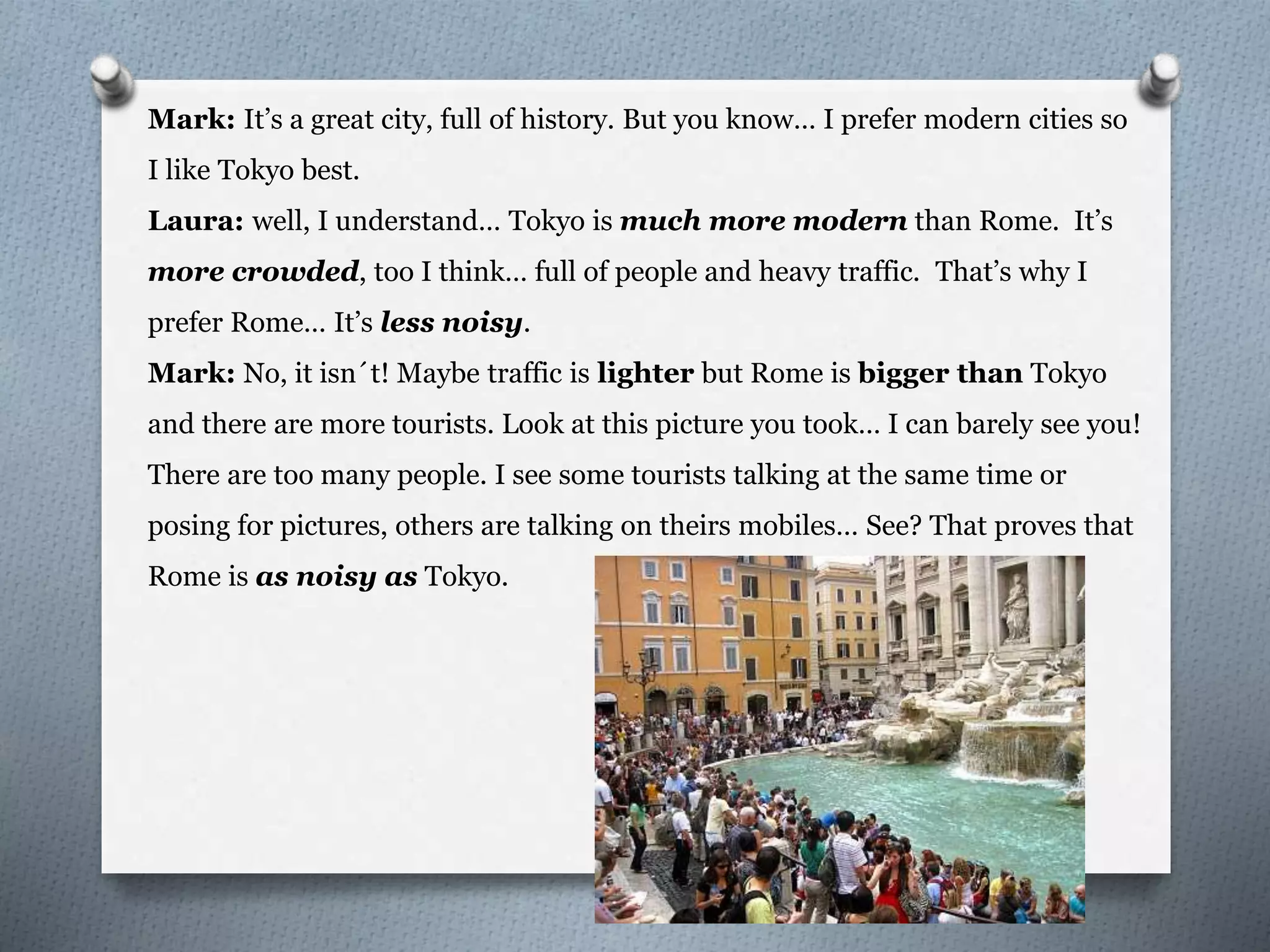
and there are more tourists. Look at this picture you took… I can barely see you!
There are too many people. I see some tourists talking at the same time or
posing for pictures, others are talking on theirs mobiles… See? That proves that
Rome is as noisy as Tokyo.
Laura: Well… you may be right but I still prefer Rome because travelling by public
transport is easier than in Tokyo… look at this photo of the subway station! How
long did you have to wait to travell?
Mark: about 20 minutes… It was so full of people! Ok… I have to agree with you.
Actually, public transport in Tokyo is worse than in many other places I have
visited.
Laura: and you have to admit that Italian food is better than Japanese food…
Mark: well, you know I love pasta… I think that we should go on holidays together
next time… somewhere in Italy!
READ, THINK AND DISCUSS
Think about or read again the
dialogue between Laura and Mark.
In general, in the conversation. Is Laura saying…?
a) that Rome is different from all other popular cities.
b) that Rome is different from one specific popular city.
How do you know ?
Which is the correct definition of the COMPARATIVE ? Why?
a) We use it to compare one person or thing with another so we can express
whether a person or thing has more, less or the same amount of a particular
quality.
b) We use it to compare a person or thing with the whole group. We can
express that someone or something is different from the rest of the group
because it has the most of a particular quality.
COMPARATIVE ADJECTIVES FORM
Read, observe and share your ideas
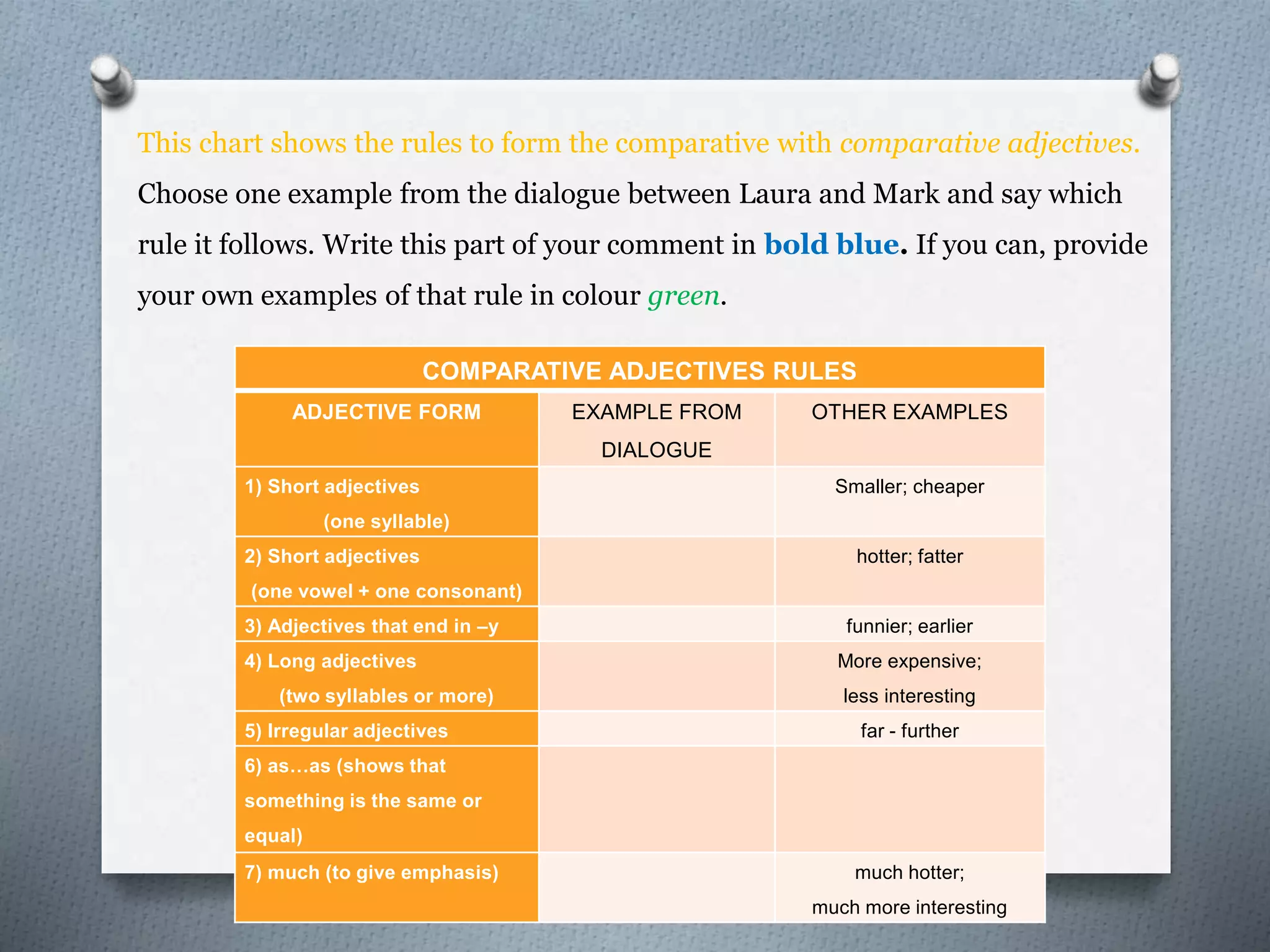
This chart shows the rules to form the comparative with comparative adjectives.
Choose one example from the dialogue between Laura and Mark and say which
rule it follows. Write this part of your comment in bold blue. If you can, provide
your own examples of that rule in colour green.
COMPARATIVE ADJECTIVES RULES
ADJECTIVE FORM EXAMPLE FROM
DIALOGUE
OTHER EXAMPLES
1) Short adjectives
(one syllable)
Smaller; cheaper
2) Short adjectives
(one vowel + one consonant)
hotter; fatter
3) Adjectives that end in –y funnier; earlier
4) Long adjectives
(two syllables or more)
More expensive;
less interesting
5) Irregular adjectives far - further
6) as…as (shows that
something is the same or
equal)
7) much (to give emphasis) much hotter;
much more interesting

Travelling comparative adjectives ppt

  • 1.
  • 2.
    Laura and Markare sharing pictures of their last holidays.
  • 3.
  • 4.
  • 5.
    Read the conversation. Payattention to the words in bold
  • 6.
    Laura: I hadan amazing time in Rome, it’s a wonderful city! Mark: It’s a nice city, yes… but after visiting Tokyo I think I will never go back to Italy! Tokyo is a dream city! Laura: If you say so… Mark: That’s a great picture of the Colosseum! Is it older than the Tower of Pisa? Laura: yes, of course! The Colosseum was finished in 80 AD while the Tower of Pisa was built in 1174. The Colosseum is as old as the Arch of Titus, which was built in 82 AD. This Arch is in Rome, too. Mark: I know… I visited Rome last year, remember? Laura: oh, right!
  • 7.
    Mark: It’s agreat city, full of history. But you know… I prefer modern cities so I like Tokyo best. Laura: well, I understand… Tokyo is much more modern than Rome. It’s more crowded, too I think… full of people and heavy traffic. That’s why I prefer Rome… It’s less noisy. Mark: No, it isn´t! Maybe traffic is lighter but Rome is bigger than Tokyo and there are more tourists. Look at this picture you took… I can barely see you! There are too many people. I see some tourists talking at the same time or posing for pictures, others are talking on theirs mobiles… See? That proves that Rome is as noisy as Tokyo.
  • 8.
    Laura: Well… youmay be right but I still prefer Rome because travelling by public transport is easier than in Tokyo… look at this photo of the subway station! How long did you have to wait to travell? Mark: about 20 minutes… It was so full of people! Ok… I have to agree with you. Actually, public transport in Tokyo is worse than in many other places I have visited. Laura: and you have to admit that Italian food is better than Japanese food… Mark: well, you know I love pasta… I think that we should go on holidays together next time… somewhere in Italy!
  • 9.
  • 10.
    Think about orread again the dialogue between Laura and Mark. In general, in the conversation. Is Laura saying…? a) that Rome is different from all other popular cities. b) that Rome is different from one specific popular city. How do you know ?
  • 11.
    Which is thecorrect definition of the COMPARATIVE ? Why? a) We use it to compare one person or thing with another so we can express whether a person or thing has more, less or the same amount of a particular quality. b) We use it to compare a person or thing with the whole group. We can express that someone or something is different from the rest of the group because it has the most of a particular quality.
  • 12.
    COMPARATIVE ADJECTIVES FORM Read,observe and share your ideas
  • 13.
    This chart showsthe rules to form the comparative with comparative adjectives. Choose one example from the dialogue between Laura and Mark and say which rule it follows. Write this part of your comment in bold blue. If you can, provide your own examples of that rule in colour green. COMPARATIVE ADJECTIVES RULES ADJECTIVE FORM EXAMPLE FROM DIALOGUE OTHER EXAMPLES 1) Short adjectives (one syllable) Smaller; cheaper 2) Short adjectives (one vowel + one consonant) hotter; fatter 3) Adjectives that end in –y funnier; earlier 4) Long adjectives (two syllables or more) More expensive; less interesting 5) Irregular adjectives far - further 6) as…as (shows that something is the same or equal) 7) much (to give emphasis) much hotter; much more interesting