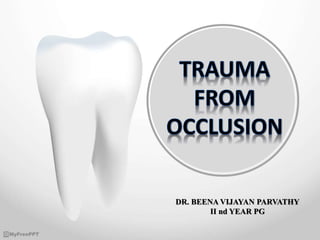
DR. BEENA VIJAYAN PARVATHY
II nd YEAR PG
CONTENTS
• DEFINITION
• ETIOLOGY
• HISTORICAL PRESPECTIVE
• TERMINOLOGIES WHICH HAVE BEEN USED TO
DESCRIBE OCCLSAL TRAUMA
• REVIEW OF LITERATURE
• OCCLUSAL FORCES DURING JAW MOVEMENTS
• CLASSIFICATION
• STAGES OF TISSUE RESPONSE TO EXCESSIVE
OCCLUSAL FORCES
• EXAMINATION AND DIAGNOSIS
• RADIOGRAPHIC SIGNS
• IS TRAUMATIC OCCLUSION REVERSIBLE?
• TRAUMA FROM OCCLUSION ARROUND
IMPLANTS
• OUR PRESENT UNDERSTANDING
• TREATMENT
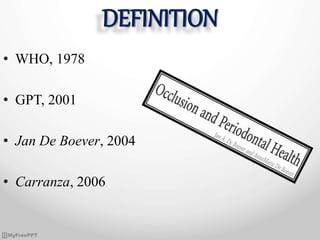
DEFINITION
• WHO, 1978
• GPT, 2001
• Jan De Boever, 2004
• Carranza, 2006
ETIOLOGY
• Precipitating factors (Primary etiology)
Destructive occlusal forces
Magnitude of force Direction of force
Frequency of force Duration of force
• Predisposing factors
Development of TFO indirectly
Intrinsic factors Extrinsic factors
Types of Occlusal Forces
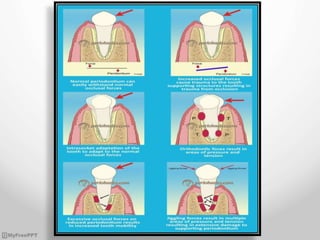
• Normal physiological forces
• Impact forces
• Continuous forces
• Jiggling forces
HISTORICAL PRESPECTIVE
• Karolyi, 1901
• Box’s Study, 1935
• Stone’s Study, 1938
• Bhaskar & Orban, 1955
TERMINOLOGIES WHICH HAVE BEEN USED TO
DESCRIBE OCCLUSAL TRAUMA
• Stillman 1917
• Box 1930
• Ramfjord & Ash 1972
• Muhlemann 1956 Traumatogenic occlusal situation
• Orban 1958 & Pichard 1965 Periodontal traumatism
• Glickman 1974 Trauma from Occlusion
Traumatic occlusion
REVIEWOF LITERATURE
• Stillmann 1917
AUTOPSY STUDIES:
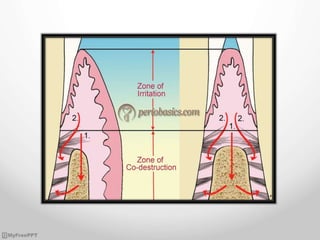
• Weinman et al
• Glickman’s Concept:-
– Glickman & Smulow (1962,1969)
– Glickman (1963,1965) “Theory of Co-destruction”
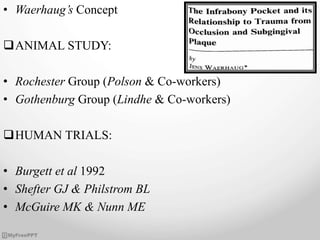
• Waerhaug’s Concept
ANIMAL STUDY:
• Rochester Group (Polson & Co-workers)
• Gothenburg Group (Lindhe & Co-workers)
HUMAN TRIALS:
• Burgett et al 1992
• Shefter GJ & Philstrom BL
• McGuire MK & Nunn ME
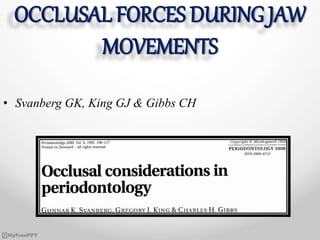
OCCLUSAL FORCES DURING JAW
MOVEMENTS
• Svanberg GK, King GJ & Gibbs CH
CLASSIFICATION
• Acute Trauma From Occlusion
• Chronic Trauma From Occlusion
• Primary Trauma From Occlusion
– GPT, AAP 1992
– Polson AM, 1976
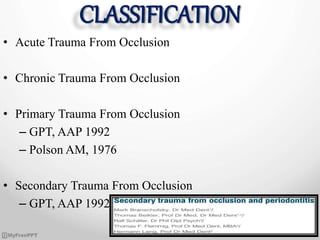
• Secondary Trauma From Occlusion
– GPT, AAP 1992
STAGES OF TISSUE RESPONSE TO EXCESSIVE
OCCLUSAL FORCES
• Carranza (1967, 1970)
I. Stage I, Injury
– Slightly excessive forces Zaki AE,1963
– Greater than slightly excessive force Rygh P,1972-
1974)
– Severly high forces Stallard,1964 & Stahl SS,1975)
II. Stage II, Repair
 Buttressing Bone Formation – Glickman & Smulov,
1965
 Lipping - Glickman & Smulov, 1962
III. Stage III, Adaptive Remodelling of the Periodontium
– Lindhe & Ericsson, 1984
– Carranza & Dotto, 1966
EXAMINATION AND DIAGNOSIS
Signs of Trauma From Occlusion
• Tooth Mobility
• Tooth Migration
• Wear Patterns
• Abfraction, especially in premolars
• V-Shaped or Angled Gingival Recession
• Fremitus Test  Ingervall B, 1972
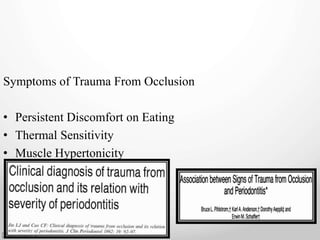
Symptoms of Trauma From Occlusion
• Persistent Discomfort on Eating
• Thermal Sensitivity
• Muscle Hypertonicity
RADIOGRAPHIC SIGNS
IS TRAUMATIC OCCLUSION
REVERSIBLE?
TRAUMA FROM OCCLUSION
ARROUND IMPLANTS
TREATMENT
• Occlusal adjustments
• Management of parafunctional habits
• Splinting of teeth
• Orthodontic tooth movement
• Occlusal reconstruction
• Extraction of selected teeth
Perio 2000, 2017
OUR PRESENT UNDERSTANDING
REFERENCE
• Role Of Occlusion In The Etiology And Treatment, Of Periodontal Disease,
IRVING GLICKMAN, Tufts University School Of Dental Medicine, Boston,
Massachusetts 02111, USA.
• Radiographs In Periodontics, Niklaus P. Langi And Roger W. HILLS, Journal Of
Clinical Periodontology: 1977: 4: 16-28.
• The Infrabony Pocket And Its Relationship To Trauma From Occlusion And
Subgingival Plaque By Jens Waerhaug.
• Role Of Occlusion In Periodontal Disease, Euloir Passanezi, Adriana Campos
Passanezi Sant'ana.
• Association Of Trauma From Occlusion With Localized Gingival Recession In
Mandibular Anterior Teeth Pratibha Panduranga Kundapur, Khandige Mahalinga
Bhat, And Giliyar Subraya Bhat, Dent Res J (Isfahan). 2009 Autumn; 6(2): 71–74.
• Occlusal Trauma And Excessive Occlusal Forces: Narrative Review, Case
Definitions, And Diagnostic Considerations Jingyuan Fan Jack G. Caton.
• Clinical Diagnosis Of Trauma From Occlusion And Its Relation With Severity Of
Periodontitis L. J. Jtn And C. F. Cao.
Trauma From Occlusion.pptx

Trauma From Occlusion.pptx

  • 1.
    DR. BEENA VIJAYANPARVATHY II nd YEAR PG
  • 2.
    CONTENTS • DEFINITION • ETIOLOGY •HISTORICAL PRESPECTIVE • TERMINOLOGIES WHICH HAVE BEEN USED TO DESCRIBE OCCLSAL TRAUMA • REVIEW OF LITERATURE • OCCLUSAL FORCES DURING JAW MOVEMENTS • CLASSIFICATION • STAGES OF TISSUE RESPONSE TO EXCESSIVE OCCLUSAL FORCES • EXAMINATION AND DIAGNOSIS
  • 3.
    • RADIOGRAPHIC SIGNS •IS TRAUMATIC OCCLUSION REVERSIBLE? • TRAUMA FROM OCCLUSION ARROUND IMPLANTS • OUR PRESENT UNDERSTANDING • TREATMENT
  • 4.
    DEFINITION • WHO, 1978 •GPT, 2001 • Jan De Boever, 2004 • Carranza, 2006
  • 5.
    ETIOLOGY • Precipitating factors(Primary etiology) Destructive occlusal forces Magnitude of force Direction of force Frequency of force Duration of force • Predisposing factors Development of TFO indirectly Intrinsic factors Extrinsic factors
  • 6.
    Types of OcclusalForces • Normal physiological forces • Impact forces • Continuous forces • Jiggling forces
  • 7.
    HISTORICAL PRESPECTIVE • Karolyi,1901 • Box’s Study, 1935 • Stone’s Study, 1938 • Bhaskar & Orban, 1955
  • 8.
    TERMINOLOGIES WHICH HAVEBEEN USED TO DESCRIBE OCCLUSAL TRAUMA • Stillman 1917 • Box 1930 • Ramfjord & Ash 1972 • Muhlemann 1956 Traumatogenic occlusal situation • Orban 1958 & Pichard 1965 Periodontal traumatism • Glickman 1974 Trauma from Occlusion Traumatic occlusion
  • 9.
    REVIEWOF LITERATURE • Stillmann1917 AUTOPSY STUDIES: • Weinman et al • Glickman’s Concept:- – Glickman & Smulow (1962,1969) – Glickman (1963,1965) “Theory of Co-destruction”
  • 11.
    • Waerhaug’s Concept ANIMALSTUDY: • Rochester Group (Polson & Co-workers) • Gothenburg Group (Lindhe & Co-workers) HUMAN TRIALS: • Burgett et al 1992 • Shefter GJ & Philstrom BL • McGuire MK & Nunn ME
  • 12.
    OCCLUSAL FORCES DURINGJAW MOVEMENTS • Svanberg GK, King GJ & Gibbs CH
  • 13.
    CLASSIFICATION • Acute TraumaFrom Occlusion • Chronic Trauma From Occlusion • Primary Trauma From Occlusion – GPT, AAP 1992 – Polson AM, 1976 • Secondary Trauma From Occlusion – GPT, AAP 1992
  • 14.
    STAGES OF TISSUERESPONSE TO EXCESSIVE OCCLUSAL FORCES • Carranza (1967, 1970) I. Stage I, Injury – Slightly excessive forces Zaki AE,1963 – Greater than slightly excessive force Rygh P,1972- 1974) – Severly high forces Stallard,1964 & Stahl SS,1975) II. Stage II, Repair  Buttressing Bone Formation – Glickman & Smulov, 1965  Lipping - Glickman & Smulov, 1962
  • 15.
    III. Stage III,Adaptive Remodelling of the Periodontium – Lindhe & Ericsson, 1984 – Carranza & Dotto, 1966
  • 17.
    EXAMINATION AND DIAGNOSIS Signsof Trauma From Occlusion • Tooth Mobility • Tooth Migration • Wear Patterns • Abfraction, especially in premolars • V-Shaped or Angled Gingival Recession • Fremitus Test  Ingervall B, 1972
  • 18.
    Symptoms of TraumaFrom Occlusion • Persistent Discomfort on Eating • Thermal Sensitivity • Muscle Hypertonicity
  • 19.
  • 20.
  • 21.
  • 22.
    TREATMENT • Occlusal adjustments •Management of parafunctional habits • Splinting of teeth • Orthodontic tooth movement • Occlusal reconstruction • Extraction of selected teeth Perio 2000, 2017
  • 23.
  • 24.
    REFERENCE • Role OfOcclusion In The Etiology And Treatment, Of Periodontal Disease, IRVING GLICKMAN, Tufts University School Of Dental Medicine, Boston, Massachusetts 02111, USA. • Radiographs In Periodontics, Niklaus P. Langi And Roger W. HILLS, Journal Of Clinical Periodontology: 1977: 4: 16-28. • The Infrabony Pocket And Its Relationship To Trauma From Occlusion And Subgingival Plaque By Jens Waerhaug. • Role Of Occlusion In Periodontal Disease, Euloir Passanezi, Adriana Campos Passanezi Sant'ana. • Association Of Trauma From Occlusion With Localized Gingival Recession In Mandibular Anterior Teeth Pratibha Panduranga Kundapur, Khandige Mahalinga Bhat, And Giliyar Subraya Bhat, Dent Res J (Isfahan). 2009 Autumn; 6(2): 71–74. • Occlusal Trauma And Excessive Occlusal Forces: Narrative Review, Case Definitions, And Diagnostic Considerations Jingyuan Fan Jack G. Caton. • Clinical Diagnosis Of Trauma From Occlusion And Its Relation With Severity Of Periodontitis L. J. Jtn And C. F. Cao.