CONTENTS :-
      TRANSPORTATION SYSTEM OF
      INDIA
1) INTTRODUCTION
2) TYPES/MODES OF TRANSPORTATIONS
     a). Traditional means
     b). Local/Public transport
     c). Personal Transport
     d). Long distance transports
     e). Water ways
     f). Air ways
3) BY PRODUCTS OF TRANSPORTATION
      a). Air pollution
       b). Water pollution
       c). Noise pollution
INTRODUCTIO
                    N
Development of infrastructure within the country has progressed at
a rapid pace, and today there is a WIDE VARIETY OF MODES OF
TRANSPORT by land, water and air.

Despite ongoing improvements in the sector, several aspects of the
transport sector are still riddled with problems due to OUTDATED
INFRASTRUCTURE and lack of PROPER MAINTEANENCE & thus it’s
lead towards a BY-PRODUCT call POLLUTION          The advent of the
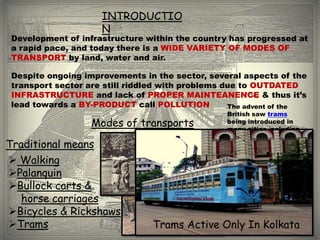
                                                British saw trams
                  Modes of transports           being introduced in
                                                many cities including
                                                Mumbai and Kolkata.
Traditional means                               They are still in use in
                                                Kolkata and provide an
 Walking                                       emission-free means of
                                                transport. Due to
Palanquin                                      technologically
                                                backward system &
Bullock carts &           palanquin            more emphasis given to
   horse carriages                              other modes of
                                                transportation is the
Bicycles & Rickshaws                           reason not being
                                                successful in our
Trams                         Trams Active Only In Kolkata
                           Bullock Carts        country
2b. Local/public
                 transports
  Public transport is the predominant mode of MOTORIZED LOCAL
   TRAVEL in cities. Mostly dominated through road ways.
  Dedicated city bus services are known to operate in at least 25
   cities with a population of over one million.
 Intermediate public transport modes like tempos and cycle
   rickshaws assume importance in medium size cities.

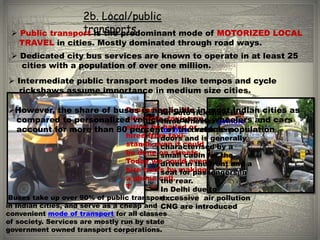
However, the share of buses is negligible in most is a
                         Depending on therickshaw Indian cities as
                                   An auto
                         city/state, taxis can
 compared to personalized vehicles, and two-wheelers and cars
                                   three-wheeler vehicle
 account for more than 80 percenthailed that has no
                         either befor hire or
                                     of the vehicle population
                                hired from taxi-and is generally
                                          doors
                                stands,even it could
                                          characterised by a
                                be done on streets. for the
                                          small cabin
                                Today we couldin the front and a
                                          driver even
                                hire taxi’s by making
                                          seat for passengers in
                                a phone call.rear.
                                          the
                                T         In Delhi due to
 Buses take up over 90% of public transportexcessive air pollution
in Indian cities, and serve as a cheap and CNG are introduced
convenient mode of transport for all classes
of society. Services are mostly run by state
government owned transport corporations.
2b. Local/public (Rapid transport
              system)
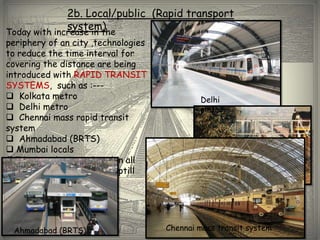
Today with increase in the
periphery of an city ,technologies
to reduce the time interval for
covering the distance are being
introduced with RAPID TRANSIT
SYSTEMS, such as :---
 Kolkata metro                              Delhi
 Delhi metro                                metro
 Chennai mass rapid transit
system
 Ahmadabad (BRTS)
 Mumbai locals
(RTS, is to be introduced in all
the major cities of Indial uptill
                                                     Mumbai locals
2021)


 Ahmadabad (BRTS)                    Chennai mass transit system
2c. Personal
                  transport
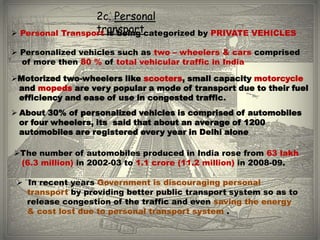
 Personal Transport is being categorized by PRIVATE VEHICLES

 Personalized vehicles such as two – wheelers & cars comprised
  of more then 80 % of total vehicular traffic in India

Motorized two-wheelers like scooters, small capacity motorcycle
 and mopeds are very popular a mode of transport due to their fuel
 efficiency and ease of use in congested traffic.
 About 30% of personalized vehicles is comprised of automobiles
  or four wheelers, its said that about an average of 1200
  automobiles are registered every year in Delhi alone

The number of automobiles produced in India rose from 63 lakh
 (6.3 million) in 2002-03 to 1.1 crore (11.2 million) in 2008-09.

  In recent years Government is discouraging personal
   transport by providing better public transport system so as to
   release congestion of the traffic and even saving the energy
   & cost lost due to personal transport system .
2d. Long distance transport (Indian Railways)
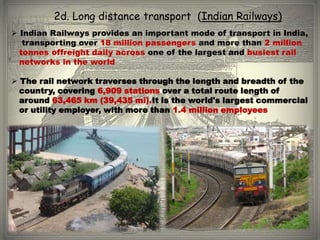
 Indian Railways provides an important mode of transport in India,
   transporting over 18 million passengers and more than 2 million
  tonnes offreight daily across one of the largest and busiest rail
  networks in the world

 The rail network traverses through the length and breadth of the
  country, covering 6,909 stations over a total route length of
  around 63,465 km (39,435 mi).It is the world's largest commercial
  or utility employer, with more than 1.4 million employees
2e. Long distance transport (Air
           Ways)
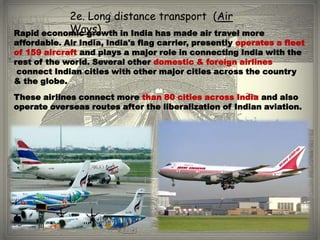
Rapid economic growth in India has made air travel more
affordable. Air India, India's flag carrier, presently operates a fleet
of 159 aircraft and plays a major role in connecting India with the
rest of the world. Several other domestic & foreign airlines
 connect Indian cities with other major cities across the country
& the globe.
These airlines connect more than 80 cities across India and also
operate overseas routes after the liberalization of Indian aviation.
5. Long distance transport (water Ways ,
         Oceans)
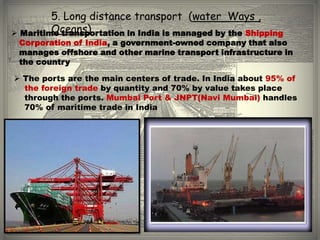
 Maritime transportation in India is managed by the Shipping
 Corporation of India, a government-owned company that also
 manages offshore and other marine transport infrastructure in
 the country

 The ports are the main centers of trade. In India about 95% of
  the foreign trade by quantity and 70% by value takes place
  through the ports. Mumbai Port & JNPT(Navi Mumbai) handles
  70% of maritime trade in India
2f. Long distance transport (water Ways ,
          Rivers)
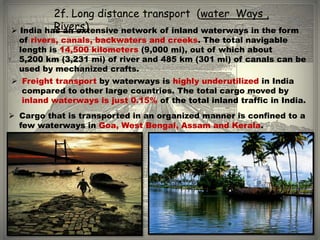
 India has an extensive network of inland waterways in the form
  of rivers, canals, backwaters and creeks. The total navigable
  length is 14,500 kilometers (9,000 mi), out of which about
  5,200 km (3,231 mi) of river and 485 km (301 mi) of canals can be
  used by mechanized crafts.
 Freight transport by waterways is highly underutilized in India
  compared to other large countries. The total cargo moved by
  inland waterways is just 0.15% of the total inland traffic in India.
 Cargo that is transported in an organized manner is confined to a
  few waterways in Goa, West Bengal, Assam and Kerala.
3. Byproduct of Transportation (air pollution)
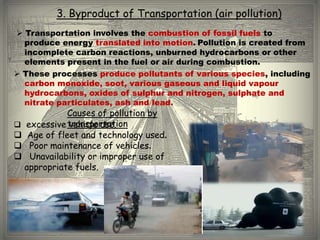
 Transportation involves the combustion of fossil fuels to
  produce energy translated into motion. Pollution is created from
  incomplete carbon reactions, unburned hydrocarbons or other
  elements present in the fuel or air during combustion.
 These processes produce pollutants of various species, including
  carbon monoxide, soot, various gaseous and liquid vapour
  hydrocarbons, oxides of sulphur and nitrogen, sulphate and
  nitrate particulates, ash and lead.
            Causes of pollution by
 excessive transportation
            vehicle use.
 Age of fleet and technology used.
 Poor maintenance of vehicles.
 Unavailability or improper use of
  appropriate fuels.
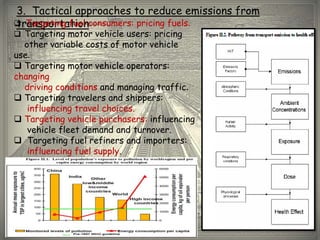
3. Tactical approaches to reduce emissions from
transportation
 Targeting fuel consumers: pricing fuels.
 Targeting motor vehicle users: pricing
  other variable costs of motor vehicle
use.
 Targeting motor vehicle operators:
changing
  driving conditions and managing traffic.
 Targeting travelers and shippers:
   influencing travel choices.
 Targeting vehicle purchasers: influencing
   vehicle fleet demand and turnover.
 Targeting fuel refiners and importers:
   influencing fuel supply.
 Targeting the general public: influencing
   public attitudes towards transportation.
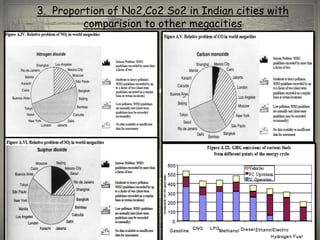
3. Proportion of No2,Co2 So2 in Indian cities with
         comparision to other megacities
3b. Byproduct of Transportation (Sound
        pollution)
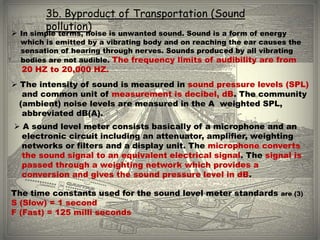
 In simple terms, noise is unwanted sound. Sound is a form of energy
  which is emitted by a vibrating body and on reaching the ear causes the
  sensation of hearing through nerves. Sounds produced by all vibrating
  bodies are not audible. The frequency limits of audibility are from
  20 HZ to 20,000 HZ.
 The intensity of sound is measured in sound pressure levels (SPL)
   and common unit of measurement is decibel, dB. The community
  (ambient) noise levels are measured in the A weighted SPL,
   abbreviated dB(A).
 A sound level meter consists basically of a microphone and an
  electronic circuit including an attenuator, amplifier, weighting
  networks or filters and a display unit. The microphone converts
  the sound signal to an equivalent electrical signal. The signal is
  passed through a weighting network which provides a
  conversion and gives the sound pressure level in dB.

The time constants used for the sound level meter standards        are (3)
S (Slow) = 1 second
F (Fast) = 125 milli seconds
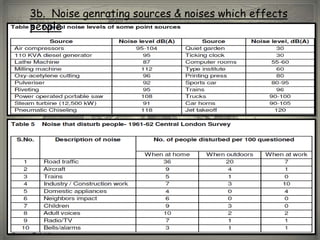
3b. Noise genrating sources & noises which effects
people
Effect of noise pollution on the environment & on
                        human’s health
 It creates annoyance to the receptors due to sound level fluctuations.
   The a periodic sound due to its irregular occurrences causes displeasure to
hearing
   and causes annoyance.
 Physiological effects: The physiological features like breathing amplitude,
blood
    pressure, heart-beat rate, pulse rate, blood cholesterol are effected.
 Loss of hearing: Long exposure to high sound levels cause loss of hearing.
This is
    mostly unnoticed, but has an adverse impact on hearing function.
 Human performance: The working performance of workers/human will be
affected
   as they'll be losing their concentration.
 Nervous system: It causes pain, ringing in the ears, feeling of tiredness,
thereby
 Sleeplessness:functioning of human system. by inducing the people to
   effecting the It affects the sleeping there
become
   restless and loose concentration and presence of mind during their
  Damage to material : The buildings and materials may get damaged by
activities
 exposure to
    infrasonic / ultrasonic waves and even get collapsed.
Bibliography : ----


 Transport of India Wikipedia & Encyclopedia
 Google
 Pollution control act


                     Thanking You

Transportation system

  • 2.
    CONTENTS :- TRANSPORTATION SYSTEM OF INDIA 1) INTTRODUCTION 2) TYPES/MODES OF TRANSPORTATIONS a). Traditional means b). Local/Public transport c). Personal Transport d). Long distance transports e). Water ways f). Air ways 3) BY PRODUCTS OF TRANSPORTATION a). Air pollution b). Water pollution c). Noise pollution
  • 3.
    INTRODUCTIO N Development of infrastructure within the country has progressed at a rapid pace, and today there is a WIDE VARIETY OF MODES OF TRANSPORT by land, water and air. Despite ongoing improvements in the sector, several aspects of the transport sector are still riddled with problems due to OUTDATED INFRASTRUCTURE and lack of PROPER MAINTEANENCE & thus it’s lead towards a BY-PRODUCT call POLLUTION The advent of the British saw trams Modes of transports being introduced in many cities including Mumbai and Kolkata. Traditional means They are still in use in Kolkata and provide an  Walking emission-free means of transport. Due to Palanquin technologically backward system & Bullock carts & palanquin more emphasis given to horse carriages other modes of transportation is the Bicycles & Rickshaws reason not being successful in our Trams Trams Active Only In Kolkata Bullock Carts country
  • 4.
    2b. Local/public transports  Public transport is the predominant mode of MOTORIZED LOCAL TRAVEL in cities. Mostly dominated through road ways.  Dedicated city bus services are known to operate in at least 25 cities with a population of over one million.  Intermediate public transport modes like tempos and cycle rickshaws assume importance in medium size cities. However, the share of buses is negligible in most is a Depending on therickshaw Indian cities as An auto city/state, taxis can compared to personalized vehicles, and two-wheelers and cars three-wheeler vehicle account for more than 80 percenthailed that has no either befor hire or of the vehicle population hired from taxi-and is generally doors stands,even it could characterised by a be done on streets. for the small cabin Today we couldin the front and a driver even hire taxi’s by making seat for passengers in a phone call.rear. the T In Delhi due to Buses take up over 90% of public transportexcessive air pollution in Indian cities, and serve as a cheap and CNG are introduced convenient mode of transport for all classes of society. Services are mostly run by state government owned transport corporations.
  • 5.
    2b. Local/public (Rapidtransport system) Today with increase in the periphery of an city ,technologies to reduce the time interval for covering the distance are being introduced with RAPID TRANSIT SYSTEMS, such as :---  Kolkata metro Delhi  Delhi metro metro  Chennai mass rapid transit system  Ahmadabad (BRTS)  Mumbai locals (RTS, is to be introduced in all the major cities of Indial uptill Mumbai locals 2021) Ahmadabad (BRTS) Chennai mass transit system
  • 6.
    2c. Personal transport  Personal Transport is being categorized by PRIVATE VEHICLES  Personalized vehicles such as two – wheelers & cars comprised of more then 80 % of total vehicular traffic in India Motorized two-wheelers like scooters, small capacity motorcycle and mopeds are very popular a mode of transport due to their fuel efficiency and ease of use in congested traffic.  About 30% of personalized vehicles is comprised of automobiles or four wheelers, its said that about an average of 1200 automobiles are registered every year in Delhi alone The number of automobiles produced in India rose from 63 lakh (6.3 million) in 2002-03 to 1.1 crore (11.2 million) in 2008-09.  In recent years Government is discouraging personal transport by providing better public transport system so as to release congestion of the traffic and even saving the energy & cost lost due to personal transport system .
  • 7.
    2d. Long distancetransport (Indian Railways)  Indian Railways provides an important mode of transport in India, transporting over 18 million passengers and more than 2 million tonnes offreight daily across one of the largest and busiest rail networks in the world  The rail network traverses through the length and breadth of the country, covering 6,909 stations over a total route length of around 63,465 km (39,435 mi).It is the world's largest commercial or utility employer, with more than 1.4 million employees
  • 8.
    2e. Long distancetransport (Air Ways) Rapid economic growth in India has made air travel more affordable. Air India, India's flag carrier, presently operates a fleet of 159 aircraft and plays a major role in connecting India with the rest of the world. Several other domestic & foreign airlines connect Indian cities with other major cities across the country & the globe. These airlines connect more than 80 cities across India and also operate overseas routes after the liberalization of Indian aviation.
  • 9.
    5. Long distancetransport (water Ways , Oceans)  Maritime transportation in India is managed by the Shipping Corporation of India, a government-owned company that also manages offshore and other marine transport infrastructure in the country  The ports are the main centers of trade. In India about 95% of the foreign trade by quantity and 70% by value takes place through the ports. Mumbai Port & JNPT(Navi Mumbai) handles 70% of maritime trade in India
  • 10.
    2f. Long distancetransport (water Ways , Rivers)  India has an extensive network of inland waterways in the form of rivers, canals, backwaters and creeks. The total navigable length is 14,500 kilometers (9,000 mi), out of which about 5,200 km (3,231 mi) of river and 485 km (301 mi) of canals can be used by mechanized crafts.  Freight transport by waterways is highly underutilized in India compared to other large countries. The total cargo moved by inland waterways is just 0.15% of the total inland traffic in India.  Cargo that is transported in an organized manner is confined to a few waterways in Goa, West Bengal, Assam and Kerala.
  • 11.
    3. Byproduct ofTransportation (air pollution)  Transportation involves the combustion of fossil fuels to produce energy translated into motion. Pollution is created from incomplete carbon reactions, unburned hydrocarbons or other elements present in the fuel or air during combustion.  These processes produce pollutants of various species, including carbon monoxide, soot, various gaseous and liquid vapour hydrocarbons, oxides of sulphur and nitrogen, sulphate and nitrate particulates, ash and lead. Causes of pollution by  excessive transportation vehicle use.  Age of fleet and technology used.  Poor maintenance of vehicles.  Unavailability or improper use of appropriate fuels.
  • 12.
    3. Tactical approachesto reduce emissions from transportation  Targeting fuel consumers: pricing fuels.  Targeting motor vehicle users: pricing other variable costs of motor vehicle use.  Targeting motor vehicle operators: changing driving conditions and managing traffic.  Targeting travelers and shippers: influencing travel choices.  Targeting vehicle purchasers: influencing vehicle fleet demand and turnover.  Targeting fuel refiners and importers: influencing fuel supply.  Targeting the general public: influencing public attitudes towards transportation.
  • 13.
    3. Proportion ofNo2,Co2 So2 in Indian cities with comparision to other megacities
  • 14.
    3b. Byproduct ofTransportation (Sound pollution)  In simple terms, noise is unwanted sound. Sound is a form of energy which is emitted by a vibrating body and on reaching the ear causes the sensation of hearing through nerves. Sounds produced by all vibrating bodies are not audible. The frequency limits of audibility are from 20 HZ to 20,000 HZ.  The intensity of sound is measured in sound pressure levels (SPL) and common unit of measurement is decibel, dB. The community (ambient) noise levels are measured in the A weighted SPL, abbreviated dB(A).  A sound level meter consists basically of a microphone and an electronic circuit including an attenuator, amplifier, weighting networks or filters and a display unit. The microphone converts the sound signal to an equivalent electrical signal. The signal is passed through a weighting network which provides a conversion and gives the sound pressure level in dB. The time constants used for the sound level meter standards are (3) S (Slow) = 1 second F (Fast) = 125 milli seconds
  • 15.
    3b. Noise genratingsources & noises which effects people
  • 16.
    Effect of noisepollution on the environment & on human’s health  It creates annoyance to the receptors due to sound level fluctuations. The a periodic sound due to its irregular occurrences causes displeasure to hearing and causes annoyance.  Physiological effects: The physiological features like breathing amplitude, blood pressure, heart-beat rate, pulse rate, blood cholesterol are effected.  Loss of hearing: Long exposure to high sound levels cause loss of hearing. This is mostly unnoticed, but has an adverse impact on hearing function.  Human performance: The working performance of workers/human will be affected as they'll be losing their concentration.  Nervous system: It causes pain, ringing in the ears, feeling of tiredness, thereby  Sleeplessness:functioning of human system. by inducing the people to effecting the It affects the sleeping there become restless and loose concentration and presence of mind during their  Damage to material : The buildings and materials may get damaged by activities exposure to infrasonic / ultrasonic waves and even get collapsed.
  • 17.
    Bibliography : ---- Transport of India Wikipedia & Encyclopedia  Google  Pollution control act Thanking You