

Transporting and Handling of
Concrete
CONSTRUCTION PLANNING AND MANAGEMENT
Presented By
AMAN KUMAR GUNSAGAR RAJPOOT SUMIT KUMAR
NANDAN
Modern demands on the transporting and handling of concrete
have imposed a wide variety of requirements on the operations
needed, and the methods and equipment that have been
developed are many. A wide variety of equipment has been
designed to satisfy these and other requirements. Concrete
handling operations now employ such diverse equipment as
trucks, hoopers, and chutes, wheelbarrows and carts operated
over runways, buckets lifted by crane, tower hoist, or cableway,
belt conveyors, pumps, and in special cases rail cars, helicopters
and boats or barges.
Requirement of Concrete Transporting
and handling
Transporting and Handling
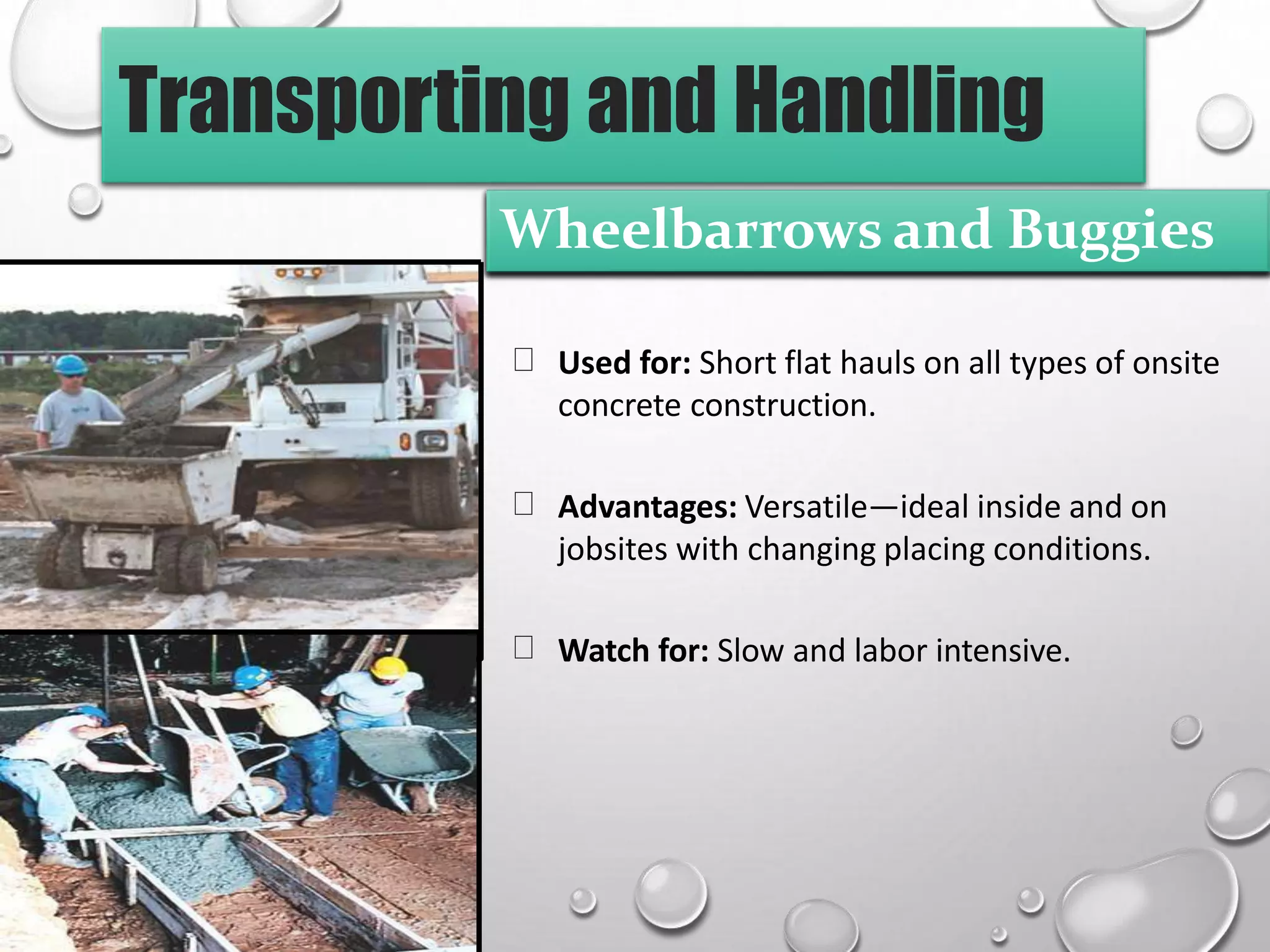
Used for: Short flat hauls on all types of onsite
concrete construction.
Advantages: Versatile—ideal inside and on
jobsites with changing placing conditions.
Watch for: Slow and labor intensive.
Wheelbarrows and Buggies
Transporting and Handling
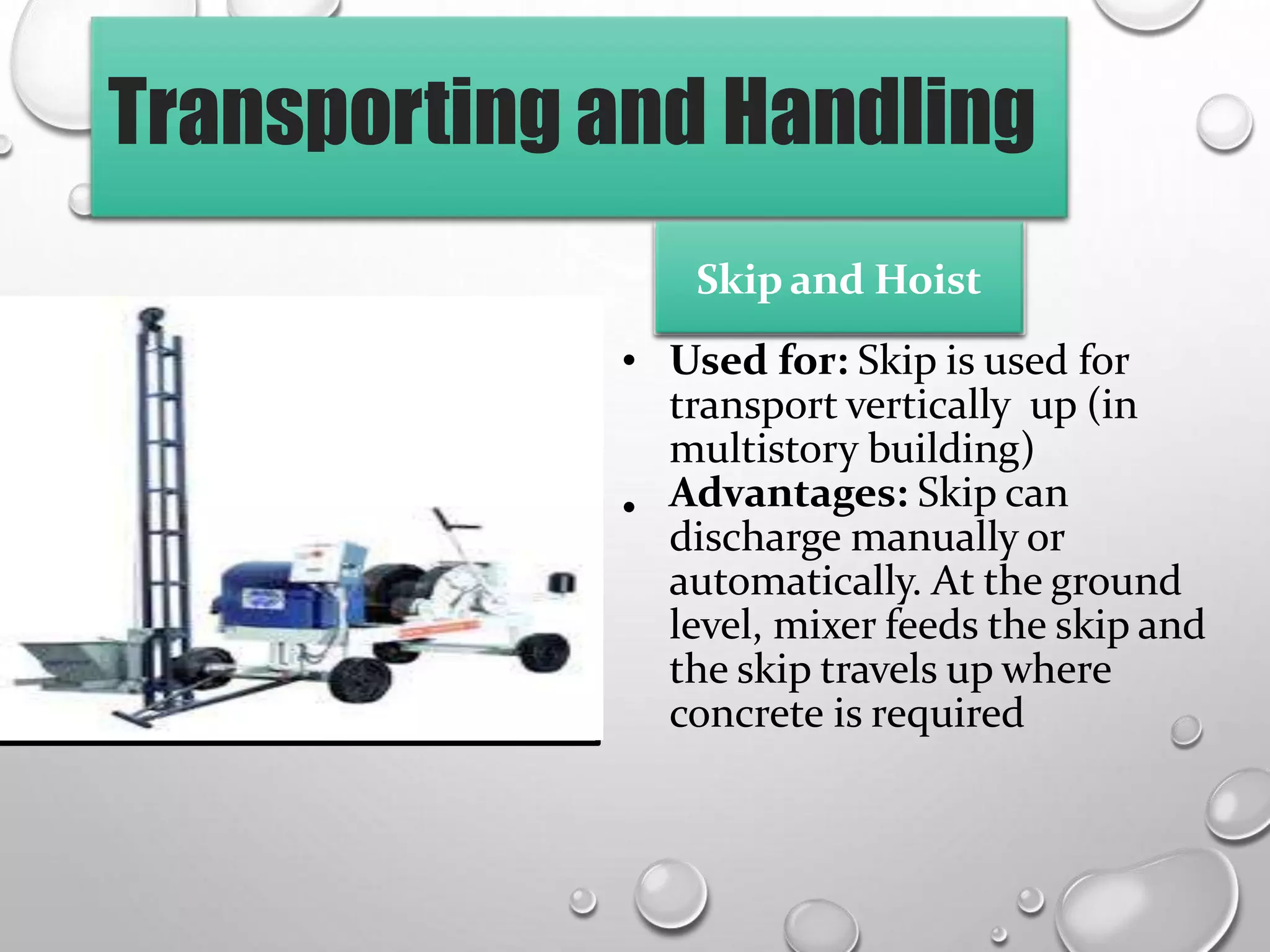
• Used for: Skip is used for
transport vertically up (in
multistory building)
Advantages: Skip can
discharge manually or
automatically. At the ground
level, mixer feeds the skip and
the skip travels up where
concrete is required
•
Skip and Hoist
Transporting and Handling
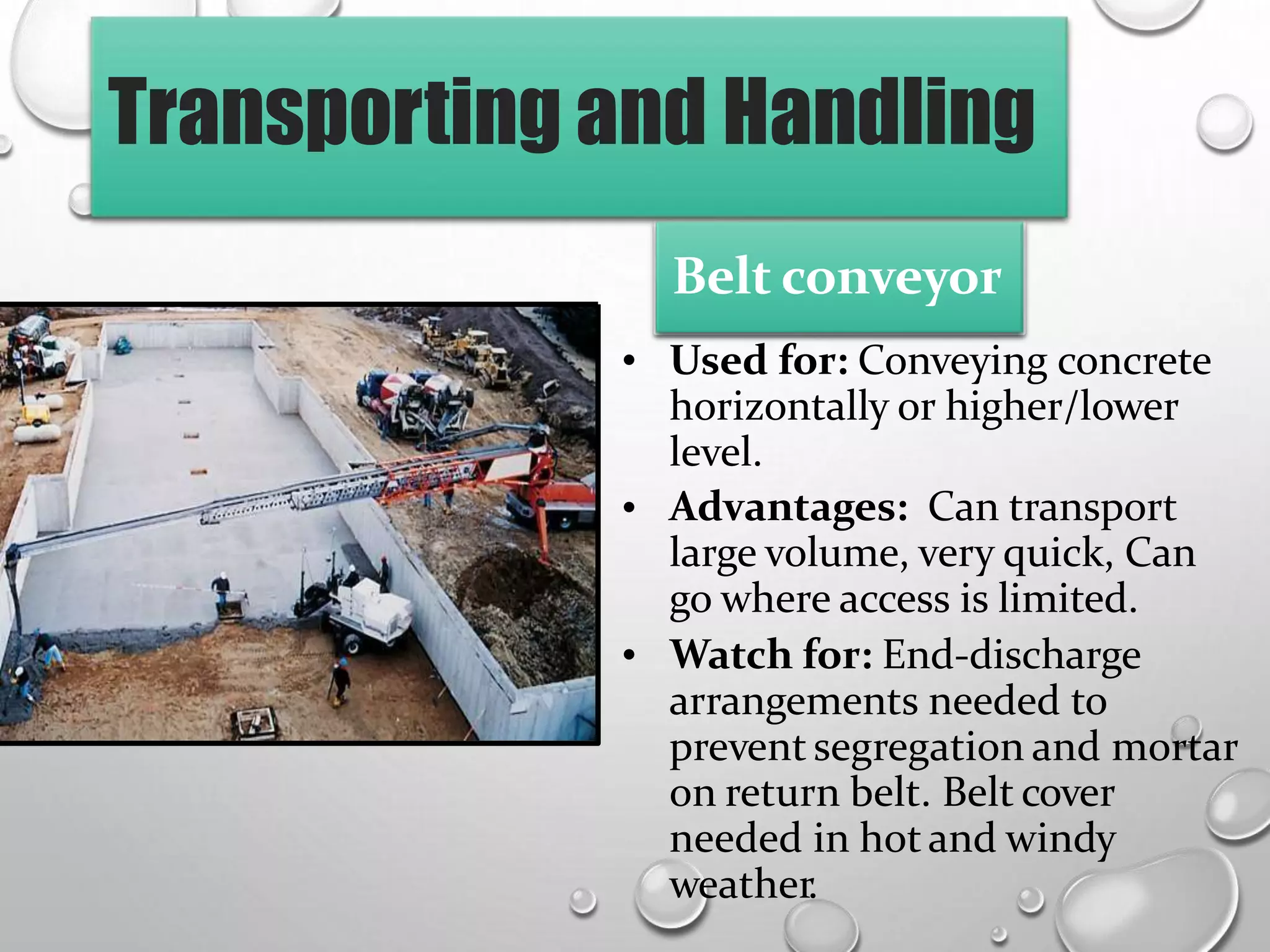
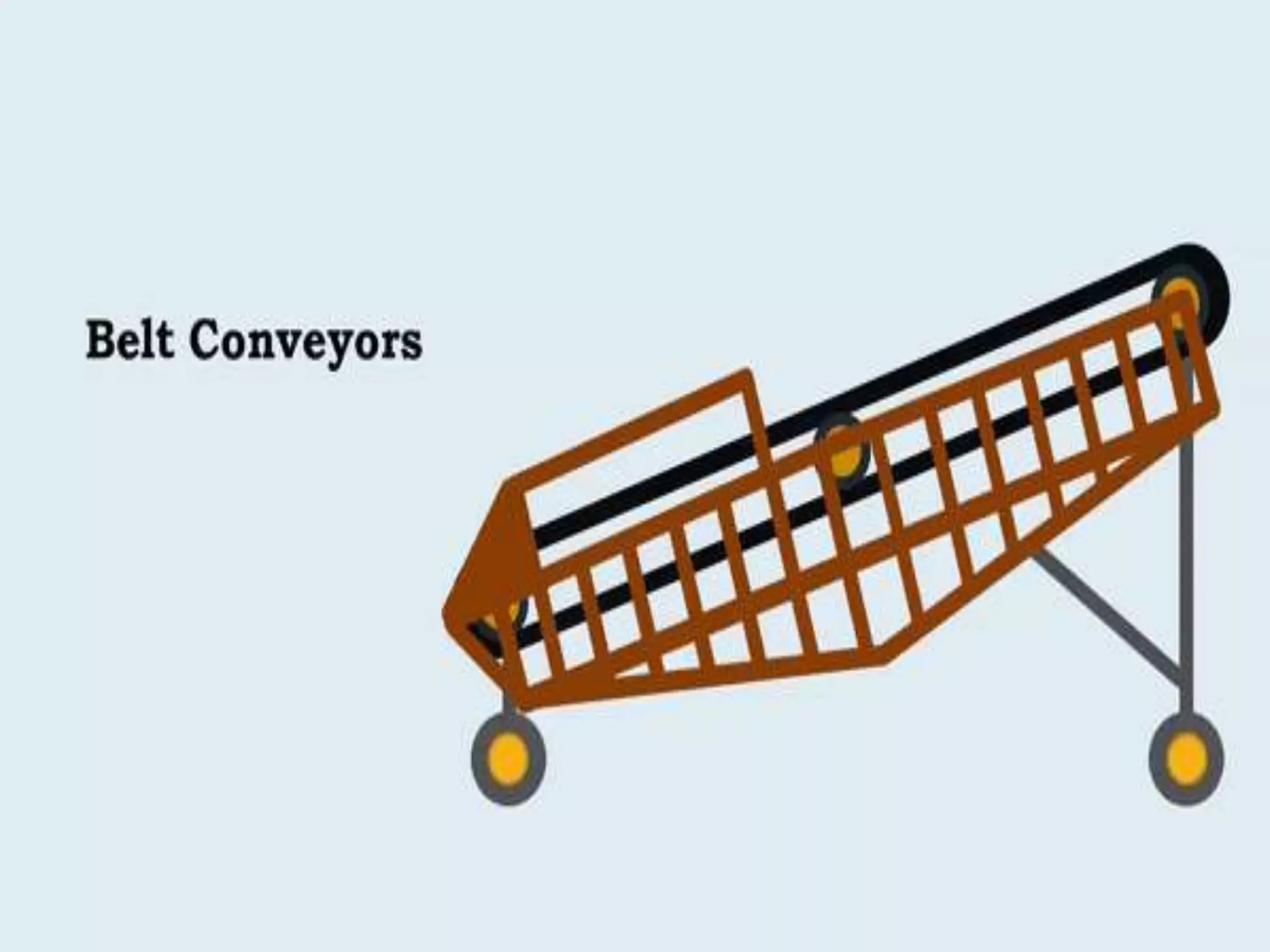
• Used for: Conveying concrete
horizontally or higher/lower
level.
Advantages: Can transport
large volume, very quick, Can
go where access is limited.
Watch for: End-discharge
arrangements needed to
prevent segregation and mortar
on return belt. Belt cover
needed in hot and windy
weather.
•
•
Belt conveyor
Transporting and Handling
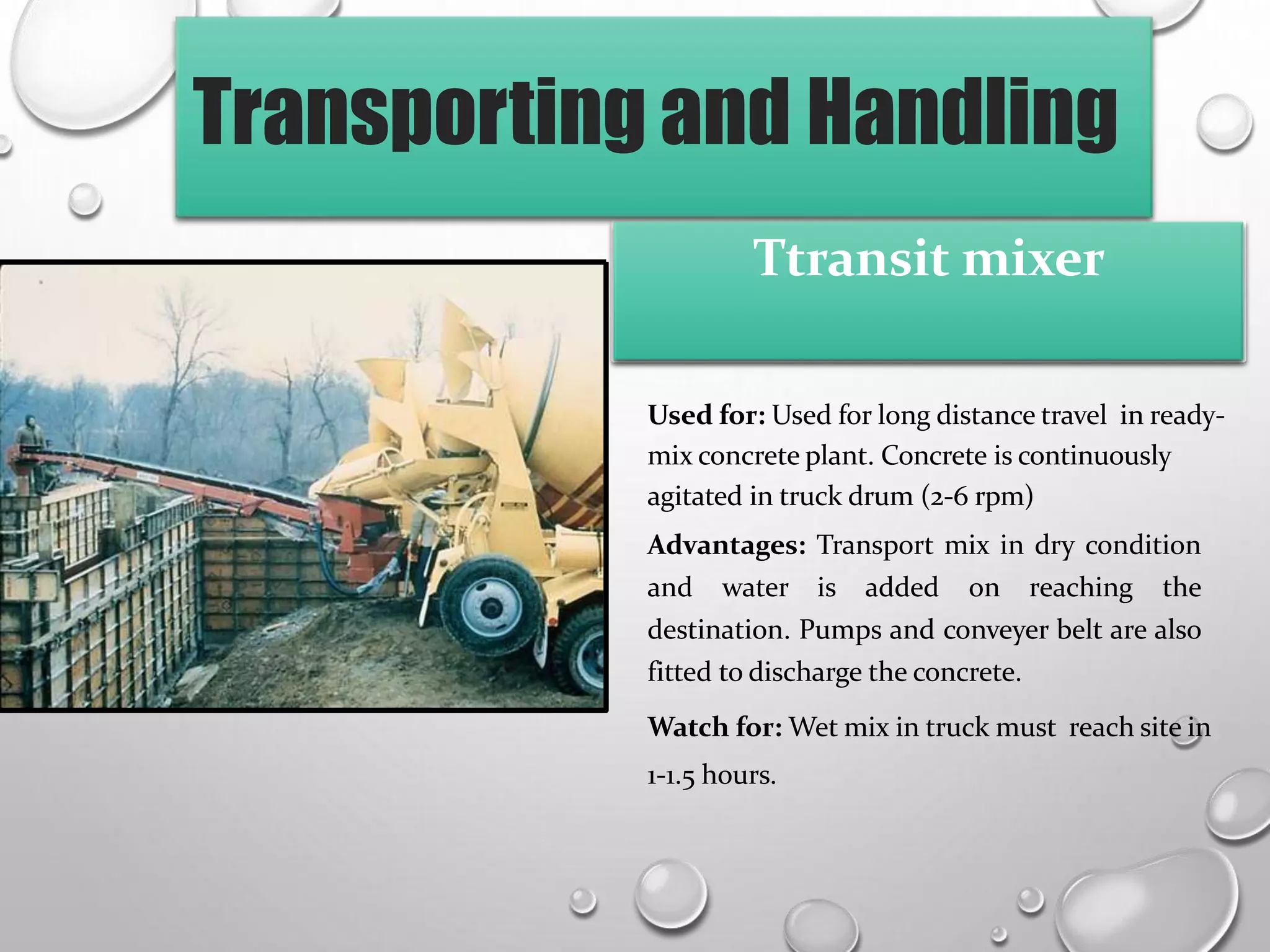
Used for: Used for long distance travel in ready-
mix concrete plant. Concrete is continuously
agitated in truck drum (2-6 rpm)
Advantages: Transport mix in dry condition
and water is added on reaching the
destination. Pumps and conveyer belt are also
fitted to discharge the concrete.
Watch for: Wet mix in truck must reach site in
1-1.5 hours.
Ttransit mixer
Transporting and Handling
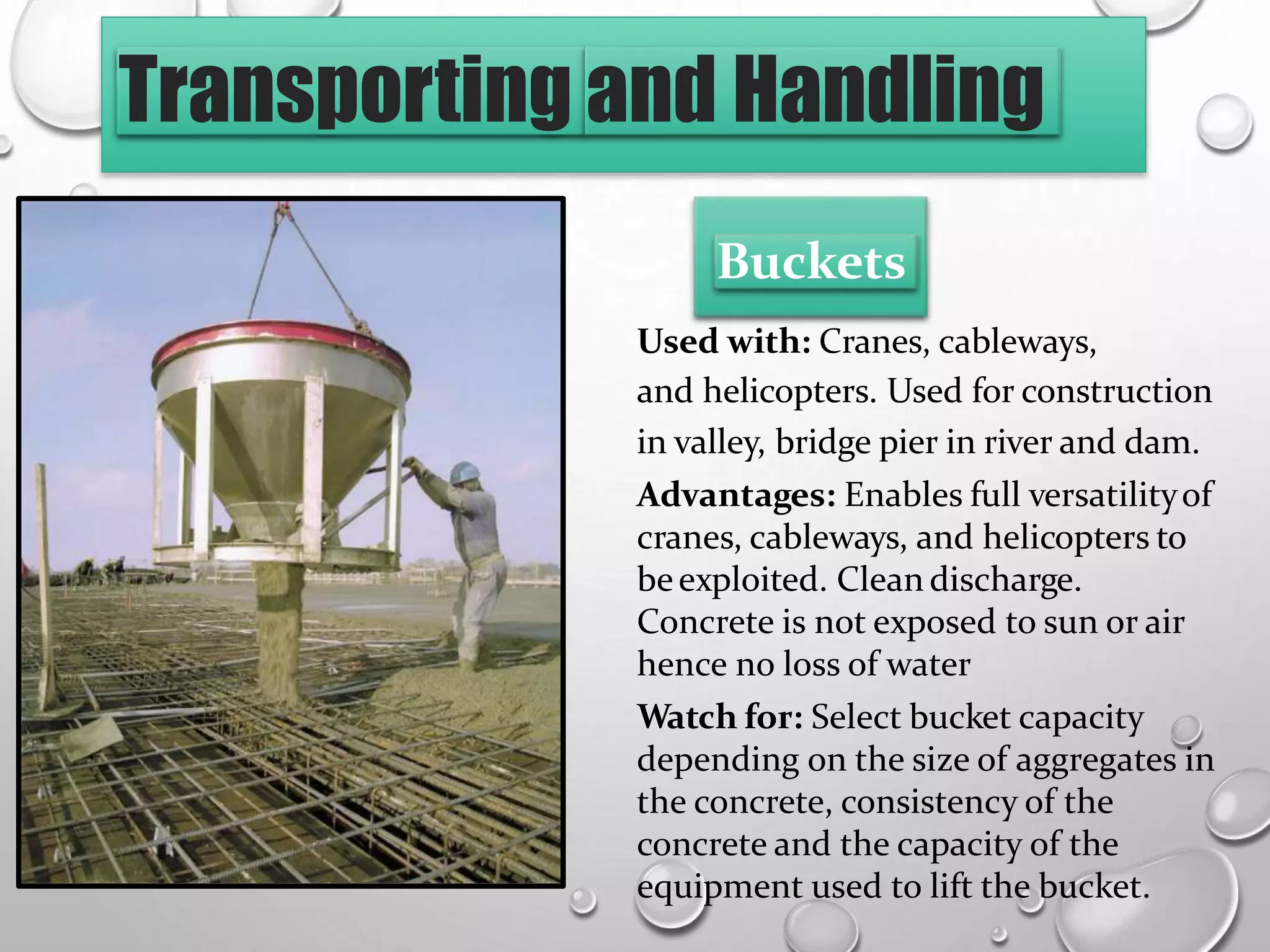
Buckets
Used with: Cranes, cableways,
and helicopters. Used for construction
in valley, bridge pier in river and dam.
Advantages: Enables full versatilityof
cranes, cableways, and helicopters to
beexploited. Clean discharge.
Concrete is not exposed to sun or air
hence no loss of water
Watch for: Select bucket capacity
depending on the size of aggregates in
the concrete, consistency of the
concrete and the capacity of the
equipment used to lift the bucket.
Transporting and Handling
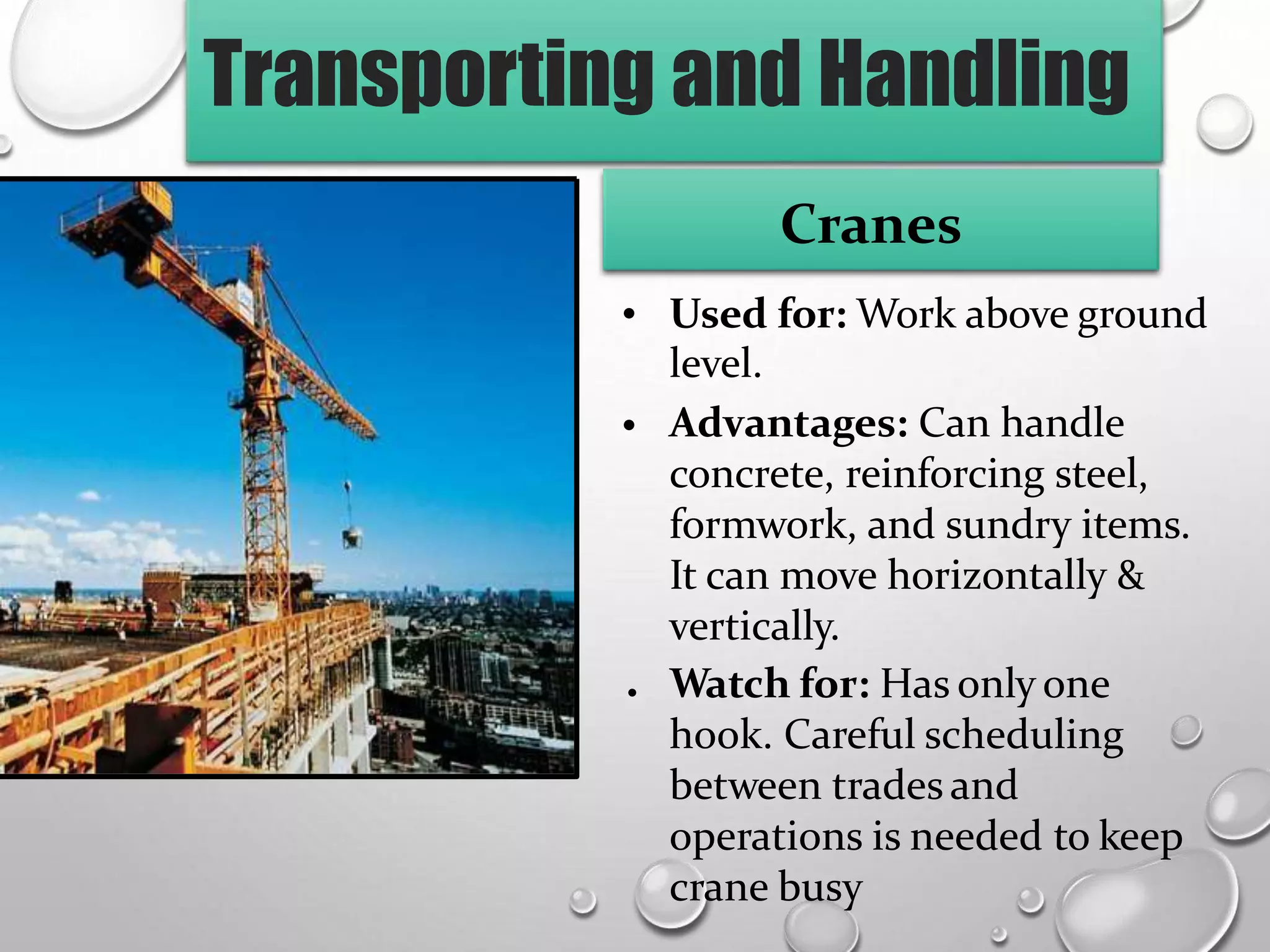
Cranes
• Used for: Work above ground
level.
Advantages: Can handle
concrete, reinforcing steel,
formwork, and sundry items.
It can move horizontally &
vertically.
Watch for: Has only one
hook. Careful scheduling
between trades and
operations is needed to keep
crane busy
•
•
Transporting and Handling
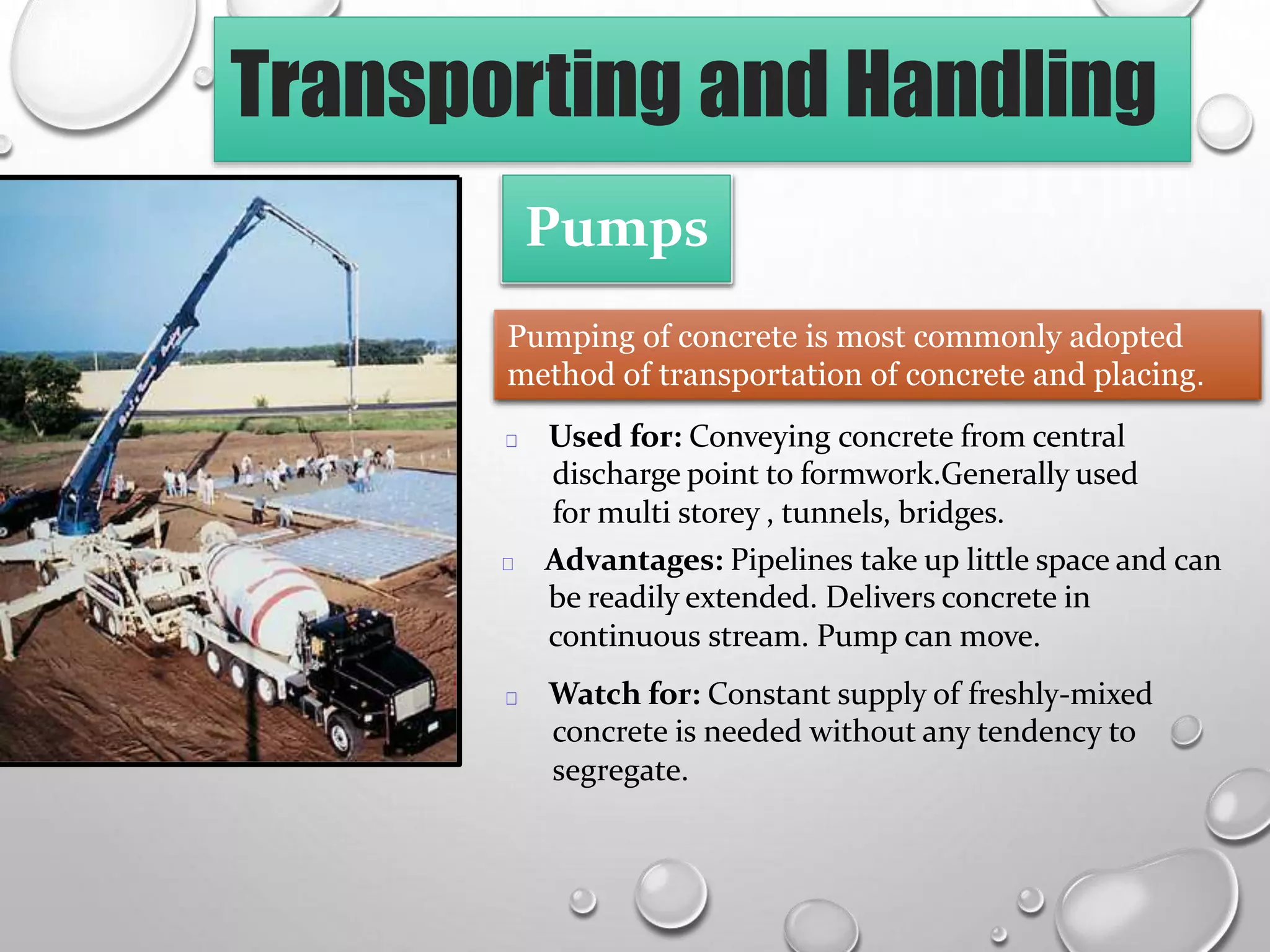
Used for: Conveying concrete from central
discharge point to formwork.Generally used
for multi storey , tunnels, bridges.
Advantages: Pipelines take up little space and can
be readily extended. Delivers concrete in
continuous stream. Pump can move.
Watch for: Constant supply of freshly-mixed
concrete is needed without any tendency to
segregate.
Pumps
Pumping of concrete is most commonly adopted
method of transportation of concrete and placing.
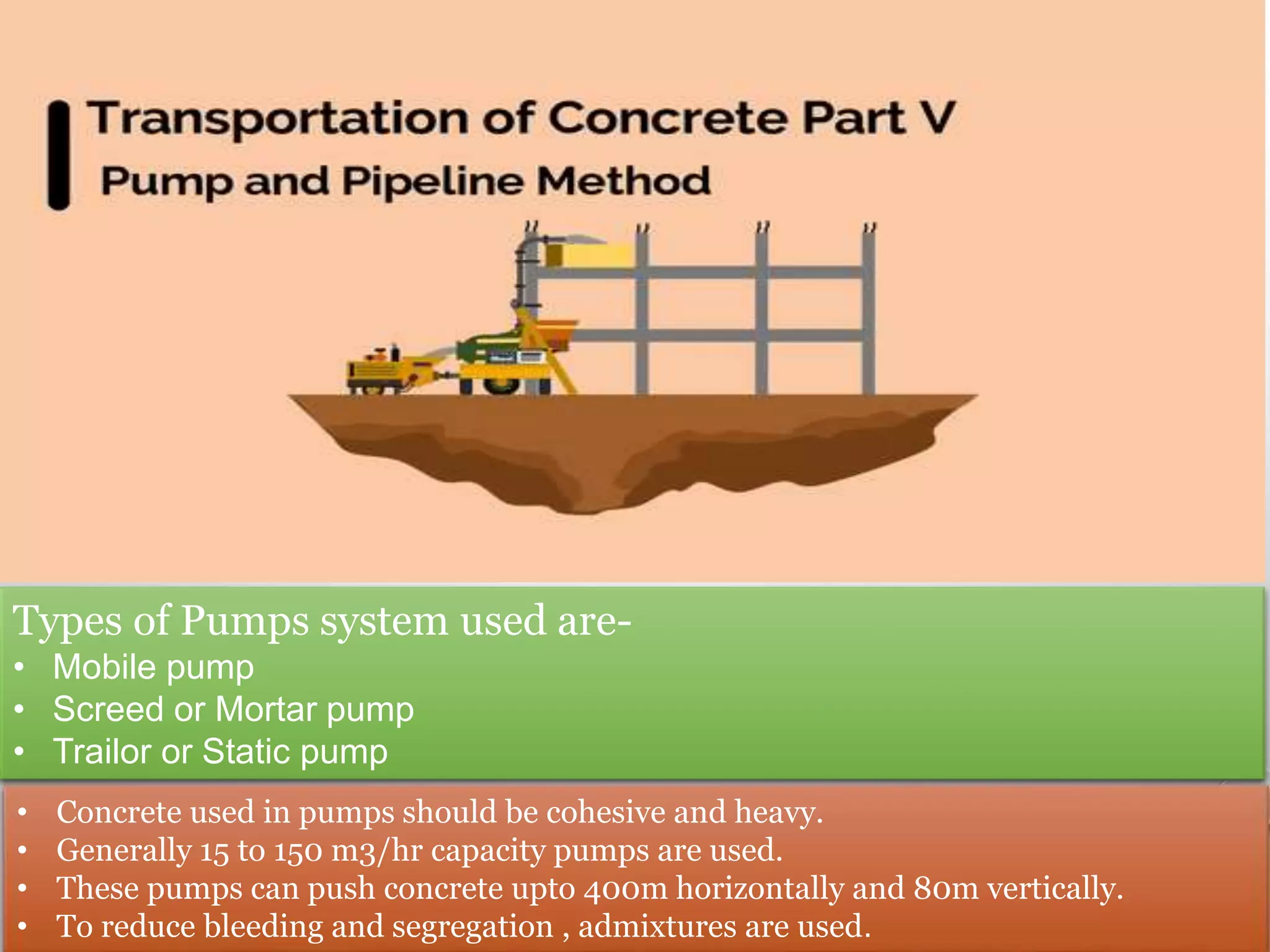
Types of Pumps system used are-
• Mobile pump
• Screed or Mortar pump
• Trailor or Static pump
• Concrete used in pumps should be cohesive and heavy.
• Generally 15 to 150 m3/hr capacity pumps are used.
• These pumps can push concrete upto 400m horizontally and 80m vertically.
• To reduce bleeding and segregation , admixtures are used.
Transporting and Handling
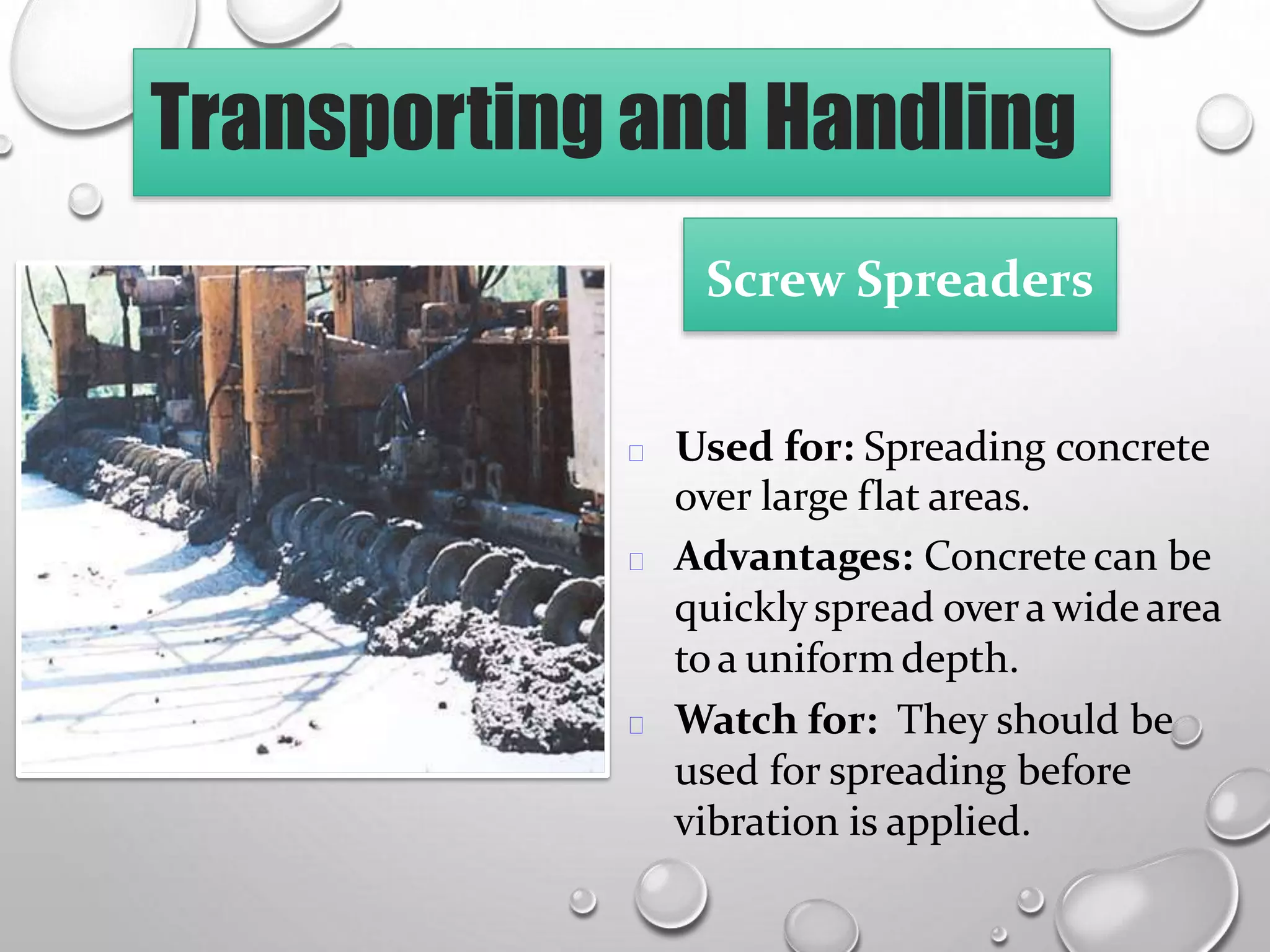
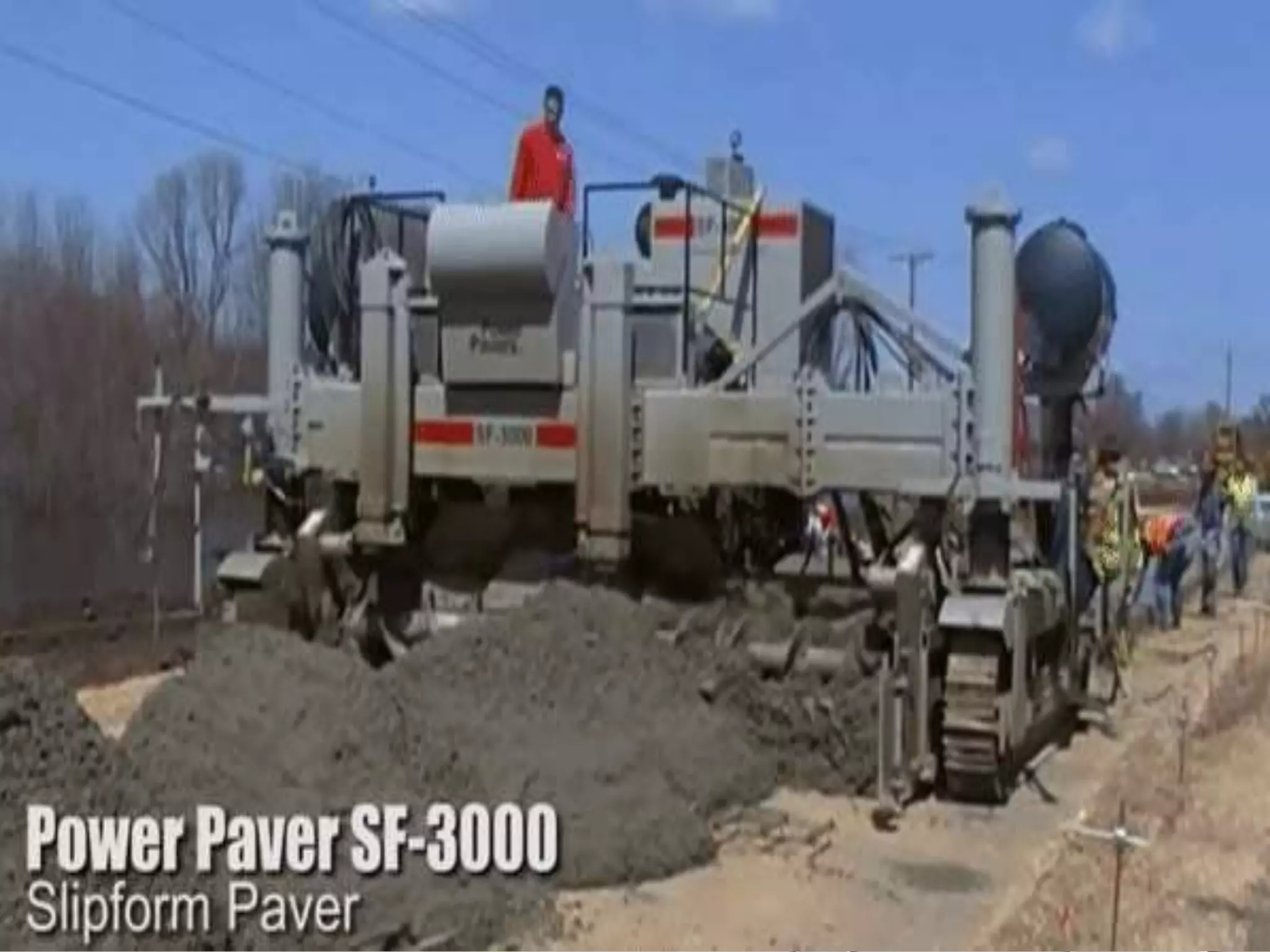
Screw Spreaders
Used for: Spreading concrete
over large flat areas.
Advantages: Concrete can be
quicklyspread overawide area
toa uniform depth.
Watch for: They should be
used for spreading before
vibration is applied.
Transporting and handling of concrete (construction planning and management)

Transporting and handling of concrete (construction planning and management)

  • 1.
    Transporting and Handlingof Concrete CONSTRUCTION PLANNING AND MANAGEMENT Presented By AMAN KUMAR GUNSAGAR RAJPOOT SUMIT KUMAR NANDAN
  • 2.
    Modern demands onthe transporting and handling of concrete have imposed a wide variety of requirements on the operations needed, and the methods and equipment that have been developed are many. A wide variety of equipment has been designed to satisfy these and other requirements. Concrete handling operations now employ such diverse equipment as trucks, hoopers, and chutes, wheelbarrows and carts operated over runways, buckets lifted by crane, tower hoist, or cableway, belt conveyors, pumps, and in special cases rail cars, helicopters and boats or barges. Requirement of Concrete Transporting and handling
  • 3.
    Transporting and Handling Usedfor: Short flat hauls on all types of onsite concrete construction. Advantages: Versatile—ideal inside and on jobsites with changing placing conditions. Watch for: Slow and labor intensive. Wheelbarrows and Buggies
  • 5.
    Transporting and Handling •Used for: Skip is used for transport vertically up (in multistory building) Advantages: Skip can discharge manually or automatically. At the ground level, mixer feeds the skip and the skip travels up where concrete is required • Skip and Hoist
  • 6.
    Transporting and Handling •Used for: Conveying concrete horizontally or higher/lower level. Advantages: Can transport large volume, very quick, Can go where access is limited. Watch for: End-discharge arrangements needed to prevent segregation and mortar on return belt. Belt cover needed in hot and windy weather. • • Belt conveyor
  • 8.
    Transporting and Handling Usedfor: Used for long distance travel in ready- mix concrete plant. Concrete is continuously agitated in truck drum (2-6 rpm) Advantages: Transport mix in dry condition and water is added on reaching the destination. Pumps and conveyer belt are also fitted to discharge the concrete. Watch for: Wet mix in truck must reach site in 1-1.5 hours. Ttransit mixer
  • 9.
    Transporting and Handling Buckets Usedwith: Cranes, cableways, and helicopters. Used for construction in valley, bridge pier in river and dam. Advantages: Enables full versatilityof cranes, cableways, and helicopters to beexploited. Clean discharge. Concrete is not exposed to sun or air hence no loss of water Watch for: Select bucket capacity depending on the size of aggregates in the concrete, consistency of the concrete and the capacity of the equipment used to lift the bucket.
  • 10.
    Transporting and Handling Cranes •Used for: Work above ground level. Advantages: Can handle concrete, reinforcing steel, formwork, and sundry items. It can move horizontally & vertically. Watch for: Has only one hook. Careful scheduling between trades and operations is needed to keep crane busy • •
  • 11.
    Transporting and Handling Usedfor: Conveying concrete from central discharge point to formwork.Generally used for multi storey , tunnels, bridges. Advantages: Pipelines take up little space and can be readily extended. Delivers concrete in continuous stream. Pump can move. Watch for: Constant supply of freshly-mixed concrete is needed without any tendency to segregate. Pumps Pumping of concrete is most commonly adopted method of transportation of concrete and placing.
  • 12.
    Types of Pumpssystem used are- • Mobile pump • Screed or Mortar pump • Trailor or Static pump • Concrete used in pumps should be cohesive and heavy. • Generally 15 to 150 m3/hr capacity pumps are used. • These pumps can push concrete upto 400m horizontally and 80m vertically. • To reduce bleeding and segregation , admixtures are used.
  • 13.
    Transporting and Handling ScrewSpreaders Used for: Spreading concrete over large flat areas. Advantages: Concrete can be quicklyspread overawide area toa uniform depth. Watch for: They should be used for spreading before vibration is applied.