Driving to Driverless
Dr. ir. Gonçalo Homem de Almeida Rodriguez Correia
(Department of Transport & Planning, TU Delft)
g.correia@tudelft.nl
Facebook group: Transportation Planning and Analysis (>1250 members)
Challenges and opportunities for research on the impacts of
vehicle automation on urban mobility
2
Driving
to
Driverless
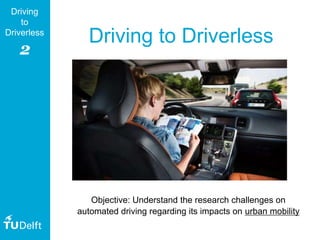
Driving to Driverless
Objective: Understand the research challenges on
automated driving regarding its impacts on urban mobility
3
Driving
to
Driverless
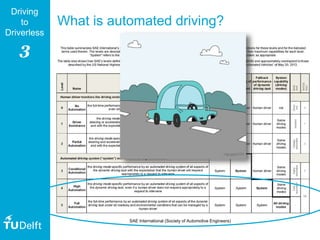
What is automated driving?
SAE International (Society of Automotive Engineers)
4
Driving
to
Driverless
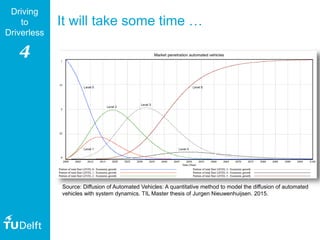
It will take some time …
Source: Diffusion of Automated Vehicles: A quantitative method to model the diffusion of automated
vehicles with system dynamics. TIL Master thesis of Jurgen Nieuwenhuijsen. 2015.
5
Driving
to
Driverless
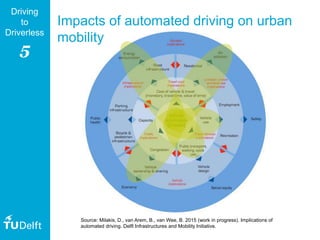
Source: Milakis, D., van Arem, B., van Wee, B. 2015 (work in progress). Implications of
automated driving. Delft Infrastructures and Mobility Initiative.
Impacts of automated driving on urban
mobility
6
Driving
to
Driverless
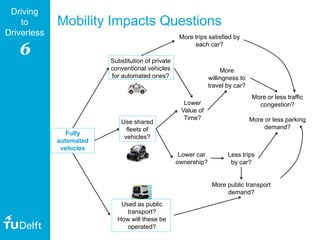
Mobility Impacts Questions
Fully
automated
vehicles
More
willingness to
travel by car?
Lower car
ownership?
Less trips
by car?
More public transport
demand?
More or less traffic
congestion?
More or less parking
demand?
Substitution of private
conventional vehicles
for automated ones?
Used as public
transport?
How will these be
operated?
Lower
Value of
Time?
More trips satisfied by
each car?
Use shared
fleets of
vehicles?
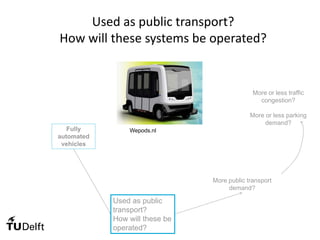
Used as public transport?
How will these systems be operated?
Wepods.nlFully
automated
vehicles
More public transport
demand?
More or less traffic
congestion?
More or less parking
demand?
Used as public
transport?
How will these be
operated?
8
Driving
to
Driverless
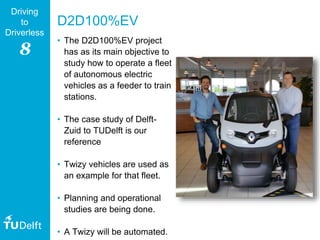
D2D100%EV
• The D2D100%EV project
has as its main objective to
study how to operate a fleet
of autonomous electric
vehicles as a feeder to train
stations.
• The case study of Delft-
Zuid to TUDelft is our
reference
• Twizy vehicles are used as
an example for that fleet.
• Planning and operational
studies are being done.
• A Twizy will be automated.
9
Driving
to
Driverless
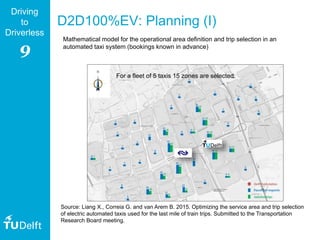
D2D100%EV: Planning (I)
Source: Liang X., Correia G. and van Arem B. 2015. Optimizing the service area and trip selection
of electric automated taxis used for the last mile of train trips. Submitted to the Transportation
Research Board meeting.
Mathematical model for the operational area definition and trip selection in an
automated taxi system (bookings known in advance)
For a fleet of 5 taxis 15 zones are selected:
10
Driving
to
Driverless
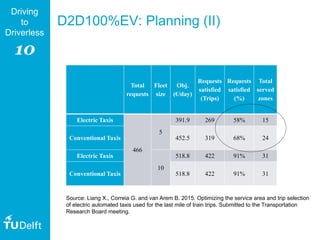
Total
requests
Fleet
size
Obj.
(€/day)
Requests
satisfied
(Trips)
Requests
satisfied
(%)
Total
served
zones
Electric Taxis
466
5
391.9 269 58% 15
Conventional Taxis 452.5 319 68% 24
Electric Taxis
10
518.8 422 91% 31
Conventional Taxis 518.8 422 91% 31
D2D100%EV: Planning (II)
Source: Liang X., Correia G. and van Arem B. 2015. Optimizing the service area and trip selection
of electric automated taxis used for the last mile of train trips. Submitted to the Transportation
Research Board meeting.
11
Driving
to
Driverless
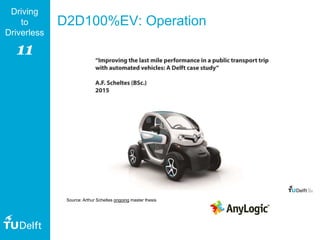
Source: Arthur Scheltes ongoing master thesis
D2D100%EV: Operation
12
Driving
to
Driverless
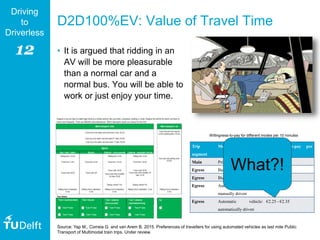
• It is argued that ridding in an
AV will be more pleasurable
than a normal car and a
normal bus. You will be able to
work or just enjoy your time.
D2D100%EV: Value of Travel Time
Trip
segment
Mode Willingness-to-pay per
10 minutes
Main Private car €1.80 - €1.90
Egress Bus/tram/metro €0.55 - €0.65
Egress Bicycle €1.45 - €1.55
Egress Automatic vehicle:
manually driven
€0.85 - €0.95
Egress Automatic vehicle:
automatically driven
€2.25 - €2.35
Willingness-to-pay for different modes per 10 minutes
What?!
Source: Yap M., Correia G. and van Arem B. 2015. Preferences of travellers for using automated vehicles as last mile Public
Transport of Multimodal train trips. Under review.
13
Driving
to
Driverless
WEpods project
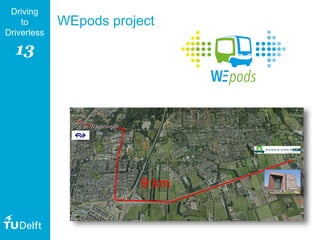
9 km
14
Driving
to
Driverless
WEpods project: Challenge
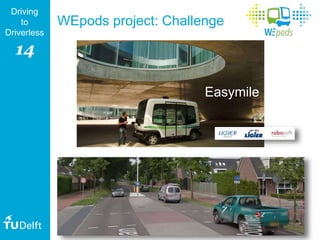
Easymile
15
Driving
to
Driverless
WEpods project: Scale up
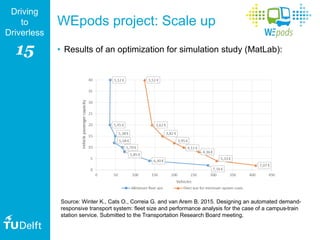
• Results of an optimization for simulation study (MatLab):
Source: Winter K., Cats O., Correia G. and van Arem B. 2015. Designing an automated demand-
responsive transport system: fleet size and performance analysis for the case of a campus-train
station service. Submitted to the Transportation Research Board meeting.
16
Driving
to
Driverless
WEpods project
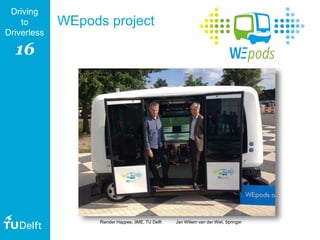
Riender Happee, 3ME, TU Delft Jan Willem van der Wiel, Springer
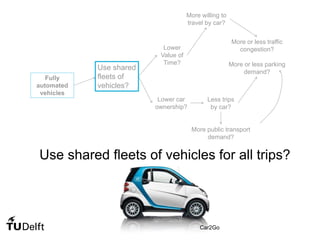
Use shared fleets of vehicles for all trips?
Car2Go
Fully
automated
vehicles
More willing to
travel by car?
Lower car
ownership?
Less trips
by car?
More public transport
demand?
More or less traffic
congestion?
More or less parking
demand?
Lower
Value of
Time?
Use shared
fleets of
vehicles?
18
Driving
to
Driverless
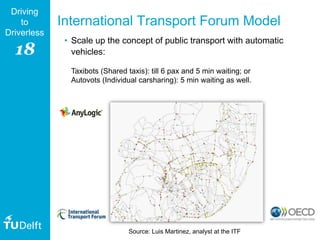
Source: Luis Martinez, analyst at the ITF
International Transport Forum Model
• Scale up the concept of public transport with automatic
vehicles:
Taxibots (Shared taxis): till 6 pax and 5 min waiting; or
Autovots (Individual carsharing): 5 min waiting as well.
19
Driving
to
Driverless
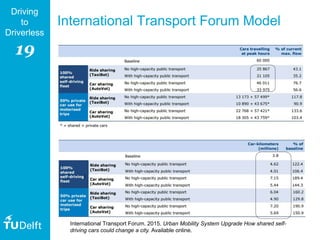
International Transport Forum Model
International Transport Forum. 2015. Urban Mobility System Upgrade How shared self-
driving cars could change a city. Available online.
20
Driving
to
Driverless
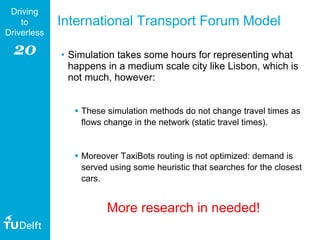
• Simulation takes some hours for representing what
happens in a medium scale city like Lisbon, which is
not much, however:
 These simulation methods do not change travel times as
flows change in the network (static travel times).
 Moreover TaxiBots routing is not optimized: demand is
served using some heuristic that searches for the closest
cars.
International Transport Forum Model
More research in needed!
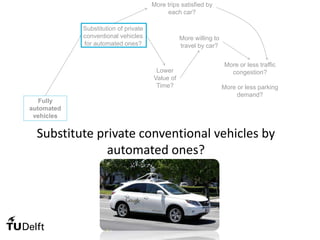
Substitute private conventional vehicles by
automated ones?
Fully
automated
vehicles
More willing to
travel by car?
More or less traffic
congestion?
More or less parking
demand?
Substitution of private
conventional vehicles
for automated ones?
Lower
Value of
Time?
More trips satisfied by
each car?
22
Driving
to
Driverless
Traffic Assignment + Routing Problem
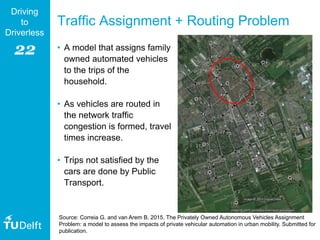
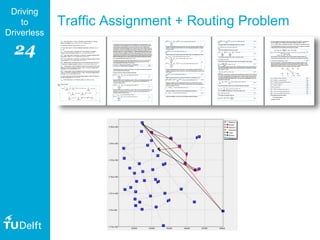
• A model that assigns family
owned automated vehicles
to the trips of the
household.
• As vehicles are routed in
the network traffic
congestion is formed, travel
times increase.
• Trips not satisfied by the
cars are done by Public
Transport.
Source: Correia G. and van Arem B. 2015. The Privately Owned Autonomous Vehicles Assignment
Problem: a model to assess the impacts of private vehicular automation in urban mobility. Submitted for
publication.
23
Driving
to
Driverless
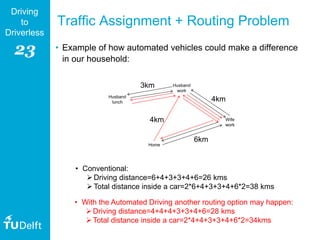
• Example of how automated vehicles could make a difference
in our household:
Traffic Assignment + Routing Problem
Home
Husband
work
Wife
work
Husband
lunch
6km
4km
3km
4km
• Conventional:
Driving distance=6+4+3+3+4+6=26 kms
Total distance inside a car=2*6+4+3+3+4+6*2=38 kms
• With the Automated Driving another routing option may happen:
Driving distance=4+4+4+3+3+4+6=28 kms
Total distance inside a car=2*4+4+3+3+4+6*2=34kms
24
Driving
to
Driverless
Traffic Assignment + Routing Problem
25
Driving
to
Driverless
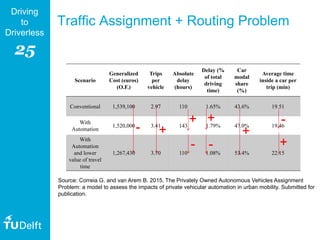
Traffic Assignment + Routing Problem
Scenario
Generalized
Cost (euros)
(O.F.)
Trips
per
vehicle
Absolute
delay
(hours)
Delay (%
of total
driving
time)
Car
modal
share
(%)
Average time
inside a car per
trip (min)
Conventional 1,539,100 2.97 110 1.65% 43.6% 19.51
With
Automation
1,520,000 3.41 143 1.79% 47.0% 19.46
With
Automation
and lower
value of travel
time
1,267,430 3.70 110 1.08% 53.4% 22.15
++-
-
+-
+
Source: Correia G. and van Arem B. 2015. The Privately Owned Autonomous Vehicles Assignment
Problem: a model to assess the impacts of private vehicular automation in urban mobility. Submitted for
publication.
-
+
26
Driving
to
Driverless
Traffic Assignment + Routing Problem
• Positive:
• This approach considers the variations of travel times as
vehicles are routed in the network.
• Choice is done in a utility maximizing perspective.
• Negative:
• The traffic assignment + Routing problem takes one day
for the city of Delft in order to converge to equilibrium! this
is quite slow!
More research in needed!
Driving to Driverless
Dr. ir. Gonçalo Homem de Almeida Rodriguez Correia
(Department of Transport & Planning, TU Delft)
g.correia@tudelft.nl
Facebook group: Transportation Planning and Analysis (>1250 members)
Thank you!

Transport Thursday driving to driverless

  • 1.
    Driving to Driverless Dr.ir. Gonçalo Homem de Almeida Rodriguez Correia (Department of Transport & Planning, TU Delft) g.correia@tudelft.nl Facebook group: Transportation Planning and Analysis (>1250 members) Challenges and opportunities for research on the impacts of vehicle automation on urban mobility
  • 2.
    2 Driving to Driverless Driving to Driverless Objective:Understand the research challenges on automated driving regarding its impacts on urban mobility
  • 3.
    3 Driving to Driverless What is automateddriving? SAE International (Society of Automotive Engineers)
  • 4.
    4 Driving to Driverless It will takesome time … Source: Diffusion of Automated Vehicles: A quantitative method to model the diffusion of automated vehicles with system dynamics. TIL Master thesis of Jurgen Nieuwenhuijsen. 2015.
  • 5.
    5 Driving to Driverless Source: Milakis, D.,van Arem, B., van Wee, B. 2015 (work in progress). Implications of automated driving. Delft Infrastructures and Mobility Initiative. Impacts of automated driving on urban mobility
  • 6.
    6 Driving to Driverless Mobility Impacts Questions Fully automated vehicles More willingnessto travel by car? Lower car ownership? Less trips by car? More public transport demand? More or less traffic congestion? More or less parking demand? Substitution of private conventional vehicles for automated ones? Used as public transport? How will these be operated? Lower Value of Time? More trips satisfied by each car? Use shared fleets of vehicles?
  • 7.
    Used as publictransport? How will these systems be operated? Wepods.nlFully automated vehicles More public transport demand? More or less traffic congestion? More or less parking demand? Used as public transport? How will these be operated?
  • 8.
    8 Driving to Driverless D2D100%EV • The D2D100%EVproject has as its main objective to study how to operate a fleet of autonomous electric vehicles as a feeder to train stations. • The case study of Delft- Zuid to TUDelft is our reference • Twizy vehicles are used as an example for that fleet. • Planning and operational studies are being done. • A Twizy will be automated.
  • 9.
    9 Driving to Driverless D2D100%EV: Planning (I) Source:Liang X., Correia G. and van Arem B. 2015. Optimizing the service area and trip selection of electric automated taxis used for the last mile of train trips. Submitted to the Transportation Research Board meeting. Mathematical model for the operational area definition and trip selection in an automated taxi system (bookings known in advance) For a fleet of 5 taxis 15 zones are selected:
  • 10.
    10 Driving to Driverless Total requests Fleet size Obj. (€/day) Requests satisfied (Trips) Requests satisfied (%) Total served zones Electric Taxis 466 5 391.9 26958% 15 Conventional Taxis 452.5 319 68% 24 Electric Taxis 10 518.8 422 91% 31 Conventional Taxis 518.8 422 91% 31 D2D100%EV: Planning (II) Source: Liang X., Correia G. and van Arem B. 2015. Optimizing the service area and trip selection of electric automated taxis used for the last mile of train trips. Submitted to the Transportation Research Board meeting.
  • 11.
    11 Driving to Driverless Source: Arthur Scheltesongoing master thesis D2D100%EV: Operation
  • 12.
    12 Driving to Driverless • It isargued that ridding in an AV will be more pleasurable than a normal car and a normal bus. You will be able to work or just enjoy your time. D2D100%EV: Value of Travel Time Trip segment Mode Willingness-to-pay per 10 minutes Main Private car €1.80 - €1.90 Egress Bus/tram/metro €0.55 - €0.65 Egress Bicycle €1.45 - €1.55 Egress Automatic vehicle: manually driven €0.85 - €0.95 Egress Automatic vehicle: automatically driven €2.25 - €2.35 Willingness-to-pay for different modes per 10 minutes What?! Source: Yap M., Correia G. and van Arem B. 2015. Preferences of travellers for using automated vehicles as last mile Public Transport of Multimodal train trips. Under review.
  • 13.
  • 14.
  • 15.
    15 Driving to Driverless WEpods project: Scaleup • Results of an optimization for simulation study (MatLab): Source: Winter K., Cats O., Correia G. and van Arem B. 2015. Designing an automated demand- responsive transport system: fleet size and performance analysis for the case of a campus-train station service. Submitted to the Transportation Research Board meeting.
  • 16.
    16 Driving to Driverless WEpods project Riender Happee,3ME, TU Delft Jan Willem van der Wiel, Springer
  • 17.
    Use shared fleetsof vehicles for all trips? Car2Go Fully automated vehicles More willing to travel by car? Lower car ownership? Less trips by car? More public transport demand? More or less traffic congestion? More or less parking demand? Lower Value of Time? Use shared fleets of vehicles?
  • 18.
    18 Driving to Driverless Source: Luis Martinez,analyst at the ITF International Transport Forum Model • Scale up the concept of public transport with automatic vehicles: Taxibots (Shared taxis): till 6 pax and 5 min waiting; or Autovots (Individual carsharing): 5 min waiting as well.
  • 19.
    19 Driving to Driverless International Transport ForumModel International Transport Forum. 2015. Urban Mobility System Upgrade How shared self- driving cars could change a city. Available online.
  • 20.
    20 Driving to Driverless • Simulation takessome hours for representing what happens in a medium scale city like Lisbon, which is not much, however:  These simulation methods do not change travel times as flows change in the network (static travel times).  Moreover TaxiBots routing is not optimized: demand is served using some heuristic that searches for the closest cars. International Transport Forum Model More research in needed!
  • 21.
    Substitute private conventionalvehicles by automated ones? Fully automated vehicles More willing to travel by car? More or less traffic congestion? More or less parking demand? Substitution of private conventional vehicles for automated ones? Lower Value of Time? More trips satisfied by each car?
  • 22.
    22 Driving to Driverless Traffic Assignment +Routing Problem • A model that assigns family owned automated vehicles to the trips of the household. • As vehicles are routed in the network traffic congestion is formed, travel times increase. • Trips not satisfied by the cars are done by Public Transport. Source: Correia G. and van Arem B. 2015. The Privately Owned Autonomous Vehicles Assignment Problem: a model to assess the impacts of private vehicular automation in urban mobility. Submitted for publication.
  • 23.
    23 Driving to Driverless • Example ofhow automated vehicles could make a difference in our household: Traffic Assignment + Routing Problem Home Husband work Wife work Husband lunch 6km 4km 3km 4km • Conventional: Driving distance=6+4+3+3+4+6=26 kms Total distance inside a car=2*6+4+3+3+4+6*2=38 kms • With the Automated Driving another routing option may happen: Driving distance=4+4+4+3+3+4+6=28 kms Total distance inside a car=2*4+4+3+3+4+6*2=34kms
  • 24.
  • 25.
    25 Driving to Driverless Traffic Assignment +Routing Problem Scenario Generalized Cost (euros) (O.F.) Trips per vehicle Absolute delay (hours) Delay (% of total driving time) Car modal share (%) Average time inside a car per trip (min) Conventional 1,539,100 2.97 110 1.65% 43.6% 19.51 With Automation 1,520,000 3.41 143 1.79% 47.0% 19.46 With Automation and lower value of travel time 1,267,430 3.70 110 1.08% 53.4% 22.15 ++- - +- + Source: Correia G. and van Arem B. 2015. The Privately Owned Autonomous Vehicles Assignment Problem: a model to assess the impacts of private vehicular automation in urban mobility. Submitted for publication. - +
  • 26.
    26 Driving to Driverless Traffic Assignment +Routing Problem • Positive: • This approach considers the variations of travel times as vehicles are routed in the network. • Choice is done in a utility maximizing perspective. • Negative: • The traffic assignment + Routing problem takes one day for the city of Delft in order to converge to equilibrium! this is quite slow! More research in needed!
  • 27.
    Driving to Driverless Dr.ir. Gonçalo Homem de Almeida Rodriguez Correia (Department of Transport & Planning, TU Delft) g.correia@tudelft.nl Facebook group: Transportation Planning and Analysis (>1250 members) Thank you!