1
DRIVERLESS CARS
INFLUENCING MOBILITY IN RURAL AREAS
Universität für Bodenkultur Wien
Department für Raum. Landschaft
und Infrastruktur
Oliver Roider
11th OECD rural development conference
Edinburgh, Scotland
10 April 2018
Oliver Roider, Institute for Transport Studies, University of Naturel Resources and Life Sciences, BOKU Vienna
Driverless cars – a couple of questions
 Technological developments (sensors, software, connectivity, road
infrastructure, ...)
 Influence on mobility behavior?
 Influence on spatial developments (urban vs rural area)?
 Influence on transport system?
 Influence on energy consumption?
 Improving capacity of transport infrastructure?
 Traffic safety, ethical and security issues?
 How can be evaluate benefits?
 Current regulatory frameworks sufficient? (support vs restrictions)
2
Oliver Roider, Institute for Transport Studies, University of Naturel Resources and Life Sciences, BOKU Vienna
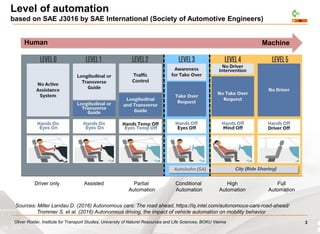
Level of automation
based on SAE J3016 by SAE International (Society of Automotive Engineers)
Human Machine
Driver only Assisted Partial
Automation
Conditional
Automation
High
Automation
Full
Automation
3
Sources: Miller Landau D. (2016) Autonomous cars: The road ahead, https://iq.intel.com/autonomous-cars-road-ahead/
Trommer S. et al. (2016) Autonomous driving, the impact of vehicle automation on mobility behavior
Oliver Roider, Institute for Transport Studies, University of Naturel Resources and Life Sciences, BOKU Vienna
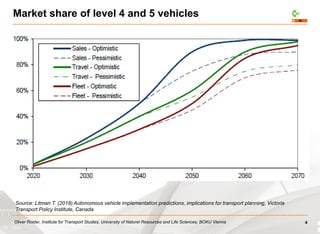
Market share of level 4 and 5 vehicles
Source: Litman T. (2018) Autonomous vehicle implementation predictions, implications for transport planning, Victoria
Transport Policy Institute, Canada
4
Oliver Roider, Institute for Transport Studies, University of Naturel Resources and Life Sciences, BOKU Vienna
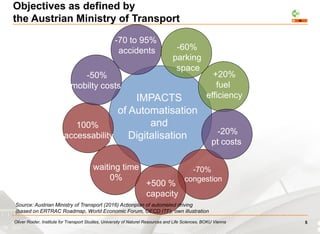
Objectives as defined by
the Austrian Ministry of Transport
5
IMPACTS
of Automatisation
and
Digitalisation
100%
accessability
waiting time
0%
-70 to 95%
accidents
+500 %
capacity
-60%
parking
space
+20%
fuel
efficiency
-50%
mobilty costs
-20%
pt costs
Source: Austrian Ministry of Transport (2016) Actionplan of automated driving
(based on ERTRAC Roadmap, World Economic Forum, OECD ITF), own illustration
-70%
congestion
Oliver Roider, Institute for Transport Studies, University of Naturel Resources and Life Sciences, BOKU Vienna
18%
25% 20% 14% 15%
7%
4% 13%
8% 6%
47%
25%
39%
52% 56%
12%
8%
11%
13%
13%
17%
38%
17% 13% 8%
0%
20%
40%
60%
80%
100%
Austria (total) Vienna towns (except
Vienna)
central areas peripheral regions
modeshareoftrips(workday)
walking cycling car as driver cas as passenger public transport others
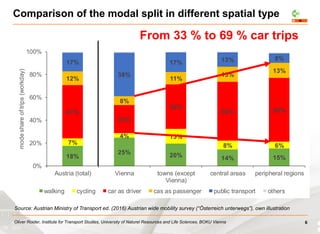
Comparison of the modal split in different spatial type
From 33 % to 69 % car trips
Source: Austrian Ministry of Transport ed. (2016) Austrian wide mobility survey (“Österreich unterwegs”), own illustration
6
Oliver Roider, Institute for Transport Studies, University of Naturel Resources and Life Sciences, BOKU Vienna
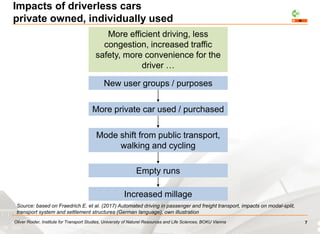
Impacts of driverless cars
private owned, individually used
More private car used / purchased
New user groups / purposes
Mode shift from public transport,
walking and cycling
Increased millage
Empty runs
Source: based on Fraedrich E. et al. (2017) Automated driving in passenger and freight transport, impacts on modal-split,
transport system and settlement structures (German language), own illustration
7
More efficient driving, less
congestion, increased traffic
safety, more convenience for the
driver …
Oliver Roider, Institute for Transport Studies, University of Naturel Resources and Life Sciences, BOKU Vienna
 Active mobility to reach public transport (walking and
cycling including e-bikes)
 Ride-sharing to P&R facilities
 Demand responsive and flexible PT systems
 Potential for driverless vehicles
Develop and promote feeder systems
to the main routes of public transport
8
Oliver Roider, Institute for Transport Studies, University of Naturel Resources and Life Sciences, BOKU Vienna
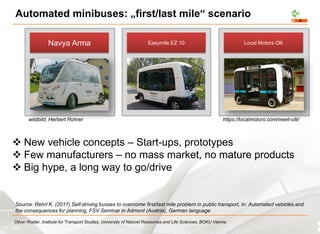
Automated minibuses: „first/last mile“ scenario
 New vehicle concepts – Start-ups, prototypes
 Few manufacturers – no mass market, no mature products
 Big hype, a long way to go/drive
Navya Arma Easymile EZ 10 Local Motors Olli
Source: Rehrl K. (2017) Self-driving busses to overcome first/last mile problem in public transport, In: Automated vehicles and
the consequences for planning, FSV Seminar in Admont (Austria), German language
wildbild, Herbert Rohrer https://localmotors.com/meet-olli/
Oliver Roider, Institute for Transport Studies, University of Naturel Resources and Life Sciences, BOKU Vienna
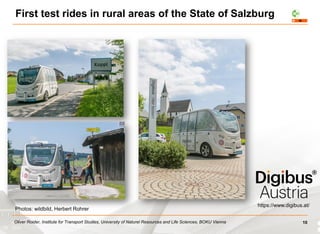
First test rides in rural areas of the State of Salzburg
https://www.digibus.at/
10
Photos: wildbild, Herbert Rohrer
Oliver Roider, Institute for Transport Studies, University of Naturel Resources and Life Sciences, BOKU Vienna
Goals of the research project Digibus Austria
starting in May 2018
https://www.digibus.at/
 Testing technical framework conditions (built environment
and infrastructure, connectivity and vehicle communication)
 Development of evaluation methods of traffic safety and
suitability for using public roads
 Human factors
 Interaction with passengers as well as other road users
 Embedding the system in new mobility services
 Identification of technical, organisational, legal, social and
economical framework conditions
11
Oliver Roider, Institute for Transport Studies, University of Naturel Resources and Life Sciences, BOKU Vienna
Focus on human factor
 Master Thesis at the Institute for Transport Studies, BOKU
Vienna, to be finalised by mid of 2018
 Focused on vulnerable groups in rural areas
 Acceptance of automated driving
 Expectations and concerns
 Influencing mobility behaviour
12
Automated driving as a chance for rural areas -
Analysis of potential user groups and possible changes of
their mobility behaviour
by Ms. L. Radics
Oliver Roider, Institute for Transport Studies, University of Naturel Resources and Life Sciences, BOKU Vienna
Conclusion
How can we ensure that the new technologies will support or
even accelerate reaching our goals of a sustainable
development of rural areas in terms of spatial planning and
transportation in order to make these areas more attractive?
13
14
DRIVERLESS CARS
INFLUENCING MOBILITY IN RURAL AREAS
Universität für Bodenkultur Wien
Department für Raum. Landschaft
und Infrastruktur
Oliver Roider
Institute for Transport Studies
University of Natural Resources and Life Sciences, BOKU Vienna
oliver.roider@boku.ac.at

Oliver Roider- Driverless cars

  • 1.
    1 DRIVERLESS CARS INFLUENCING MOBILITYIN RURAL AREAS Universität für Bodenkultur Wien Department für Raum. Landschaft und Infrastruktur Oliver Roider 11th OECD rural development conference Edinburgh, Scotland 10 April 2018
  • 2.
    Oliver Roider, Institutefor Transport Studies, University of Naturel Resources and Life Sciences, BOKU Vienna Driverless cars – a couple of questions  Technological developments (sensors, software, connectivity, road infrastructure, ...)  Influence on mobility behavior?  Influence on spatial developments (urban vs rural area)?  Influence on transport system?  Influence on energy consumption?  Improving capacity of transport infrastructure?  Traffic safety, ethical and security issues?  How can be evaluate benefits?  Current regulatory frameworks sufficient? (support vs restrictions) 2
  • 3.
    Oliver Roider, Institutefor Transport Studies, University of Naturel Resources and Life Sciences, BOKU Vienna Level of automation based on SAE J3016 by SAE International (Society of Automotive Engineers) Human Machine Driver only Assisted Partial Automation Conditional Automation High Automation Full Automation 3 Sources: Miller Landau D. (2016) Autonomous cars: The road ahead, https://iq.intel.com/autonomous-cars-road-ahead/ Trommer S. et al. (2016) Autonomous driving, the impact of vehicle automation on mobility behavior
  • 4.
    Oliver Roider, Institutefor Transport Studies, University of Naturel Resources and Life Sciences, BOKU Vienna Market share of level 4 and 5 vehicles Source: Litman T. (2018) Autonomous vehicle implementation predictions, implications for transport planning, Victoria Transport Policy Institute, Canada 4
  • 5.
    Oliver Roider, Institutefor Transport Studies, University of Naturel Resources and Life Sciences, BOKU Vienna Objectives as defined by the Austrian Ministry of Transport 5 IMPACTS of Automatisation and Digitalisation 100% accessability waiting time 0% -70 to 95% accidents +500 % capacity -60% parking space +20% fuel efficiency -50% mobilty costs -20% pt costs Source: Austrian Ministry of Transport (2016) Actionplan of automated driving (based on ERTRAC Roadmap, World Economic Forum, OECD ITF), own illustration -70% congestion
  • 6.
    Oliver Roider, Institutefor Transport Studies, University of Naturel Resources and Life Sciences, BOKU Vienna 18% 25% 20% 14% 15% 7% 4% 13% 8% 6% 47% 25% 39% 52% 56% 12% 8% 11% 13% 13% 17% 38% 17% 13% 8% 0% 20% 40% 60% 80% 100% Austria (total) Vienna towns (except Vienna) central areas peripheral regions modeshareoftrips(workday) walking cycling car as driver cas as passenger public transport others Comparison of the modal split in different spatial type From 33 % to 69 % car trips Source: Austrian Ministry of Transport ed. (2016) Austrian wide mobility survey (“Österreich unterwegs”), own illustration 6
  • 7.
    Oliver Roider, Institutefor Transport Studies, University of Naturel Resources and Life Sciences, BOKU Vienna Impacts of driverless cars private owned, individually used More private car used / purchased New user groups / purposes Mode shift from public transport, walking and cycling Increased millage Empty runs Source: based on Fraedrich E. et al. (2017) Automated driving in passenger and freight transport, impacts on modal-split, transport system and settlement structures (German language), own illustration 7 More efficient driving, less congestion, increased traffic safety, more convenience for the driver …
  • 8.
    Oliver Roider, Institutefor Transport Studies, University of Naturel Resources and Life Sciences, BOKU Vienna  Active mobility to reach public transport (walking and cycling including e-bikes)  Ride-sharing to P&R facilities  Demand responsive and flexible PT systems  Potential for driverless vehicles Develop and promote feeder systems to the main routes of public transport 8
  • 9.
    Oliver Roider, Institutefor Transport Studies, University of Naturel Resources and Life Sciences, BOKU Vienna Automated minibuses: „first/last mile“ scenario  New vehicle concepts – Start-ups, prototypes  Few manufacturers – no mass market, no mature products  Big hype, a long way to go/drive Navya Arma Easymile EZ 10 Local Motors Olli Source: Rehrl K. (2017) Self-driving busses to overcome first/last mile problem in public transport, In: Automated vehicles and the consequences for planning, FSV Seminar in Admont (Austria), German language wildbild, Herbert Rohrer https://localmotors.com/meet-olli/
  • 10.
    Oliver Roider, Institutefor Transport Studies, University of Naturel Resources and Life Sciences, BOKU Vienna First test rides in rural areas of the State of Salzburg https://www.digibus.at/ 10 Photos: wildbild, Herbert Rohrer
  • 11.
    Oliver Roider, Institutefor Transport Studies, University of Naturel Resources and Life Sciences, BOKU Vienna Goals of the research project Digibus Austria starting in May 2018 https://www.digibus.at/  Testing technical framework conditions (built environment and infrastructure, connectivity and vehicle communication)  Development of evaluation methods of traffic safety and suitability for using public roads  Human factors  Interaction with passengers as well as other road users  Embedding the system in new mobility services  Identification of technical, organisational, legal, social and economical framework conditions 11
  • 12.
    Oliver Roider, Institutefor Transport Studies, University of Naturel Resources and Life Sciences, BOKU Vienna Focus on human factor  Master Thesis at the Institute for Transport Studies, BOKU Vienna, to be finalised by mid of 2018  Focused on vulnerable groups in rural areas  Acceptance of automated driving  Expectations and concerns  Influencing mobility behaviour 12 Automated driving as a chance for rural areas - Analysis of potential user groups and possible changes of their mobility behaviour by Ms. L. Radics
  • 13.
    Oliver Roider, Institutefor Transport Studies, University of Naturel Resources and Life Sciences, BOKU Vienna Conclusion How can we ensure that the new technologies will support or even accelerate reaching our goals of a sustainable development of rural areas in terms of spatial planning and transportation in order to make these areas more attractive? 13
  • 14.
    14 DRIVERLESS CARS INFLUENCING MOBILITYIN RURAL AREAS Universität für Bodenkultur Wien Department für Raum. Landschaft und Infrastruktur Oliver Roider Institute for Transport Studies University of Natural Resources and Life Sciences, BOKU Vienna oliver.roider@boku.ac.at