Translation in Eukaryotes
Shishta Sharma
Department of Biotechnology
G.v.m Girls college
Sonepat
Eukaryotic Translation
In prokaryotic cell, transcription and translation are
coupled, that is, translation begins while the mRNA
is still being synthesized. In a eukaryotic cell,
transcription occur in the nucleus , and translation
occur in the cytoplasm.
Translation process in eukaryotes involve
- Activation ( not essentially the step of translation.
This occur the same way as in prokaryotes)
- Initiation
- Elongation and
- termination
1. Initiation
The initiation of translation in
eukaryotes is complex, involving at least
10 initiation factors (eIFs) and is divided
into three steps :
a)Formation of 43s preinitiation complex.
b)Formation of 48s initiation complex.
c)Formation of 80s initiation complex.
a. Formation of 43s preinitiation complex
A ternary complex containing met-tRNA and eIF-2 bound to
GTP attaches to 40s ribosomal subunit to form 43s preinitiation
complex.
The presence of eIF-3 and eIF-1A stabilizes this complex.
b.Formation of 48s initiation
complex
The binding of mRNA to 43s preinitiation complex results in
formation of 48s initiation complex.
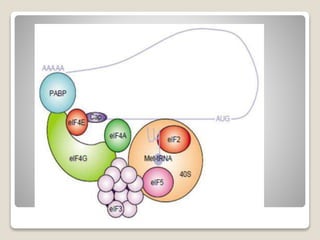
eIF-4f is formed by the association of eIF-4G, eIF-4A with
eIF-4E
The eIF-4F(referred to as cap binding protein ) binds to the
cap of mRNA.
Cont…..
Then eIF-4A and eIF-B binds to mRNA and
reduces its complex structure.
This mRNA is then transferred to 43s complex
The ribosomal initiation complex scans the
mRNA for identification of appropriate initiation
codon
5’-AUG is the initiation codon
c. Formation of 80s initiation complex
48s initiation complex binds to 60s ribosomal subunit
to form 80s initiation complex
The binding involves hydrolysis of GTP(bound to
eIF-2)
This step is facilitated by the involvement of eIF-5
As the 80s complex is formed, the initiation factors
bound to 43s initiation complex are released and
recycled
2. Elongation
Ribosomes elongate the polypeptide chain by
sequential addition of amino acids
The amino acid sequence is determined by the order of
the codons in the specific mRNA
Elongation, a cyclic process involving certain
elongation factors(EFs)
Elongation may be divided into three steps
a. Binding of aminoacyl-tRNA to A-site
b. Peptide bond formation
c. translocation
a.Binding of Aminoacyl t-RNA to A-site
The 80s initiation complex contains met tRNA in the
P-site and A- site is free
Another aminoacyl-tRNA is placed in the A site
This require proper codon recognition on mRNA and
involvement of EF-1a and supply of energy by GTP
The aminoacyl –tRNA is placed in the A-site ,EF-1a
and GDP are recycled to bring another aminoacyl-tRNA
b. Peptide bond formation
The peptidyl transferase catalyzes the
formation of peptide bond
Net result of peptide bond formation is
the attachment off the growing peptide
chain to the tRNA in A-site
c. Translocation
The ribosome moves to the next codon of mRNA
(towards 3’ end)
This process is called translocation, involves the
movement of growing peptide chain from A-site to P-
site
Translocation require EF-2 and GTP
GTP get hydrolyzed and supplies energy to move
mRNA
EF-2 and GTP complex recycles for translocation
3. Termination
One of the stop signals (UGA,UAA and UGA)
terminates the growing polypeptide
When the ribosome encounter s a stop codon,
there is no tRNA available to bind to the A site of
ribosome
Instead a release factor binds to it
In eukaryotes eRF1 recognizes all the three stop
codons, and eRF3 stimulate the termination events
Once the release factor binds, the ribosome unit falls apart
- releasing the large and small subunits
- the tRNA carrying the polypeptide is also released, freeing up
the polypeptide product
 References
 www.namrata.com (biochemistry For
Medics By Dr.Namrata Chhabra)
 slideshares
 www.easybiologyclass.com
 YouTube lecture by shomou’s Biology
 Wikipedia

Translation in eukaryotes

  • 1.
    Translation in Eukaryotes ShishtaSharma Department of Biotechnology G.v.m Girls college Sonepat
  • 2.
    Eukaryotic Translation In prokaryoticcell, transcription and translation are coupled, that is, translation begins while the mRNA is still being synthesized. In a eukaryotic cell, transcription occur in the nucleus , and translation occur in the cytoplasm. Translation process in eukaryotes involve - Activation ( not essentially the step of translation. This occur the same way as in prokaryotes) - Initiation - Elongation and - termination
  • 3.
    1. Initiation The initiationof translation in eukaryotes is complex, involving at least 10 initiation factors (eIFs) and is divided into three steps : a)Formation of 43s preinitiation complex. b)Formation of 48s initiation complex. c)Formation of 80s initiation complex.
  • 4.
    a. Formation of43s preinitiation complex A ternary complex containing met-tRNA and eIF-2 bound to GTP attaches to 40s ribosomal subunit to form 43s preinitiation complex. The presence of eIF-3 and eIF-1A stabilizes this complex. b.Formation of 48s initiation complex The binding of mRNA to 43s preinitiation complex results in formation of 48s initiation complex. eIF-4f is formed by the association of eIF-4G, eIF-4A with eIF-4E The eIF-4F(referred to as cap binding protein ) binds to the cap of mRNA.
  • 5.
    Cont….. Then eIF-4A andeIF-B binds to mRNA and reduces its complex structure. This mRNA is then transferred to 43s complex The ribosomal initiation complex scans the mRNA for identification of appropriate initiation codon 5’-AUG is the initiation codon
  • 6.
    c. Formation of80s initiation complex 48s initiation complex binds to 60s ribosomal subunit to form 80s initiation complex The binding involves hydrolysis of GTP(bound to eIF-2) This step is facilitated by the involvement of eIF-5 As the 80s complex is formed, the initiation factors bound to 43s initiation complex are released and recycled
  • 8.
    2. Elongation Ribosomes elongatethe polypeptide chain by sequential addition of amino acids The amino acid sequence is determined by the order of the codons in the specific mRNA Elongation, a cyclic process involving certain elongation factors(EFs) Elongation may be divided into three steps a. Binding of aminoacyl-tRNA to A-site b. Peptide bond formation c. translocation
  • 9.
    a.Binding of Aminoacylt-RNA to A-site The 80s initiation complex contains met tRNA in the P-site and A- site is free Another aminoacyl-tRNA is placed in the A site This require proper codon recognition on mRNA and involvement of EF-1a and supply of energy by GTP The aminoacyl –tRNA is placed in the A-site ,EF-1a and GDP are recycled to bring another aminoacyl-tRNA
  • 10.
    b. Peptide bondformation The peptidyl transferase catalyzes the formation of peptide bond Net result of peptide bond formation is the attachment off the growing peptide chain to the tRNA in A-site
  • 11.
    c. Translocation The ribosomemoves to the next codon of mRNA (towards 3’ end) This process is called translocation, involves the movement of growing peptide chain from A-site to P- site Translocation require EF-2 and GTP GTP get hydrolyzed and supplies energy to move mRNA EF-2 and GTP complex recycles for translocation
  • 13.
    3. Termination One ofthe stop signals (UGA,UAA and UGA) terminates the growing polypeptide When the ribosome encounter s a stop codon, there is no tRNA available to bind to the A site of ribosome Instead a release factor binds to it In eukaryotes eRF1 recognizes all the three stop codons, and eRF3 stimulate the termination events Once the release factor binds, the ribosome unit falls apart - releasing the large and small subunits - the tRNA carrying the polypeptide is also released, freeing up the polypeptide product
  • 14.
     References  www.namrata.com(biochemistry For Medics By Dr.Namrata Chhabra)  slideshares  www.easybiologyclass.com  YouTube lecture by shomou’s Biology  Wikipedia