1
FROM DRAFT TO DEPLOYMENTFROM DRAFT TO DEPLOYMENT
TRANSLATION/LOCALIZATIONTRANSLATION/LOCALIZATION
PROCESS OPTIMIZATIONPROCESS OPTIMIZATION
2
TRANSLATION PROCESS OPTIMISATION
CONTENTS
 Goals & Objectives
 Translation memories - “CAT” tools
 Major TMs vs project/target group TMs
 Terminology management - vision, mission,
results
 Target audiences
 Communication between customer and parties
involved
 Project schedules/timing
 Multilingual projects - connecting translators
 Supporting target countries in the context of
translation/localization projects
3
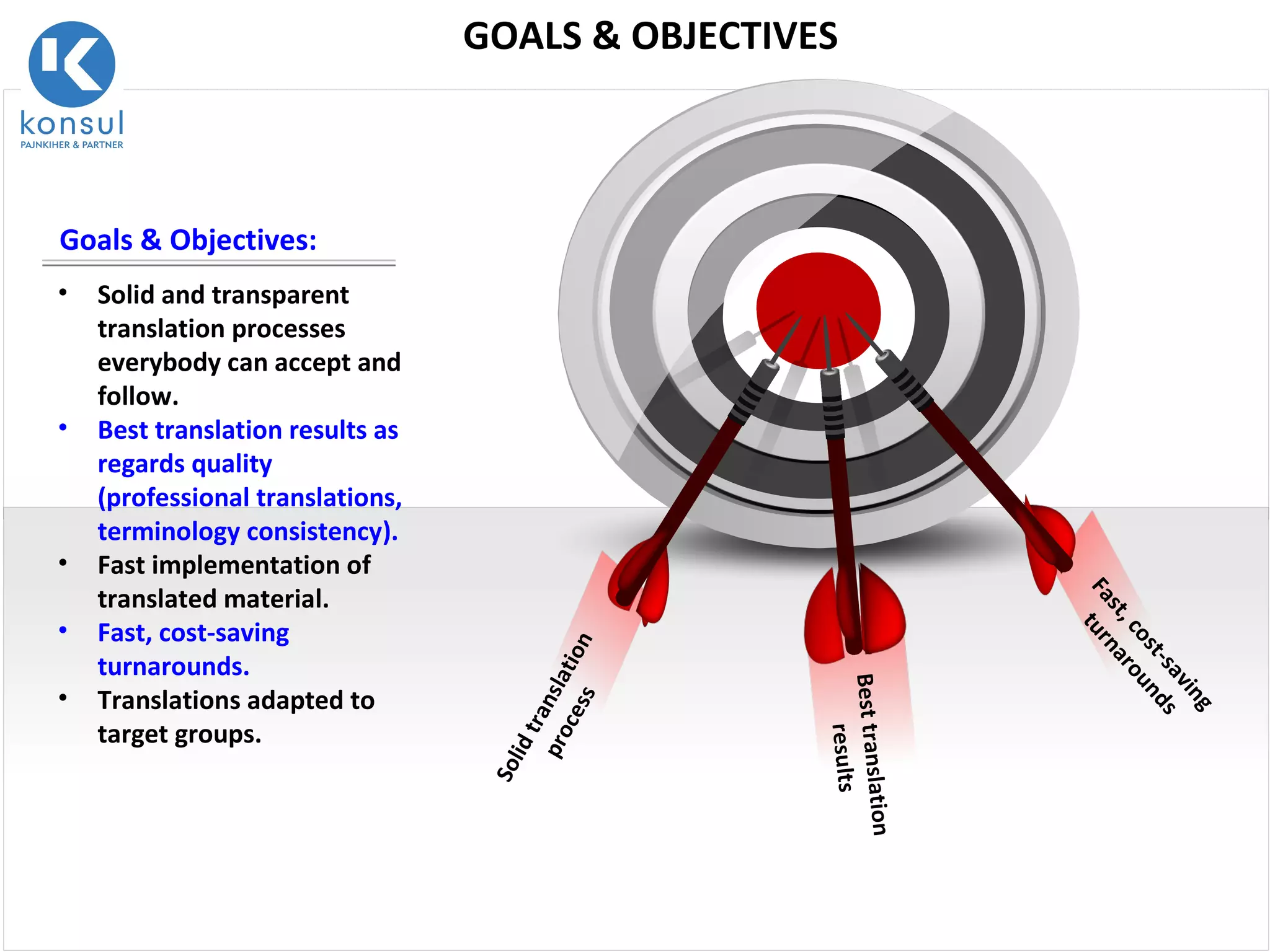
• Solid and transparent
translation processes
everybody can accept and
follow.
• Best translation results as
regards quality
(professional translations,
terminology consistency).
• Fast implementation of
translated material.
• Fast, cost-saving
turnarounds.
• Translations adapted to
target groups.
Goals & Objectives:
Solidtranslation
process
Besttranslation
results
Fast,cost-saving
turnarounds
GOALS & OBJECTIVES
4
TRANSLATION MEMORIES
“CAT” TOOLS
(Computer-Assisted Translation)
5
WHAT IS A CAT-tool /
TRANSLATION MEMORY?
Translation memories are linguistic databases (commonly
known as TM) translators use to leverage words during the
translation process. TMs store data bits – packets of information
– relating to language, i.e. source text segments and their
translations.
Benefits:
 Systematic translation re-use.
 High level of consistency throughout the project.
 Improved translation productivity.
 Multiple translators can work on a single large assignment
via TM servers.
 Quick and easy access to a wide array of file formats.
 Faster turnarounds resulting in cost-saving.
6
MAJOR TMs (“Big Mamas”)
vs. PROJECT/TARGET GROUP TMs
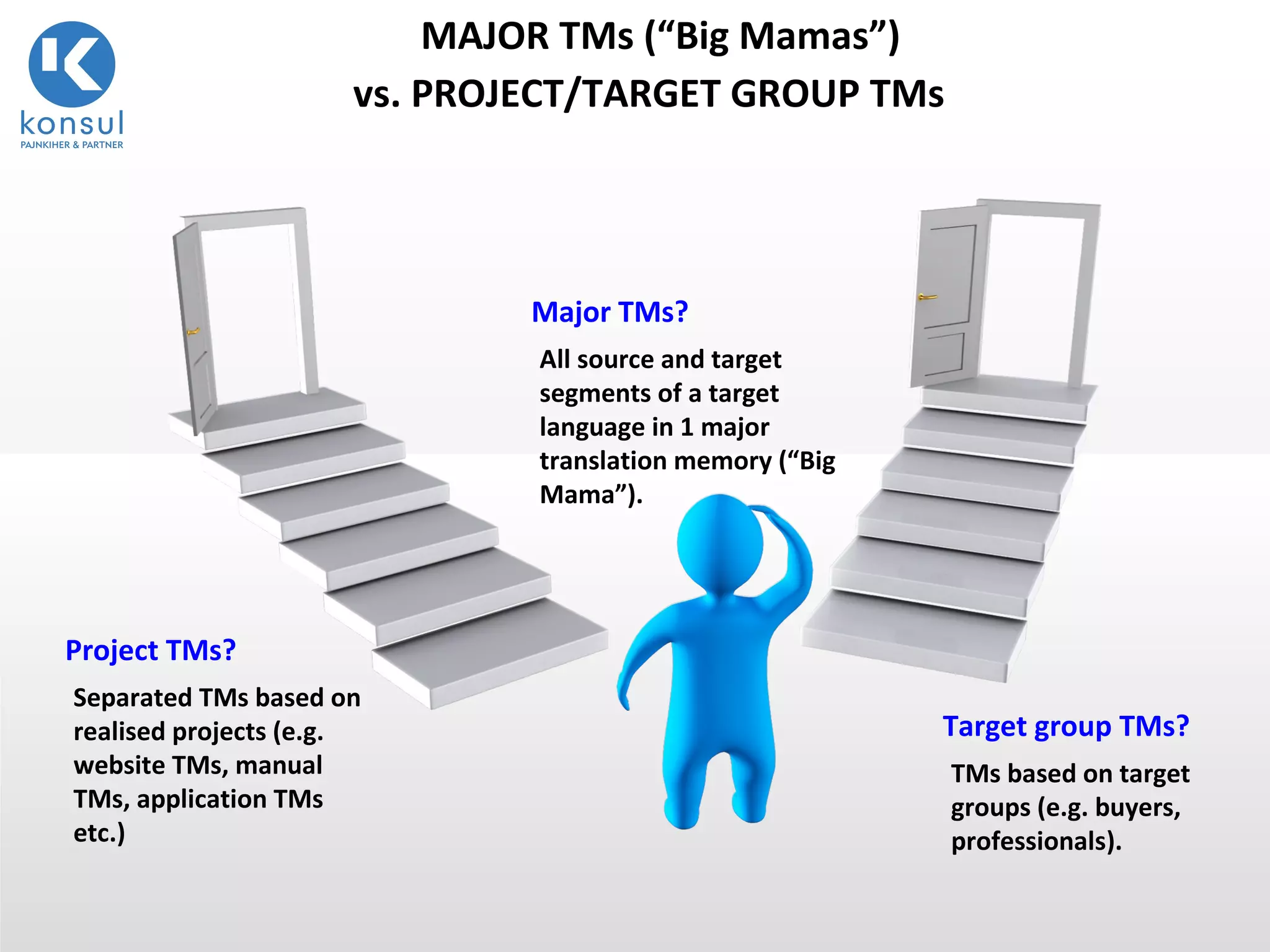
Major TMs?
All source and target
segments of a target
language in 1 major
translation memory (“Big
Mama”).
Target group TMs?
TMs based on target
groups (e.g. buyers,
professionals).
Project TMs?
Separated TMs based on
realised projects (e.g.
website TMs, manual
TMs, application TMs
etc.)
7
MAJOR TMs (“Big Mamas”)
Advantages and Disadvantages
Disadvantages
• File complexity (“heavy”
TMs), thus hard to
process.
• Data hard to find.
• Difficult TM
monitoring/updating.
• Responsibility for TM
contents?
Advantages
• Relatively small number
of TMs.
8
TARGET GROUP TMs
Advantages and Disadvantages
AdvantagesAdvantages
•TMs ordered by target
groups (buyers,
professionals, deciders)
•Fast access to
contents.
•Faster TM verification
and updating.
DisadvantagesDisadvantages
•Increased
organisational
tasks/expenditures.
•Mixed contents (some
source materials
address several target
groups).
•Problems when
searching for specific
contents (e.g. manuals
etc.).
9
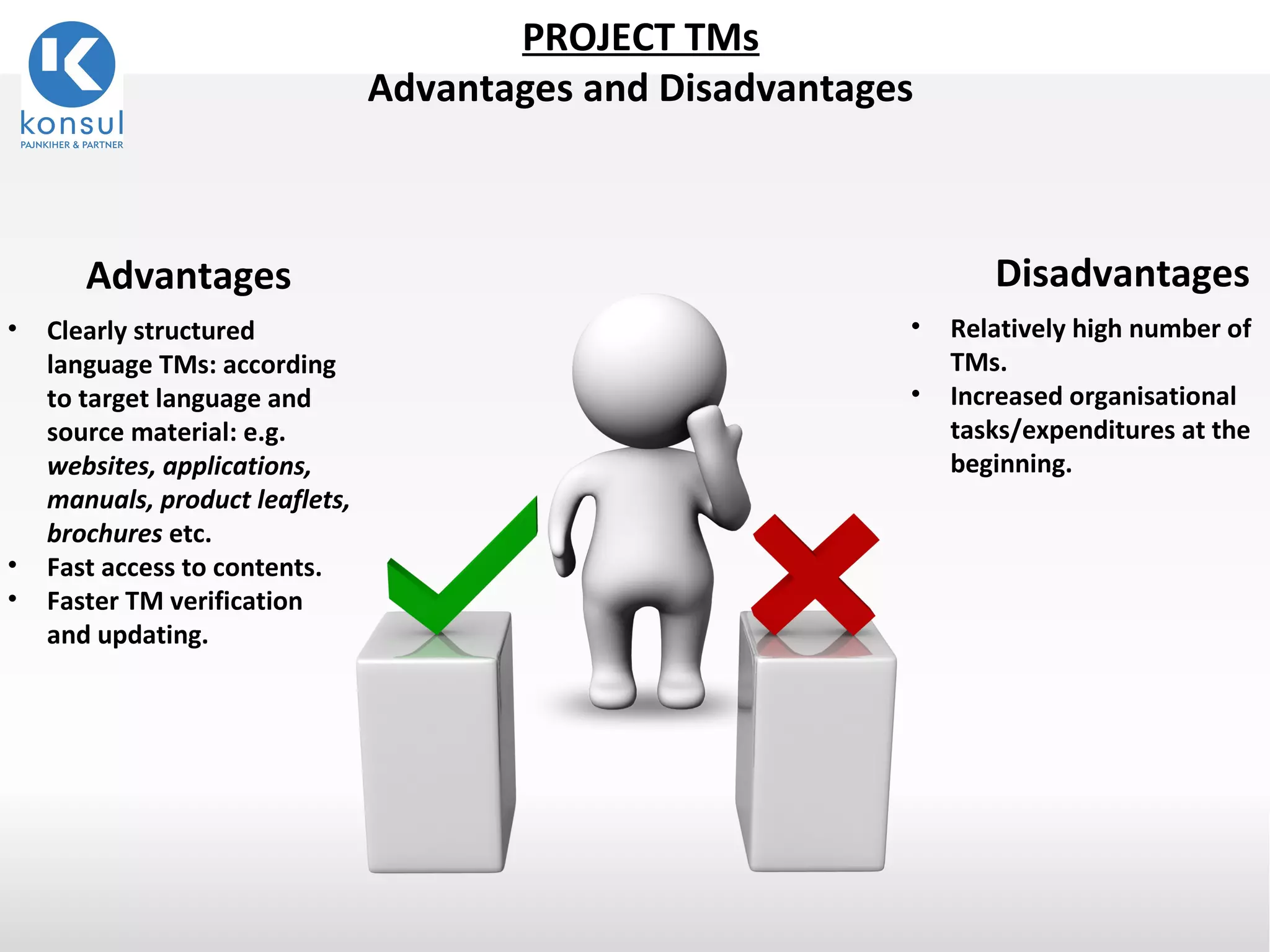
Disadvantages
• Relatively high number of
TMs.
• Increased organisational
tasks/expenditures at the
beginning.
Advantages
• Clearly structured
language TMs: according
to target language and
source material: e.g.
websites, applications,
manuals, product leaflets,
brochures etc.
• Fast access to contents.
• Faster TM verification
and updating.
PROJECT TMs
Advantages and Disadvantages
10
TERMINOLOGY MANAGEMENT
VISION
MISSION
RESULTS
11
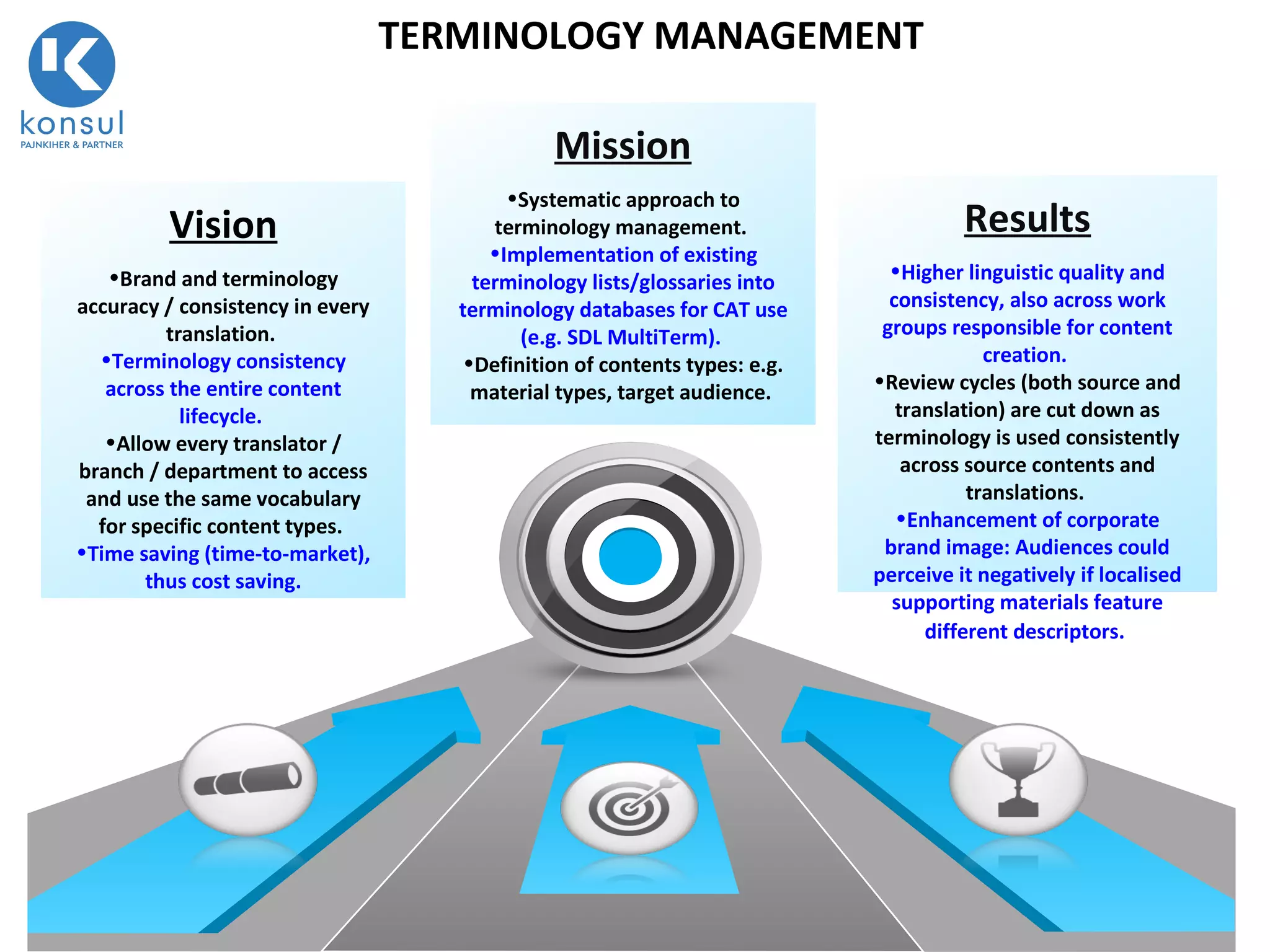
•Brand and terminology
accuracy / consistency in every
translation.
•Terminology consistency
across the entire content
lifecycle.
•Allow every translator /
branch / department to access
and use the same vocabulary
for specific content types.
•Time saving (time-to-market),
thus cost saving.
Vision
•Systematic approach to
terminology management.
•Implementation of existing
terminology lists/glossaries into
terminology databases for CAT use
(e.g. SDL MultiTerm).
•Definition of contents types: e.g.
material types, target audience.
Mission
•Higher linguistic quality and
consistency, also across work
groups responsible for content
creation.
•Review cycles (both source and
translation) are cut down as
terminology is used consistently
across source contents and
translations.
•Enhancement of corporate
brand image: Audiences could
perceive it negatively if localised
supporting materials feature
different descriptors.
Results
TERMINOLOGY MANAGEMENT
12
TERMINOLOGY MANAGEMENT
• Strong brands build on consistent messaging; this nearly is impossible
without consistent terminology. Maintaining terminology consistencyMaintaining terminology consistency is a
key part of both sound content management and localization strategy.
• Approved terminology databases, e.g. resulting in fewer questions from
linguists during translation production cycles.
• Proper terminology management processes in the early-stage authoringearly-stage authoring
phasephase, continuing throughout the content's lifecycle. Effective integrationintegration
withwith terminology managementterminology management systemssystems in the translation phase.
• Reduced timeReduced time for localization of source material (time-to-market)
 cost saving.
13
TERMINOLOGY MANAGEMENT
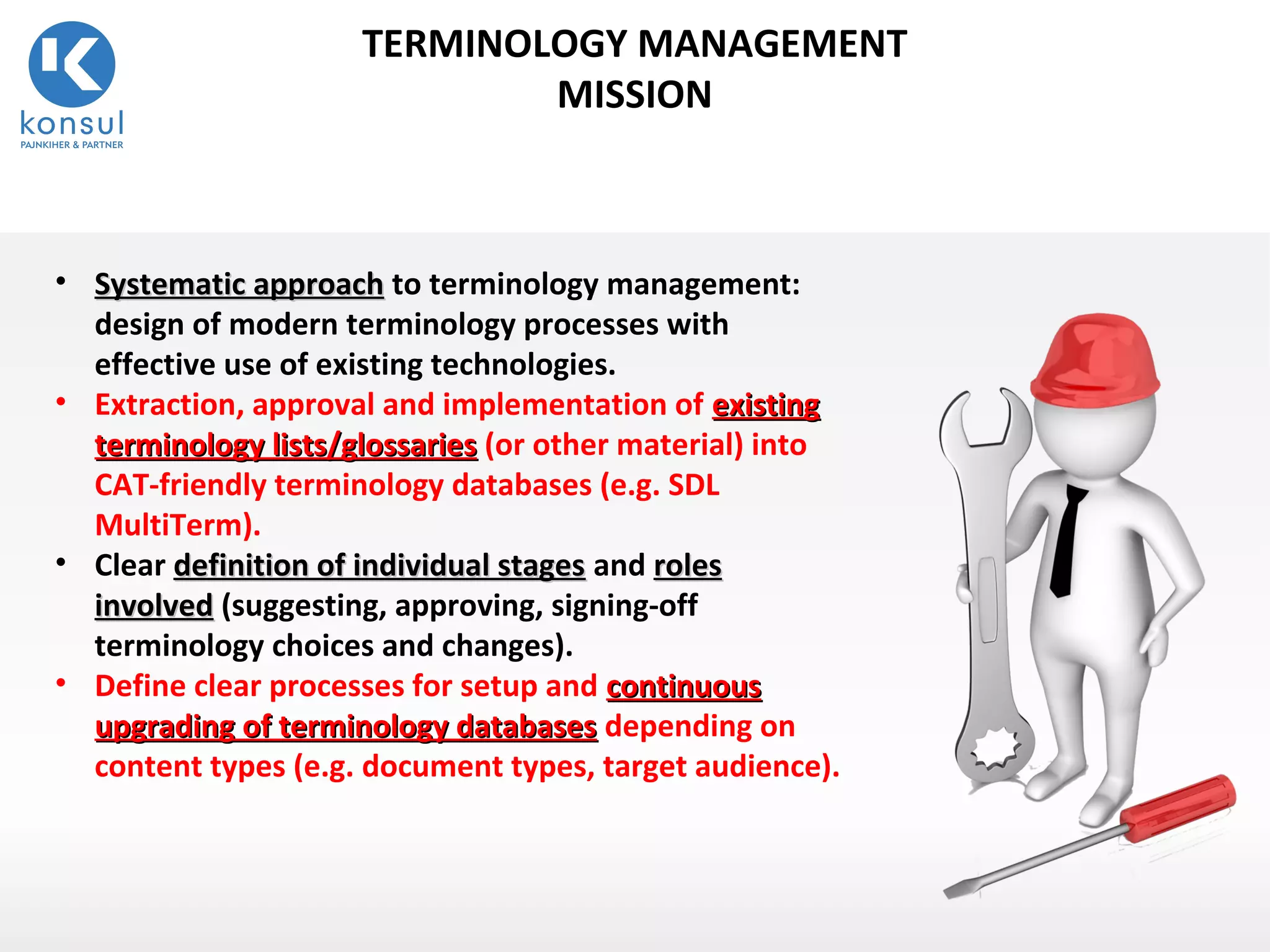
MISSION
• Systematic approachSystematic approach to terminology management:
design of modern terminology processes with
effective use of existing technologies.
• Extraction, approval and implementation of existingexisting
terminology lists/glossariesterminology lists/glossaries (or other material) into
CAT-friendly terminology databases (e.g. SDL
MultiTerm).
• Clear definition of individual stagesdefinition of individual stages and rolesroles
involvedinvolved (suggesting, approving, signing-off
terminology choices and changes).
• Define clear processes for setup and continuouscontinuous
upgrading of terminology databasesupgrading of terminology databases depending on
content types (e.g. document types, target audience).
14
• Higher linguistic qualitylinguistic quality and consistency, also across work
groups responsible for content creation.
• Consistent messaging  brand and content accuracy.
• Brand protectionBrand protection by preventing translation mistakes and
inconsistent terminology use.
• Parties involved have access to the same vocabularyaccess to the same vocabulary for all
content types.
• ReductionReduction of additional review cycles and QA measures.
• ShorteningShortening total turnaround time (time-to-market)
 cost saving.
TERMINOLOGY MANAGEMENT
RESULTS
15
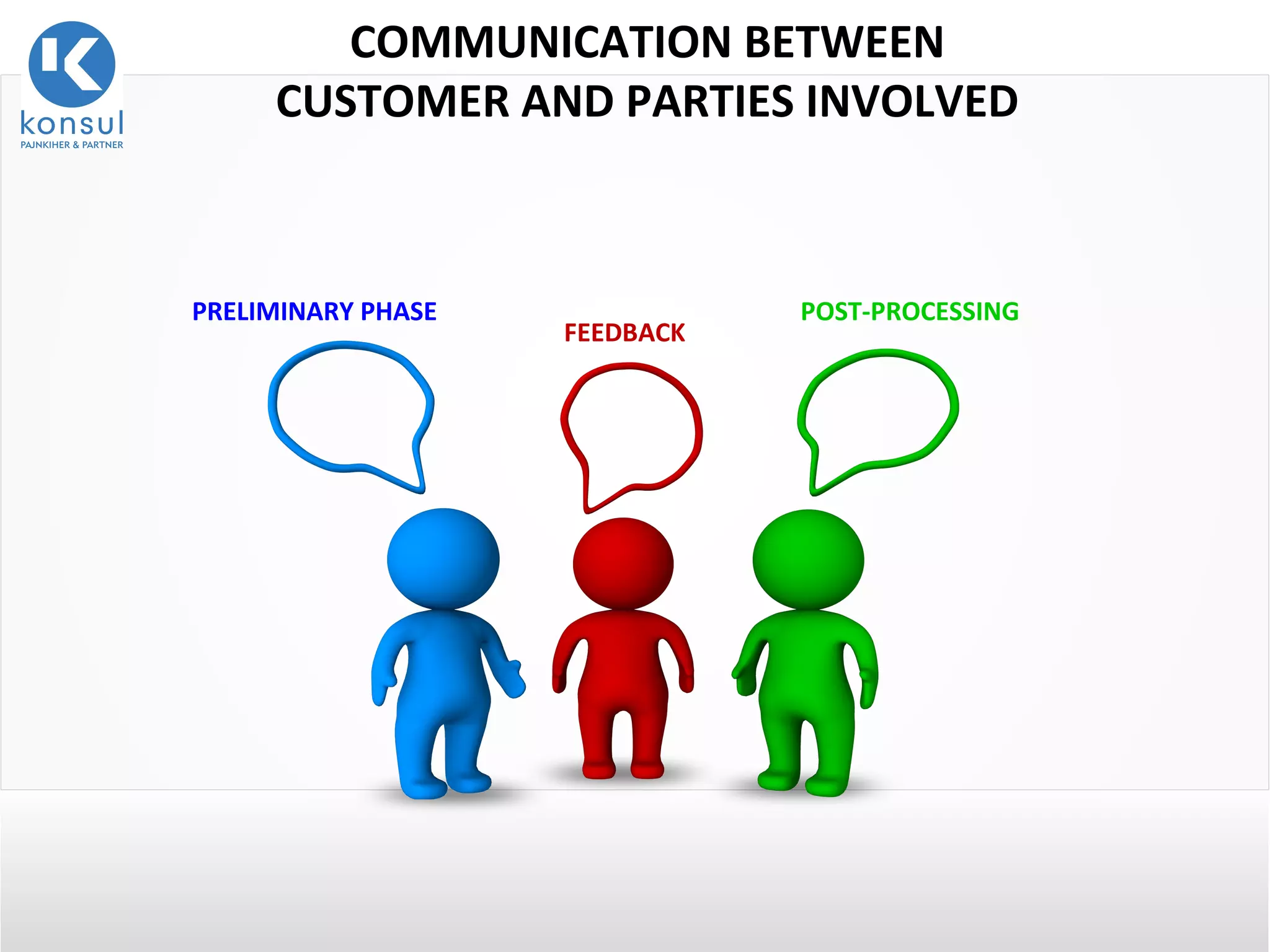
COMMUNICATION BETWEEN
CUSTOMER AND PARTIES INVOLVED
PRELIMINARY PHASE
FEEDBACK
POST-PROCESSING
16
PRELIMINARY PHASE – 1/2
• Involve our project managerInvolve our project manager into the document setup process
to avoid pitfalls with regard to “translator-unfriendly”
formats / other processing problems.
 Time and cost-saving in the long term.
• Clearly define target audiencetarget audience and Style GuideStyle Guide to be used.
• Clearly define Translation MemoryTranslation Memory and Terminology DatabaseTerminology Database
to be used.
• Define contact person(s)contact person(s) (HQ and/or target country) in case of
questions, for terminology adjustment purposes etc.
SUGGESTIONS:
17
PRELIMINARY PHASE – 2/2
• Receive lists with abbreviations, definitions and their
explanations. Information whether abbreviations/definitions
are to be localized or not.
• Receive countcountrry-specificy-specific regulatory specifications/standards to
be adhered to.
• Cleary define special requestsspecial requests (as regards format, style, target
audience etc.).
• Clearly define project turnaround times/deadlinesturnaround times/deadlines.
SUGGESTIONS:
18
FEEDBACK ON TRANSLATED MATERIAL
• Securing translators are translating according to
customer’s preferences as regards style, terminology etc.
• Updating Translation Memories according to customer’s
modifications in order to avoidavoid using initially chosen
translation again.
• Updating Terminology Databases according to customer’s
modifications in order to avoidavoid using initially chosen term
again.
• “Growing” with customer’s documentation; constant
improvement of translation output.
FEEDBACK IS ESSENTIAL
19
POST-PROCESSING
• In-house quality assessment of translated material:
by means of our Evaluation FormEvaluation Form.
• Customer’s quality assessment of translated material:
Evaluation Form? Revised translations only? Both?
• Feedback revisionFeedback revision:
Updating corresponding Translation Memory.
Updating corresponding Terminology Database.
• Consultation with customer’s contact person (HQ and/or
target countries); suggestions for improvementsuggestions for improvement (general,
subject-specific).
POSSIBLE POST-PROCESSING PROCEDURES:
20
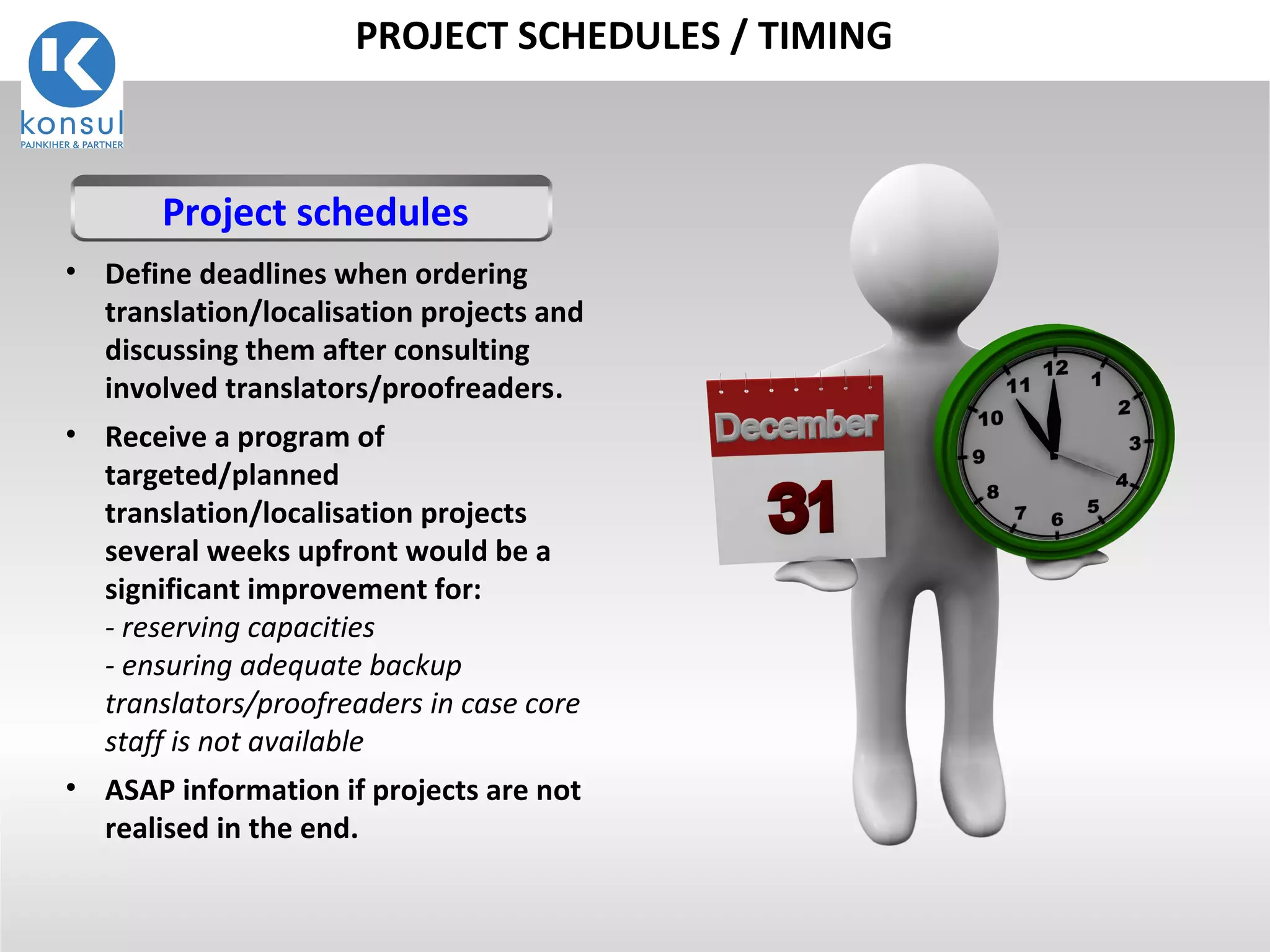
PROJECT SCHEDULES / TIMING
• Define deadlines when ordering
translation/localisation projects and
discussing them after consulting
involved translators/proofreaders.
• Receive a program of
targeted/planned
translation/localisation projects
several weeks upfront would be a
significant improvement for:
- reserving capacities
- ensuring adequate backup
translators/proofreaders in case core
staff is not available
• ASAP information if projects are not
realised in the end.
Project schedules
21
MULTILINGUAL PROJECTS
22
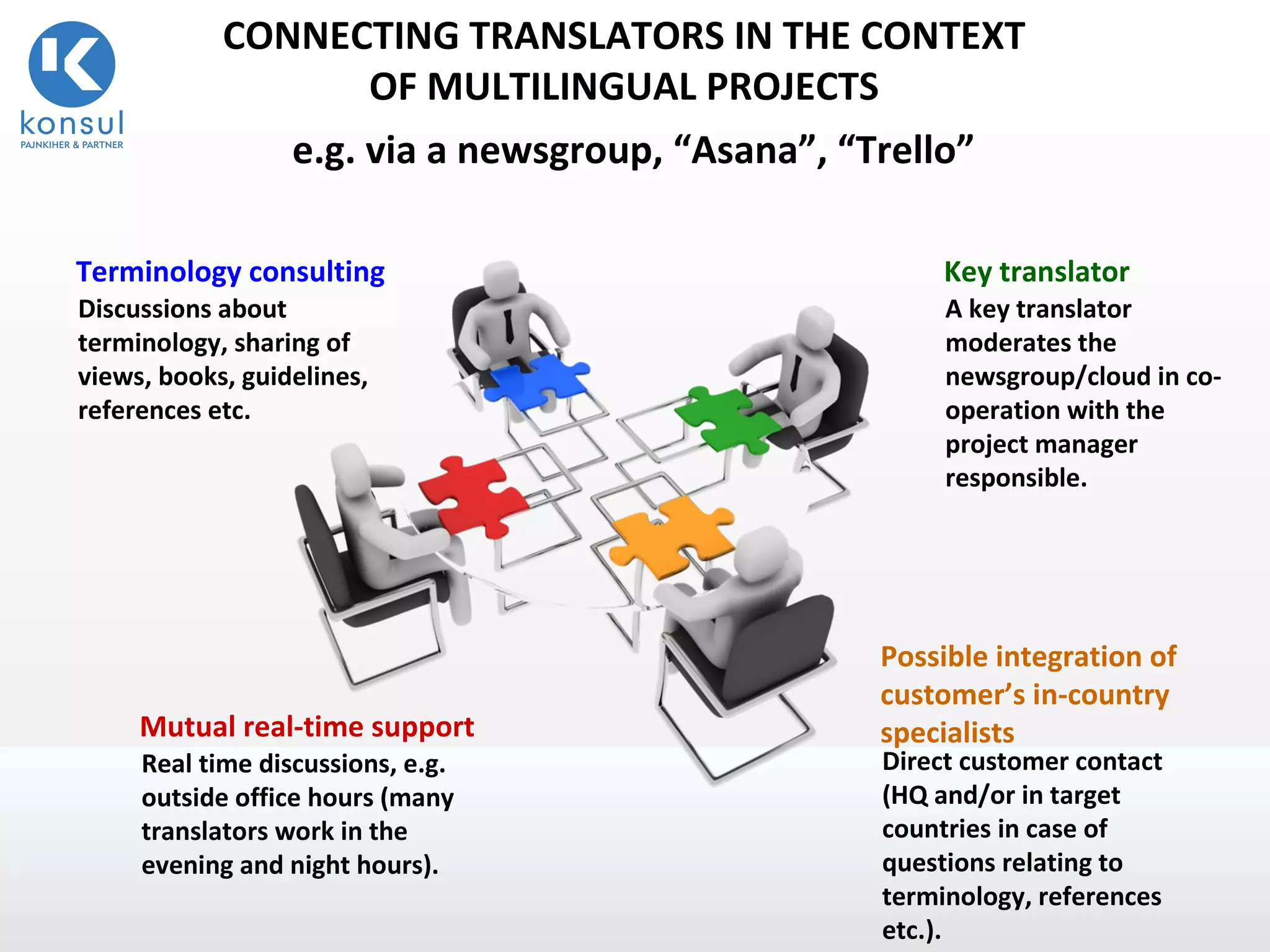
CONNECTING TRANSLATORS IN THE CONTEXT
OF MULTILINGUAL PROJECTS
e.g. via a newsgroup, “Asana”, “Trello”
Terminology consulting
Discussions about
terminology, sharing of
views, books, guidelines,
references etc.
Possible integration of
customer’s in-country
specialists
Direct customer contact
(HQ and/or in target
countries in case of
questions relating to
terminology, references
etc.).
Key translator
A key translator
moderates the
newsgroup/cloud in co-
operation with the
project manager
responsible.
Mutual real-time support
Real time discussions, e.g.
outside office hours (many
translators work in the
evening and night hours).
23
SUPPORTING TARGET COUNTRIES
IN THE CONTEXT OF
TRANSLATION/LOCALISATION PROJECTS
• Define contact responsiblecontact responsible for translation/localization procedures
(project manager(s), HQ etc.).
• Develop Style Guides, country-specific terminology specifications and
other translation/localization-related requirements in direct codirect co--
operation with target countriesoperation with target countries.
• Employee trainingEmployee training (training manuals, webinars; better: on-site training):
 document preparation (pitfalls to avoid);
 proper use and maximum utilization of CAT tools (translation
memories, terminology databases);
 post-processing procedures.
24
Thank you very much
for your kind attention!
Please contact us for further information.
www.konsul.info

Translation and localization process optimization - www.konsul.info

  • 1.
    1 FROM DRAFT TODEPLOYMENTFROM DRAFT TO DEPLOYMENT TRANSLATION/LOCALIZATIONTRANSLATION/LOCALIZATION PROCESS OPTIMIZATIONPROCESS OPTIMIZATION
  • 2.
    2 TRANSLATION PROCESS OPTIMISATION CONTENTS Goals & Objectives  Translation memories - “CAT” tools  Major TMs vs project/target group TMs  Terminology management - vision, mission, results  Target audiences  Communication between customer and parties involved  Project schedules/timing  Multilingual projects - connecting translators  Supporting target countries in the context of translation/localization projects
  • 3.
    3 • Solid andtransparent translation processes everybody can accept and follow. • Best translation results as regards quality (professional translations, terminology consistency). • Fast implementation of translated material. • Fast, cost-saving turnarounds. • Translations adapted to target groups. Goals & Objectives: Solidtranslation process Besttranslation results Fast,cost-saving turnarounds GOALS & OBJECTIVES
  • 4.
  • 5.
    5 WHAT IS ACAT-tool / TRANSLATION MEMORY? Translation memories are linguistic databases (commonly known as TM) translators use to leverage words during the translation process. TMs store data bits – packets of information – relating to language, i.e. source text segments and their translations. Benefits:  Systematic translation re-use.  High level of consistency throughout the project.  Improved translation productivity.  Multiple translators can work on a single large assignment via TM servers.  Quick and easy access to a wide array of file formats.  Faster turnarounds resulting in cost-saving.
  • 6.
    6 MAJOR TMs (“BigMamas”) vs. PROJECT/TARGET GROUP TMs Major TMs? All source and target segments of a target language in 1 major translation memory (“Big Mama”). Target group TMs? TMs based on target groups (e.g. buyers, professionals). Project TMs? Separated TMs based on realised projects (e.g. website TMs, manual TMs, application TMs etc.)
  • 7.
    7 MAJOR TMs (“BigMamas”) Advantages and Disadvantages Disadvantages • File complexity (“heavy” TMs), thus hard to process. • Data hard to find. • Difficult TM monitoring/updating. • Responsibility for TM contents? Advantages • Relatively small number of TMs.
  • 8.
    8 TARGET GROUP TMs Advantagesand Disadvantages AdvantagesAdvantages •TMs ordered by target groups (buyers, professionals, deciders) •Fast access to contents. •Faster TM verification and updating. DisadvantagesDisadvantages •Increased organisational tasks/expenditures. •Mixed contents (some source materials address several target groups). •Problems when searching for specific contents (e.g. manuals etc.).
  • 9.
    9 Disadvantages • Relatively highnumber of TMs. • Increased organisational tasks/expenditures at the beginning. Advantages • Clearly structured language TMs: according to target language and source material: e.g. websites, applications, manuals, product leaflets, brochures etc. • Fast access to contents. • Faster TM verification and updating. PROJECT TMs Advantages and Disadvantages
  • 10.
  • 11.
    11 •Brand and terminology accuracy/ consistency in every translation. •Terminology consistency across the entire content lifecycle. •Allow every translator / branch / department to access and use the same vocabulary for specific content types. •Time saving (time-to-market), thus cost saving. Vision •Systematic approach to terminology management. •Implementation of existing terminology lists/glossaries into terminology databases for CAT use (e.g. SDL MultiTerm). •Definition of contents types: e.g. material types, target audience. Mission •Higher linguistic quality and consistency, also across work groups responsible for content creation. •Review cycles (both source and translation) are cut down as terminology is used consistently across source contents and translations. •Enhancement of corporate brand image: Audiences could perceive it negatively if localised supporting materials feature different descriptors. Results TERMINOLOGY MANAGEMENT
  • 12.
    12 TERMINOLOGY MANAGEMENT • Strongbrands build on consistent messaging; this nearly is impossible without consistent terminology. Maintaining terminology consistencyMaintaining terminology consistency is a key part of both sound content management and localization strategy. • Approved terminology databases, e.g. resulting in fewer questions from linguists during translation production cycles. • Proper terminology management processes in the early-stage authoringearly-stage authoring phasephase, continuing throughout the content's lifecycle. Effective integrationintegration withwith terminology managementterminology management systemssystems in the translation phase. • Reduced timeReduced time for localization of source material (time-to-market)  cost saving.
  • 13.
    13 TERMINOLOGY MANAGEMENT MISSION • SystematicapproachSystematic approach to terminology management: design of modern terminology processes with effective use of existing technologies. • Extraction, approval and implementation of existingexisting terminology lists/glossariesterminology lists/glossaries (or other material) into CAT-friendly terminology databases (e.g. SDL MultiTerm). • Clear definition of individual stagesdefinition of individual stages and rolesroles involvedinvolved (suggesting, approving, signing-off terminology choices and changes). • Define clear processes for setup and continuouscontinuous upgrading of terminology databasesupgrading of terminology databases depending on content types (e.g. document types, target audience).
  • 14.
    14 • Higher linguisticqualitylinguistic quality and consistency, also across work groups responsible for content creation. • Consistent messaging  brand and content accuracy. • Brand protectionBrand protection by preventing translation mistakes and inconsistent terminology use. • Parties involved have access to the same vocabularyaccess to the same vocabulary for all content types. • ReductionReduction of additional review cycles and QA measures. • ShorteningShortening total turnaround time (time-to-market)  cost saving. TERMINOLOGY MANAGEMENT RESULTS
  • 15.
    15 COMMUNICATION BETWEEN CUSTOMER ANDPARTIES INVOLVED PRELIMINARY PHASE FEEDBACK POST-PROCESSING
  • 16.
    16 PRELIMINARY PHASE –1/2 • Involve our project managerInvolve our project manager into the document setup process to avoid pitfalls with regard to “translator-unfriendly” formats / other processing problems.  Time and cost-saving in the long term. • Clearly define target audiencetarget audience and Style GuideStyle Guide to be used. • Clearly define Translation MemoryTranslation Memory and Terminology DatabaseTerminology Database to be used. • Define contact person(s)contact person(s) (HQ and/or target country) in case of questions, for terminology adjustment purposes etc. SUGGESTIONS:
  • 17.
    17 PRELIMINARY PHASE –2/2 • Receive lists with abbreviations, definitions and their explanations. Information whether abbreviations/definitions are to be localized or not. • Receive countcountrry-specificy-specific regulatory specifications/standards to be adhered to. • Cleary define special requestsspecial requests (as regards format, style, target audience etc.). • Clearly define project turnaround times/deadlinesturnaround times/deadlines. SUGGESTIONS:
  • 18.
    18 FEEDBACK ON TRANSLATEDMATERIAL • Securing translators are translating according to customer’s preferences as regards style, terminology etc. • Updating Translation Memories according to customer’s modifications in order to avoidavoid using initially chosen translation again. • Updating Terminology Databases according to customer’s modifications in order to avoidavoid using initially chosen term again. • “Growing” with customer’s documentation; constant improvement of translation output. FEEDBACK IS ESSENTIAL
  • 19.
    19 POST-PROCESSING • In-house qualityassessment of translated material: by means of our Evaluation FormEvaluation Form. • Customer’s quality assessment of translated material: Evaluation Form? Revised translations only? Both? • Feedback revisionFeedback revision: Updating corresponding Translation Memory. Updating corresponding Terminology Database. • Consultation with customer’s contact person (HQ and/or target countries); suggestions for improvementsuggestions for improvement (general, subject-specific). POSSIBLE POST-PROCESSING PROCEDURES:
  • 20.
    20 PROJECT SCHEDULES /TIMING • Define deadlines when ordering translation/localisation projects and discussing them after consulting involved translators/proofreaders. • Receive a program of targeted/planned translation/localisation projects several weeks upfront would be a significant improvement for: - reserving capacities - ensuring adequate backup translators/proofreaders in case core staff is not available • ASAP information if projects are not realised in the end. Project schedules
  • 21.
  • 22.
    22 CONNECTING TRANSLATORS INTHE CONTEXT OF MULTILINGUAL PROJECTS e.g. via a newsgroup, “Asana”, “Trello” Terminology consulting Discussions about terminology, sharing of views, books, guidelines, references etc. Possible integration of customer’s in-country specialists Direct customer contact (HQ and/or in target countries in case of questions relating to terminology, references etc.). Key translator A key translator moderates the newsgroup/cloud in co- operation with the project manager responsible. Mutual real-time support Real time discussions, e.g. outside office hours (many translators work in the evening and night hours).
  • 23.
    23 SUPPORTING TARGET COUNTRIES INTHE CONTEXT OF TRANSLATION/LOCALISATION PROJECTS • Define contact responsiblecontact responsible for translation/localization procedures (project manager(s), HQ etc.). • Develop Style Guides, country-specific terminology specifications and other translation/localization-related requirements in direct codirect co-- operation with target countriesoperation with target countries. • Employee trainingEmployee training (training manuals, webinars; better: on-site training):  document preparation (pitfalls to avoid);  proper use and maximum utilization of CAT tools (translation memories, terminology databases);  post-processing procedures.
  • 24.
    24 Thank you verymuch for your kind attention! Please contact us for further information. www.konsul.info