Copyright © 2015 The Translation Company Group LLC
262 W. 38th St. #1705, New York, NY 10018
TheTranslationCompany.com
LOCALIZATION
PROCESS CHECKLIST
Copyright © 2015 The Translation Company Group LLC
262 W. 38th St. #1705, New York, NY 10018
TheTranslationCompany.com
THE TRANSLATION COMPANY
LOCALIZATION CHECKLIST
This checklist should be completed for all new projects involving localization. A proper planning of the
requirements upfront will assure our localization process addresses both cultural and non-textual
components of the adaptation of our clients’ content for their target markets.
Project
Date: ____/____/________
Project #: ______________
Client Name: ___________________________________________
Localization Team
Project Manager: __________________________________________________________
Local Resource: ____________________________________________________________
Reviewer: _________________________________________________________________
1. Numerical
a) Numbers [ ]
 Check decimal separator
 Check digit grouping
b) Measurement [ ]
 Metric System
 Imperial System
 United States Customary Units
 Check if we should use only main system or dual system. Some clients choose to present
multiple systems to cover different markets with the same localized material (e.g.: US/Metric in
a French document to be used in France and Canada as well)
Copyright © 2015 The Translation Company Group LLC
262 W. 38th St. #1705, New York, NY 10018
TheTranslationCompany.com
c) Phone Numbers [ ]
 Phone format: use official format
Notes: ________________________________________________________________________
______________________________________________________________________________
2. Addresses
a) Official [ ]
 Based on national postal service
b) SEO-driven [ ]
 Google will have specific requirements for SEO and online map features to operate properly.
Such requirements not always match the official standard from the target country. Check if they
match. If they don’t, client should choose which one should be used
Notes: ________________________________________________________________________
______________________________________________________________________________
3. Currency
a) Currencies [ ]
 Single or multiple currencies in the target country
 If multiple, check which one(s) should be used.
b) Symbol and Usage [ ]
 Define proper currency symbol and usage
 Choice for ISO or country-preferred codes
Notes: ________________________________________________________________________
______________________________________________________________________________
Copyright © 2015 The Translation Company Group LLC
262 W. 38th St. #1705, New York, NY 10018
TheTranslationCompany.com
4. Dates
a) Dates [ ]
 Define proper format for dates
b) Time [ ]
 Define proper format for time
 Time zone may be UTC (international) or location-based (e.g.: name of the city). Location-based
time zones should be used unless specified otherwise by the client
c) Calendar [ ]
 Check if there is more than one calendar in use (e.g.: for Israel)
 The Gregorian calendar should be used unless specified otherwise by the client
Notes: ________________________________________________________________________
______________________________________________________________________________
5. Language Variant
a) Impact on content size [ ]
 Translation length and differences in character size should be considered when quoting and
planning for Desktop Publishing
b) Language technical elements [ ]
 For software and HTML projects, check character type to be used. Character type should be
“Unicode” unless specified otherwise
 Writing direction when doing DTP procedures: right-to-left in Hebrew and Arabic while vertical
for some Asian languages. Check preference upfront
 Capitalization is common in the US while not in many countries. For US, use capitalization freely.
Outside the US follow local standards. When more than one standard exists, avoiding
capitalization should be the preferred choice
 Potentially different sorting rules: only for non-western languages
 Punctuation is language driven (e.g.: exceptions in French content). Check for wrongly converted
punctuation by word processors, CAT tools and DTP software during the final proofreading stage
Copyright © 2015 The Translation Company Group LLC
262 W. 38th St. #1705, New York, NY 10018
TheTranslationCompany.com
 Paper size: most common is A4 while some countries like the US have the letter-size as
standard. Check the desktop publishing tool configuration before preparing files to be delivered
to the client
b) Variant choice strategy [ ]
 Grammar / Spelling may be substantially different depending on the language variant spoken in
the target country. Choice of vocabulary is also strongly driven by local culture
 Is client targeting smaller countries? Unless client requires localization for specific countries
instead of cultural blocks (e.g.: Hispanic countries, Portuguese-speaking countries, French-
speaking countries, etc.), a localization for the largest markets may possibly accommodate the
smaller similar markets.
 Example: it is quite common for our clients to sell their products and services localized for
Mexico to other Latin American countries as well. For most cases, it would be financially
unfeasible to localize it for every single country in Latin America.
 Check Appendix for a detailed review of each main variant
Notes: ________________________________________________________________________
______________________________________________________________________________
6. Cultural Aspects
a) Brand appropriateness [ ]
Check if there is a meaning for the brand name in the target country. We have seen several instances of
brand names that would have a profane meaning in certain target countries. If the client chooses to
proceed with a bad-choice brand name in the target country, make sure to document in written such
choice by the client
b) Register [ ]
Some cultures will prefer serious styles for business (e.g.: Hispanics in general) while others will be more
concerned with effectiveness (e.g.: North Americans). Client should choose the appropriate style based
on:
 Target country
 Audience
 Knowledge area
 Desired effect
c) Grammar / Spelling [ ]
Copyright © 2015 The Translation Company Group LLC
262 W. 38th St. #1705, New York, NY 10018
TheTranslationCompany.com
 Check the governing language authority for the target country
 Most countries will have a language governing entity. In Spain, for instance, there is the Royal
Spanish Academy. They choose what is right and what is wrong in the Spanish language.
 For some countries like Brazil, multiple systems may coexist. The Brazil-Portugal Reform of the
Portuguese language became effective in 2009, but some clients still want our writers to use the
previous set of rules.
d) Personal Name [ ]
 Name orders: check on first / last name order. Latin countries, for instance, will not use last
name as often as the US or the UK
 Titles
Titles should be properly used in the content. Some countries will use a title along the first name
instead of the last one (e.g.: Mr. John instead of Mr. Smith).
 Colors: meaning of colors will vary greatly among different countries. Black and red are two of
the most difficult colors to use universally
c) Political issues [ ]
 Assess which facts could be troublesome when writing the content
 Common political issues include geographical disputes and disputed borders
d) Social issues [ ]
Social aspects that may be important during the content writing include:
 Ethnicity [ ]
 Clothing [ ]
 Socioeconomic status [ ]
 Conventions [ ]
 Taboos [ ]
 Religions [ ]
 Superstition [ ]
Notes: ________________________________________________________________________
______________________________________________________________________________
7. Local Regulations
Clients and projects will need to meet different regulations. While some segments (e.g.: medical
content) may be highly regulated, others (e.g.: giftware) may have fewer requirements.
Copyright © 2015 The Translation Company Group LLC
262 W. 38th St. #1705, New York, NY 10018
TheTranslationCompany.com
 Local privacy requirements [ ]
 Additional required disclaimers (e.g.: California) [ ]
 Specific labeling requirements [ ]
 Encryption and data access by local authorities [ ]
 Taxation [ ]
 Government assigned documents [ ]
 Battery Sizes [ ]
 Voltage and current standards [ ]
 Others [ ]
Notes: ________________________________________________________________________
______________________________________________________________________________
______________________________________________________________________________
______________________________________________________________________________
______________________________________________________________________________
______________________________________________________________________________
8. Graphics
A full inspection in the graphic files should be done immediately after delivery by the client. Some of the
main steps during the life cycle of the graphic content of a localization project:
 Check source files: are they in the agreed format? Are they complete? [ ]
 For InDesign file packages check if all the necessary links are available [ ]
 For missing specialty fonts check with client about the availability [ ]
 Check target file type: projects should be delivered in the agreed formats [ ]
 Issues related to size reduction and expansion of the text should be checked upfront. Latin
languages, for instance, will take substantially more room to convey the same meaning of an
equivalent text in English [ ]
 Writing orientation should also be checked during the project setup [ ]
Notes: ________________________________________________________________________
______________________________________________________________________________
______________________________________________________________________________
Copyright © 2015 The Translation Company Group LLC
262 W. 38th St. #1705, New York, NY 10018
TheTranslationCompany.com
______________________________________________________________________________
______________________________________________________________________________
______________________________________________________________________________
Copyright © 2015 The Translation Company Group LLC
262 W. 38th St. #1705, New York, NY 10018
TheTranslationCompany.com
Appendix
a) Choice of Language Variant
Description of the main language variants chosen today along comments on the best choice
strategies.
Spanish [ ]
a) Mexican [ ]
Mexican Spanish is the most sought variety. Mexican Spanish is well accepted in both the US
and other Latin American countries. It is also a consistent Spanish variant since there is a
qualified pool of resources in Mexico
b) Neutral [ ]
Neutral Spanish is an imaginary type of Spanish, which doesn’t exist anywhere. Some LSPs, for
marketing reasons, came up with the idea of a Spanish that wouldn’t use grammar or spelling
particular to just one country. Although we can direct our Spanish translators to avoid localisms,
it is actually impossible produce a Spanish content that will read perfect in every single country
Neutral Spanish translations should be assigned to our Argentinean translators. Argentinean
translations are well accepted in other Latin countries while not being so particular to a single
country like the Mexican variant
c) Hispanic [ ]
Hispanic Spanish usually refers to the Spanish variant spoken within the US. While there isn’t a
pure variety of Spanish spoken in the US, we can provide a Spanish variant targeting US
residents by assigning US-born Spanish translators. Such translators are aware of the current
usage of idioms, and they can implement an American stylized version of the Spanish language.
d) Latin American [ ]
Similar to “Neutral Spanish”. Latin American Spanish, just like Neutral Spanish translations,
should be assigned to our Argentinean translators. Argentinean translations are well accepted in
other Latin countries while not being so particular to a single country like the Mexican variety
e) Spaniard [ ]
Copyright © 2015 The Translation Company Group LLC
262 W. 38th St. #1705, New York, NY 10018
TheTranslationCompany.com
Probably the least sought variety of Spanish. Few clients will be concerned with the Spaniard
markets due to its small size compared to other Spanish-speaking markets like Mexico or Latin
America.
Portuguese [ ]
a) Brazilian [ ]
By far the most sought after Portuguese variant. The Brazilian economy has been booming for
several decades. Although it is currently going through a mix of economy and political issues,
Brazil remains part of the BRIC block of developing nations with the eight largest economies in
the world.
b) European [ ]
Although the Portuguese economy is about ten times smaller than the Brazilian economy, the
European Portuguese is still ordered by some clients.
c) Angolan [ ]
Today’s Angolan Portuguese is in the middle of a transition. Until the 80’s, the choice of
Portuguese was the European variety. After the arrival of the behemoth Brazilian company
Odebrecht in Angola, which is the “de-facto governor” of his country, the preferred variety has
slowly changed to the Brazilian variety.
Unless requested otherwise, the Brazilian variety should be used in content produced for
Angola.
d) Others [ ]
Unless requested otherwise, the Brazilian variety should be used in content produced for
Angola. Brazil’s dominance of the Portuguese speaking markets has continuously pushed other
Portuguese speaking markets to adopt products, services and content provided in Brazilian
Portuguese.
French [ ]
a) French from France
Still has a decent demand although being slowly corroded by the Canadian variant
b) Canadian French
We have seen a slow but ever growing demand for Canadian French. Canada’s economy is about
half the size of the French economy, but its proximity to the US makes it a specially suitable
target country for our clients
Copyright © 2015 The Translation Company Group LLC
262 W. 38th St. #1705, New York, NY 10018
TheTranslationCompany.com
English [ ]
 American English
Our preferred choice of English. It should be the standard variant used unless requested
otherwise
 British English
Our second choice of English. Important to note that there is a substantially smaller pool of
resources working with British English when compared to American English
 Indian English
Another made-up variety created by the language industry. India is an extremely fragmented
country with different people, languages, religions and casts. While there isn’t a true “Indian
English”, this term is commonly used to address English content written by English speakers
from India. Such content may vary considerably in terms of vocabulary and writing style. Our
choice for such requests is to work with top resources from the most prominent areas of India.
Using such resources increases the chance of acceptance by other regions
b) Language Nomenclature and Codification
Top 100 languages according to observed demand over the last 10 years of business at The Translation
Company Group.
Language ISO 639-1 All Names
Afrikaans AF Afrikaans
Albanian SQ Albanian
Arabic AR Arabic
Armenian HY Armenian
Azerbaijani AZ Azerbaijani
Basque EU Basque
Belarusian BE Belarusian
Bengali BN Bengali
Bokmål, Norwegian NB Bokmål, Norwegian; Norwegian Bokmål
Bosnian BS Bosnian
Bulgarian BG Bulgarian
Burmese MY Burmese
Castilian ES Spanish; Castilian
Catalan CA Catalan; Valencian
Copyright © 2015 The Translation Company Group LLC
262 W. 38th St. #1705, New York, NY 10018
TheTranslationCompany.com
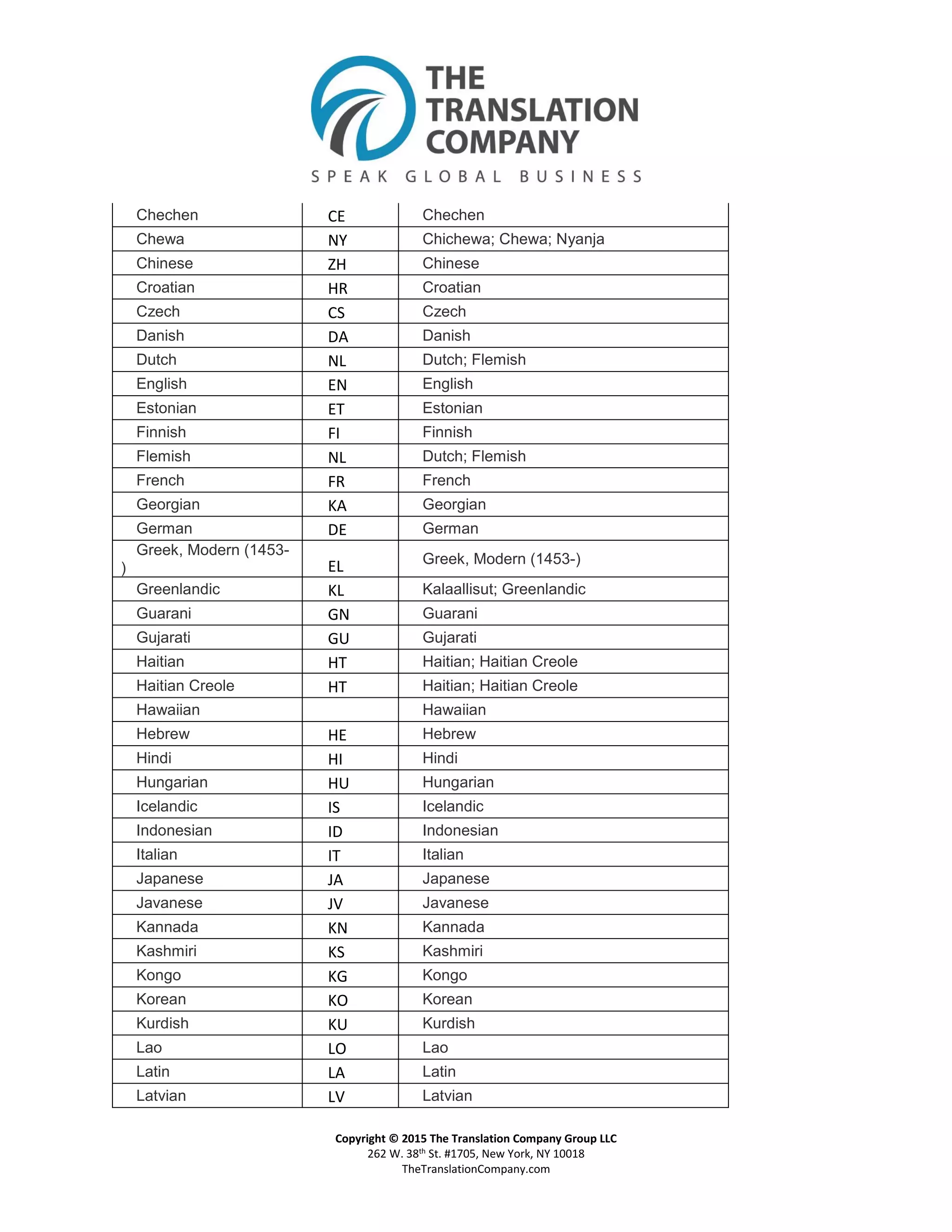
Chechen CE Chechen
Chewa NY Chichewa; Chewa; Nyanja
Chinese ZH Chinese
Croatian HR Croatian
Czech CS Czech
Danish DA Danish
Dutch NL Dutch; Flemish
English EN English
Estonian ET Estonian
Finnish FI Finnish
Flemish NL Dutch; Flemish
French FR French
Georgian KA Georgian
German DE German
Greek, Modern (1453-
) EL Greek, Modern (1453-)
Greenlandic KL Kalaallisut; Greenlandic
Guarani GN Guarani
Gujarati GU Gujarati
Haitian HT Haitian; Haitian Creole
Haitian Creole HT Haitian; Haitian Creole
Hawaiian Hawaiian
Hebrew HE Hebrew
Hindi HI Hindi
Hungarian HU Hungarian
Icelandic IS Icelandic
Indonesian ID Indonesian
Italian IT Italian
Japanese JA Japanese
Javanese JV Javanese
Kannada KN Kannada
Kashmiri KS Kashmiri
Kongo KG Kongo
Korean KO Korean
Kurdish KU Kurdish
Lao LO Lao
Latin LA Latin
Latvian LV Latvian
Copyright © 2015 The Translation Company Group LLC
262 W. 38th St. #1705, New York, NY 10018
TheTranslationCompany.com
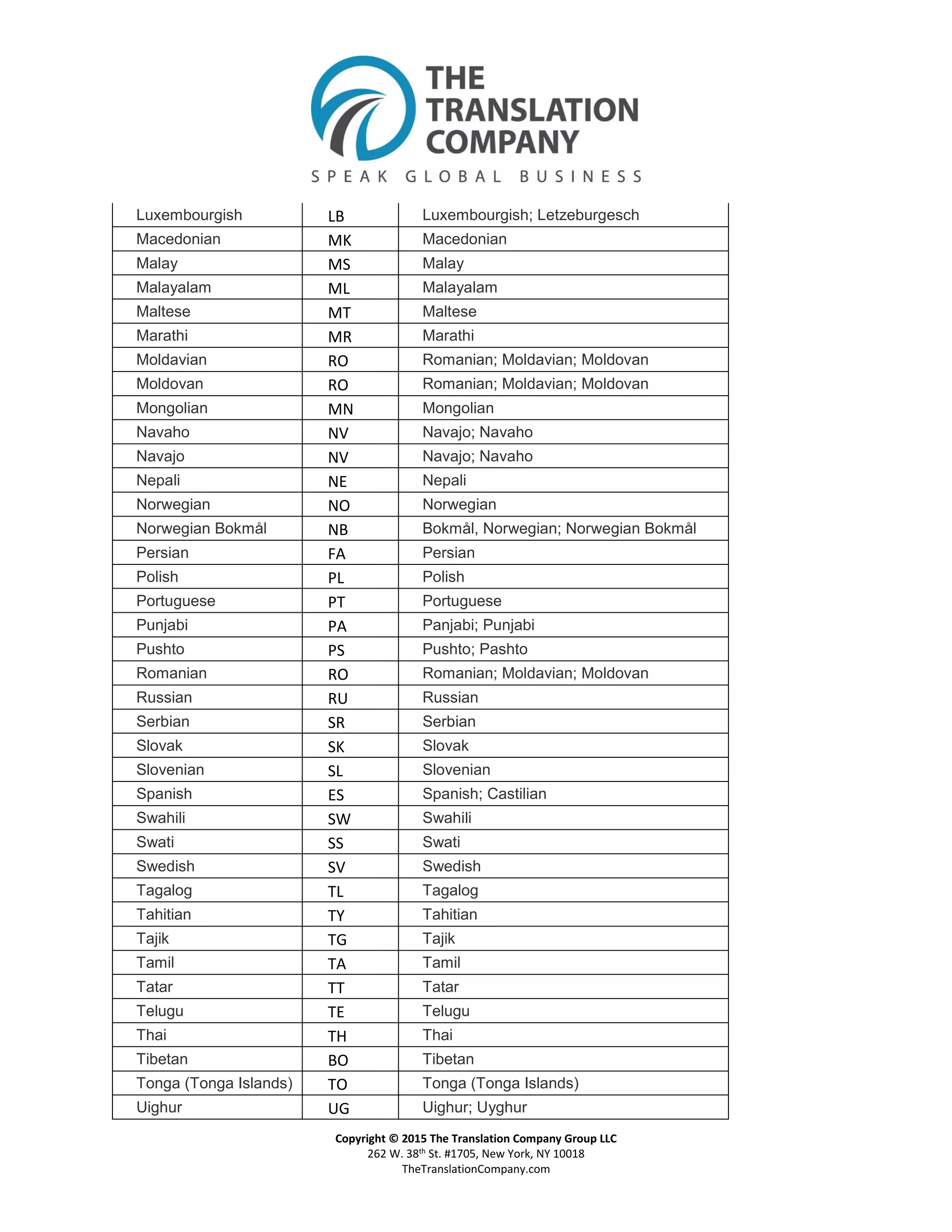
Luxembourgish LB Luxembourgish; Letzeburgesch
Macedonian MK Macedonian
Malay MS Malay
Malayalam ML Malayalam
Maltese MT Maltese
Marathi MR Marathi
Moldavian RO Romanian; Moldavian; Moldovan
Moldovan RO Romanian; Moldavian; Moldovan
Mongolian MN Mongolian
Navaho NV Navajo; Navaho
Navajo NV Navajo; Navaho
Nepali NE Nepali
Norwegian NO Norwegian
Norwegian Bokmål NB Bokmål, Norwegian; Norwegian Bokmål
Persian FA Persian
Polish PL Polish
Portuguese PT Portuguese
Punjabi PA Panjabi; Punjabi
Pushto PS Pushto; Pashto
Romanian RO Romanian; Moldavian; Moldovan
Russian RU Russian
Serbian SR Serbian
Slovak SK Slovak
Slovenian SL Slovenian
Spanish ES Spanish; Castilian
Swahili SW Swahili
Swati SS Swati
Swedish SV Swedish
Tagalog TL Tagalog
Tahitian TY Tahitian
Tajik TG Tajik
Tamil TA Tamil
Tatar TT Tatar
Telugu TE Telugu
Thai TH Thai
Tibetan BO Tibetan
Tonga (Tonga Islands) TO Tonga (Tonga Islands)
Uighur UG Uighur; Uyghur
Copyright © 2015 The Translation Company Group LLC
262 W. 38th St. #1705, New York, NY 10018
TheTranslationCompany.com
Ukrainian UK Ukrainian
Urdu UR Urdu
Uzbek UZ Uzbek
Valencian CA Catalan; Valencian
Vietnamese VI Vietnamese
Welsh CY Welsh
Xhosa XH Xhosa
Yiddish YI Yiddish
Zhuang ZA Zhuang; Chuang
Zulu ZU Zulu

TTC Localization Check-List

  • 1.
    Copyright © 2015The Translation Company Group LLC 262 W. 38th St. #1705, New York, NY 10018 TheTranslationCompany.com LOCALIZATION PROCESS CHECKLIST
  • 2.
    Copyright © 2015The Translation Company Group LLC 262 W. 38th St. #1705, New York, NY 10018 TheTranslationCompany.com THE TRANSLATION COMPANY LOCALIZATION CHECKLIST This checklist should be completed for all new projects involving localization. A proper planning of the requirements upfront will assure our localization process addresses both cultural and non-textual components of the adaptation of our clients’ content for their target markets. Project Date: ____/____/________ Project #: ______________ Client Name: ___________________________________________ Localization Team Project Manager: __________________________________________________________ Local Resource: ____________________________________________________________ Reviewer: _________________________________________________________________ 1. Numerical a) Numbers [ ]  Check decimal separator  Check digit grouping b) Measurement [ ]  Metric System  Imperial System  United States Customary Units  Check if we should use only main system or dual system. Some clients choose to present multiple systems to cover different markets with the same localized material (e.g.: US/Metric in a French document to be used in France and Canada as well)
  • 3.
    Copyright © 2015The Translation Company Group LLC 262 W. 38th St. #1705, New York, NY 10018 TheTranslationCompany.com c) Phone Numbers [ ]  Phone format: use official format Notes: ________________________________________________________________________ ______________________________________________________________________________ 2. Addresses a) Official [ ]  Based on national postal service b) SEO-driven [ ]  Google will have specific requirements for SEO and online map features to operate properly. Such requirements not always match the official standard from the target country. Check if they match. If they don’t, client should choose which one should be used Notes: ________________________________________________________________________ ______________________________________________________________________________ 3. Currency a) Currencies [ ]  Single or multiple currencies in the target country  If multiple, check which one(s) should be used. b) Symbol and Usage [ ]  Define proper currency symbol and usage  Choice for ISO or country-preferred codes Notes: ________________________________________________________________________ ______________________________________________________________________________
  • 4.
    Copyright © 2015The Translation Company Group LLC 262 W. 38th St. #1705, New York, NY 10018 TheTranslationCompany.com 4. Dates a) Dates [ ]  Define proper format for dates b) Time [ ]  Define proper format for time  Time zone may be UTC (international) or location-based (e.g.: name of the city). Location-based time zones should be used unless specified otherwise by the client c) Calendar [ ]  Check if there is more than one calendar in use (e.g.: for Israel)  The Gregorian calendar should be used unless specified otherwise by the client Notes: ________________________________________________________________________ ______________________________________________________________________________ 5. Language Variant a) Impact on content size [ ]  Translation length and differences in character size should be considered when quoting and planning for Desktop Publishing b) Language technical elements [ ]  For software and HTML projects, check character type to be used. Character type should be “Unicode” unless specified otherwise  Writing direction when doing DTP procedures: right-to-left in Hebrew and Arabic while vertical for some Asian languages. Check preference upfront  Capitalization is common in the US while not in many countries. For US, use capitalization freely. Outside the US follow local standards. When more than one standard exists, avoiding capitalization should be the preferred choice  Potentially different sorting rules: only for non-western languages  Punctuation is language driven (e.g.: exceptions in French content). Check for wrongly converted punctuation by word processors, CAT tools and DTP software during the final proofreading stage
  • 5.
    Copyright © 2015The Translation Company Group LLC 262 W. 38th St. #1705, New York, NY 10018 TheTranslationCompany.com  Paper size: most common is A4 while some countries like the US have the letter-size as standard. Check the desktop publishing tool configuration before preparing files to be delivered to the client b) Variant choice strategy [ ]  Grammar / Spelling may be substantially different depending on the language variant spoken in the target country. Choice of vocabulary is also strongly driven by local culture  Is client targeting smaller countries? Unless client requires localization for specific countries instead of cultural blocks (e.g.: Hispanic countries, Portuguese-speaking countries, French- speaking countries, etc.), a localization for the largest markets may possibly accommodate the smaller similar markets.  Example: it is quite common for our clients to sell their products and services localized for Mexico to other Latin American countries as well. For most cases, it would be financially unfeasible to localize it for every single country in Latin America.  Check Appendix for a detailed review of each main variant Notes: ________________________________________________________________________ ______________________________________________________________________________ 6. Cultural Aspects a) Brand appropriateness [ ] Check if there is a meaning for the brand name in the target country. We have seen several instances of brand names that would have a profane meaning in certain target countries. If the client chooses to proceed with a bad-choice brand name in the target country, make sure to document in written such choice by the client b) Register [ ] Some cultures will prefer serious styles for business (e.g.: Hispanics in general) while others will be more concerned with effectiveness (e.g.: North Americans). Client should choose the appropriate style based on:  Target country  Audience  Knowledge area  Desired effect c) Grammar / Spelling [ ]
  • 6.
    Copyright © 2015The Translation Company Group LLC 262 W. 38th St. #1705, New York, NY 10018 TheTranslationCompany.com  Check the governing language authority for the target country  Most countries will have a language governing entity. In Spain, for instance, there is the Royal Spanish Academy. They choose what is right and what is wrong in the Spanish language.  For some countries like Brazil, multiple systems may coexist. The Brazil-Portugal Reform of the Portuguese language became effective in 2009, but some clients still want our writers to use the previous set of rules. d) Personal Name [ ]  Name orders: check on first / last name order. Latin countries, for instance, will not use last name as often as the US or the UK  Titles Titles should be properly used in the content. Some countries will use a title along the first name instead of the last one (e.g.: Mr. John instead of Mr. Smith).  Colors: meaning of colors will vary greatly among different countries. Black and red are two of the most difficult colors to use universally c) Political issues [ ]  Assess which facts could be troublesome when writing the content  Common political issues include geographical disputes and disputed borders d) Social issues [ ] Social aspects that may be important during the content writing include:  Ethnicity [ ]  Clothing [ ]  Socioeconomic status [ ]  Conventions [ ]  Taboos [ ]  Religions [ ]  Superstition [ ] Notes: ________________________________________________________________________ ______________________________________________________________________________ 7. Local Regulations Clients and projects will need to meet different regulations. While some segments (e.g.: medical content) may be highly regulated, others (e.g.: giftware) may have fewer requirements.
  • 7.
    Copyright © 2015The Translation Company Group LLC 262 W. 38th St. #1705, New York, NY 10018 TheTranslationCompany.com  Local privacy requirements [ ]  Additional required disclaimers (e.g.: California) [ ]  Specific labeling requirements [ ]  Encryption and data access by local authorities [ ]  Taxation [ ]  Government assigned documents [ ]  Battery Sizes [ ]  Voltage and current standards [ ]  Others [ ] Notes: ________________________________________________________________________ ______________________________________________________________________________ ______________________________________________________________________________ ______________________________________________________________________________ ______________________________________________________________________________ ______________________________________________________________________________ 8. Graphics A full inspection in the graphic files should be done immediately after delivery by the client. Some of the main steps during the life cycle of the graphic content of a localization project:  Check source files: are they in the agreed format? Are they complete? [ ]  For InDesign file packages check if all the necessary links are available [ ]  For missing specialty fonts check with client about the availability [ ]  Check target file type: projects should be delivered in the agreed formats [ ]  Issues related to size reduction and expansion of the text should be checked upfront. Latin languages, for instance, will take substantially more room to convey the same meaning of an equivalent text in English [ ]  Writing orientation should also be checked during the project setup [ ] Notes: ________________________________________________________________________ ______________________________________________________________________________ ______________________________________________________________________________
  • 8.
    Copyright © 2015The Translation Company Group LLC 262 W. 38th St. #1705, New York, NY 10018 TheTranslationCompany.com ______________________________________________________________________________ ______________________________________________________________________________ ______________________________________________________________________________
  • 9.
    Copyright © 2015The Translation Company Group LLC 262 W. 38th St. #1705, New York, NY 10018 TheTranslationCompany.com Appendix a) Choice of Language Variant Description of the main language variants chosen today along comments on the best choice strategies. Spanish [ ] a) Mexican [ ] Mexican Spanish is the most sought variety. Mexican Spanish is well accepted in both the US and other Latin American countries. It is also a consistent Spanish variant since there is a qualified pool of resources in Mexico b) Neutral [ ] Neutral Spanish is an imaginary type of Spanish, which doesn’t exist anywhere. Some LSPs, for marketing reasons, came up with the idea of a Spanish that wouldn’t use grammar or spelling particular to just one country. Although we can direct our Spanish translators to avoid localisms, it is actually impossible produce a Spanish content that will read perfect in every single country Neutral Spanish translations should be assigned to our Argentinean translators. Argentinean translations are well accepted in other Latin countries while not being so particular to a single country like the Mexican variant c) Hispanic [ ] Hispanic Spanish usually refers to the Spanish variant spoken within the US. While there isn’t a pure variety of Spanish spoken in the US, we can provide a Spanish variant targeting US residents by assigning US-born Spanish translators. Such translators are aware of the current usage of idioms, and they can implement an American stylized version of the Spanish language. d) Latin American [ ] Similar to “Neutral Spanish”. Latin American Spanish, just like Neutral Spanish translations, should be assigned to our Argentinean translators. Argentinean translations are well accepted in other Latin countries while not being so particular to a single country like the Mexican variety e) Spaniard [ ]
  • 10.
    Copyright © 2015The Translation Company Group LLC 262 W. 38th St. #1705, New York, NY 10018 TheTranslationCompany.com Probably the least sought variety of Spanish. Few clients will be concerned with the Spaniard markets due to its small size compared to other Spanish-speaking markets like Mexico or Latin America. Portuguese [ ] a) Brazilian [ ] By far the most sought after Portuguese variant. The Brazilian economy has been booming for several decades. Although it is currently going through a mix of economy and political issues, Brazil remains part of the BRIC block of developing nations with the eight largest economies in the world. b) European [ ] Although the Portuguese economy is about ten times smaller than the Brazilian economy, the European Portuguese is still ordered by some clients. c) Angolan [ ] Today’s Angolan Portuguese is in the middle of a transition. Until the 80’s, the choice of Portuguese was the European variety. After the arrival of the behemoth Brazilian company Odebrecht in Angola, which is the “de-facto governor” of his country, the preferred variety has slowly changed to the Brazilian variety. Unless requested otherwise, the Brazilian variety should be used in content produced for Angola. d) Others [ ] Unless requested otherwise, the Brazilian variety should be used in content produced for Angola. Brazil’s dominance of the Portuguese speaking markets has continuously pushed other Portuguese speaking markets to adopt products, services and content provided in Brazilian Portuguese. French [ ] a) French from France Still has a decent demand although being slowly corroded by the Canadian variant b) Canadian French We have seen a slow but ever growing demand for Canadian French. Canada’s economy is about half the size of the French economy, but its proximity to the US makes it a specially suitable target country for our clients
  • 11.
    Copyright © 2015The Translation Company Group LLC 262 W. 38th St. #1705, New York, NY 10018 TheTranslationCompany.com English [ ]  American English Our preferred choice of English. It should be the standard variant used unless requested otherwise  British English Our second choice of English. Important to note that there is a substantially smaller pool of resources working with British English when compared to American English  Indian English Another made-up variety created by the language industry. India is an extremely fragmented country with different people, languages, religions and casts. While there isn’t a true “Indian English”, this term is commonly used to address English content written by English speakers from India. Such content may vary considerably in terms of vocabulary and writing style. Our choice for such requests is to work with top resources from the most prominent areas of India. Using such resources increases the chance of acceptance by other regions b) Language Nomenclature and Codification Top 100 languages according to observed demand over the last 10 years of business at The Translation Company Group. Language ISO 639-1 All Names Afrikaans AF Afrikaans Albanian SQ Albanian Arabic AR Arabic Armenian HY Armenian Azerbaijani AZ Azerbaijani Basque EU Basque Belarusian BE Belarusian Bengali BN Bengali Bokmål, Norwegian NB Bokmål, Norwegian; Norwegian Bokmål Bosnian BS Bosnian Bulgarian BG Bulgarian Burmese MY Burmese Castilian ES Spanish; Castilian Catalan CA Catalan; Valencian
  • 12.
    Copyright © 2015The Translation Company Group LLC 262 W. 38th St. #1705, New York, NY 10018 TheTranslationCompany.com Chechen CE Chechen Chewa NY Chichewa; Chewa; Nyanja Chinese ZH Chinese Croatian HR Croatian Czech CS Czech Danish DA Danish Dutch NL Dutch; Flemish English EN English Estonian ET Estonian Finnish FI Finnish Flemish NL Dutch; Flemish French FR French Georgian KA Georgian German DE German Greek, Modern (1453- ) EL Greek, Modern (1453-) Greenlandic KL Kalaallisut; Greenlandic Guarani GN Guarani Gujarati GU Gujarati Haitian HT Haitian; Haitian Creole Haitian Creole HT Haitian; Haitian Creole Hawaiian Hawaiian Hebrew HE Hebrew Hindi HI Hindi Hungarian HU Hungarian Icelandic IS Icelandic Indonesian ID Indonesian Italian IT Italian Japanese JA Japanese Javanese JV Javanese Kannada KN Kannada Kashmiri KS Kashmiri Kongo KG Kongo Korean KO Korean Kurdish KU Kurdish Lao LO Lao Latin LA Latin Latvian LV Latvian
  • 13.
    Copyright © 2015The Translation Company Group LLC 262 W. 38th St. #1705, New York, NY 10018 TheTranslationCompany.com Luxembourgish LB Luxembourgish; Letzeburgesch Macedonian MK Macedonian Malay MS Malay Malayalam ML Malayalam Maltese MT Maltese Marathi MR Marathi Moldavian RO Romanian; Moldavian; Moldovan Moldovan RO Romanian; Moldavian; Moldovan Mongolian MN Mongolian Navaho NV Navajo; Navaho Navajo NV Navajo; Navaho Nepali NE Nepali Norwegian NO Norwegian Norwegian Bokmål NB Bokmål, Norwegian; Norwegian Bokmål Persian FA Persian Polish PL Polish Portuguese PT Portuguese Punjabi PA Panjabi; Punjabi Pushto PS Pushto; Pashto Romanian RO Romanian; Moldavian; Moldovan Russian RU Russian Serbian SR Serbian Slovak SK Slovak Slovenian SL Slovenian Spanish ES Spanish; Castilian Swahili SW Swahili Swati SS Swati Swedish SV Swedish Tagalog TL Tagalog Tahitian TY Tahitian Tajik TG Tajik Tamil TA Tamil Tatar TT Tatar Telugu TE Telugu Thai TH Thai Tibetan BO Tibetan Tonga (Tonga Islands) TO Tonga (Tonga Islands) Uighur UG Uighur; Uyghur
  • 14.
    Copyright © 2015The Translation Company Group LLC 262 W. 38th St. #1705, New York, NY 10018 TheTranslationCompany.com Ukrainian UK Ukrainian Urdu UR Urdu Uzbek UZ Uzbek Valencian CA Catalan; Valencian Vietnamese VI Vietnamese Welsh CY Welsh Xhosa XH Xhosa Yiddish YI Yiddish Zhuang ZA Zhuang; Chuang Zulu ZU Zulu